eBook - ePub
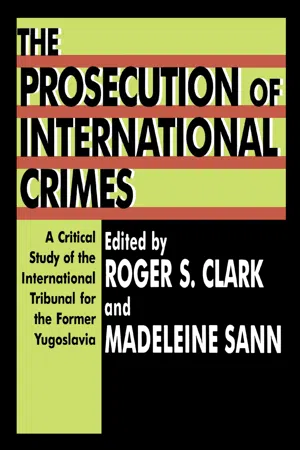
The Prosecution of International Crimes
A Critical Study of the International Tribunal for the Former Yugoslavia
- 502 pages
- English
- ePUB (mobile friendly)
- Available on iOS & Android
eBook - ePub
The Prosecution of International Crimes
A Critical Study of the International Tribunal for the Former Yugoslavia
About this book
The post-World War Two period has witnessed numerous armed conflicts characterized by extensive violations of relevant obligatory international norms. Responding to these events, the United Nations General Assembly created a permanent international court in 2003, with jurisdiction over selected international crimes. The International Tribunal for the Former Yugoslavia was a precursor to this permanent court. It was established for the purpose of "prosecuting persons responsible for serious violations of international humanitarian law committed in the territory of the former Yugoslavia." As a precedent for what we may expect in the future, it deserves special attention from a historical, political, and especially an international law point of view.The Prosecution of International Crimes comprehensively examines the creation, mandate, and challenges of the International Tribunal for the Former Yugoslavia. Derived from a special issue of Criminal Law Forum: An International Journal, a peer-review journal dedicated to the advancement of criminal law theory, practice, and reform throughout the world, it is now available in paperback.
I
Introductory Remarks
Introduction*
Dušan Cotič**
I
Over the past decades, various international initiatives undertaken under the auspices of the United Nations, other international organizations (such as the Organization of American States and the Council of Europe), and nongovernmental organizations (such as the Association Internationale de Droit Pénal) have addressed the question of creating effective international mechanisms for stopping aggression, genocide, crimes against humanity, and violations of internationally established rules of warfare.1 Despite recently completed texts of a Draft Code of Crimes against the Peace and Security of Mankind2 and a Draft Statute for an International Criminal Court,3 we nevertheless do not expect to see a permanent international criminal court for some time. The principle of sovereignty and states’ assertion of exclusive competence over criminal matters still dominate the international scene.4 Despite the fact that the post-World War II period has witnessed numerous armed conflicts characterized by extreme examples of violations of relevant obligatory international norms, the community of nations is not likely soon to agree to a binding convention ceding jurisdiction to an international criminal regime. Thus, the establishment of an ad hoc international tribunal5 “for the sole purpose of prosecuting persons responsible for serious violations of international humanitarian law committed in the territory of the former Yugoslavia between 1 January 1991 and a date to be determined by the Security Council upon the restoration of peace,” under Security Council Resolution 827,6 represents a precedent deserving special attention from a historical, sociological, political, and especially an international law point of view.
II
Yugoslavia was founded in 1918, following World War I, as the Kingdom of Serbs, Croats, and Slovenians. The name “Yugoslavia” was adopted in 1930. After the second world war, Yugoslavia became a republic and, through minor modifications introduced in the 1974 Constitution, it became the Socialist Federal Republic of Yugoslavia. It is beyond the scope of my introduction to this study of the International Tribunal for the Former Yugoslavia to examine in detail the historical and contemporary factors behind the current crisis and the disintegration of Yugoslavia—a state that had existed for seventy years as a union of Southern Slavs and that had, despite its problems, held a respected position in the international community. Suffice it to say that a complex mix of internal and external factors have contributed to the most atrocious bloodshed in contemporary Europe since World War II. These include cultural differences among the nations of the Balkans dating back to the division of the region between the eastern and the western Roman Empire, the schism in the Catholic and Orthodox churches, and the centuries’ long rule and domination by the Turkish and Austro-Hungarian empires (which bordered this region), coupled with often violent confrontations among the Slav peoples under foreign flags. One historical event that may be singled out for its consequences in the current conflict is that a considerable number of Slavs converted to Islam under the pressure of five centuries of rule, and persecution of Christians, by the Turks. Bosnia in particular—occupied partly by the Turks and partly by the Austro-Hungarians, and later annexed by Austria—was in a sense predestined to become a battlefield of mutual conflicts between groups distinguishable primarily by their religious convictions and the cultural legacy of the various influences noted above.
An important division along nationalistic lines also emerged between Orthodox Christian Serbs and Catholic Croats—the East and the West. This conflict plagued the Kingdom of Serbs, Croats, and Slovenians and, later, Yugoslavia. In this struggle, Serb extremists assassinated two deputies of the National Assembly who belonged to the Croatian Rural Party, and Croatian extremists of fascist sympathies (Ustashi) assassinated King Alexander I of Yugoslavia some years later. The conflict reached a peak during World War II, when the Axis powers proclaimed the Independent State of Croatia, a puppet Ustashi-fascist entity. This period saw the terrible genocide of hundreds of thousands of Serbs, Jews, and Gypsies in the region. This is not to forget that many Croats participated in the struggle against fascism. Josip Broz Tito, commander-in-chief of the Partisans, was himself a Croat.7 However, despite an official policy of “fraternity and unity” aimed at national unification and reconciliation in Yugoslavia, intolerance and mistrust ran deep at the local level, especially in the areas currently engaged in armed conflict (such as the Serbian enclave of Krajina in Croatia), only to erupt into armed resistance on the part of Serbs when the new Republic of Croatia declared its independence from Yugoslavia in 1991.8 The situation was aggravated because the original Constitution of the new republic declared itself to be a state only of Croats,9 and the new government adopted symbols of state that disturbed the Serbs due to their similarity, if not identity, to the flag and other state symbols of the wartime Axis puppet government. The Croatian authorities took the position that local Serbs were rebels, terrorists, and aggressors against the newly declared Croatian republic, which further complicated efforts to find a peaceful settlement of the conflict.
From the outset of the breakup of the union, Serbs throughout the territory of the former Yugoslavia have maintained that the dismantling of the federal republic has affected their interests most adversely since they, unlike the other constitutional peoples of the old federation, did not achieve unification into an ethnically homogeneous state. They argue that they should have the same right to self-determination that Croats, Slovenians, and Macedonians exercised in forming their own states and in securing international recognition.10
Bosnia-Herzegovina, a republic under the Constitution of the former Yugoslavia, was a community comprising three separate nations—Muslims, 43.7 percent; Serbs, 31.4 percent; and Croats, 17.3 percent—while 5.5 percent of the population identified themselves as Yugoslavian, and 2.1 percent of the population belonged to other ethnic groups. Thus, Bosnia-Herzegovina presented a special case and, unlike the other new republics, kept its historical name for the very reason that it does not have an overwhelming majority of one ethnic group.11 The Bosnian Serbs, asserting their constitutional right that all major political decisions can be implemented only by consensus of all three national groups, rejected the referendum to separate Bosnia from Yugoslavia. They seized by force, and at least at the beginning with the help of the Yugoslav National Army and volunteers from Serbia, nearly 70 percent of the territory of Bosnia, especially areas they considered traditionally to belong to them.12 The Bosnian Croats had a similar interest in forming their own Herzeg-Bosna community. Their aim was to preclude political domination on the part of the Bosnian Muslims and eventually to form close links with the Croatian republic. It seemed clear to people living in the area that the Muslims, with a demographic advantage, had a strong interest, and still have, in becoming politically dominant in Bosnia. This three-way conflict has been limited somewhat by the formation, under foreign pressure, of a federation between Muslims and Croats, a shaky alliance that has faltered at times (such as the heavy fighting around Mostar in the late fall of 1992, with participation from the Croatian Army). At the same time, there have been confrontations among the Muslims themselves in western Bosnia, due primarily to conflicting views over the character and organization of the Bosnian state.
Armed clashes in the Balkans have always been brutal. The historical record—its political, cultural, and social dimensions—goes far toward explaining the present crisis in which countless grave violations of international humanitarian law have occurred and continue to occur. Hundreds of thousands of persons have been victimized,13 and media coverage has brought their plight to the public’s attention. This in turn has put pressure on national and world leaders to “do something.” Without in any way attempting to condone the crimes that we have witnessed, it is also clear that there has been manipulation of even the most influential world media, as well as biased reporting. There is evidence, for example, that partisans of all sides have attacked their own people in an attempt to sway public opinion against the supposed attackers and to prompt an international military response.14 Moreover, while we can appreciate the difficulties and the personal dangers that journalists have experienced in covering an ongoing war, some correspondents have deliberately falsified reports either because of partisan feeling or because of pressure to do so. Early in the war, in particular, the public in the territory of the former Yugoslavia relied heavily for information on nationally controlled television, which consistently showed its own partisans as victims and placed the blame for the brutal crimes being committed on enemy forces. Even with greater coverage by foreign media and independent domestic media, objectivity has not necessarily been the rule.15
This “media war” has had a crucial influence on the international community in taking certain emergency measures, such as the imposition of political and economic sanctions on Serbia and Montenegro and an arms embargo on the republics of the former Yugoslavia; the organization of humanitarian assistance to the wounded, refugees, and others affected by the war; the deployment of international peacekeeping forces; and finally the establishment of the Commission of Experts for the investigation, and of the International Tribunal for the prosecution, of serious violations of international humanitarian law. Regardless of whether one approves or condemns these efforts, the world community is to be faulted for not intervening in the early stages of the disintegration of Yugoslavia, when it might have been possible to avert the war and the ensuing bloodbath. As a result, when it finally did act, the United Nations (and other intergovernmental organizations) made some hasty decisions of vital importance to a country that had been a conscientious member of the United Nations and to all the peoples living in the region.
III
The establishment of the International Tribunal for the Former Yugoslavia attracted special attention not only among political and academic circles throughout the territory of the former Yugoslavia but also among the public in general. This was particularly true in Yugoslavia (Serbia and Montenegro) because the discussions surrounding the creation of such a court were focused almost entirely on crimes allegedly committed by Serbs (the Federal Army, Serbs from Krajina and the Bosnian Serb Republic, and Serbian volunteers) and their leadership.16 This presumption, and the bias in media coverage noted earlier, undoubtedly rallied Serbian public opinion against the proposed court and other international initiatives. Later this one-sided picture began to change somewhat. Thus, in May 1993, UN Special Rapporteur for Human Rights in the Former Yugoslavia, Tadeusz Mazowiecki, issued an official statement condemning crimes perpetrated by Muslims against Serbs;17 shortly thereafter, the European Parliament adopted a resolution condemning both Serb and Croat attacks.18 Nonetheless, the initial direction of world public opinion was such that it persuaded Croats and Bosnians, and their governments, to give their support to the swift establishment of the International Tribunal.19
Experts in international criminal law also took up their positions. Among legal experts in Serbia, the prevailing opinion is that “the Security Council has no mandate to set up such a tribunal” under chapter VII of the UN Charter, that the invocation of article 29 of the Charter is legally unfounded and arbitrary, and that...
Table of contents
- Cover
- Half Title
- Title Page
- Copyright Page
- Contents
- Editors’ Preface
- Part I: Introductory Remarks
- Part II: Fact-Finding
- Part III: Establishment of the Tribunal
- Part IV: Substantive and Procedural Issues
- Part V: Appendixes
Trusted by 375,005 students
Access to over 1.5 million titles for a fair monthly price.
Study more efficiently using our study tools.
Frequently asked questions
Yes, you can cancel anytime from the Subscription tab in your account settings on the Perlego website. Your subscription will stay active until the end of your current billing period. Learn how to cancel your subscription
No, books cannot be downloaded as external files, such as PDFs, for use outside of Perlego. However, you can download books within the Perlego app for offline reading on mobile or tablet. Learn how to download books offline
Perlego offers two plans: Essential and Complete
- Essential is ideal for learners and professionals who enjoy exploring a wide range of subjects. Access the Essential Library with 800,000+ trusted titles and best-sellers across business, personal growth, and the humanities. Includes unlimited reading time and Standard Read Aloud voice.
- Complete: Perfect for advanced learners and researchers needing full, unrestricted access. Unlock 1.5M+ books across hundreds of subjects, including academic and specialized titles. The Complete Plan also includes advanced features like Premium Read Aloud and Research Assistant.
We are an online textbook subscription service, where you can get access to an entire online library for less than the price of a single book per month. With over 1.5 million books across 990+ topics, we’ve got you covered! Learn about our mission
Look out for the read-aloud symbol on your next book to see if you can listen to it. The read-aloud tool reads text aloud for you, highlighting the text as it is being read. You can pause it, speed it up and slow it down. Learn more about Read Aloud
Yes! You can use the Perlego app on both iOS and Android devices to read anytime, anywhere — even offline. Perfect for commutes or when you’re on the go.
Please note we cannot support devices running on iOS 13 and Android 7 or earlier. Learn more about using the app
Please note we cannot support devices running on iOS 13 and Android 7 or earlier. Learn more about using the app
Yes, you can access The Prosecution of International Crimes by Madeleine Sann in PDF and/or ePUB format, as well as other popular books in Law & Criminal Law. We have over 1.5 million books available in our catalogue for you to explore.