eBook - ePub
World Water Actions
Making Water Flow for All
- 202 pages
- English
- ePUB (mobile friendly)
- Available on iOS & Android
eBook - ePub
World Water Actions
Making Water Flow for All
About this book
This text is divided into three parts. Part I focuses on the need for management to assess the challenges of water scarcity and plan changes based on proper valuation and financial instruments, international co-operation and efficient use. Part II analyses the problems of water scarcity and the available solutions in each main sector: water supply and sanitation, energy, health, agriculture, ecosystems and biodiversity. Part III assesses the state of the debate following the third World Water Forum and sets out the priorities for action, including increased investment, institutional reform and capacity building in the water sector. Downloadable resources with extensive case studies and statistical data accompanies this text.
Information
1Assessing Challenges, Initiating Change
1. Water’s many values
DOI: 10.4324/9781849776301-2
Abstract
The “Ministerial Declaration of The Hague Conference on Water Security in the 21st Century” (Council of Ministers 2000) recognized “valuing water” as one of the seven key challenges for the global community, proclaiming that we have to “manage water in a way that reflects its economic, social, environmental, and cultural values for all its uses, and move towards pricing water services to reflect the cost of their provision. This approach should take account of the need for equity and the basic needs of the poor and vulnerable.”
Present situation
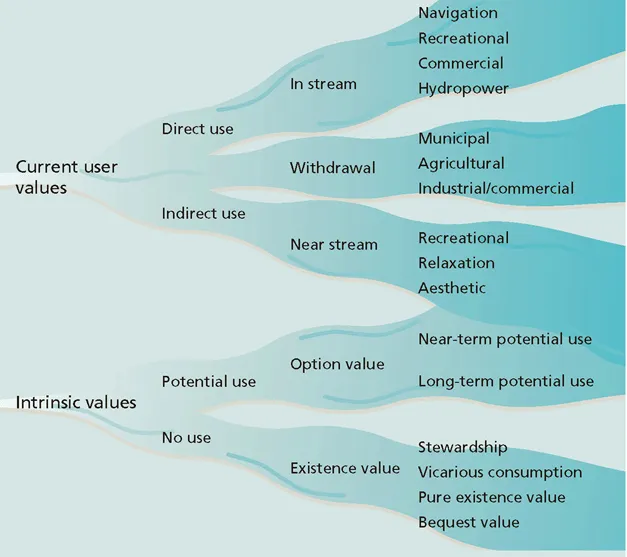
As the Ministerial Declaration affirms, water has many values. Some of the values commonly associated with water are shown in figure 1.1.
Water values are both economic (see chapter 6) and non-financial. While the economic values influence how well water services are provided, the non-financial values are also important for establishing the foundation of a more just and equitable management of the world’s water. These values shape the institutions through which water is managed.
Institutions here encompasses the full range of policies, laws, regulations, standards, and norms by which actions and behaviours are governed, as well as the organizations through which these principles are put into practice in the management of water. All of this is embedded in the overall institutional framework in which people live and the cultural, religious, and socio-economic factors that reflect their basic values.
The range of water values
Many of the services water provides are irreplaceable and thus invaluable. From practical uses (livelihood, food production, sanitation, energy, transport) to recreational, aesthetic, religious, and cultural values, water affects nearly every aspect of life. In the extreme it is the sine qua non of life on Earth, and humanity has not been an adequate steward of this precious resource. The implications of that hard truth are finally dawning on us.
For centuries, but much intensified in the past 100 years, humanity has had a free ride in its use of water. Those days are over. Ecosystems are telling us that, loud and clear. It is time to start repaying our water debts, to recognize the value of all the services that water provides, and to ensure that the services are equitably shared by humanity and ecosystems alike, based on a set of agreed values that should shape water institutions.
Life-giving value. Water may well be accepted as a basic human right, but reliable provision of safe water supplies is far from universally available. It is clear from the “compensation culture” that pervades the high-income world that the value of an individual human life in an industrial country is many hundreds of thousands of dollars. Yet if the millions of children who die annually from preventable water-related disease in developing countries are taken as an indicator, the value accorded to a human life in developing countries is very low. These deaths are both indefensible and unnecessary, since so many of the causes are readily preventable.
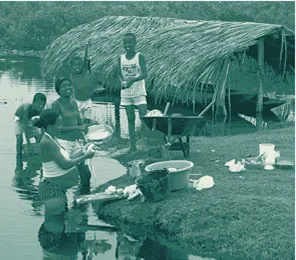
In addition to water’s importance as a basic human right, water is central to socio-economic development and poverty alleviation
Source:Desvouges and Smith 1983.
Social value. In addition to water’s importance as a basic human right, water has other important roles in development. As this report emphasizes in many ways, water is central to socio-economic development and poverty alleviation. For many decades it has been clear that good water resources development and management plus the establishment of sound water supply and sanitation systems in all communities constitute a key foundation of growth. Every community, large or small, urban or rural, must have a safe and reliable water supply for the health, well-being, and development of its residents. That we seem to be relearning this lesson again in the 21st century is one of the mysteries of modern life.
Value to ecosystems. Only in the past few decades have people started to explicitly recognize the enormous range of values provided by ecosystems, including their irreplaceable services, their monetary value, and their role in sustaining human and other life on the planet. The services include producing food, decomposing organic waste, purifying water and air, storing and recycling nutrients, preventing floods and regulating run-off, absorbing human and industrial wastes and converting them to beneficial uses, and storing, cycling, and distributing freshwater. In addition to their practical benefits, ecosystems provide amenity and recreational values.
Ecosystems are essential to civilization, and their services operate on a vast scale in little-known ways that cannot be replicated by technology. The practical benefits of ecosystem services have an estimated worth of $36–$58 trillion a year, compared with gross world product of $39 trillion in 1998 (Hawken, Lovins, and Lovins 1999).
Economic value. Water has an economic value in some of its uses because of its contributions to many economic activities. Water enables agriculture, fishing, navigation, and hydropower generation, and it is an input for many industries. Water also receives and carries away waste. It is possible to estimate the economic value of water for all these uses, and also to determine the price that people, industries, and governments are ready to pay for these services. Furthermore, because businesses value healthy workers and healthy customers, water’s contribution to health has an additional value to industry. Businesses also values freedom from environment-related threats and are reluctant to invest where such threats—many allied to widespread water-related diseases— are prevalent.
Ethics should have a key role in water management, as should recognition of the importance of the unquantifiable values of water. Preserving the life-giving value of water should always be a priority in water allocation
‘I notice the dreadfulness of water and my gratefulness for it only when floods and shortages come. Yet we have many other opportunities to think about water.—Japan’
Essential values are missing. Missing from this partial catalogue of water’s values are the human values of justice and equity. Crucially, access to adequate and safe water supplies by the disadvantaged and frequently undeerrepresented – the poor (among whom the burden falls disproportionately on women, children and the elderly) and natural ecosystems – is still far from equitable and just. While attitudes toward these values are changing, they are still not adequately reflected in the way the water community and water institutions work. These attitudes are not changing fast enough to preserve the social order and ecosystems in the future.
What needs to be done?
Ethics should have a key role in water management, as should recognition of the importance of the unquantifiable values of water. Preserving the life-giving value of water should always be a priority in water allocation. Only when these values are incorporated into our thinking about water and water management will our institutions function to provide fairly for all water needs and enable economic values to be used more productively to help rationalize the use of water.
What is being done?
Efforts are under way to better understand the full range of water values and translate them into practice. Research projects by the International Institute for Infrastructural, Hydraulic, and Environmental Engineering in Delft seek to clarify the understanding of these concepts (action 2481), while the Water Academy’s Social Charter for Water is working on their practical application (action 2362).
Life-giving value
Water is increasingly recognized as a human right. The United Nations Committee on Economic, Cultural, and Social Rights declared access to water a human right and established it as a social and cultural good, not merely an economic commodity (UN CESCR 2002). The World Health Organization published in 2003 a book on this issue (WHO 2003). Drinking water is a vital resource for human beings, and inadequate quantities of water or unsafe water can gravely impair health (chapter 9). South Africa, which inscribed the basic right to water in its Constitution, is working to put this principle into practice (box 6.1 in chapter 6).
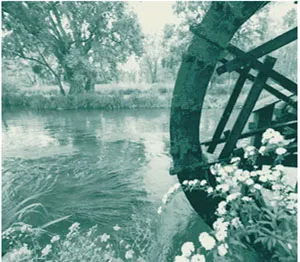
‘I still remember the sound of the streaming brook and the smell of grasses…. Now a paved road covers the brook, and many cars run over it.—Jamaica’
Water plays a role in reaching most of the other Millennium Development Goals
Value to ecosystems
Attempts to quantify the value of aquatic ecosystems services can be spotted in Haiti (action 2064), in Japan (action 1841), and in Costa Rica (action 1810). These few examples cannot readily be replicated widely, because these efforts are time-consuming and should be undertaken only when necessary to improve decision-making. But it is important to point out that the knowledge exists, particularly within international organizations, such as IUCN–The World Conservation Union, that can guide such calculations where and when needed (Barbier, Acreman, Knowler 1997). Universities and research institutes are working to improve these methodologies, as in the United States (action 2477) and the Netherlands (Seyam and others 2001).
Social value
Water is rising higher on the international political agenda. Once viewed largely as a technical sector, it now gets greater recognition as central to poverty alleviation and sustainable development. One of the Millennium Development Goals is to halve the proportion of people without reliable access to drinking water by 2015. But as shown throughout this report, water plays a role in reaching most of the other Millennium Development Goals as well.
The 2001 Bonn International Conference on Freshwater contributed to global awareness that water is essential for human development and for sustaining ecosystems (Ministerial Session of the International Conference on Freshwater 2001). The conference also underscored problems of corruption and identified measures that governments, financial institutions, and other organizations can take to eliminate it.
The recent World Summit on Sustainable Development identified water and sanitation, energy, health, agriculture, and biodiversity (together referred to as WEHAB) as integral to a coherent approach to sustainable development and affirmed that water is essential to all of these. The World Summit approved a supplementary target for the Millennium Development Goals: to halve by 2015 the proportion of people without access to sanitation facilities.
All of this emphasizes strongly how central water security is to social cohesion and move out of poverty.
Economic value
It is widely accepted that water has an economic value. The 1992 Dublin International Conference on Water and the Environment established the four “Dublin Principles” for sound water management. Among them was that water should be treated as an economic good. This principle and the concept of water’s economic value is a very contentious issue. Many people in lower-income countries view water as a gift from God and can see no reason to pay for it. On the other hand, it is increasingly recognized that water delivery systems are unsustainable without pricing the water supplied – but also that not everybody can afford to pay for it. The debate on what are the economic values of water and how to apply them to facilitate better water management is continuing, and different countries and communities still hold a wide range of different views on the subject. All of this complicates the challenge of financing the much needed expansion of the water sector, a topic which is dealt with in more details in chapter 6.
Water management is an issue of politics and human relationships, and as such may have to reconcile conflicting values
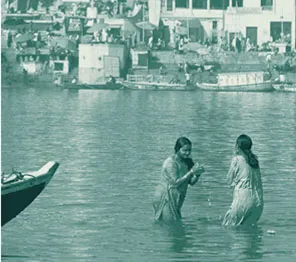
‘Water and air are the blessings of God to the planet for all of humanity. Let us make them pure and clean and see that they are easily available to all.—Pakistan’
What remains to be done?
Water management is an issue of ...
Table of contents
- Cover Page
- Half-Title Page
- Copyright Page
- Title Page
- Foreword
- Table of Contents
- List of figures, tables and boxes
- About the authors
- Preface
- Background
- Acknowledgements
- Overview: Recording actions, identifying gaps
- 1 Assessing Challenges, Initiating Change
- 2 Focusing on Key Areas, Promoting Change
- 3 Taking Stock, Advancing Change
- Photo credits
- References
- Index
Trusted by 375,005 students
Access to over 1.5 million titles for a fair monthly price.
Study more efficiently using our study tools.
Frequently asked questions
Yes, you can cancel anytime from the Subscription tab in your account settings on the Perlego website. Your subscription will stay active until the end of your current billing period. Learn how to cancel your subscription
No, books cannot be downloaded as external files, such as PDFs, for use outside of Perlego. However, you can download books within the Perlego app for offline reading on mobile or tablet. Learn how to download books offline
Perlego offers two plans: Essential and Complete
- Essential is ideal for learners and professionals who enjoy exploring a wide range of subjects. Access the Essential Library with 800,000+ trusted titles and best-sellers across business, personal growth, and the humanities. Includes unlimited reading time and Standard Read Aloud voice.
- Complete: Perfect for advanced learners and researchers needing full, unrestricted access. Unlock 1.5M+ books across hundreds of subjects, including academic and specialized titles. The Complete Plan also includes advanced features like Premium Read Aloud and Research Assistant.
We are an online textbook subscription service, where you can get access to an entire online library for less than the price of a single book per month. With over 1.5 million books across 990+ topics, we’ve got you covered! Learn about our mission
Look out for the read-aloud symbol on your next book to see if you can listen to it. The read-aloud tool reads text aloud for you, highlighting the text as it is being read. You can pause it, speed it up and slow it down. Learn more about Read Aloud
Yes! You can use the Perlego app on both iOS and Android devices to read anytime, anywhere — even offline. Perfect for commutes or when you’re on the go.
Please note we cannot support devices running on iOS 13 and Android 7 or earlier. Learn more about using the app
Please note we cannot support devices running on iOS 13 and Android 7 or earlier. Learn more about using the app
Yes, you can access World Water Actions by Francois Guerquin,Tarek Ahmed,Mi hua,tetsuya Ikeda,Vedat Ozbilen,Marlies Schuttelaar in PDF and/or ePUB format, as well as other popular books in Politics & International Relations & Environmental Economics. We have over 1.5 million books available in our catalogue for you to explore.