- 272 pages
- English
- ePUB (mobile friendly)
- Available on iOS & Android
eBook - ePub
About this book
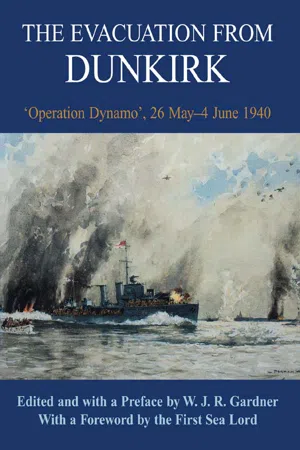
This is the Naval Staff History of "Operation Dynamo", originally published internally in 1949. British ships evacuated nearly 100,000 men of the BEF from the beaches, and over 200,000 from harbours. Other nations' vessels carried more than 30,000.
CHAPTER IX
SATURDAY, 1ST JUNE
GERMANS RENEW THEIR HEAVY AIR EFFORT
E-Boat activity: sinking of the Stella Dorado and Argyllshire
During the night of 31st May—1st June there was a recrudescence of enemy E-boat activity. After the torpedoing of the destroyers Grafton and Wakeful off Nieuport in the early hours of the 29th May M.T.B. patrols had been established during the dark hours to prevent enemy E-boats from using the inshore channels.
It was, however, in the less confined waters along Route Y that the enemy obtained their successes, despite intensive air and surface patrols. Route Y was patrolled that night by 2 corvettes and 6 trawlers, while Coastal Command provided 6 aircraft with bombs and parachute flares; and owing to magnetic mines ships evacuating troops were given permission in the early hours of 1st June to use that route as well as Route X.
At 0230 on the 1st June the A/S trawler Stella Dorado, which 24 hours earlier had picked up 55 survivors from the Siroco, torpedoed by an E-boat near T buoy, was herself torpedoed in the same position and sunk whilst on patrol. About a quarter of an hour later the A/S trawler Argyllshire, on patrol in company with the Lord Melchett and Stella Rigel about 2 miles east of S buoy, commenced an attack on what appeared to be a submarine. Within 5 minutes she was struck by a torpedo fired by an E-Boat and sank immediately. Five survivors, including her Captain, Sub-Lieutenant J. S. Weddle, R.N.R., S.O. 11th A/S Striking Force, were picked up by the trawler Malabar.
At the time there were many trawlers and other small craft in the neighbourhood, and one of the two E-Boats responsible for these sinkings was reported to have been disguised as a sailing boat.
Final evacuation postponed
Already on the afternoon of the 31st May ships in Dunkirk road had come under fire from guns on shore at Mardyck, and early on 1st June it became evident that Major General Alexander's force could not be evacuated completely on the night of 1st/2nd June. At 0800, therefore, he agreed on a modified plan with Admiral Abrial and General Fagalde which involved holding his present line till midnight 1st/2nd June, so as to cover Dunkirk and to enable the French to evacuate as many of their troops as possible. Subsequently Major General Alexander was to withdraw to a bridgehead round Dunkirk with all available A/A and anti-tank guns and such troops as had not yet embarked.
Embarkations over Bray beaches
It was not only in Dunkirk roads that the ships had been under fire on the previous day; off Bray they had the same experience. Troops were moving westward, and embarkation at La Panne was no longer possible. It was clear to Rear-Admiral Wake-Walker that beach work at Bray would be costly, and he so informed Vice-Admiral, Dover (0235/1), who concurred, whilst pointing out the necessity of using the beaches up to the last possible moment.
The Rear-Admiral, in the Keith, with the Basilisk for supporting fire against enemy tanks or lorries along the beach, was investigating the position to the east of Dunkirk. As the light grew, at 0330, it was seen that the beach by La Panne was deserted. The sea too, was empty, small boats had vanished under instructions to move westward to Dunkirk whilst those which were full were going back to England as intended. However, ships were still loading off Bray and to the westward, though men were moving westward along the beaches.
The minesweeper Speedwell was anchored a little west of La Panne, using her motor boat and two whalers to ferry troops to the ship as the pontoon pier had been hit by shell fire. She closed the shore at daylight, and at about 0500, shortly after low water, she grounded aft and continued thus to embark troops under machine-gun fire by enemy aircraft of the troops on shore, the boats, and the ship, until the minesweeper Albury towed her off. She sailed at 0730 for Dunkirk. On the way she took off 100 troops from the Ivanhoe which was damaged by a bomb as the Speedwell was steaming past her. At Dunkirk she made up her number of troops to 972 and left for Dover at 0950 after being repeatedly but unsuccessfully bombed. The minesweeper Salamander was anchored a mile east of Bray Dunes, similarly engaged in embarking troops with her boats, and she sailed for Dunkirk astern of the Keith and Skipjack soon after 0600. At Dunkirk she came in for two air attacks in one of which, at about 0820, she was damaged by a near miss, but she reached Dover on one boiler at 1530 and disembarked 479 troops. It was her last trip. A mile east of Bray, too, the minesweeper Sutton embarked 453 troops from the beaches before sailing at 0600 for Dover. She was bombed and machine-gunned, but the only man hit was one wounded soldier. The minesweeper Dundalk was anchored nearer to La Panne, also embarking troops. Having no motor boat, the Speedwell and Salamander both lent a hand to tow her whalers. From 0500 onwards she was subjected to air attacks at regular intervals, and about 0800 she “decided to proceed to Margate,” where she arrived at 1215 with 280 troops. Still further east, the minesweeper Halcyon was anchored off La Panne embarking troops swimming off to the ship, paddling in rubber boats, and in her whalers, during which she had one officer (Lieut. N. Thurston, R.N.) mortally wounded and suffered some casualties amongst the crew from machine gunning by enemy aircraft.
Off Bray, the destroyer Sabre was embarking 451 troops and the minesweeper Niger 310, pressing into service carley floats and lifebelts with which men swam from the beach. Daylight showed a minesweeper and a paddle minesweeper ashore, and the Rear-Admiral hailed a tug which was on its way homeward with soldiers on board, and told him to go in and try to tow off the minesweepers. However, the tugs had been sent over from England with pulling boats in tow and told to load up, and they regarded themselves as transports only, whereas Rear-Admiral Wake-Walker, who knew nothing of these instructions, naturally regarded them as tugs. It was not until a gun was trained on the tug and an R.N.V.R. Sub.-Lieutenant put on board to take charge, that the master's anxiety to get away was overcome.
A welcome addition to the evacuation craft consisted of the first of a dozen Belgian fishing boats which now appeared on the scene from seaward down the Zyuidcoote Pass. 1
Early liftings from Dunkirk
At 0241 Rear-Admiral Wake-Walker had given orders for all small craft to move westward with boats in tow in the direction of Dunkirk, towards which the troops were now marching from La Panne.
The first loaded ship to leave Dunkirk seems to have been the Whippinghan, in time of peace an Isle of Wight paddle ferry boat belonging to the Southern Railway. She had been embarking troops alongside the mole since 2200 on the previous day, and when she cast off at 0130 on 1st with 2,700 troops on board she was overladen and her sponsons were only about a foot above water. Disaster nearly overwhelmed her at the start, when she was straddled by shell fire and the troops rushed over to the port side, causing the ship to list 20°. Fortunately, the sea was calm. The chief mechanician (Ch. Mech. 2nd Cl. F. A. Ford) checked the rush, moved the troops back to starboard, and thereby probably saved the ship.
Another early sailer was the personnel vessel Lady of Mann, who proceeded at 0430 for Dover, with 1500 casualties. The hospital carriers St. Andrew and St. Julien disembarked in England this day 130 and 287 wounded, respectively, after which no more hospital ships brought wounded from Dunkirk. Space alongside the large-ship berths was too valuable to be occupied by hospital ships, and walking wounded went with the troops, whilst those that could not walk had to be left behind.
The personnel ship Maid of Orleans berthed at the East Mole at about 0330 and for 6 hours, most of the time under air attack, she acted as a floating stage for the embarkation of troops on board the destroyers Icarus, Vanquisher and Windsor, whose upper decks were far below the top of the mole. The pier was crowded and as many troops as possible were embarked over mess tables rigged across the “B” gun decks of inside ships to the outside vessel. The Vanquisher was the first of the three to leave, at 0630 with 1200 troops. An hour later the Icarus and Windsor sailed in company, with 1,114 and 493 troops respectively. Finally, at about 0900 the Maid of Orleans herself proceeded, during an air attack, with 1,856 troops, which, like the destroyers, she disembarked at Dover. In six trips, once being diverted without completing the trip and once returning on account of collision, the Maid of Orleans had transported in all 5,461 men; but this was her last crossing, for when leaving Dover again for Dunkirk at 2030 that day she was rammed amidships by the destroyer Worcester returning from Dunkirk with manoeuvrability impaired through damage to propellers and rudder, caused by air attack at 1630 in which she had 6 men killed and 40 wounded, and shot down two enemy aircraft. No lives were lost in the collision, but the Maid of Orleans was too badly damaged to continue her voyage. For the Worcester, too, this was the final crossing: she had evacuated 4,545 troops in 6 trips.
Other destroyers were embarking troops at the same time alongside Dunkirk pier. The Vivacious, after being dive-bombed whilst waiting to enter harbour, went alongside at 0630, embarked 475 troops in a quarter of an hour, and sailed again for Dover at 0645. The Winchelsea was bombed at 0745 an...
Table of contents
- Cover
- Half Title
- Title Page
- Copyright Page
- Table of Contents
- List of Illustrations
- Foreword
- Preface to the New Edition
- Addendum to Sources
- List of Abbreviations
- The Evacuation from Dunkirk:
- I: Preliminary Events, 10–18 May 1940
- II: The Week before ‘Operation Dynamo’, 19–25 May 1940
- III: Operation Dynamo is Commenced, Sunday, 26 May 1940
- IV: Monday, 27 May
- V: Tuesday, 28 May
- VI: Wednesday, 29 May
- VII: Thursday, 30 May
- VIII: Friday, 31 May: Evacuation Reaches its Zenith
- IX: Saturday, 1 June: Germans Renew Their Heavy Air Effort
- X: The Night of 1–2 June and from Daylight to Dusk on the 2nd
- XI: The Night of 2–3 June: BEF Evacuated
- XII: The Final Night, 3–4 June
- XIII: Analysis of the Operation
- Appendices (A-Z)
- Index
- Note to Tables 1-3
- Tables and Plans
Trusted by 375,005 students
Access to over 1.5 million titles for a fair monthly price.
Study more efficiently using our study tools.
Frequently asked questions
Yes, you can cancel anytime from the Subscription tab in your account settings on the Perlego website. Your subscription will stay active until the end of your current billing period. Learn how to cancel your subscription
No, books cannot be downloaded as external files, such as PDFs, for use outside of Perlego. However, you can download books within the Perlego app for offline reading on mobile or tablet. Learn how to download books offline
Perlego offers two plans: Essential and Complete
- Essential is ideal for learners and professionals who enjoy exploring a wide range of subjects. Access the Essential Library with 800,000+ trusted titles and best-sellers across business, personal growth, and the humanities. Includes unlimited reading time and Standard Read Aloud voice.
- Complete: Perfect for advanced learners and researchers needing full, unrestricted access. Unlock 1.5M+ books across hundreds of subjects, including academic and specialized titles. The Complete Plan also includes advanced features like Premium Read Aloud and Research Assistant.
We are an online textbook subscription service, where you can get access to an entire online library for less than the price of a single book per month. With over 1.5 million books across 990+ topics, we’ve got you covered! Learn about our mission
Look out for the read-aloud symbol on your next book to see if you can listen to it. The read-aloud tool reads text aloud for you, highlighting the text as it is being read. You can pause it, speed it up and slow it down. Learn more about Read Aloud
Yes! You can use the Perlego app on both iOS and Android devices to read anytime, anywhere — even offline. Perfect for commutes or when you’re on the go.
Please note we cannot support devices running on iOS 13 and Android 7 or earlier. Learn more about using the app
Please note we cannot support devices running on iOS 13 and Android 7 or earlier. Learn more about using the app
Yes, you can access The Evacuation from Dunkirk by W.J.R. Gardner in PDF and/or ePUB format, as well as other popular books in History & Military & Maritime History. We have over 1.5 million books available in our catalogue for you to explore.