![]()
| 1 | Planning for Urban-Scale Photovoltaic Systems |
| Donna Munro |
This chapter looks at lessons learnt from urban areas where large numbers of photovoltaic systems have been installed or planned. The lessons learnt come from the experience of many engineers, architects, urban planners and occupants who have been willing to pass on their experiences so that others may learn from their successes and problems.
The lessons learnt are divided up into the four main stages of developing an urban area:
1 National and regional policy formation and strategies. These set the context in which urban planners create plans for specific urban areas and developments.
2 Site layout and initial design. This stage is critical for maximizing the possibilities for installing renewables.
3 Implementation – from design to construction. Good sharing of information and team-working are critical at this stage.
4 Occupation – when the real success or otherwise of a project can be seen. It is all too easy to ignore photovoltaic systems once they are installed but this risks reductions in energy output.
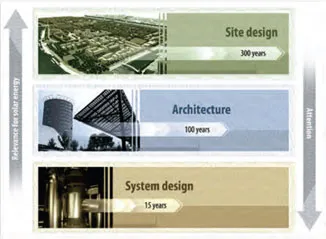
Planning Time Scales
Source: © Ecofys
Planning for Renewables
National policies to promote renewables, such as feed-in tariffs, can provide a positive backdrop and encourage the implementation of individual buildings with renewables. However, when it comes to larger projects such as new developments or concentrations of renewable projects within particular areas, local government has a key role to play.
In the majority of cities that have installed significant amounts of renewable energy infrastructure over the last ten years the local municipal government has had a key role in stimulating projects. When it comes to installation of large amounts of PV, these cities tend to have several important factors in common:
a strong local political commitment to the environment and sustainability;
the presence of municipal departments or offices dedicated to the environment, sustainability or renewable energy;
obligations that some or all buildings include renewable energy;
information provision about the possibilities of renewable energy;
challenging development sites that have inspired ambitious renewable energy projects.
Political Commitment
In areas where an initial political commitment to renewables has led to successful projects, the positive results and feedback from the projects have strengthened and reinforced the political commitment, and led to further projects. Thus a positive cycle can be set up, with good projects leading to further projects and the continuation of supportive policies. Methods of providing feedback to political bodies that can have a positive impact include winning environmental awards (which can result in positive publicity and in some cases monetary prizes that can be used for further projects in renewables) and ensuring that positive impacts on the local economy and consumers’ energy behaviour are identified and fed back to the decision-makers.
Environmental Departments Make a Difference
Having proactive municipal environment/ sustainability departments or officers can make an enormous difference. They can play a key role in defining new development areas with a renewable component; linking up developers and architects of suitable building projects with information on renewables; and providing assistance in obtaining funding. They are also involved with the drafting of supportive local policies and ensuring that the wider results of renewable energy projects, such as the impact on the local economy, are fed back to political bodies and lead to the continuation of supportive policies.
Obligations have a Major Impact
Obligations to include renewable energy in new developments can have a major impact. In the UK a rule that 10 per cent of the predicted energy demand from new developments must be supplied by renewables (also known as the Merton Rule after the London suburb where it was first applied) is rapidly being taken up by municipal authorities and is a major driver towards the implementation of renewables in the UK.
In The Netherlands entire new cities can be defined in a top-down approach that can include requirements for renewables. This has led to some massive projects such as the Stad van der Zon (City of the Sun in the Heerhugowaard-Alkmaar-Langedijk (HAL) region. These huge projects can be inspirational – but they can also take such a long time to be implemented that they can be unwieldy to steer and vulnerable to changes in government policy.
In France and Germany, municipalities can define new quarters but the development of individual buildings is up to private investors. The role of the municipality is to set targets and to inform and inspire investors. Some municipalities have found methods of setting specific requirements for the implementation of PV For example, in Gelsenkirchen in Germany, the city is imposing solar requirements in the contract of land purchase.
Money Helps but Information is Vital
Many of the case studies reviewed in this book obtained funding through public programmes. However, capital funding programmes supporting PV have become rare. Some projects, such as the Schlierberg solar estate in Freiburg and the communal PV power plant in Gleisdorf, used innovative financing mechanisms such as shares, and enhanced payments for renewable electricity are becoming more widely available.
When obligations are imposed on developers to include a certain proportion of renewable power generation in new developments, capital funding tends not to be available; instead the provision of information is the crucial factor.
Information can be provided by different actors at different stages. Croydon in London was one of the first municipalities to impose a planning rule of 10 per cent renewables contribution for new major developments. It sees the main barrier as know-how, not cost, so the Croydon Energy Network’s Green Energy Centre provides advice and support to developers on accessing grants and deciding what type of renewable technology to use.
In Lyon, France, the local energy agency organized technical visits to renewable energy systems for housing associations. This initiative led to the La Darnaise project with PV on the façades of refurbished apartment buildings. A major redevelopment of the confluence area near the centre of Lyon is now under way and information is being provided by an informal group of local experts.
Challenging Development Sites Lead to Innovative Projects
The final common factor noted in many of the innovative PV developments was that they were often based on challenging development sites. These more challenging sites seem to have inspired creative approaches and led to the inclusion of renewables in some major developments. Examples include projects to redevelop old industrial areas in Lyon in France, Barrow in the UK and Gelsenkirchen in Germany, as well as the challenging Olympic Village in Sydney, Australia. The inclusion of renewables formed part of a strategy to transform the image of social residential areas such as Alessandria in Italy or La Darnaise near Lyon. The fall of the Berlin Wall led to development opportunities in the centre of Berlin, and also in the centre of Freiburg, where French troops vacated a vast area after the fall of the Wall.
Site Layout and Solar Access
As a solar technology, the effectiveness of PV is highly dependent on solar orientation and shading. This means that many aspects considered early on in the urban planning and site layout process, from the layout of the roads to the building massing and shape of the roofs, will crucially affect the feasibility of installing PV Most other technologies included in buildings can be considered at the building design stage, rather than the site layout stage. The need to consider PV, and the other solar technologies of solar water heating and passive solar design, from the initial planning of the urban layout challenges the usual way of doing things.
At many of the developments where PV has been installed the decision to include PV was made at a late stage, long after the site layout had been fixed. In many cases developers or builders who had become interested in PV had looked at projects that were already under way and selected areas where PV could be installed on the basis that the development site concerned happened to have a good solar layout. Other sites available were not suitable for PV due to factors that may have been easy to change if they had been considered at an earlier stage. If we do not start taking solar access into account earlier in site planning the proportion of buildings that can make use of solar energy will be a fraction of what it could have been.
In a standard new development, planners may define the site layout without any consideration of solar access, and infrastructure such as roads and electricity supply may be installed before developers and building design teams are appointed. The challenge is to ensure that solar energy is considered during the site layout process. The difficulty today is that many professionals involved in the building industry have very little experience of solar energy. A renewables consultant may not be on board from the beginning and the PV sub-contractor is not likely to be on board until late in the day. As experience is gained across the industry and knowledge of PV and its implications for site layout and planning become a standard part of planners’ and developers’ repertoire all will become easier. Until then it will take a special effort to ensure that the potential of solar energy is considered during the site layout stage.
If solar access is taken into account at the earliest planning stages, in the same way as car and pedestrian routes or the need for parking, it is usually possible to ensure that the majority of buildings on a site are orientated between southeast and southwest to have good solar access. If it is not taken into account there is a risk that many of the buildings will have poor solar access. Not only will this lower the feasibility of installing photovoltaic systems, it will also restrict the use of passive solar design techniques, daylighting and solar water heating. The resulting urban layout will be in place for hundreds of years, restricting the feasibility of using any of the solar technologies available now and in the foreseeable future.
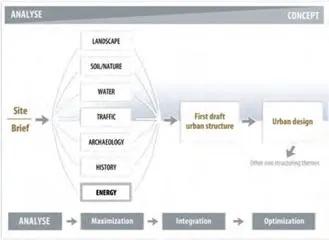
Solar Access must be Considered in the Initial Planning of the Urban Layout to Correctly Include PV in Buildings
Source: © Kees Duijvestein
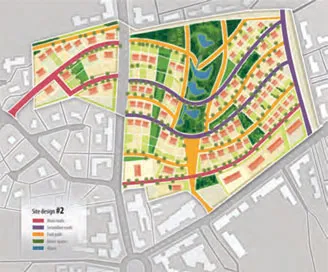
Example of Site Design Without Taking Solar Access into Consideration
Source: © Grand-Lyon
Example of Site Design with Solar Access Taken into Consideration
Source: ©: Grand-Lyon
The sizing and layout of the electricity supply network may also be fixed fairly early on. However, with moves towards sustainable construction there is an increasing trend towards micro-generation of electricity in buildings. These micro-generators can range from micro-CHP (combined heat and power) systems to micro-wind to PV. The Distribution Network Operator (DNO) should be informed of the possible installation of micro-generation in a new development so that it can be taken into account when designing the local electricity network.
Variations in the Urban Planning Process
The approach towards urban planning, who undertakes it, when and at what level of detail varies quite dramatically between different countries; even the term ‘town planning’ means different things in different places. In some countries it appears to be easier than in other countries to include PV early on in the urban planning process.
In The Netherlands, top-down planning of major new developments is normal. As part of this there is a long consultative process during which PV may be added and urban designs modified. The Nieuwland case study reviews the first large urban PV project, realized in 1999. Here solar optimization was taken into account in the urban planning phase with the land being parcelled out to provide as many roof surfaces as possible suitable for the installation of solar panels. The Stad van der Zon (City of the Sun) case study, again in The Netherlands, also took the sun as one of the starting points in urban planning, although there were some comments that this was more as a philosophical approach than a practical, technical approach as a result of the planners having very limited experience with the technology.
The approach is slightly different in Germany where the case studies demonstrate a willingness on the part of some municipalities to commission detailed analysis and shading simulations of urban renewal or development areas and use the results to inform developers and building designers. At Gelsenkirchen-Bismark, for example, an overall urban plan was developed which included a simulation of shading and solar irradiation on building surfaces. The initial draft of the area plan, with building massing and layout was evaluated and some modifications suggested regarding the height and distance between the buildings in order to provide each building with an ideal sun exposure. To avoid major shading of the building surfaces an advisory committee was formed to assist individual investors.
In the French and UK case studies, PV was added into the plan at a later stage in the urban planning process. This may relate to responsibility for detailed urban planning being more split between municipal planning departments, who tend to set guidelines rather than prepare detailed plans, and commercial developers who are then responsible for a greater part of the detailed urban planning. These breaks in the chain can make it much harder to carry a plan through to completion.
Successful Implementation
As sustainability becomes a more mainstream part of the construction and development industries, the installation of PV systems on buildings is moving from isola...