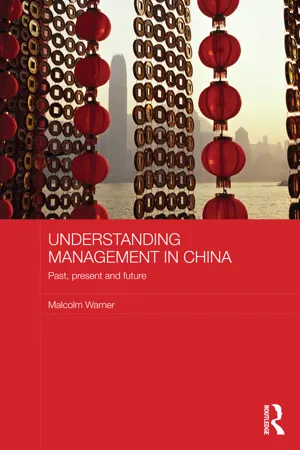
China has become one of the fastest-growing economies ever seen in the world in recent times. In the last three decades, China has transformed itself from a command economy to a market one, albeit a nominally socialist one, and its management systems have been reformed accordingly. In the light of these changes, Malcolm Warner, one of the leading authorities on management in China, explores the past, present and future of Chinese management. The first part of the work examines the history of management practices in the 'Middle Kingdom', outlining the influence of traditional Chinese values, especially the Confucian inheritance, and the legacy of the imperial bureaucracy with its meritocratic examination system, as well as the role of industrialization and the influx of foreign-owned businesses in the late nineteenth century and the twentieth century. It next goes on to consider the current state of China's management, showing how a new breed of manager has evolved since the beginning of Deng Xiaoping's reforms in the late 1970s and 1980s. The resulting impact of this strategy which has continued into the 1990s and the 2000s, up to the present day, is then examined. The final part of the book concludes with reflections on how management in China is likely to develop in the near future, especially on how far it will converge with global practices or to what degree an indigenous form of management 'with Chinese characteristics' will prevail.
- 244 pages
- English
- ePUB (mobile friendly)
- Available on iOS & Android
eBook - ePub
Part I
Introduction
1
Introduction
Let the states of equilibrium and harmony exist in perfection, and a happy order will prevail throughout heaven and earth, and all things will be nourished and flourish.
Confucius (1979: 5)
1.1 Introduction
Many Westerners in past years first knew about China through the tales of Marco Polo (1254–1324). They saw it as a country far away and in the East and were impressed by its many mechanical gadgets, paper-money, silk and the like. His book was originally titled Le Devisement du Monde or Il Milione and was circulated in his lifetime but only first printed in 1477 (see Polo 1958 edition). The writer, said to travel from Europe to Asia in 1271–1295, also conceded that he did not tell ‘half’ of what he saw – because he thought no one would believe him. In any case, it is said he made no mention of chop-sticks, foot-binding or the Great Wall of China, so some doubt if he ever went there at all (see Wood 1995). His book may in fact have finally been recast by another writer, Rustichello da Pisa to whom he told his story, perhaps hoping it would sell as a ‘Handbook’ for merchants, detailing itineraries, maps, weights and measures in use in far-flung lands (Psaki 2011). Even so, his book is still in print and provides an inspiration for both sinophiles and history-fans.
Later, another European who influenced how China was seen in the West was the Jesuit Father Matteo Ricci (1552–1610), who was also Italian. He was one of the first Western scholars to achieve a mastery of both spoken and written Chinese and translated many of the classics, eventually becoming advisor to the Ming dynasty Emperor Wanli (AD 1572–1620). He helped diffuse Christian knowledge in China through the medium of Mandarin (putonghua).1 Ricci also became the first outsider to translate the Confucian classics into a Western language, Latin, helped by the scholar Xu Guangqi. He may also have been the first to ‘latinize’ the name of the Chinese sage, Kongzi or Kong-fuzi, into the now familiar Confucius, of whom we will speak much more later. In his book The True Meaning of the Lord of Heaven, published in 1603 (Ricci 1985 edition), he argued that Confucianism and Christianity were not opposed ways of seeing the world and in advocating this position, he was able to build a bridge between East and West and vice versa (see Spence 1984: 1).
It is thus clear that to come to grips with modern China, we have to take into account past and present influences on Western perceptions of the ‘Middle Kingdom’ (Zhongguo).2 In Understanding Management in China, we will therefore take the perspective of the longue durée.3 Now, contemporary life in that country is very different today from that found three or more decades ago, let alone much earlier, whether in its society (shehui), its economy (jingji) or its management (guanli) but at the same time we will argue that there are nonetheless continuities stretching over the millennia. This story, of how the past links up with the present and extends to its future, is the substance of this work on this remarkable country. To give it its full name these days, the nominally Marxist, People’s Republic of China (Zhonghua Renmin Gongheguo), hitherto to be referred to as the PRC or just ‘China’, seems light-years away from the dawn of Chinese civilization but we hope to deconstruct its narrative, its economy and its management and make sense of it all.
Today’s China is in the eyes of many commentators, to use a Maoist phrase, well along the ‘Capitalist road’, as well perhaps on its ‘Silk’ equivalent. It is ironic that Karl Marx (Makesi) (1818–1883) who knew only a little about the Middle Kingdom over one hundred and fifty years ago, confidently wrote about it – as a commentator on international affairs in the New York Daily Tribune from 1852 to 1861, sometimes with his lifelong collaborator Frederich Engels (Engesi) (1820–1895) as ‘ghost-writer’ (see Marx 1853) – well before China knew anything at all about the said Dr Marx, as we shall see later. Even so, this ‘Kingdom’ has a much longer back history – going back millennia, rather than centuries. We therefore seek to present our analysis taking this consideration into account, as will be seen in Chapters 2 and 3.
In our exposition of the major themes in this book, we will try determinably to avoid using excessive jargon along the way and to employ plain language as far as possible. From time to time, however, some technical terms may have to be employed but we will try to keep these to a minimum. A list of abbreviations and a glossary are provided elsewhere in the volume to help the reader where needed. In doing so, we will mainly refer to management as practised within China’s frontiers and inside its enterprises, as well references to those in the Overseas Chinese4 (haiwai huaren) communities of Hong Kong, Macau (both now Special Administrative Regions, SAR, of the nation5), Taiwan and elsewhere. Even here, however, there are no doubt significant regional variations, both past and present. Thus, it cannot be seen as a wholly homogenous entity.
There is also a question of defining management (guanli) as found in China. What is to be dubbed as ‘Chinese’ management even within China? Is it just management taking place in China? Or management carried out by ethnically Chinese managers? Indeed, how ‘Chinese’ is Chinese? Here, one needs to point out that there have long been enterprises in the Middle Kingdom which have been foreign owned, administered and/or influenced. In recent years, many businesses have been run by American, British, Japanese or Korean managers, to name but a few. This reality complicates any analysis somewhat, as we shall see later in this chapter. In essence, some of these enterprises may be said to be imbued with American management and the various national variations mentioned. In the case of the Overseas Chinese influenced/owned businesses, they may appear to be superficially ‘Chinese’ but are in fact often perhaps subtle or else subtly different in their management styles, as is the case with Hong Kong, Macau or Taiwan cases. We will return to these points further in the book.
Since the writer is a specialist in people-management, it is probably not surprising that this study may tend to lean in such a direction. Some of the book will inevitably approach the subject of such management in China through the eyes of such a specialism. Even so, the book aspires to cover many different dimensions of managing overall but it will be inevitable that there will be an emphasis on human resource management (HRM) and management training and development, amongst other topics, rather than on functional areas, such as accounting, finance, marketing, sales and so on. Furthermore, we will give priority to qualitative analysis in our coverage, although not neglecting quantitative data vis-à-vis the above areas of investigation.
1.2 The structure of the book
The structure of this book consists of ten linked chapters. They are set out in the following order: 1 Introduction; 2 History; 3 Culture; 4 Economy; 5 Industry; 6 Managers; 7 Labour–management relations; 8 Human resource management; 9 Looking to the future; 10 Conclusions. Each of these chapters is designed to unfold the story of management in China, moving from past, present and future. They are closely linked to each other in a meaningful narrative (ji xu), rather than an unambiguously ‘causal’ model as such. A number of appendices follow at the end of work, plus a glossary, references and index.
1.3 Background
In order to put the subject matter into the perspective of recent history at this point, we now set out a timeline of background economic, political and social developments in the last century which are listed below (see Figure 1.1), starting with the Republican Revolution of 1911 as inspired by Sun Yat-Sen (1866–1925), through to the Liberation in 1949 led by Mao Zedong (1983–1976) and the Economic Reforms carried through by Deng Xiaoping (1904–1997) to the present day. A recent biographer has indeed described Deng, as ‘the general manager’ of the new reforms (Vogel 2011: 694).


Figure 1.1 Timeline of economic, political and social events in China, 1911–2012
Source: Miscellaneous
Perhaps the events of 1911 are a good place to start, as the narrative of modern China very much stems from this point in time. The chronology, I hope, will provide support for what we believe is a plausible account of how its recent history unfolded. I think it is important to place the development of management in China in such a dimension. The way the constituent chapters are introduced is intended to show that there is an underlying order in the argument presented, albeit with caveats along the way.
1.4 An emerging China
China is indeed a vast country, being third in land-mass size after Russia and Canada, with many far-flung provinces and large cities. It has a huge population of over 1.3 billion citizens, which encompasses a wide range of differences in behaviour, practices and values, with the Han Chinese ethnically preponderant. In the last decade, half of the population lived in the countryside and half in the urban areas. Just under 49 per cent of the labour force of close to a billion folk of working age still work in agriculture, some better-off than others, as well as multitudes of migrant workers (nong min gong). A floating population of as many as 200 million, or possibly more, are said to have moved to the cities and towns in recent decades.
Yet since 1979, the one-child policy (jihua shengyu zhengce) has kept the population numbers under control. The policy has no doubt boosted the role of women in the labour force, as it was easier to arrange childcare for a single infant. By 2012, for the first time, the number of urbanized Chinese outnumbered those who officially live outside cities and towns. This statistic is not to downplay the importance of those areas outside the main conurbations, as the hinterland provinces and rural, mainly agricultural sector remain of critical importance to the economy (see Webber 2012). Even so, the main thrust of this book will be more closely related to business and management in those urban parts of China which have experienced the main impact of modernization over the recent decades, heavily skewed towards the eastern and south-eastern coastal areas – but not excluding other major urban conglomerations elsewhere.
Lurking in the wings is the so-called ‘demographic time-bomb’ (see Harper 2012) in China, as seen even more seriously in mature economies, such as Germany and Japan. The population of the PRC is now an ageing one, as the logic of the one-child policy, unfolds. The dependency ratio will no doubt rise and there will be a shrinking labour force. The implication of the policy mentioned above is that it has already given rise to labour shortages and higher wage-costs in many parts of China. By the year 2050, the demographic profile of the PRC is predicted to be in fact noticeably different from that of the US, the former with a much older age-profile than the latter. This observation has already led to talk of a relaxing of the one-child policy and even the possibility of immigration, under the new leadership, to be considered perhaps in the coming year or so. The nation has come a long way from the few tens of millions of ur – Chinese in the early dynasties millennia ago – to the over 1.3 billion populace of today, noted earlier.
1.5 Seeking modernity
The Middle Kingdom today presents a bold new model of modernization (xiandaihua), albeit ‘with Chinese characteristics’ (juyou Zhongguo tese) to the world. The ‘sinification’ of Marxism, as it has been dubbed, has seen the introduction of a new ideology pursuing the interests of the working class (gongren jieji) but one which, perhaps in spite of tensions, eventually has accommodated itself to traditional norms, or so it seems.
After three decades of isolation from the West, from 1949 to 1978, China has now become a global player in both its international and its domestic domains, although still styling itself as a transitional economy6 (see Warner et al. 2005: 1). Yet, economic growth has truly transformed its society in both the inland provinces and the coastal towns and cities, although not evenly. Living standards, too, are at a record level in Chinese history, taking what has been called purchasing power parity (PPP)7 into account but with unequal shares. Even so, the country enjoyed a massive expansion of its infrastructure over the period and still does.
The educational sector, in turn, has grown enormously, with nine years of schooling for every Chinese child and it constitutes the largest system of its kind in the world. In international testing, Shanghai high-school students are said to achieve the top scores in international educational tests; others, in the less resourced places do less well. Even so, nationally many more young people go on to tertiary education than ever before. New university campuses now abound; the top universities such as Peking8 (Beida) and Tsinghua, are amongst the best in Asia, as well as its business schools such as the Guanghua School of Management in the former, as well as the Tsinghua School of Economics and Management in the latter, and the China Europe International Business School (CEIBS) part of Jiaotong University in Shanghai, of which more later.
New transport links now connect to both internal and global markets by longdistance air, rail and maritime routes, as well as through the internet (wangluo). Airports abound and super highways criss-cross the land. Fast ‘TGV’-style trains also link the major conurbations – now the 1,400 miles from Beijing to Guangzhou, the longest run in the world of its kind – at speeds which are purportedly faster than such trains in Europe or Japan but which have recently been curbed for reasons of safety.
The lavish Beijing Olympics (ao lin pi ke) of 2008 also vividly displayed China’s apparent self-confident face to the world under the rubric ‘One World, One Dream’. The hosts invited over 11,000 athletes to over thirty-one sporting venues. China won 100 gold medals, rising to the top of the chart. Estimated costs varied from US$14 million to US$44 million in total. Millions of tourist arrived in the Middle Kingdom for the event but its economic impact did not apparently last long. It was, however, claimed as a media success by officialdom estimating that as many as seven in ten of the world’s population were watching the games on TV.
On the cultural front, a resident Chinese writer, the novelist Mo Yan (1955–), gained the Nobel Prize for Literature in 2012, and another in exile, Gao Xingjian (1940–), now a French citizen, was likewise honoured earlier in 2000. Dissident citizen L...
Table of contents
- Cover
- Half Title
- Title Page
- Copyright Page
- Table of Contents
- List of figures
- List of tables
- Abbreviations
- Acknowledgements
- Preface
- Part I: Introduction
- Part II: Past
- Part III: Present
- Part IV: Future
- Appendix 1
- Appendix 2
- Appendix 3
- Glossary
- Notes
- Bibliography
- Index
Trusted by 375,005 students
Access to over 1.5 million titles for a fair monthly price.
Study more efficiently using our study tools.
Frequently asked questions
Yes, you can cancel anytime from the Subscription tab in your account settings on the Perlego website. Your subscription will stay active until the end of your current billing period. Learn how to cancel your subscription
No, books cannot be downloaded as external files, such as PDFs, for use outside of Perlego. However, you can download books within the Perlego app for offline reading on mobile or tablet. Learn how to download books offline
Perlego offers two plans: Essential and Complete
- Essential is ideal for learners and professionals who enjoy exploring a wide range of subjects. Access the Essential Library with 800,000+ trusted titles and best-sellers across business, personal growth, and the humanities. Includes unlimited reading time and Standard Read Aloud voice.
- Complete: Perfect for advanced learners and researchers needing full, unrestricted access. Unlock 1.5M+ books across hundreds of subjects, including academic and specialized titles. The Complete Plan also includes advanced features like Premium Read Aloud and Research Assistant.
We are an online textbook subscription service, where you can get access to an entire online library for less than the price of a single book per month. With over 1.5 million books across 990+ topics, we’ve got you covered! Learn about our mission
Look out for the read-aloud symbol on your next book to see if you can listen to it. The read-aloud tool reads text aloud for you, highlighting the text as it is being read. You can pause it, speed it up and slow it down. Learn more about Read Aloud
Yes! You can use the Perlego app on both iOS and Android devices to read anytime, anywhere — even offline. Perfect for commutes or when you’re on the go.
Please note we cannot support devices running on iOS 13 and Android 7 or earlier. Learn more about using the app
Please note we cannot support devices running on iOS 13 and Android 7 or earlier. Learn more about using the app
Yes, you can access Understanding Management in China by Malcolm Warner in PDF and/or ePUB format, as well as other popular books in Business & Business History. We have over 1.5 million books available in our catalogue for you to explore.