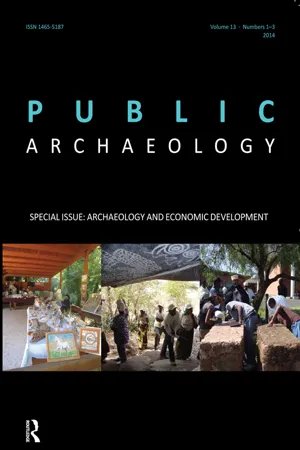
- 290 pages
- English
- ePUB (mobile friendly)
- Available on iOS & Android
eBook - ePub
Archaeology and Economic Development
About this book
"Nowhere in archaeology is the gap between theory and practice more evident than in its ambivalent engagement with economic development. This groundbreaking volume assembles practicing archaeologists, economists, and NGO officials in an extensive exploration of the theoretical, practical and ethical issues raised by archaeologists' use of cultural heritage to support economic development. The first chapters consider the problem of articulating the value of tangible and intangible heritage when economic measures alone are inadequate. Subsequent chapters present regional perspectives on archaeology and development, and present a host of case studies from around the globe that describe archaeologists' development projects, including some that are successful and others that are less so. These studies both suggest best practices in the implementation of development projects and illuminate the obstacles to success created by political conflict and competing human needs. Ethical issues and practical considerations converge in chapters that explore the role that members of local communities should play in the design, management and governance of archaeological and heritage resources. In this volume, archaeologists and heritage professionals will encounter a thought-provoking international discourse concerning the path forward for archaeology as the field engages with economic development."
Information
A Tale of Two Villages: Institutional Structure and Sustainable Community Organizations
This paper describes the organizational features of community-controlled economic development ventures associated with heritage sites located in two contrasting rural communities, one in Ireland and the other in Belize. The paper demonstrates that sustainable community organizations share institutional governance features that reflect general principles previously identified by scholars of common pool resources and community heritage tourism projects. The paper argues that archaeologists or heritage specialists working with local communities to develop sustainable economic development projects are more likely to succeed if attention is paid to the establishment of appropriate governance institutions for the project that are rooted in local conditions but follow proven governance principles.
KEYWORDS community archaeology, governance institutions, common pool resources, economic development, sustainability
Introduction
As numerous papers in this volume demonstrate, many archaeologists are initiating projects to assist communities to realize economic benefits from nearby archaeological and heritage resources. A search of the literature reveals some examples of development projects relating to archaeology that have survived for many years (Davis, 2011; de Merode, et al., 2003; Gamarra, 2010; Silverman, 2006). However, Díaz-Andreu’s (2013: 232–34) recitation of failed projects in Latin America illustrates the conventional wisdom in the field that the globe is littered with failed field museums and community projects that have gone undocumented. The pressing question for archaeologists is: do insights exist into how better to do this work in a manner that can make archaeologists’ efforts more successful?
This paper will address one potential response to that question, an answer inspired by literatures in economics, political science, and project evaluation. That literature suggests that archaeologists need to pay closer attention to the nature of the community institutions they create as they try to advance economic development. For the purpose of illustrating this issue, this paper will present data derived from my PhD research (Gould, 2014), examining the governance institutions of community-based economic development projects in communities adjacent to archaeological sites. The data presented here are drawn from extensive qualitative and quantitative interviews with community leaders and project members and reviews of internal documents conducted in two such locations between 2010 and 2013.
The two communities described here, one in a small Irish village in County Clare and one in a small Maya village in central Belize, have little in common from the standpoint of history, culture, or community politics. Yet both are home to decades-old community projects rooted in environmental and archaeological heritage. These two village projects exhibit common characteristics that may inform the way archaeologists think about establishing and sustaining community-level development activities. The argument presented here is that commonalities in the nature of the governance institutions in these two community organizations, and the manner in which those institutions relate to local conditions, are important contributors to the sustainability of these organizations across several decades.
One project, the Burren Centre, is located in Kilfenora, a small village midway between Galway and Limerick on Ireland’s western coast. Kilfenora is situated in a region known as ‘The Burren’, a limestone karst landscape that has been home to humans for more than 6000 years (Carthy, 2011). In 1972, a plan was launched in Kilfenora by local leaders and an outside adviser to establish a centre to interpret the unique environmental and archaeological heritage of the Burren for tourists. Today, the Burren Centre is the largest employer in the village and the reason that 25,000 to 30,000 tourists visit each year, helping to sustain the village’s unusually collaborative culture even in the face of the recent Irish economic crisis (interviews with F. Connole, 8 March 2012; J. Keane, 9 October 2011).
The village of Maya Centre, Belize presents a strong contrast. Situated on the entrance road to the Coxcomb Basin Wildlife Sanctuary, the approximately fifty households in Maya Centre are Mopan Maya families who moved to the area in the 1970s after a dispute in a neighbouring village. Men in the community tend to leave the village during the day for work, generally in agriculture. Family disputes, religious differences, and political divides all contribute to a far less harmonious community than Kilfenora. Nonetheless, since 1987, a cross-section of the women in the community has coalesced around the Maya Centre Women’s Group (MCWG), which sells traditional crafts produced by local families. It is a primary source of cash income to this community.
This paper tells the tale of the heritage-related projects in these two villages and the lessons to be gleaned from their success.
Governance institutions, communities, and sustainability
What is a governance institution? By ‘institution’, scholars of institutional economics mean what Douglass North has called ‘the rules of the game’ (1990: 4). These may be formal rules, laws, regulations, contracts, patents, or procedures enforced by entities such as the officers of organizations, bureaucracies, or even the courts. Alternatively, they may be informal rules such as traditions, taboos, and community compacts that are enforced through informal social structures such as ostracism, public shame, or other penalties. Institutional economists argue that institutions serve distinct purposes by reducing the ‘transaction costs’ (such as those to obtain information or to enforce agreements) and the risks of commercial relationships (Acheson, 1994; Williamson, 1998).
The ideas of institutional economists have been extended by scholars studying common pool resources, which are resources owned or controlled in common by a defined group. Examples are grazing lands, forests, fisheries, or irrigation systems managed on a community-wide basis. These scholars have examined the many examples of collaborative ventures that refute what Hardin (1968) famously termed the ‘tragedy of the commons’ and demonstrated that there are institutional commonalities in the way communities have self-organized to manage common pools (Ostrom, 1990; Poteete, et al., 2010). Thus, governance institutions may be seen as the rules, traditions, and practices created to manage the affairs of a community project. Viewed in this light, community-based governance institutions must promote assurances of good faith, redress grievances, or otherwise enable individuals to engage in relationships requiring some degree of trust. Rules and regulations of community organizations, particularly those that engage in commercial transactions, serve an identical purpose.
‘Community’ is a critical notion in this conversation. Anderson (2006) has popularized the notion of ‘imagined communities’ that may be comprised of geographically dispersed groups sharing a common interest or groups coalescing around a notional commonality such as family, nationality, or a community of expertise such as ‘heritage professionals’ (Smith & Waterton, 2009: 11). From this perspective, every heritage site is inevitably a potential collision-ground for competing ‘communities’ and every community-based project engages a network of ‘communities’ with overlapping membership (Haggstrom, 1983; Richards & Hall, 2000; Shackel & Chambers, 2004; Stonich, 2005; Sutton Jr, 1983; see also Leventhal; Morris; Pyburn, this volume). Thus, from the standpoint of practical institution making, the community that matters is the complex and conflicted one that archaeologists find on the ground. Therefore, the word ‘community’, as used in this paper, simply means all of the residents who live in the vicinity of an archaeologist’s project, whether or not they are a culturally homogenous group and whether or not individuals have competing traditional, religious, economic, or political claims on the heritage resources. Indeed, it is precisely the fact of those competing interests that compels a focus on the governance mechanisms through which the intra-community politics in economic development projects are played out at the local level.
Finally, what are ‘sustainable’ projects and institutions? In an environmental context, sustainability seeks to balance the demand for development from corporate and individual interests with the ‘carrying capacity’ of a resource. Carrying capacity, a biological concept, may be seen as ‘the maximum number of a species that can be supported indefinitely by a particular habitat […] without degradation of the environment and without diminishing the carrying capacity into the future’ (Hardin, 1977: 113). Carrying capacity has been extended to historical and cultural assets by scholars of the tourism industry, who use the concept to describe the conditions necessary to the preservation of the natural environment and the physical features of historic sites such as archaeological ruins (Murphy, 1985). Numerous comprehensive definitions of sustainable development have been offered and even more indicators of sustainability proposed (see Kates, et al., 2005; Marshall & Toffel, 2005). In this paper, however, following Ostrom (1990), the notion of ‘sustainability’ applied to these projects is simply their institutional survival across long stretches of time.
The Burren Centre
Running from Galway Bay nearly to the County Clare seat of Ennis, the Burren is a unique limestone karst environment where glacial activity millennia ago created an ecosystem in which alpine and Mediterranean plants grow side by side. Tillable soil is scarce but there is plenty of surface fodder for the beef and dairy cattle, sheep, and goats that give life to its economy. While the first clearly attributable archaeological remains in the Burren date from the Mesolithic, herders and farmers asserted a settled presence in this part of western Ireland in the warmer Neolithic period (Carthy, 2011). Within a short span, they began to domesticate the rugged landscape and to construct the oldest artefacts remaining in the Burren, a collection of megalithic dolmen and tombs epitomized by the iconic portal tomb at Poulnabrone (c. 3200 bce). By the sixth century ce, Christian churches appeared in the landscape; cathedrals, such as the one now ruined in Kilfenora, had their founding late in the first millennium, when local clans built stone ring forts and field walls to protect family and livestock (Carthy, 2011). One systematically examined ring fort, Caherconnell, has C-14 dated artefacts to the seventh century ce and assigned structural remains to the late Neolithic or early Bronze Ages (Comber, 2012). As one essayist of the region has noted, ‘the Burren is more than just an open-air museum, it is an archaeologically saturated landscape’ (Clements, 2011: 25).
Kilfenora is a former market town on the southern edge of the Burren. Residents frequently describe Kilfenora in the late 1960s as ‘derelict’, citing seventeen or so abandoned houses in a village centre that even today numbers no more than about fifty structures, many newly built. This was also the time when the west of Ireland was at the early stages of an economic revival led by the growing importance to international air travel of nearby Shannon Airport. The Chairman of the Shannon Development Corporation, Brendan O’Reagan, saw development around the airport’s free trade zone and tourism in Limerick’s hinterland as potential offsets to the decline of rural communities in the region. In 1969, village leaders asked O’Reagan for help and he dispatched a young associate, Brian Mooney, to Kilfenora.
There was a long tradition of community-funded, committee-led efforts to improve Kilfenora when Mooney arrived. When asked today, residents can name more than twenty voluntary organizations in this village of 463 people, each led by a volunteer committee. Mooney began in 1969 by organizing a series of educational lectures in Kilfenora while he met with local figures and slowly assembled a committee to manage a tourism project. Mooney encouraged the creation of an ‘interpretive centre’ for tourists to learn about the ecology and heritage of the Burren before setting off to discover it for themselves. His process was to engage community leaders, primarily from Kilfenora and pivotally including Kilfenora’s parish priest and a ‘village elder’ (a local farmer), in an extended dialogue that culminated in the establishment of the Burren Centre (interview with B. Mooney, 7 March 2012).
The project was incorporated in 1975 as a for-profit cooperative of residents in three villages in County Clare (Connole, 2006). The idea was to construct the Centre on an abandoned site in the main square in Kilfenora and from there promote tourism throughout the Burren area. The Centre was financed by a grant from Bord Failte, an Irish tourism development authority, and from the proceeds of an offering of shares in the Burren Centre’s parent organization to local residents. About 300 individuals, from the vast majority of households in Kilfenora, subscribed at least IR£5 per share (some residents contributed much more, although each shareholder receives only one vote at business meetings). About 80 per cent of the shareholders lived in Kilfenora, while 10 per cent were from each of two neighbouring villages.
The Centre, which opened in 1975, housed a model of the Burren and other exhibits through which visitors were guided by local students. In 1981, two adjacent buildings were acquired and converted into tea-rooms to serve visitors and house a crafts shop. In its first decade, the cooperative launched a number of other projects, seeking to expand its economic development impact. These included ventures to produce fruit jams, peat firebricks, and wooden toys. By the early 1980s all had failed due to poor planning and marketing or inattention to costs, with only the interpretive centre, tea shop, and craft sales businesses enduring commercially (IPC, 1983).
From the early 1990s until 2000, the Centre faced two related crises. First, in 1991, national government officials sought to situate a new interpretive centre adjacent to Mullaghmore Mountain in the heart of undeveloped Burren land, a location less than 15 km from Kilfenora. Burren Centre officials saw this proposal as potentially fatal to the Burren Centre. Fearful of alienating powerful government funders but in an uncertain economic situation itself, the Burren Centre’s governing Committee opposed the Mullaghmore project but also sought a contingency funding arrangement. Other shareholders believed more aggressive and public opposition was essential. Ultimatel y, nearly 50 per cent of the shareholders turned out for a 1991 Extraordinary General Meeting (EGM) to debate the strategy. After robust debate, the Committee’s position prevailed by majority vote.
Subsequently, in 1993, local business owners who were fearful that the Centre might founder in the wake of the Mullaghmore controversy sought to eliminate Article 5 of the centre’s governing ‘constitution’, which precludes shareholders who are owners of competing local businesses (such as pubs or retail shops) from sitting on the Centre’s governing Committee. Protagonists on each side differ regarding the others’ motivations, but in interviews they are unanimous that their mutual concern was to ensure continued life for the Burren Centre itself. At a second EGM, in 1993, Article 5 was retained by majority vote and competitors remain barred to this day from the Committee. The ten-year legal fight over the Mullaghmore centre, which was waged primarily by a group located in the nearby village of Kilnaboy on the road to Mullaghmore, finally ended in 2000 when the Irish Supreme Court quashed the Mullaghmore project. Shortly after, a new Irish government provided almost IR£1 million in funding to the Kilfenora centre to acquire additional land and construct an expanded interpretive centre, which opened in 2001.
Formally, the Burren Centre is the primary activity of the Comhar Conradh na Boirne Teoranta (the ‘Comhar’), an enterprise organized under Irish cooperative laws. Technically, the Comhar is a for-profit entity, though it has never declared a dividend. Co-ops are a traditional rural collective structure in Ireland, where a government entity, the Irish Cooperative Organisation Society, Ltd (ICOS), provides governance principles in the form of a model ‘constitution’. The Burren Centre adopted the standard form ICOS constitution in 1975, updated it in the 1980s, and follows it to the letter.
Day-to-day operations of the Comhar are delegated to paid professional management under the supervision of a volunteer governing Committee whose members are nominated by other shareholders prior to the Annual General Meeting each year. The Committee, which has the authority to undertake most actions, is headed by a Chairman and includes a Vice Chair, Secretary, Treasurer, and occasional assistant officers, all chosen by the Committee itself. Quorums, votin...
Table of contents
- Cover
- Title
- Foreword
- Guest Editorial: Archaeology and Economic Development
- Keynotes
- Values in Archaeology
- National Perspectives and the Role of International Organizations
- Archaeology and Communities
- Measuring and Presenting Impacts
Trusted by 375,005 students
Access to over 1.5 million titles for a fair monthly price.
Study more efficiently using our study tools.
Frequently asked questions
Yes, you can cancel anytime from the Subscription tab in your account settings on the Perlego website. Your subscription will stay active until the end of your current billing period. Learn how to cancel your subscription
No, books cannot be downloaded as external files, such as PDFs, for use outside of Perlego. However, you can download books within the Perlego app for offline reading on mobile or tablet. Learn how to download books offline
Perlego offers two plans: Essential and Complete
- Essential is ideal for learners and professionals who enjoy exploring a wide range of subjects. Access the Essential Library with 800,000+ trusted titles and best-sellers across business, personal growth, and the humanities. Includes unlimited reading time and Standard Read Aloud voice.
- Complete: Perfect for advanced learners and researchers needing full, unrestricted access. Unlock 1.5M+ books across hundreds of subjects, including academic and specialized titles. The Complete Plan also includes advanced features like Premium Read Aloud and Research Assistant.
We are an online textbook subscription service, where you can get access to an entire online library for less than the price of a single book per month. With over 1.5 million books across 990+ topics, we’ve got you covered! Learn about our mission
Look out for the read-aloud symbol on your next book to see if you can listen to it. The read-aloud tool reads text aloud for you, highlighting the text as it is being read. You can pause it, speed it up and slow it down. Learn more about Read Aloud
Yes! You can use the Perlego app on both iOS and Android devices to read anytime, anywhere — even offline. Perfect for commutes or when you’re on the go.
Please note we cannot support devices running on iOS 13 and Android 7 or earlier. Learn more about using the app
Please note we cannot support devices running on iOS 13 and Android 7 or earlier. Learn more about using the app
Yes, you can access Archaeology and Economic Development by Paul Burtenshaw in PDF and/or ePUB format, as well as other popular books in Art & History of Medieval Art. We have over 1.5 million books available in our catalogue for you to explore.