The crash of an Amtrak train near Baltimore, the collapse of the Hyatt hotel in Kansas City, the incident at Three Mile Island, and other large-scale technological disasters have provided powerful examples of the ways that communication practices influence the events and decisions that precipitate a disaster. These examples have raised ethical questions about the responsibility of writers within agencies, epistemological questions about the nature of representation in science, and rhetorical questions about the nature of expertise and experience as grounds for judgments about risk.
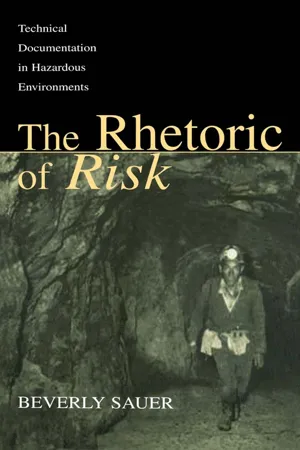
In The Rhetoric of Risk: Technical Documentation in Hazardous Environments, author Beverly Sauer examines how the dynamic uncertainty of the material environment affects communication in large regulatory industries. Sauer's analysis focuses specifically on mine safety, which provides a rich technical and historical context where problems of rhetorical agency, narrative, and the negotiation of meaning have visible and tragic outcomes. But the questions Sauer asks have larger implication for risk and safety: How does writing function in large regulatory industries? What can we learn from experience? Why is this experience so difficult to capture in writing? What information is lost when agencies rely on written documentation alone? Given the uncertainties, how can we work to improve communication in hazardous and uncertain environments?
By exploring how individuals make sense of the material, technical, and institutional indeterminancies of their work in speech and gesture, The Rhetoric of Risk helps communicators rethink their frequently unquestioned assumptions about workplace discourse and the role of writers in hazardous worksites. It is intended for scholars and students in technical writing and communication, rhetoric, risk analysis and risk communication, as well as a wide range of engineering and technical fields concerned with risk, safety, and uncertainty.
- 384 pages
- English
- ePUB (mobile friendly)
- Available on iOS & Android
eBook - ePub
About this book
Information
I
THE PROBLEM OF TECHNICAL
DOCUMENTATION IN
HAZARDOUS ENVIRONMENTS
1
Regulating Hazardous Environments:
The Problem of Documentation
What is required is a paradigm that on the one hand acknowledges the inevitable interaction between known and unknown, and on the other hand respects the equally inevitable gap between theory and phenomena.1
—Fox Keller, (1985)
I do not want to sell coal that is stained by the blood of Kentucky coal miners.2
—Carroll, 1976. (In Gibson, 1977)
As miners dig, they continually reshape the underground landscape. Every cut changes the immediate shape of the walls, floor, and roof (ceiling) of the mine. As miners remove rock from the face, pressures from the overburden— the mass of mountain above the immediate mine roof—produce subtle changes in the rock strata. If the rock itself is unstable or if miners fail to sup-port this rock, these changes can produce sudden and violent falls of rock that may crush miners without warning. Tiny cracks in the rock may also liberate methane that can burn as a layer of blue flame above miners’ heads. If mines are not properly ventilated, if miners do not replace their picks frequently, if cutting picks hit the hard layer of rock rather than the soft coal layer, if electrical equipment sparks, or if miners increase the force of the cut to increase production, frictional heat produced by the cutting pick can ignite methane in a violent chain reaction that can turn tiny particles of coal dust into a deadly explosion.
The earliest printed mining texts acknowledge the risks inherent in mining. In the De Re Metallica (1556/1950), Georgius Agricola admits that the dangers of mining are of such “exceeding gravity” and so “fraught with terror and peril” that he would “consider that the metals should not be dug up at all, if such things were to happen very often or if miners could not safely guard against danger by any means”:3
The critics say further that mining is a perilous occupation to pursue because the miners are sometimes killed by the pestilential air which they breathe; sometimes their lungs rot away; sometimes the men perish by being crushed in masses of rock; sometimes, falling from the ladders into the shafts, they break their arms, legs, or necks; and it is added there is no compensation which should be thought great enough to equalize the extreme dangers to safety and life.4
Four hundred years later, miners continue to die.
Despite improvements in mining technology and engineering, 20th century miners still confront risks from gas, falling rock, and black lung disease.5 In 1983, Richard Trumka, President of the United Mine workers of America (UMWA), testified before Congress about what he called the continuing “slaughter and maiming” of coal miners in the U.S. Between 1900 and 1968, he argued, over 71,000 coal miners had died and over 300,000 miners had been totally disabled with black lung disease.6 “Untold thousands of coal miners” had been injured, he argued, because the Federal government had no means of enforcing mine safety standards and mining regulations.
The history of Federal mining legislation demonstrates the continual struggle to create enforceable standards that would protect the health and safety of workers. Although Congress had introduced a bill to create the Federal Bureau of Mining as early as 1865, the earliest mining legislation lacked “any right or authority with the inspection or supervision of mines….”7 In 1910, Congress established the Bureau of Mines within the Department of the Interior to investigate mining methods, mining operations, and new technologies to improve mine safety. This legislation was intended to “attack” hazards in the mining industry, but Federal inspectors lacked authority to inspect or supervise mines.8 In 1941, Congress gave Federal inspectors the right to enter and inspect all bituminous, anthracite, and lignite mines.9 But the Mine Safety Code (established by the Federal Bureau of Mining) served only as a guideline for Federal inspectors and “compliance by operators was purely voluntary.”10 As a result, inspectors had no legal means of enforcing compliance with standards.
In 1951, following the death of 119 miners in West Frankfurt, Illinois, Congress gave the Bureau of Mines a “reinspection closing order” (Public Law 552) that enabled inspectors to prevent some repeat violations of the Bureau recommendations. But the legislation fell short of President Harry Truman’s recommendations submitted to Congress, and miners continued to die.11 Public Law 89–376 (1966) extended Federal authority to small mines that had been excluded in previous legislation. Because this law was intended to attack major disasters, it covered only 10% of all occurrences that might cause a fatality or accident. Ninety percent of accident occurrences were still left to be covered by State law and the Bureau’s voluntary safety code.12
Then, on November 20, 1968, a spark ignited gas at the Number 9 Farmington mine in Marion County, West Virginia. In that one disaster alone, 78 miners died. Trumka recounts the horror in vivid terms:
There was a dangerous accumulation of methane in that mine that day. I would like for you to remember that that was the cause of the disaster, an accumulation of methane, coupled with the lack of rock dust, coupled with the accumulation of coal dust…. A spark ignited that gas and turned the Farm-ington mine into an inferno; 78 miners lost their lives that day. They were cooked. They were cooked externally. They were fried like you could fry an egg…13
The 1968 Farmington disaster marked a turning point in U.S. policy. In the wake of public outcry over Farmington, Congress adopted the Federal Coal Mine Health and Safety Act of 1969 (Public Law 91473). The legislation was drafted in two weeks over Christmas vacation.
The Mine Act (as it is now referred to)14 represented a major victory for la-bor in its struggle to hold management accountable for safety underground. The Act provided the first mandatory Federal standards, the first mandatory inspections, and the first civil penalties for violations of the Act’s standards. The Act authorized a separate enforcement agency, the Mine Enforcement and Safety Administration (MESA). The Act promised miners “the safety that they deserved in their workplace, a healthful workplace that they deserved, free of dust, free of noise, free of dangerous accumulations of coal dust and methane”—with compensation for black lung disease and civil and criminal penalties to force compliance.15 Under the Act, the Bureau of Mines retained its responsibility for mine safety research, funded through a separate budget.
With the passage of the 1969 Mine Act, miners were no longer dependent upon the good will or voluntary compliance of owners and management.16 The Act specified that management must provide training for both new and experienced miners, and it specified a mechanism for enforcement and penalties for violations. Most important, the Act held management ultimately liable for willful violations of safety. The Act was further revised in 1977 in response to another series of disasters that underscored the inadequacy of safety and enforcement.17
The 1977 Act consolidated metal and coal mines under a single set of standards and transferred the functions of the former MESA (under the Bureau of Mines) to the newly created Mine Safety and Health Administration (MSHA).18 The 1977 Act thus placed the responsibility for worker safety within the Department of Labor and removed the potential conflict of interest that might occur if MESA inspectors interrupted production to enforce health and safety standards.
But miners continued to die.
In 1987, Congress convened oversight hearings to determine why agencies had failed to publish regulations to protect workers’ safety and health. These hearings revealed problems with the regulatory process at all levels, from compliance and enforcement to problems with training, ambiguities in language and interpretation, and a process of regulatory review and revision that paralyzed the agency and left workers unprotected.
Labor and management agreed that the regulatory process needed to be improved, but they disagreed about the locus of liability and the cause of the problems. In testimony before Congressional oversight hearings, the Bituminous Coal Operators’ Association and American Mining Congress (1977) argued that regulations were hard to interpret because they lacked “a clear and sensible meaning”; yet if operators failed to abide by the strict letter of “this compendium of legal detail,” they were cited for “violation” of the standards. 19 Operators charged that it was unreasonable to hold management liable for mine safety violations when MSHA and management disagreed about the meaning and interpretation of regulations. The number of regulations and their complexity made unreasonable demands upon foremen, inspectors, supervisors, and management, who were forced to interpret and apply general standards in highly local and unpredictable situations in the field.
The United Mineworkers countered that tougher standards and consistent enforcement would prevent disaster. They criticized MSHA for allowing mines to violate safety standards and change plans. They argued that such flexibility encouraged abuse and would return miners to the hazards they faced under voluntary compliance.
Senator Edward Kennedy (1987) charged that the agency spent too much time “reviewing the re-review.”20 Kennedy called the process a “regulatory nightmare” that “provide[d] little chance for regulation ever to be finalized.”21 United Mineworkers President Joseph Trumka (1987) was more direct. He argued that the agency’s proposals for new mine ventilation standards had missed the “simple changes in work procedures” and “simple measures” that could have prevented disaster.22 In calling upon agencies to write clearer, more enforceable standards, unions and Congressional overseers sought to move the site of risk decision making away from the pressures of production and the economies of mine management in local mines.23
In criticizing the agency for failing to write clear standards that might protect miners’ lives, the hearing raised questions about the problems that agencies faced as they attempted to regulate hazardous environments: Why did management deliberately and willfully fail to comply with standards even as condi...
Table of contents
- Cover Page
- Half Title page
- Title Page
- Copyright Page
- Dedication
- Contents
- List of Figures
- Editor's Introduction
- Introduction: The Rhetoric of Risk
- I The Problem of Technical Documentation in Hazardous Environments
- II Moments of Transformation
- III Documenting Experience
- IV Transforming Experience
- References
- Author Index
- Subject Index
Trusted by 375,005 students
Access to over 1.5 million titles for a fair monthly price.
Study more efficiently using our study tools.
Frequently asked questions
Yes, you can cancel anytime from the Subscription tab in your account settings on the Perlego website. Your subscription will stay active until the end of your current billing period. Learn how to cancel your subscription
No, books cannot be downloaded as external files, such as PDFs, for use outside of Perlego. However, you can download books within the Perlego app for offline reading on mobile or tablet. Learn how to download books offline
We are an online textbook subscription service, where you can get access to an entire online library for less than the price of a single book per month. With over 1.5 million books across 990+ topics, we’ve got you covered! Learn about our mission
Look out for the read-aloud symbol on your next book to see if you can listen to it. The read-aloud tool reads text aloud for you, highlighting the text as it is being read. You can pause it, speed it up and slow it down. Learn more about Read Aloud
Yes! You can use the Perlego app on both iOS and Android devices to read anytime, anywhere — even offline. Perfect for commutes or when you’re on the go.
Please note we cannot support devices running on iOS 13 and Android 7 or earlier. Learn more about using the app
Please note we cannot support devices running on iOS 13 and Android 7 or earlier. Learn more about using the app
Yes, you can access The Rhetoric of Risk by Beverly A. Sauer in PDF and/or ePUB format, as well as other popular books in Lingue e linguistica & Studi sulla comunicazione. We have over 1.5 million books available in our catalogue for you to explore.