eBook - ePub
How to Set Up Information Systems
A Non-specialist's Guide to the Multiview Approach
- 217 pages
- English
- ePUB (mobile friendly)
- Available on iOS & Android
eBook - ePub
How to Set Up Information Systems
A Non-specialist's Guide to the Multiview Approach
About this book
This introductory user's guide to systems analysis and systems design focuses on building sustainable information systems to meet tomorrow's needs. It shows how practitioners can apply multiple participatory perspectives in development, so as to avoid future problems. As a practical guide, it is presented to be readily comprehensible and is organized to enable users to concentrate on their goals efficiently, and with minimum theoretical elaboration. The chapters follow the sequence involved in planning an information system, explaining key words, the time involved in each step, ending with a tutorial or exercises.
Trusted by 375,005 students
Access to over 1.5 million titles for a fair monthly price.
Study more efficiently using our study tools.
Information
CHAPTER 1
INFORMATION SYSTEMS AND ORGANIZATIONS

KEYWORDS: sustainability, planning, change, risk, failure, learning organization, methods
SUMMARY: Information as a commodity is briefly discussed. The sustainability of information systems is introduced and the need for information systems planning is introduced and described. Incidental virtues of information systems planning (eg, learning about and with your organization, developing an understanding of the stakeholders, assumptions and mindsets of colleagues) are discussed. Common problems with information systems are reviewed.
Introduction
It may appear to be obvious but information systems (IS) are supposed to inform people. In the process of planning or development it is advisable never to lose sight of this primary objective. By informing, the information system assists people or ‘users’ to make intelligent decisions based upon good information derived in turn from reliable data. Therefore, if the information to be used is:
• poorly gathered and sorted;
• inadequately edited;
• incorrectly analysed or analysed under the wrong assumptions;
• analysed for the wrong things; or
• badly presented;
The information system will probably fail in its primary function. This in turn has a knock-on effect on decision-making, the results of which feed through to the effectiveness of the organization as a whole. Therefore any information system needs to be carefully planned in terms of:
• The data to be gathered.
• The information products being derived from the data.
• The ultimate knowledge which is thought by the planner to be the final requirement of the system (this can be a very difficult thing to define).
In our experience, it is all too often the case that an information system will be designed prior to anyone having asked what question(s) it is intended to answer. Thus, incorrect data is gathered, inappropriate information products are generated and insufficient knowledge is derived for effective decision-making.
Organizations of all kinds, be they small private companies, non-governmental agencies or large government departments, are primarily users and producers of information. Information is a most versatile and pliable commodity. Literally anything which leads to any form of action could be seen as being information. A kick in the rear, an impact or sustainability indicator or a bank statement are informative and could lead to action, maybe immediate or delayed, possibly positive or negative, experienced as brief or sustained.
It is worth briefly describing some of the major attributes of information systems:
• They deal with endlessly changing commodities – the need for knowledge and the proliferation of data.
• They are required to facilitate decision-making.
• They exist in all organizations.
• They are vital to an organization's function.
• They are increasingly thought of primarily as computer-based applications.
• They are frequently badly planned.
An information system, particularly a computer-based information system, can appear to be efficient and yet be experienced by end users as being unhelpful or even hostile. There can be many reasons for this, some of which we look at in the second section of this chapter, ‘Information systems: A catalogue of failures?’. At this point we need to make clear that an information system is rarely isolated but is an integral and integrated part of the wider organizational system.
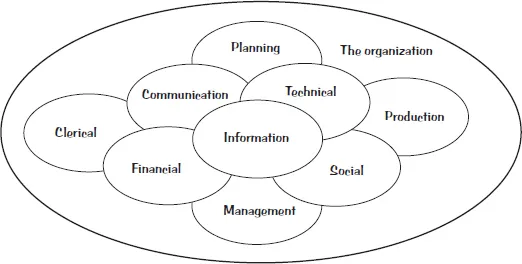
Figure 1.1 Linked aspects
The way in which an organization functions is very often experienced by those within and those outside as being highly complex. Information systems impinge upon most of the features of organizations. Therefore, as well as being established on technically sound principles, the planning process needs to be both diligent and sensitive to organizational needs and user thinking.
When we refer to ‘organizational needs and user thinking’ we mean such common issues as:
• Lack of experience of the planning or systems analysis and systems design (SA&SD) process in the recipient community.
• Senior management reluctance to adopt suggested change.
• Staff reluctance to adopt new practices and procedures.
• Absence of local, reliable support for incoming systems.
• Sense of risk and uncertainty in a new endeavour.
• Staff too stretched to accommodate changes gladly or to be able to provide time and effort to working with the development of a new technology.
• Distrust of change processes.
This book is designed to introduce one means for effective information systems planning for organizations whilst taking into account this range of issues.
Whilst not wishing to give the impression that information systems in use today are generally unfriendly and inappropriate, it is our experience that there are a large number of such systems which fail because they do not take into account the views and worries of the end users. A glance through just about any edition of Computer Weekly would confirm this statement, the litany of disasters relating to information technology (IT) are numerous (see Suggested Reading). The headlines themselves are instructive:
• Lack of systems back-up causes hospital chaos.
• Bank chief learns from computer failure.
• GPs’ network buckles under huge workload.
• How British Gas took the blame and still managed to survive.
• Why British Gas jumped out of the frying pan...
• The politics of risk: Trials and tribulations of the Taurus project.
• Bug delays £25m court case system.
AUTHORS’ NOTE: There is a great deal written about organizations and their capacity to deal with change including the changes which IT brings with it (see Suggested Reading and References at the end of the book). This book focuses on analysis and design but we would particularly like to flag the work of Morgan (1997). In his book he indicates a range of metaphors which can be used to help us in describing organization (eg, organization as machine, as brain, as prison). In Chapter 3 we make use of metaphors to describe the systems analyst. Metaphor is a useful device to develop insights into a complex context. To think of an organization as being ‘like’ a brain is to raise questions like:
• ‘Is this organization behaving rationally?’
• ‘Is this organization learning?’
These types of question are provoking and can be really helpful in the early stages of systems thinking when we are trying to understand problems. We will return to this approach in Chapter 5.
Both private and public sectors are prone to massive IT project failure (£80 million in the case of the City of London computerization ‘Taurus’ project) and the big headlines tend to dominate the news on this topic. This disguises the massive amount of time and energy lost in irritating errors, localized failures in information delivery and frustration in non-working technologies.
One of the problems which often arises with new computer-based information systems is that users feel that the new information system is being imposed upon them with little or no discussion. It is our observation that, generally speaking, the end users of information systems do not have enough say in the analysis and design process.
AUTHORS’ NOTE: There are a number of approaches to information systems building which are intended to develop the users’ input to the system, eg rapid applications development (RAD) and prototyping. However, these approaches require that the user be given technical support in developing new information systems making use of software tools. In this book we wish to focus on empowering the user to think about and plan his or her information system and not on the approaches designed by technical facilitators.
Lack of input to processes can often result in a lack of sense of ownership amongst the end users of the system supposedly being implemented to improve ‘user efficiency’. Further, the information systems analysis and design process is suffering from a dose of ‘expert imposition’. To explain what we mean by ‘expert imposition’ we have to look no further than the types of problem which have been confronting architects in recent years.
After years of quiescence the end user (in this case the householder or office worker) is asking architects questions like: ‘would you live in one of your buildings?’. Anecdotally, in the UK, architects are thought to tend to prefer Georgian detached homes in quiet mews not the tower block habitations which they are often designing for ‘others’ to live in. The question being asked of information systems planners is:
• Would you like to work with one of your information systems?
Simply stated, one of the major problems implicit in information systems design appears to be that if information systems are planned at all they tend to be planned by computer experts for users.
Our observation is that information systems often suffer from a highly technocratic, project-based approach derived from experts of the computer profession. Those that use this approach tend to be large companies and/or government departments and agencies which have access to the necessary financial resources required to purchase the professional skills for systems analysis and systems design. Generally speaking, the type of information systems project planning engaged with is characterized by the information system being designed in isolation from th...
Table of contents
- Cover Page
- Half Title page
- Title Page
- Copyright Page
- Contents
- List of Figures and Tables
- Preface
- Acknowledgements
- List of Acronyms and Abbreviations
- Introduction to the Book
- Chapter 1 Information Systems and Organizations
- Chapter 2 What is Systems Analysis and Systems Design?
- Chapter 3 The Role of the Systems Planner or Systems Analyst
- Chapter 4 Terms of Reference and Selecting Our Planning/Development Tools: Sequence and Schedule
- Chapter 5 What is the Problem? The Human Activity System: Making a Model
- Chapter 6 Information Modelling: Making a Workable System
- Chapter 7 Technical Needs, Social Needs: Getting the Right Balance
- Chapter 8 The Human–Computer Interface
- Chapter 9 Technical Aspects: What is Needed?
- Chapter 10 The Total Design, Training, Hardware, Software and Implementation
- Appendix 1 Systems Analysis and Systems Design: Methodologies in Relation to Each Other
- Appendix 2 The Project Cycle: Seeing the Task in Perspective
- Appendix 3 Some thoughts on Answers to the Exercises
- Glossary of Buzzwords
- Suggested Reading
- References
- Index
Frequently asked questions
Yes, you can cancel anytime from the Subscription tab in your account settings on the Perlego website. Your subscription will stay active until the end of your current billing period. Learn how to cancel your subscription
No, books cannot be downloaded as external files, such as PDFs, for use outside of Perlego. However, you can download books within the Perlego app for offline reading on mobile or tablet. Learn how to download books offline
Perlego offers two plans: Essential and Complete
- Essential is ideal for learners and professionals who enjoy exploring a wide range of subjects. Access the Essential Library with 800,000+ trusted titles and best-sellers across business, personal growth, and the humanities. Includes unlimited reading time and Standard Read Aloud voice.
- Complete: Perfect for advanced learners and researchers needing full, unrestricted access. Unlock 1.5M+ books across hundreds of subjects, including academic and specialized titles. The Complete Plan also includes advanced features like Premium Read Aloud and Research Assistant.
We are an online textbook subscription service, where you can get access to an entire online library for less than the price of a single book per month. With over 1.5 million books across 990+ topics, we’ve got you covered! Learn about our mission
Look out for the read-aloud symbol on your next book to see if you can listen to it. The read-aloud tool reads text aloud for you, highlighting the text as it is being read. You can pause it, speed it up and slow it down. Learn more about Read Aloud
Yes! You can use the Perlego app on both iOS and Android devices to read anytime, anywhere — even offline. Perfect for commutes or when you’re on the go.
Please note we cannot support devices running on iOS 13 and Android 7 or earlier. Learn more about using the app
Please note we cannot support devices running on iOS 13 and Android 7 or earlier. Learn more about using the app
Yes, you can access How to Set Up Information Systems by Simon Bell,Trevor Wood-Harper in PDF and/or ePUB format, as well as other popular books in Computer Science & Management. We have over 1.5 million books available in our catalogue for you to explore.