United Nations Politics takes a unique approach that focuses on the politics that is, the persistent and mostly singular emphasis that all member states place on the pursuit of national political, economic, cultural and ideological interests of UN affairs. The project began as an effort to research and write a ten-year-later sequel to The Challenge of Relevance written by Puchala and Coate in 1989. This earlier volume was an assessment of the United Nations and its operations in the late eighties. United Nations Politics builds from a series of some 200 interviews conducted at the UN and in various member-state missions between 2000 and 2005. Among other things , these interviews revealed that the existing English-language literature on the UN fails to take into appropriate account the dynamics and the impacts of the internal and external political contexts within which the UN operates. This book directly addresses this shortcoming in the academic literature.
eBook - ePub
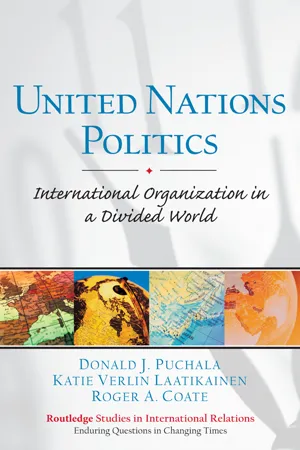
United Nations Politics
International Organization in a Divided World
- 256 pages
- English
- ePUB (mobile friendly)
- Available on iOS & Android
eBook - ePub
United Nations Politics
International Organization in a Divided World
About this book
Information
CHAPTER 1
______
The United Nations at the Turn of the Twenty-First Century
The occasion of the fiftieth anniversary of the United Nations (UN) in 1995 was one of celebration and broad support for the world body that in the aftermath of the Cold War was asked to be ever more central in issues of peace and security. In this new post-Cold War world, the UN was also expected to be more active in fostering economic and social development worldwide, and it was to be newly energized in the goal of supporting universal human rights and democracy. Yet, ten years later, UN members found themselves struggling with the consequences of a war in Iraq that was entered into in direct defiance of the Security Council and arguably in contravention of the United Nations Charter. Among other things, the unilateral action by the United States in militarily invading and conquering Iraq set public opinion around the world to wondering what had happened to the authority of the UN. Is not preventing preventable wars the chief mission of the United Nations? As if to add injury to insult, in 2003 when the UN was finally invited into Iraq to assist with postwar humanitarian relief and reconstruction, its headquarters in Baghdad was attacked by terrorists whose massive car bomb caused more than a hundred casualties, including twenty-two deaths, among UN personnel. Emotional shocks, as well as political fallout, from this event were still impacting the UN Secretariat years afterward.
What is more, in this first decade after the UN’s fiftieth anniversary, the world organization’s commitment to human development was challenged by the failure to meet most of the targets outlined in the Millennium Declaration in 2000.1 Meanwhile, the Security Council, whose newly found solidarity appeared to be a welcomed consequence of the end of the Cold War, reverted to a divisive politics of narrow national interest. Elsewhere in the UN, rhetorical questions about the universality of human rights continued to be asked, and the potentials for cultural conflict remained undiminished. The UN’s abilities to protect human rights and provide humanitarian assistance were bound up in contentious debates over cultural relativism and humanitarian intervention. Suspicions exchanged between the Islamic world and the West intensified after 9/11, and these degenerated in some quarters into manifest hostility after the American attack on Iraq. Rather uncharacteristically, and for the UN most unfortunately, in 2004 the Secretariat itself became publicly suspect in the so-called oil-for-food scandal. Sizable private fortunes were apparently amassed by some high UN officials, as well as by some prominent national delegates, who profited handsomely by managing exchanges of food and medicine for Iraqi oil under the sanctions regime between 1996 and 2003. Already hemorrhaging credibility, one thing that United Nations clearly did not need in 2004 was a fraud, bribery, nepotism, and embezzlement scandal.
THE UNITED NATIONS IN A NEW AGE OF INSECURITY
In many ways, the UN was as unprepared for the first decade of the new century as it was for the last decade of the old one. The institution was designed to provide collective security by protecting states from one another. Ironically, a fair number of states, as reflected in the positions of governments, are seeking today to be protected from the UN, or at least from members of the Security Council bent upon “humanitarian intervention,” which some read rather cynically as “Western intervention.” Otherwise, the end of the Cold War did not eliminate the scores of festering inter-state disputes about borders and resources or struggles over all manner of symbols, icons, institutions, and atavisms about which states and peoples choose to be indignant and intolerant. Although the end of the Cold War eliminated the imminent danger of nuclear war between the superpowers, it may also have increased the longer-run danger of nuclear war between lesser powers. It now appears that many long-standing political-military rivalries are rapidly transforming, via nuclear proliferation, into nuclear rivalries, as, for example between India and Pakistan, India and China, and potentially also between North Korea and Japan and Israel and Iran. The terrorist attacks on New York and Washington on September 11, 2001 crystallized further challenges facing the UN in a new and turbulent world. Before the world had moved much more than a year into the new century, it became apparent that protecting people from transnational terrorists is to be as significant a threat to physical security as protecting states from one another. Despite the glitter and glow of globalization, some apparent progress in democratization, and the gradual uplifting of humanity that some see occurring, what may have actually dawned with the turn of the twenty-first century is a new Age of Increasing Insecurity.
If “chronic” appropriately describes evolving conditions of national insecurity in international relations today, the only way to describe conditions of human insecurity is to label them “acute.” Physical threats of considerable magnitude presently confront countless people living in various failed states, where conditions of civil anarchy are engulfing and destroying millions of lives. Others are falling prey to ethnic cleansing or falling victim to perpetrators of genocide. Mass murder, with accompanying brutality, mutilation, torture, rape, and all other forms of atrocity tend to occur today with shocking frequency. These horrors are most often deliberately planned and perpetrated as political acts inflicted upon people either by their own governments, by factions opposed to governments, or by brigands operating where there are no longer effective governments.2
Elsewhere, in places where violations of human rights do not attain to mass murder, they nevertheless relentlessly and extensively deprive people of freedom, voice, employment and income, family, solace and safety. Political prisoners, forced laborers, and asylum seekers today number in the hundreds of thousands. Smashed printing presses, jailed or murdered editors and closed radio and television stations, silenced writers and artists, banned political parties and persecuted leaders likewise number in the thousands. Slavery is not an archaic institution; slave trading today is a profitable business, particularly as regards trafficking in women and children.3 Armed children, some younger than ten years old, forcibly inducted into guerrilla armies, are today killing men, women, and other children in western and central Africa, in southeast Asia, and elsewhere in the Third World.4 Peoples in many places are denied an identity because practicing their cultures, speaking their languages, worshipping their gods, and publicly recalling their histories are politically forbidden. There are over seven million refugees in the world today, the majority of them forced from their homes by fear for their lives.5
Poverty remains the greatest contributor to human insecurity today. Wretchedness is present even in the midst of the material abundance of the northern societies. It is pervasive in much of Africa, in South Asia, in much of the Caribbean and Central America, in parts of South America, in China, in Central Asia, parts of the Balkans, and in Russia. What poverty means for human insecurity is limited choice, limited control over one’s life, poor health, limited information, exposure to exploitation, almost no meaningful leisure, high anxiety, and little expectation of change.6 Despite some amelioration in a few places like China and India, poverty appears to be increasing rather than decreasing as an aspect of the human condition in the twenty-first century.7 In 2005 the 2.8 billion people living on less than $2 a day constituted 44 percent of humanity.
Of all of this, the heightening physical insecurity, the relentless persecution of minorities, the quashing of freedom, the mass murder and the wretchedness, the members of the United Nations are well aware. It cannot be otherwise. Throughout its existence the UN has been monitoring and reporting on the human condition, and in recent years the organization has produced thousands of reports, amounting to millions of words describing the state of world. But describing the world is one thing while acting to change it for the better is something quite different. According almost all analyses, from perspectives of the North, the South, the West, and the Non-West and both within the UN House (as the Secretariat is called) and without, UN responses to the insecure world that it faithfully monitors have been less than satisfactory.
This is not because the organization has been allotted limited capacity. The United Nations Charter remains a remarkable document, wherein its signatories have agreed to allow their organization to function toward establishing peace and security, toward furthering social and economic development, toward promoting human rights, toward creating international law and adjudicating under it, and toward ushering peoples to political independence. The Charter establishes means and mechanisms for making collective decisions. It also gives the UN the authority to establish all manner of subsidiary organizations that might be deemed necessary to fulfill its missions. Under the Charter, the UN can provide global governance; it can make international public policy and it can act. Most notably, this historic treaty even grants supranational prerogative to the Security Council because the principle of non-intervention enshrined in Article 2, Paragraph 7 is qualified in that same paragraph with the affirmation that “this principle shall not prejudice the application of enforcement measures under Chapter VII.” In effect, the Security Council is empowered to decide when it will act under Chapter VII, and when it acts under Chapter VII it can pretty much do what it wants.
Nor in attempting to explain the shortcomings of the United Nations can we realistically fall back on the old saws of incompetence and bureaucratic inertia. Our interactions with both the Secretariat staff and the national delegations over a period of several years revealed that in terms of intellectual and administrative talent the UN compares very favorably with other public bureaucracies and indeed with many private-sector bureaucracies as well. Top-echelon personnel in the Secretariat, for example, consistently work up to very high standards of performance, even under constantly stressful conditions brought on by insufficient resources, unreasonable demands, and the urgent and chaotic outside world. At lower levels the ratio of dedicated international civil servants to underachievers not only very much favors the former but also challenges the myth of incompetence at the UN. As for the diplomatic corps that populates the UN “worlds” of New York, Geneva, Vienna and elsewhere, they are for the most part well trained, remarkably knowledgeable regarding the multitude of issues before them, and savvy regarding the opportunities and constraints that accompany multilateralism. They reliably represent their governments. Most member states continue to post their best people to UN missions because for many the UN is a convenient center for both multilateral and bilateral diplomacy. Although it is probably still true that “a diplomat’s life is made up of… protocol, Geritoi and alcohol,” at the United Nations, it tends to be an extremely busy life that is at the same time very frustrating because of the tedious and too often inconsequential nature of UN diplomacy.8 We have come to understand that one of the reasons that diplomats at the UN are so often frustrated is actually because they are so talented and might in other settings accomplish more for their countries.
Ultimately, in seeking to explain the poor performance of the United Nations, one must reach the conclusion that the organization cannot be a vehicle for international cooperation, and hence a motor for collective action toward ameliorating the ills of the human condition, as long as it remains a crucible of world political conflict. Too many scholarly analyses of the United Nations miss the mark of veracity by assuming that international cooperation is mainly what takes place at the UN. What the United Nations excels at producing, and reproducing, is politics. This volume assesses the political challenges facing the United Nations and evaluates the capacities of the organization to face them. Despite the evolution of complex processes of global governance, including the increased importance of nonstate actors and international bureaucracies, many of the challenges to multilateralism today stem from the tension between these broader developments and the political proclivities of national governments to defend sovereign prerogatives and to competitively promote national and factional interests.
Pondering the UN system evokes competing visions of the perceived and desired roles of international institutions in contemporary world affairs. Some observers, for example, view UN multilateralism as a stepping-stone toward creating more effective, authoritative regimes of global governance, whilst others view the UN as a forum for the pursuit of national interest. Still others view the system of international agencies as a mechanism for promoting a particular hegemonic order that preserves a status quo favoring the powerful and the rich. These differing conceptions have shaped the interpretation of politics within the UN. Analysis in United Nations Politics acknowledges these different explanations of strategies adopted by member states and other participants in international policy making. Our conclusions, however, emphasize the extent to which multilateral politics within the UN continue to reflect world politics outside the UN. In our view, the UN system does not transcend world politics but rather functions as a distinctive prism through which these broader dynamics are reflected in particular patterns.
TAKING POLITICS SERIOUSLY
In United Nations Politics we purposely avoid entering into any of the theoretical debates swirling about in our discipline of international relations. Yet this should not be taken to mean that we are unfamiliar with our colleagues’ work or that we find theoretical questions uninteresting. What we offer is a text informed by social science theory but not about it. Our own theoretical standpoint, if it warrants being labeled as such, is Lasswellian: politics is about “who gets what, when, how,” and this certainly includes intergovernmental politics at the UN.9 Regarding approaches to the study of international relations, we observe that the essential dynamics of contemporary UN politics cannot be adequately understood from the perspective of American social science paradigms and theoretical orientations such as idealism, liberalism, institutionalism, or functionalism that are conventionally used to frame examinations of the world organization. In the contemporary discourses of our discipline, all of these frameworks either positively or critically focus analytical attention on phenomena of global governance, which have to do with managing anarchy or interdependence by making and enforcing rules that constrain governments’ international behavior.10 “Global governance” in meek, mild, and faltering forms does happen as a result of deliberative and bureaucratic processes at the UN. But the UN is not mainly about global governance, or, put differently, global governance is not mainly what happens within the political confines of the UN or as a result of UN deliberations. Making the study of the United Nations into a search for global governance therefore misses the point. The organization is mainly a club of governments, and their principal mode of interaction is conflict emanating from differing interests. This intergovernmental conflict does not produce global governance, at least not very much of it, although it does yield a somewhat distorted mirror image of the politically fragmented world of the early twenty-first century.
There appears as well in the literature on international organizations the curious notion that the United Nations is an autonomous actor in world affairs that can and does take action independent of the will and wishes of the member governments that constitute the organization. Champions of the organization therefore speak of the UN doing much good in world affairs, sympathetic critics frequently ask why “the UN does not do more,” and unsympathetic critics blame the UN for perpetrating messes and causing disasters. But the United Nations is not an autonomous agent, and the last thing that most of its member states would want is that the organization per se should become more autonomous. Realistically speaking, what the UN does or does not do in global affairs results mainly from the preferences of its members or more precisely from the interplay of intergovernmental politics among them. In this way, what the UN does—or more frequently does not do—cannot be separated from the proclivities of its members. Yet intergovernmental politics at the UN are seldom highlighted in analyses of global governance and also rarely integrated into criticisms of the organization by its skeptics. This volume therefore focuses primarily on politics within the UN and highlights the perceptions and behavior of national governments in responding via international organization to a turbulent wo...
Table of contents
- Cover
- Half Title
- Title Page
- Copyright Page
- Table of Contents
- Preface
- Chapter 1 The United Nations at the Turn of the Twenty-First Century
- Chapter 2 The Evolution of an Institutional Form
- Chapter 3 The UN Charter and Beyond
- Chapter 4 The United Nations: The Last Bastion of Sovereignty?
- Chapter 5 In Search of Leadership
- Chapter 6 The Politics of Culture
- Chapter 7 Peacekeeping: Paper, Preparation, and Politics
- Chapter 8 Development and Its Discontents
- Chapter 9 Reconsidering the United Nations
- Appendix A The United Nations System
- Appendix B Charter of the United Nations
- Bibliography
- Index
Trusted by 375,005 students
Access to over 1.5 million titles for a fair monthly price.
Study more efficiently using our study tools.
Frequently asked questions
Yes, you can cancel anytime from the Subscription tab in your account settings on the Perlego website. Your subscription will stay active until the end of your current billing period. Learn how to cancel your subscription
No, books cannot be downloaded as external files, such as PDFs, for use outside of Perlego. However, you can download books within the Perlego app for offline reading on mobile or tablet. Learn how to download books offline
Perlego offers two plans: Essential and Complete
- Essential is ideal for learners and professionals who enjoy exploring a wide range of subjects. Access the Essential Library with 800,000+ trusted titles and best-sellers across business, personal growth, and the humanities. Includes unlimited reading time and Standard Read Aloud voice.
- Complete: Perfect for advanced learners and researchers needing full, unrestricted access. Unlock 1.5M+ books across hundreds of subjects, including academic and specialized titles. The Complete Plan also includes advanced features like Premium Read Aloud and Research Assistant.
We are an online textbook subscription service, where you can get access to an entire online library for less than the price of a single book per month. With over 1.5 million books across 990+ topics, we’ve got you covered! Learn about our mission
Look out for the read-aloud symbol on your next book to see if you can listen to it. The read-aloud tool reads text aloud for you, highlighting the text as it is being read. You can pause it, speed it up and slow it down. Learn more about Read Aloud
Yes! You can use the Perlego app on both iOS and Android devices to read anytime, anywhere — even offline. Perfect for commutes or when you’re on the go.
Please note we cannot support devices running on iOS 13 and Android 7 or earlier. Learn more about using the app
Please note we cannot support devices running on iOS 13 and Android 7 or earlier. Learn more about using the app
Yes, you can access United Nations Politics by Donald Puchala,Katie Verlin Laatikainen,Roger Coate,Katie Laatikainen in PDF and/or ePUB format, as well as other popular books in Politics & International Relations & Civil Rights in Politics. We have over 1.5 million books available in our catalogue for you to explore.