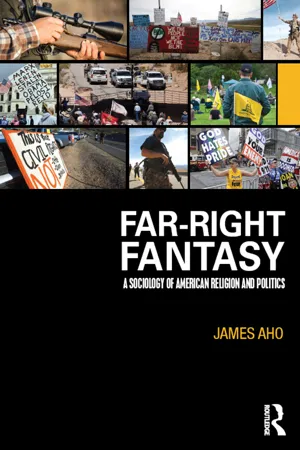
Far-Right Fantasy is a straight-forward, jargon-free study of contemporary American right-wing extremism. Accessible to both professional and lay audiences, it allows activists to speak for themselves in their own words. It takes the self-announced religious motivations of extremists seriously, and illustrates this by citing numerous cases of radical politics. The book addresses the strengths and weaknesses of the standard psycho-social-cultural explanations of far-right activism. It shows how extremists are similar educationally and psychologically to their more conventional neighbors; that they get into the movement in the same way that others become peace activists or radical environmentalists, namely, through their ties with fellow workers and church-goers, family members, and classmates; and that their views are given a patina of certainty by being repeatedly corroborated within closed, non-contaminated communication systems. The book avoids being preachy or judgmental, but it does try to challenge readers morally by submitting far-right fantasy to a formal ideology critique. It does this by showing how the reforms it recommends – a marketplace free of regulation, draconian immigration restrictions; an end to the federal reserve bank and the income tax; a balanced budget amendment to the Constitution; anti-union "right to work" laws and a return to debt slavery; the privatization of schools, the post office, and the commons, and so on – contradict its ostensible goal, which is to protect and enhance middle class interests. Far-Right Fantasy is suitable for adoption as a supplemental text in political psychology and sociology, sociologies of religion and knowledge, collective behavior, and American political history.
- 168 pages
- English
- ePUB (mobile friendly)
- Available on iOS & Android
eBook - ePub
About this book
Information
Interlude 1
Sovereign Citizens
Following a four-month undercover investigation by the Las Vegas Metro Police, David Brutsche, 42, and Devon Newland (female), 67, were arrested in 2013 for plotting to torture, try, and then execute police officers found guilty of “treason” by a private citizens’ court. Reportedly, the couple had rented a vacant house for use as a jail, rigged its crossbeams with ropes to bind the “defendants,” and prepared a way to “arrest” them as they conducted routine traffic stops.
Brutsche is a convicted child predator and considers himself a “Sovereign Citizen,” so named after the title of a leaderless radical movement that has been involved in several murders in the last few years (see Appendix, Feb. 18 and May 20, 2010, Jan. 26 and 30 and Aug. 16, 2012, June 6 and 8, 2014), including the bombing of the Murrah Federal Building in Oklahoma City. According to its on-line pronouncements, Sovereign Citizens believe that one can be either a “true American” or a “slave” of a corporation known as the United States, not both. The U.S. Corporation is said to have been established according to the strictures of British admiralty law, which itself presumably was written to facilitate colonialism, the plantation system, and the enslavement of both white Irish people and black Africans. The website says that at birth each child is given a corporate account that assigns him or her to a specific corporate bond holder and allots to the child a grant of money that can be accessed by filing appropriate papers. As reputed “Americans,” Sovereign Citizens refuse to pay taxes, purchase license plates, or buy driver’s licenses. (Timothy McVeigh initially was arrested for driving a car that had no plates.) They print their own currency and the legalistic papers they believe are sufficient to access their corporate accounts. Because they do not acknowledge the legitimacy of any law enforcement official but the “shire-reve”(sheriff), a pre-twelfth-century English rural magistrate that predates the existence of the modern police, urban police forces such as Las Vegas Metro are, by definition, seen as criminal enterprises.
1 The American Far-Right in Perspective
More than a half century ago, sociologist Seymour Martin Lipset (1960) postulated that each stratum of modern society—upper, middle, and lower—has a characteristic brand of demagogic extremism and an audience for it. “Working-class authoritarianism,” for example, finds its core of support among the lower stratum of manual blue-collar laborers and peasants. Conservative authoritarianism, on the other hand, attracts the upper stratum of nontitled gentry, landed aristocrats, ordained clerics, and the general staff of the military. As for the middle stratum of small merchants and farmers, craftspeople, low-level clerks, and professionals, they gravitate toward what Lipset calls “classical fascism,” an objectionable label that I will avoid in these pages (for a scathing critique of the rhetorical abuses of “fascism,” see Gregor, 2006).
Lipset characterizes the authoritarianism of the middle ranks this way: It is hostile to both the lower and upper classes, although it can temporarily ally with either. It glorifies the “exceptionalism” of the middle ranks, whose values and interests it conflates with those of the nation. It calls for moral renewal, meaning the bourgeois ethos of small merchants that valorizes industriousness over idleness and luck, promotes deferred gratification, and advocates frugality. It is xenophobic, except when foreigners can be economically exploited, and jingoistic when not inward turning and isolationist. Most important, it utilizes “nondemocratic” means to achieve its ends. Updated to take into consideration recent American developments, without being exhaustive, these include:
• Denying or suppressing the civil rights of poor minority citizens, including their access to public accommodations and/or to certain occupations. Denying them the right to marry and/or adopt children; to express themselves and/or worship as they see fit; to bodily privacy; and/or the rights that would otherwise be granted them as criminal suspects (trial before a jury of their peers, competent counsel, protection from illegal search and seizure, immunity from torture or cruel and unusual punishment, and immunity from double jeopardy, etc.);
• Infringing on or denying the political rights of poor minority citizens, including the right to vote and/or to hold office or to peacefully petition civil authorities; this by geographically limiting their access to polls, setting up onerous voting requirements, or outlawing same-day registration or Sunday voting;
• Denying the social rights of poor minority citizens, including their right to a reasonable public education, food surpluses, adequate shelter, and/or competent health care;
• State nullification of what are considered unconstitutional federal laws and mandates, such as those concerning racial desegregation, mandatory federal health insurance, and/or federal gun registration;
• Advocacy of secession from the United States;
• Politically motivated welfare fraud, robbery, counterfeiting, tax evasion, and/or the issuance of fraudulent liens;
• Criminalization of efforts by state and/or local officials to enforce considered-unconstitutional federal laws; the use of nonauthorized private “citizens’ courts” to try such officials; and/or the execution of their judgments by means of private citizens’ militias or posses;
• Establishment of private paramilitary encampments, engagement in combat training exercises, and/or the display of weapons in public for purposes of political intimidation;
• Vigilante monitoring of border crossings and/or the private lives of citizens; and
• Armed insurrection through nonfatal assaults on citizens, targeted assassination, and/or indiscriminate murder (for examples, see Appendix).
Lipset observes that whatever such “classical fascists” as Franco, Hitler, Tojo, Mussolini, Perón, Pinochet, or Poujade (an anti-Jewish French tax resister and advocate of the “Common Man”) have in common, the flavor of a country’s middle-class extremism always reflects its history and culture. Thus, insofar as the American far-right emerges from a middle stratum imbued with a fundamentalist Protestant outlook and with a mythos of constitutional republicanism, its authoritarianism marches under the Cross and Flag. That is, it exhibits a puritanical obsession with (female) body functions, dirty pictures, homosexuality, and erotic books, dance, and music. It is unfriendly toward non-Christians and nonfundamentalist Protestant Christianities, which it rebukes as “cults.” It is suspicious of “nonproductive” mental activities such as science for itself, the fine arts, and poetry. Its republican antipathy toward royalty takes the form of distrust of “big government.” And its antagonism toward the working class finds an outlet in hostility toward labor unions, which it equates with socialism or Communism.
A telling case of American-style ultra-right politics is the anti-intellectual, antipapist, anti–eastern European immigrant American Protective Association of the 1890s, whose rolls are said to have included 2.5 million members from 1893 to 1894. This was an era during which Jim Crow laws were introduced in the Confederate South and the Supreme Court (in Plessey v. Ferguson) ruled that racial segregation and the denial of voting rights to blacks were constitutional.
Another example is Louisiana “dictator” Huey Long who, in the 1930s, campaigned against the Bourbon gentry on behalf of the “Little Man.” Still another is (Catholic) Father Charles Coughlin’s National Union for Social Justice, the first right-wing movement in America to market itself through radio broadcasts, the audience for which was over 1 million by the late 1930s. Sinclair Lewis uses Coughlin as the model for Bishop Prang in his antifascist dystopia, It Can’t Happen Here (1935). In Philip Roth’s The Plot against America, based on the author’s childhood traumas, Coughlin is portrayed as a particularly villainous figure. While at one time he supported Franklin Roosevelt’s New Deal, Coughlin eventually turned against it (and him), claiming it favored New York banks over Main Street merchants. Wall Street, he said, was one of the “twin faces of Satan,” the other being Bolshevism. Both, he contended, were Jewish plots.
Other, more recent, instances of right-wing extremism include Rev. Carl McIntire’s Christian Anti-Communist Crusade of the late 1950s and Rev. Gerald L. K. Smith’s Cross and Flag. Smith’s one-time bodyguard, ex-Methodist minister and Ku Klux Klan chaplain Rev. Wesley Swift, founded the Church of Jesus Christ Christian (Aryan Nations) mentioned in the Introduction. A fourth instance is Rev. Gerald Winrod, the so-called “Jayhawk (Kansas) Nazi,” who flourished in the Midwest in the 1930s and 1940s. The latest expression of comparable sentiments can be found in Christian Dominionism, an outgrowth of an even more radical movement known as Christian Reconstruction, both of which are discussed at length in Chapter 6.
Lipset points out that the American middle class has experienced many outbursts of ultra-right insurgency but, for the most part, its politics lean liberal. That is, it favors the extension of the voting franchise and civil rights to once-excluded minorities, supports universal access to education, parks, utilities, and medical care, and champions measures that encourage open competition and a culture of achievement over inheritance and titles. During times of economic distress and/or status insecurity, however, its politics can turn mean-spirited, reactionary, and “to some degree irrational” (Lipset, 1960: 136). This is the thesis of his encyclopedic social history of American extremism, co-authored with Earl Raab, The Politics of Unreason (1970). In it Lipset argues that all major American right-wing movements, beginning with the anti-Illuminatists of the early 1800s, have been composed of people who feel disempowered and displaced by industrialization, immigration, urbanization, and government bureaucratization. Besides the groups cited earlier, Lipset and Raab mention the Anti-Masonic Party (of the 1830s), the Southern secessionist movement (of the 1850s and 1860s), the “new” Ku Klux Klan, which came into control of municipal and state governments from Indiana to Oregon during the 1920s; McCarthyism and the John Birch Society of the 1950s and 1960s, George Wallace’s American Independent Party in 1968, and (in Lipset & Raab, 1981) the New Christian Right of the 1980s, whose most rabid cadres were members of the Christian Coalition and the Moral Majority. (For a critique of Lipset and Raab’s account of the New Christian Right, see Simpson, 1983.) There is evidence that one-time Klan leader David Duke’s nearly successful campaign for Louisiana governor in 1991 also drew its most energetic support from the “dispossessed” middle class (Zeskind, 2009: 271–7).
To label these and related movements “fascistic” is, as I said earlier, unfortunate for a number of reasons, not the least of which is that the word was not even coined until the 1920s and then by Futurist Italians, whose probable nearest American cousins—absent Italian fascism’s glorification of battle-torn flesh and the mystical communion of race and nation (very big absences indeed)—were the proponents of technocracy. Technocrats have little in common with the science-wary, backward-looking, profamily fundamentalist Protestants and Constitution fetishists who historically fill the ranks of American rightist insurgencies.
For all this, however, Lipset and Raab’s historically grounded, measured tone is leagues ahead of what passes today as intelligent political commentary. “Femi-Nazi,” “lesbo-fascist,” and “food-Nazi” (as used by radio entertainer Rush Limbaugh to describe feminist “sluts” and officials at the Center for Disease Control, respectively) are routinely bandied about, often interchangeably, with “socialist,” “liberal,” “Fabian,” and “Progressive,” sometimes in the same sentence. Indeed, if we can believe recent punditry, left- and right-wing alike, we are awash in fascists. There are “eco-fascists” (Murray Bookchin’s term), “Islamofascists” (a favorite phrase of the late Christopher Hitchens, and critically slammed by Sheehi [2011]), “body fascists” (Pronger, 2002), “technofascism” (a reference to mechanized music), “the merry band of [atheist] fascists” (Bill O’Reilly), and “homo-fascists” (Glenn Beck’s term for gays and lesbians who are conspiring to “force” Americans to grant them “special rights”). And this is to name just a few. According to Jonah Goldberg (2007), there are even counterintuitive “liberal fascists.” In sum, what George Orwell once observed is true: “The word ‘fascism’ … is almost entirely meaningless, except in so far as it signifies ‘something not desirable’” (Orwell, 1944).
Take liberal fascism. Goldberg announces that, contrary to what readers might think, fascism is not a right-wing phenomenon at all. “Instead, it is, and always has been, a phenomenon of the left” (J. Goldberg, 2007: 7). Adolf Hitler, head of the National Socialist German Workers Party, for example, was a devoted “man of the left.” So too, Goldberg insists, were the “Progressive fascists,” Woodrow Wilson and Franklin Roosevelt. In fact, to Goldberg (2007: 8), American Progressivism was not just a relative of fascism; it was “in some respects the major source of the fascist ideas applied … by Mussolini and Hitler.” He alleges that Progressivism, in turn, was in thrall to history’s “first fascist movement, the French Revolution” (2007: 12). A more sober assessment of Roosevelt is that he was an easygoing, conservatively inclined, but otherwise ideologically blind pragmatist who borrowed his ideas ad hoc from virtually every conceivable source. “There was no master plan, no guiding philosophy, for the reforms that Roosevelt oversaw,” according to David M. Kennedy in his Pulitzer Prize–winning biography, Freedom from Fear (quoted by Menand, 2013: 72).
Jonah Goldberg (2007) goes on to argue that in the present moment, Hillary Clinton is the most cunning and dangerous agent of the fascist conspiracy. (His book was composed before her presidential ambitions were crushed in 2008 by Barack Obama, whom Goldberg would view as an even more sinister character.) Included in Goldberg’s itemization of so-called “crypto-fascist” sentiments are medical homeopathy, the animal rights movement, New Age spiritualism, vegetarianism, advocacy of artificial contraception, antismoking campaigns, the Civilian Conservation Corps (the harmless Boy Scout–like work project that built trails and shelters in national forests during the 1930s), and John F. Kennedy’s Peace Corps. By all appearances, in Goldberg’s imagination, “fascism” is his verbal substitute for the cultural orientation of modernity, with its embracement of difference, its scientific skepticism, and its toleration of moral ambiguity.
The Audience for American Right-Wing Extremism
Whatever we call it, and whatever its source, the American appetite for far-right ideology has always been small, and that remains true today. A 2013 survey finds that membership in its latest, most vocal iteration, the tea party, adds up to only a fraction of the American public: to be exact, 0.14 percent (or 14 for every 10,000 citizens) (Burghart, 2014). The count of tea party sympathizers is a bit larger than this. As indicated by “favorable” responses to polling queries about the tea party, this number fluctuates somewhere between 20 and 40 percent of the public, depending on the crisis of the moment. The percentage of active supporters, as operationalized by Facebook “likes,” however, totals but 2 percent. As has been the case for far-right activism since at least the 1980s (cf. Aho, 1994: 153), about two-thirds of tea party members are men, with the largest per capita representation coming from the sparsely populated, rural states of Alaska (no. 1), Montana (2), Wyoming (3), Idaho (4), and Utah (5).
The results of more comprehensive surveys comport with this. One poll conducted by the Pew Center on the religious landscape of the United States (Pew Forum, 2008) found that no more than one-quarter of Americans are affiliated with an evangelical Protestant church (either liberal or reactionary).1 George Barna (2008) argues that far fewer than half of these, perhaps 10 percent of all Americans, can rightly be considered political activists. These 10 percent are the subject of this book.
As tiny as the tea party or any other right-wing insurgency is or has been, it is a grave mistake to dismiss any of them as artificial fabrications of business elites or media executives (as claimed, for example, by Eric Zuesse, 2013). As we will see presently, right-wing movements burst from the grass roots as expressions of popular discontents and grow through face-to-face contact between ordinary people at the workplace, church, and school. Only after they have taken root are they set upon by profiteers, proselytizers, politicians, and pundits to enhance their own interests.
Cycles of Far-Right Enthusiasm
Many commentators are willing to concede that in the past the American far-right was able to mobilize only a small following, but today, they claim, the situation is different (cf. Wolf, 2007a). After all, Lipset, Raab, Hofstadter, and others such as Louis Hartz (1955) were writing during an era of buoyant postwar optimism, when prosperity was relatively widely shared and there was unanimity of national vision. But that reality no longer exists. America’s erstwhile enemy, the Soviet Union, has faded into obscurity and been superseded by a succession of cartoon bogeymen such as “Panamanian Strongman Manuel Noriega,” the “Communist outpost” of Grenada, the blustering Iranian traffic engineer, Mahmoud Ahmadenijad, and the pudgy North Korean despot, Kim Jong Un. Most important, to an extent not witnessed for over a century, America’s surplus wealth has been expropriated by bankers and corporate CEOs, leaving the American middle stratum comparatively impoverished, its opportunities for upward mobility shattered, and its political prospects hollowed out. (For riveting documentation of this fact, see Packer, 2013, and Dyer, 1997.) Which is to say, any capacity American institutions once may have had to moderate the frothing rages of authoritarian demagogy from the right (or the left) has collapsed—some fear, forever. In other words, so the argument goes, ours is an unprecedented age, not one of temperance and magnanimity but of misery, bitterness, and despair, and a style of political thinking has arisen to mirror it: far-right fantasy. The 1995 Oklahoma bombing, warns Joel Dyer, was “only the beginning of [what he predicts will be] an unprecedented wave of terror” (Dyer, 1997: 2).
Before jumping to conclusions, however, let us pause for a moment to reconsider past periods of ultra-right insurgency, when equally dire warnings were aired, and a pattern becomes evident: While far-right fantasies are always afloat in the cultural atmosphere, and have been since the beginning (Stock, 1996), they seem to seize the public imagination only every third decade or so, as phases of a larger cycle of Democratic-revisionist vs. Republican-traditionalist ascendancies (Schlesinger Jr., 1986).
Take the anti-Illuminatist fervor of the early 1800s. After it barely left behind a footprint of its short existence, the Anti-Masonic movement ...
Table of contents
- Cover
- Half Title
- Title Page
- Copyright Page
- Dedication
- Table of Contents
- Acknowledgments
- Prologue: The Battle of “Bunker Ville”
- Introduction
- Interlude 1: Sovereign Citizens
- Interlude 2: The Secessionist State of Jefferson
- Interlude 3: Dreams of a Right-Wing Homeland
- Interlude 4: “Cut It or Shut It!”
- Interlude 5: The Rhetoric of “No-Spin” News
- Interlude 6: Nullification
- Interlude 7: “Justus” Served
- Interlude 8: Biblically Inspired Investing
- Epilogue: A Latter-Day Fortress
- Appendix: American Right-Wing-Implicated Fatalities from 1980 to 2015
- References
- Index
Trusted by 375,005 students
Access to over 1.5 million titles for a fair monthly price.
Study more efficiently using our study tools.
Frequently asked questions
Yes, you can cancel anytime from the Subscription tab in your account settings on the Perlego website. Your subscription will stay active until the end of your current billing period. Learn how to cancel your subscription
No, books cannot be downloaded as external files, such as PDFs, for use outside of Perlego. However, you can download books within the Perlego app for offline reading on mobile or tablet. Learn how to download books offline
Perlego offers two plans: Essential and Complete
- Essential is ideal for learners and professionals who enjoy exploring a wide range of subjects. Access the Essential Library with 800,000+ trusted titles and best-sellers across business, personal growth, and the humanities. Includes unlimited reading time and Standard Read Aloud voice.
- Complete: Perfect for advanced learners and researchers needing full, unrestricted access. Unlock 1.5M+ books across hundreds of subjects, including academic and specialized titles. The Complete Plan also includes advanced features like Premium Read Aloud and Research Assistant.
We are an online textbook subscription service, where you can get access to an entire online library for less than the price of a single book per month. With over 1.5 million books across 990+ topics, we’ve got you covered! Learn about our mission
Look out for the read-aloud symbol on your next book to see if you can listen to it. The read-aloud tool reads text aloud for you, highlighting the text as it is being read. You can pause it, speed it up and slow it down. Learn more about Read Aloud
Yes! You can use the Perlego app on both iOS and Android devices to read anytime, anywhere — even offline. Perfect for commutes or when you’re on the go.
Please note we cannot support devices running on iOS 13 and Android 7 or earlier. Learn more about using the app
Please note we cannot support devices running on iOS 13 and Android 7 or earlier. Learn more about using the app
Yes, you can access Far-Right Fantasy by James Aho in PDF and/or ePUB format, as well as other popular books in Social Sciences & Fascism & Totalitarianism. We have over 1.5 million books available in our catalogue for you to explore.