eBook - ePub
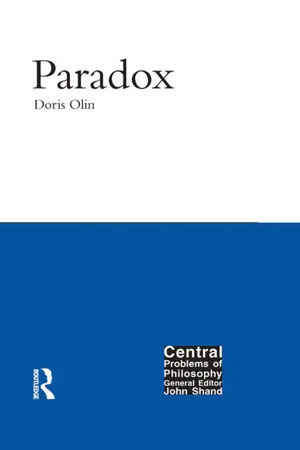
Paradox
About this book
Paradoxes are more than just intellectual puzzles - they raise substantive philosophical issues and offer the promise of increased philosophical knowledge. In this introduction to paradox and paradoxes, Doris Olin shows how seductive paradoxes can be, why they confuse and confound, and why they continue to fascinate. Olin examines the nature of paradox, outlining a rigorous definition and providing a clear and incisive statement of what does and does not count as a resolution of a paradox. The view that a statement can be both true and false, that contradictions can be true, is seen to provide a challenge to the account of paradox resolution, and is explored. With this framework in place, the book then turns to an in-depth treatment of the Prediction Paradox, versions of the Preface/Fallibility Paradox, the Lottery Paradox, Newcomb's Problem, the Prisoner's Dilemma and the Sorites Paradox. Each of these paradoxes is shown to have considerable philosophical punch. Olin unpacks the central arguments in a clear and systematic fashion, offers original analyses and solutions, and exposes further unsettling implications for some of our most deep-seated principles and convictions.
Information
| 1 | The nature of paradox |
Paradoxes can be fun. They can also be instructive, for the unravelling of a paradox may lead to increased philosophical knowledge and understanding. The paradoxes studied in this work offer promise of both these features. But paradoxes may be also disturbing; their study may reveal inadequacies, confusion or incoherence in some of our most deeply entrenched principles and beliefs. The reader is forewarned: some of the material that follows may prove unsettling.
It seems wise to begin at the beginning, with the questions “What is a paradox?” and “How does one resolve a paradox?” But first we need some examples of paradoxes at our disposal.
The Monty Hall paradox
You are invited to be a contestant on a fabulous game show. The host of the show, Monty Hall, explains how the game works. After some initial banter and scintillating chat, you will be presented with three doors, A, B and C. Behind one of the doors will be the car of your dreams – a Porsche, a Jaguar, whatever you wish. Behind each of the other two doors is a worthless goat. Which door conceals the car is decided randomly. You will first be asked to pick a door; then Monty, who knows what is behind each door, will pick, from one of the other two doors, a door that has a goat behind it, open that door, and show you the goat.
At that point, you will be offered a second option. You may stay with your original choice, and keep whatever is behind that door. Or, you may switch to another door, and keep whatever lies behind it.
Naturally, you are delighted to accept the invitation. With a week to go before the show, you feel there is nothing to deliberate about other than what you will wear. It seems clear that it is all a matter of luck. The first choice is entirely arbitrary. It is equally likely that the car is behind any one of the three doors; the probability that the car is behind any given door is 1/3. Similarly, the second choice is a matter of whim; there is no reason to prefer either switching to another door or staying with your original choice. Suppose, for example, you first pick door A, and Monty then shows you the goat behind door C. That means the car is either behind door A or behind door B. But it is equally likely that it is behind either door; there is no reason to prefer one to the other. So the probability that the car is behind either door is now 1/2, and there is nothing to gain either by switching or by not switching.
It’s all a matter of common sense, you tell yourself. How could being shown that one of the doors I did not choose has a goat behind it give me any reason to prefer one of the two remaining doors?
The night before your television appearance, a mathematician friend appears at your door, seemingly agitated. “Do whatever you want on the first choice”, he says. “But on the second choice, you must switch! It’s just become clear to me”, he continues. “Look at it this way. Suppose you pick door A on the first round, and that Monty then shows you that door C has a goat behind it. Monty had to choose between doors B and C, and he wanted to pick a door that concealed a goat. He might have been in a position where he could pick either door (both were ‘goat doors’); or he might have had to pick door C. Initially, the probability that the car was behind either door B or door C was 2/3. So the probability that his choice was forced was 2/3. But his choice was forced only if the car is behind door B. So if you switch to door B, your chance of winning is 2/3. You can’t do better than that!”
Panicked, you start to protest, but he interrupts. “Let me put it another way. Suppose you get to play the game many times and you are going to pick a strategy. If you consistently pick a door (say door A) and stay with it, you will win 1/3 of the time (the ‘car door’ is determined randomly). But 2/3 of the time the car will be behind either door B or door C, in which case Monty will, in effect, show you which of the two it is not behind. So you will win 2/3 of the time if you follow the strategy of switching – twice as often as if your strategy were not switching.”
What should you do?
Other paradoxes
The barber paradox
Imagine a charming village, as yet untouched by the tourist trade, in which there is only one barber. He is extremely busy, for he cuts the hair of all and only those villagers who do not cut their own hair. But who, we may wonder, cuts the barber’s hair? Suppose he cuts his own hair. If he does, then, since he is a villager, he does not cut his own hair. Suppose, alternatively, that he does not cut his own hair. If he does not, then, since he is a villager, it follows that he does cut his own hair. So the barber in this village cuts his own hair if and only if he does not cut his own hair.
The Achilles and the tortoise paradox
The tortoise and Achilles are to have a race. Of course, the tortoise is much slower than Achilles; Achilles, at his best, can run ten times faster than the tortoise. To make the contest interesting, the tortoise is given a head start of 10 metres; the racetrack is 100 metres. Can Achilles overtake the tortoise? Consider. By the time Achilles reaches the tortoise’s starting point (point 1, which is 10 metres ahead of Achilles’ starting-point), the tortoise will have travelled another metre to reach point 2 (since Achilles runs ten times as fast as the tortoise). But once Achilles has reached point 2, the tortoise will have travelled another tenth of a metre to reach point 3. By the time Achilles has reached point 3, the tortoise will still be one hundredth of a metre further ahead at point 4. And so on. It seems that whenever Achilles has caught up to where the tortoise was, the tortoise is still some tiny distance ahead. Thus, Achilles cannot pass the tortoise and cannot win the race.
The ship of Theseus paradox
Theseus, an experienced sailor well aware of the hazards of the sea, has a ship that he decides needs complete renovation. The ship – call it “T” – consists of 1,000 old planks. When the renovation begins, Theseus’ ship is placed in dock A. The crew is ordered to work as follows. In the first hour of renovation, they are to remove one plank from T, replace it with a new one, and carry the old plank to dock B. In the second hour of renovation, they are to remove an adjoining plank, replace it with a new one, and carry the old plank to dock B, where it is appropriately fastened to the plank that has been removed in the previous hour. They are to remove a third plank in the third hour. And so on. After 1,000 hours, a ship has been assembled in dock A, call it “X”, that consists of 1,000 new planks; there is also a ship in dock B – call it “Y” – that consists of the 1,000 old planks removed from Theseus’ ship and then reassembled in exactly the same way they had been arranged prior to the renovation. Which ship is Theseus’ ship? Which ship is T?
If you methodically took apart the ship, and then reassembled it exactly as it was, surely you would say that it was the same ship.1 But that is exactly what has happened here. T was first taken apart, then reassembled and is now in dock B. So Y is T. Note that Y is made out of exactly the same materials, arranged in exactly the same fashion, as T was when Theseus brought it into port.
On the other hand, if you remove one plank from a ship and replace it with a new one, you still have the same ship. Such a slight change cannot affect the identity of the object. So after one hour, the ship in dock A is still T. But again, removing one plank from a ship and replacing it does not affect the identity of the ship. Thus, after two hours the ship in dock A is T. And so on. Finally, after 1,000 hours, the ship in dock A is T. Thus, X must be T.
The taxi-cab paradox
In the town of Greenville there are exactly 100 taxis, of which 85 are green and 15 are blue. A prominent citizen witnesses a hit-and-run accident that involves a taxi, and testifies that the taxi was blue. The witness is subjected to tests that determine that, in similar circumstances, he is 80 per cent reliable in his colour reports. Is it likely that the taxi in the accident was blue?
First, it seems clear that we are entitled to accept what the witness says as highly likely. He has proved 80 per cent reliable in similar circumstances, and there is no reason to think there is any relevant difference in this situation. Surely what he says can be considered highly probable, and should be regarded as such in a court of law.
On second thought, if we take the long view, it seems unlikely that the witness was correct in his colour identification. To see this, consider 100 randomly selected taxi accidents in Greenville. About 85 of these accidents will involve a green taxi and about 15 will involve a blue taxi. If the witness were to report on the 85 green taxi accidents, he would report correctly in about 80 per cent of the cases and incorrectly in 20 per cent. This means that of the 85 green taxi accidents, he would report about 17 as involving a blue taxi. The 15 blue taxi accidents would presumably also yield 80 per cent correct reports, or 12 reports of blue taxis involved in accidents. Were a witness of 80 per cent reliability to report on 100 randomly selected taxi accidents in Greenville, then, there would be about 29 (= 17 + 12) blue taxi reports, only 12 of which would be accurate; that is, only 41 per cent of the blue taxi reports would be correct. So it seems more likely than not that the witness in our original case was mistaken in his report of a blue taxi.
What is a paradox?
In order to appreciate why these scenarios seem baffling, confusing and yet absorbing, it is necessary to have a better understanding of the sort of problem they pose. Using these few paradoxes as background, let us consider the question: what is a paradox?
One striking feature of these problems is that they present a conflict of reasons. There is, in each, an apparently impeccable use of reason to show that a certain statement is true; and yet reason also seems to tell us that the very same statement is utterly absurd. Apparently letter-perfect operations of reason lead to a statement that reason is apparently compelled to reject.
Let us unpack what this means. It should first be noted that each paradox presented above contains an argument; this feature is central to the philosophical notion of paradox. The popular use of the term “paradox”, by contrast, is undoubtedly broader. A recent newspaper report, for instance, says that the rosier health picture for those with HIV-AIDS has “sparked a paradoxical response, a disturbing trend to unprotected sex among young gay men”.2 Here “paradoxical” seems to have the force of “irrational” or “unfitting”. Statements that seem absurd at first sight, but on closer examination are seen to be true, are also referred to as “paradoxical” in popular usage. In Gilbert and Sullivan’s The Pirates of Penzance, for instance, the following is taken to be paradoxical: Frederic is 21 years old, but has had only five birthdays. (The clue is that Frederic was born in a leap year on February 29.)
But we are pursuing the philosophical notion of paradox. We might say with Quine that “a paradox is just any conclusion that at first seems absurd, but that has an argument to sustain it”.3 This seems to be essentially in line with the traditional definitions in the literature. It should be made explicit, however, that the argument in question must seem strong or compelling; arguments that are clearly fallacious do not yield paradox. Revising Quine’s definition, we can say: a paradox is an argument that appears flawless, but whose conclusion nevertheless appears to be false.
But what is meant by speaking of an argument as flawless? Evaluating an argument normally requires assessing two components: the premises, and the reasoning from the premises. For an argument to be without fault, the premises must be true and the reasoning correct. So we have:
A paradox is an argument in which there appears to be correct reasoning from true premises to a false conclusion.
This is to be understood as saying that the appearance of each of three elements is required: correct reasoning, true premises and a false conclusion.
Is this an adequate account of the notion of paradox? It is easy enough to see how this traditional definition fits the example of Achilles and the tortoise. There we have what seems to be a meticulous argument leading to the obviously false conclusion that Achilles can never pass the tortoise. However, some of the other paradoxes considered above do not fit quite so neatly into this mould. In the ship of Theseus paradox, for instance, there are seemingly compelling arguments for two different conclusions. And while neither conclusion may appear clearly false, the two conclusions (X is T, Y is T) certainly appear to be inconsistent. The Monty Hall paradox and the taxi-cab paradox also seem to share this feature: two apparently faultless arguments lead to two apparently inconsistent conclusions.
This points to the need to distinguish two types of paradox. A type I paradox, such as Achilles and the tortoise, has one argument and one conclusion; a type II paradox, such as the ship of Theseus, involves two arguments and two conclusions. The definition just given may do for type I paradoxes, but type II paradoxes require a more complex account as follows:
A type II paradox occurs when there is one argument in which there appears to be correct reasoning leading from true premises to a conclusion A, and another argument in which there appears to be correct reasoning leading from true premises to a conclusion B, and A and B appear to be inconsistent.
Since it would be tedious to express eve...
Table of contents
- Cover
- Half Title
- Title Page
- Copyright Page
- Dedication
- Table of Contents
- Preface
- 1 The nature of paradox
- 2 Paradox and contradiction
- 3 Believing in surprises: the prediction paradox
- 4 The preface paradox, fallibility and probability
- 5 The lottery paradox
- 6 Newcomb’s problem
- 7 The prisoner’s dilemma
- 8 The sorites paradox
- Appendix
- Notes
- Bibliography
- Index
Trusted by 375,005 students
Access to over 1.5 million titles for a fair monthly price.
Study more efficiently using our study tools.
Frequently asked questions
Yes, you can cancel anytime from the Subscription tab in your account settings on the Perlego website. Your subscription will stay active until the end of your current billing period. Learn how to cancel your subscription
No, books cannot be downloaded as external files, such as PDFs, for use outside of Perlego. However, you can download books within the Perlego app for offline reading on mobile or tablet. Learn how to download books offline
Perlego offers two plans: Essential and Complete
- Essential is ideal for learners and professionals who enjoy exploring a wide range of subjects. Access the Essential Library with 800,000+ trusted titles and best-sellers across business, personal growth, and the humanities. Includes unlimited reading time and Standard Read Aloud voice.
- Complete: Perfect for advanced learners and researchers needing full, unrestricted access. Unlock 1.5M+ books across hundreds of subjects, including academic and specialized titles. The Complete Plan also includes advanced features like Premium Read Aloud and Research Assistant.
We are an online textbook subscription service, where you can get access to an entire online library for less than the price of a single book per month. With over 1.5 million books across 990+ topics, we’ve got you covered! Learn about our mission
Look out for the read-aloud symbol on your next book to see if you can listen to it. The read-aloud tool reads text aloud for you, highlighting the text as it is being read. You can pause it, speed it up and slow it down. Learn more about Read Aloud
Yes! You can use the Perlego app on both iOS and Android devices to read anytime, anywhere — even offline. Perfect for commutes or when you’re on the go.
Please note we cannot support devices running on iOS 13 and Android 7 or earlier. Learn more about using the app
Please note we cannot support devices running on iOS 13 and Android 7 or earlier. Learn more about using the app
Yes, you can access Paradox by Doris Olin in PDF and/or ePUB format, as well as other popular books in Philosophy & Epistemology in Philosophy. We have over 1.5 million books available in our catalogue for you to explore.