- 288 pages
- English
- ePUB (mobile friendly)
- Available on iOS & Android
eBook - ePub
About this book
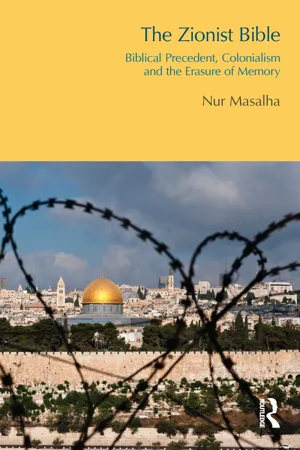
Throughout the history of European imperialism the grand narratives of the Bible have been used to justify settler-colonialism. "The Zionist Bible" explores the ways in which modern political Zionism and Israeli militarism have used the Bible - notably the Book of Joshua and its description of the entry of the Israelites into the Promised Land - as an agent of oppression and to support settler-colonialism in Palestine. The rise of messianic Zionism in the late 1960s saw the beginnings of a Jewish theology of zealotocracy, based on the militant land traditions of the Bible and justifying the destruction of the previous inhabitants. "The Zionist Bible" examines how the birth and growth of the State of Israel has been shaped by this Zionist reading of the Bible, how it has refashioned Israeli-Jewish collective memory, erased and renamed Palestinian topography, and how critical responses to this reading have challenged both Jewish and Palestinian nationalism.
Trusted by 375,005 students
Access to over 1.5 million titles for a fair monthly price.
Study more efficiently using our study tools.
Chapter 1
FRAMING THE CONFLICT
Instrumentalizing the Hebrew Bible and settler-colonialism in Palestine
HERZL’S MISSION CIVILISATRICE
Zionism would not have been able to achieve its goals without the overall support of the Western imperialist powers. The Israeli state was and still is central to Western projects in the “East”. In fact the Israeli state owes its very existence to the British colonial power in Palestine, despite the military tensions that existed in the last decade of the British mandatory period between the colonial power and the leadership of the militarized Jewish “Yishuv”. Under the Ottomans the European Zionist settlers were not given a free hand in Palestine; had the Ottomans been left in control of Palestine after the First World War, it is very unlikely that a Jewish state would have come into being. The situation changed radically with the occupation of Palestine by the British in 1918; already on 2 November 1917 Zionism had been granted title to Palestine in the well-known Balfour Declaration, a letter sent by foreign secretary Arthur James Balfour to the Zionist Federation, via Baron Walter Rothschild, in which the British government declared its commitment to Zionism: “His Majesty’s Government view with favour the establishment in Palestine of a national home for the Jewish people, and will use their best endeavours to facilitate the achievement of this object.”
Both the British prime minister Lloyd George and Arthur Balfour were members of Protestant churches which shared the Christian Zionist belief that Jews should be “restored” in Palestine before the Second Coming. Over the next 30 years, the British colonial power in Palestine allowed the Zionist movement to settle hundreds of thousands of European Jews in Palestine, establish hundreds of settlements, including several cities and to lay the political, military-security, economic, industrial, demographic, cultural and academic foundations of the Israeli state (Segev, 2010).
The mega-myth narratives of Zionism and the state of Israel conflate Judaism with political Zionism and frames the conflict with the Palestinians within its Zionist ideological moorings: Zionism is a product of a “national liberation movement” of the Jewish people; the “biblical Israelites” returning (from the late nineteenth century onwards) to “redeem the ancient homeland” and “restore Jewish statehood” after two millennia of absence and “exile”. In fact the State of Israel owes its very existence to the British colonial power in Palestine, despite the tensions that existed between the colonial power and the leadership of the European Zionist Yishuv in the last decade of the British mandate.
The ideas of the father of modern political Zionism, Theodor Herzl, were taken from pan-German nationalist sources (Hans Kohn, quoted in W. Khalidi, 2005: 813). Herzl was a deeply secular man. He set out the Zionist programme in his 1896 book, The State of the Jews: Proposal of a Modern Solution for the Jewish Question (Der Judenstaat: Versuch einer modernen Lösung der Judenfrage). He called for a Jewish state to be set up in an “undeveloped” country outside Europe. From the outset it was clear to Herzl that the Jewish state would be part of the system of Western colonial domination of Asia, Africa and Latin America. In Der Judenstaat Herzl mooted the possibility of a Jewish state in Argentina. Other potential territories for Zionist colonisation for were considered, including Uganda, North Sinai and Madagascar. But with the decisive influence of Russian Zionists, Palestine was chosen by the Zionist movement as the “biblical land”.
Inspired by the notion of “benevolent imperialism” and the myth that “enlightened imperialism” was the greatest force for good in the world, the Jewish benevolent settlement/colonization of Palestine has been (and remains) one of the most enduring themes of the Zionist project in Palestine. It was the notion of European Jews as carriers and transmitters of European enlightenment to the backward Orient, spreading Western modernity, enlightenment, reason, modern sciences and “scientific” methodologies and technology to an underdeveloped, backward and semi-deserted Asiatic geography (Massad, 2004: 61). Hanna Arendt has shown that the founder of political Zionism, Theodor Herzl, “thought in terms of nationalism inspired from German sources” (quoted by Kohn in W Khalidi, 2005:813). The “New Society”/New Jew theme was at the centre of Altneuland (Old New Land; Herzl 2000), a futuristic novel devoted to the love of the “Old New Land” and developmental settler-colonization of Palestine.
The reality of Zionist settler-colonization has not always been camouflaged or dressed up in biblical pieties. The World Zionist Organization (WZO) was founded in 1897 and its first congress took place in the same year in Basel, Switzerland. Its first president was Theodor Herzl. The “Jewish Colonial Trust” (“Die Jüdische Colonialbank”, later becoming the Anglo-Palestine Bank) was the first financial instrument of the WZO set up at Herzl’s initiative. Jewish Colonial Trust was approved by the Second Zionist Congress in 1898 and established a year later, and registered as a limited colonial company in London. Its objectives were to encourage Jewish migration from Europe and the establishment and economic development of industry and agriculture in Jewish colonies in Palestine. A subsidiary corporation of the Jewish Colonial Trust, the Anglo-Palestine Company/Bank – predecessor to present-day Israeli Bank Leumi (“National Bank”) – was also established in 1902 and a branch opened in Jaffa.1 Earlier in 1880s B’nai B’rith (“Sons of the Covenant”) became one of the earliest modern Zionist organizations operating in the West. It was created by German Zionist Jews2 to foster European Jewish colonization in Palestine. B’nai B’rith provided financial support to early Zionist colonies in Palestine and published a weekly newspaper proudly named Der Kolonist.
Following Herzl, political Zionism went on to construct a whole discourse of European (Jewish) settlement-cum-modernization versus Oriental (Arab) backwardness, based on the “New Society”/”New Yishuv” versus the “Old Yishuv” – a pre-1882 backward space inhabited by non-Zionist religious Jews living until 1948 in the mixed Arab–Jewish cities of Jerusalem, Tiberias, Safad and al-Khalil (Hebron). The European colony of the New Yishuv, by contrast, was made of secular, modern, scientifically minded, urbane, rational and civilized people. One of the main characters in Altneuland is a Palestinian Arab called “Reschid Bey” an engineer who welcomes with open arms the Zionist mission civilisatrice in Palestine; the indigenous Palestinian is extremely grateful to his European Zionist-Jewish neighbours for “making the Asiatic desert boom” and transforming the economic conditions of the country through “the scientific measures of the ‘New Hebrew Man’“ (Herzl, 2000:121–3). As Israeli Mizrahi scholar Ella Shohat puts it:
Herzl’s 1902 futuristic novel Altneuland, which deals with the two-decades metamorphosis of a miserable turn of the century Palestine into a wonderfully civilized oasis of scientific progress and humanist tolerance, already relied on the “good Arab” (Raschid bey and his wife Fatma) to witness the advantages of Zionism’s Manifest destiny. The fragile project of occupying an Eastern site to implant Zionism’s Western utopia perhaps even required the expressed approval of the vanishing Arab.(Shohat, 2010: 264)
In Palestine the highly educated and organized Zionist settlers quickly developed the usual kind of colonial relations found in the European colonies of Africa, Asia and the Americas, with contempt for the poorer, less organized and (predominantly peasant and Muslim) indigenous population (Thomas, 2009: 12). Consequently, almost from the beginning, the Herzlian utopia had its own Jewish critics and opponents. Asher Ginsberg (1856–1927) – better known by his pen name Ahad Ha’am, the Russian founder of cultural Zionism and promoter of the vision of a Jewish “spiritual centre” in Palestine – criticized Herzl’s political Zionism. In his critique of Old New Land, Ahad Ha’am pointed that there was no sign of new Jewish cultural activity or creativity in Herzl’s New Society. Its culture was European and German; the language of the educated classes was German, not Hebrew. Jews were not depicted as producers or creators of culture, but simply transmitters, carrying the (imperialist) culture and civilization of the West to the Orient (Ahad Ha’am, 1897, 1912: cited in Herzl, 2000: xxviii).
Also from the start it became clear that the Jewish “restorationist” project could only be achieve with the backing and active support of the European powers. From Herzl to Chaim Weizmann and David Ben-Gurion, the Zionist leadership was fully aware that its programme cannot be secured without the support of imperialist powers. When Herzl published Der Judenstaat in 1896, he was explicit that the “state of the Jews” could only be established with the support of one or more major European powers, at a time when the imperial powers were carving up the non-European world between them. The establishment of a Jewish state would have to be secured and guaranteed in public law – “völkkerrechtig” – with the backing of the great powers. Once such official backing had been secured, the Zionist movement would conduct itself like other colonizing ventures. Thus the history of the early Zionist movement in the years between 1896 and the British Balfour Declaration of 1917 is characterized by relentless Zionist efforts to secure imperialist backing. Aware of the growing German influences on the Ottoman state, Herzl initially strove in favour of German imperialist backing. In Der Judenstaat, Herzl wrote frankly about the (non-European) Asiatic land “reclaimed” by Zionism and the setting up of a quasi-European state in Palestine: “If His Majesty the Sultan were to give us Palestine, we could in return undertake to regulate the whole finances of Turkey. We should form there part of a wall of defence for Europe in Asia, an outpost of civilisation against Barbarism” (Herzl, 1914: 30, cited in Polkehn, 1975: 76; Herzl, 1972: 30, cited in Rodinson, 1973:14).
In October 1898 Herzl travelled to Ottoman Palestine to meet with Kaiser Wilhelm II of Germany. However, the meeting with the Kaiser turned out to be only ceremonial, and the Kaiser refused to commit himself. When these efforts became unsuccessful, Herzl and his successors turned to the British Empire (Polkehn, 1975: 76–90). In his diaries, Herzl also explicitly drew parallels between himself and Cecil Rhodes (1853–1902), an English-born businessman, the founder of the diamond company De Beers, ardent believer in colonialism and British imperialism in South Africa, and the founder of Rhodesia: “Naturally there are big differences between Cecil Rhodes and my humble self, the personal ones very much in my disfavor, but the objective ones greatly in favor of our [Zionist] movement” (cited in U. Davis, 1987: 3–4).
Zionist colonization of Palestine has taken place in four distinct phases: the first, 1882–1918, began on a small scale under Ottoman rule; the second (important) phase, 1918–48, under British imperial protection; the third, 1948–67, was characterized by “internal colonization” and the “Judaization of the Galilee and Negev projects” within the Green Line; the fourth began in 1967 and is still going on today. At the time of the first Zionist congress at Basle, Switzerland, in 1897, 95 per cent of the population of Palestine was Arab and 99 per cent of the land was Arab-owned (W. Khalidi, 1992a: 17). Today over 90 per cent of the land in historic Palestine is controlled by Israel and designated for Jewish-use only. From the late nineteenth century and throughout the mandatory period the demographic and land policies of the Zionist Yishuv in Palestine continued to evolve. But its demographic and land battles with the indigenous inhabitants of Palestine was always a battle for “maximum land and minimum Arabs” (Masalha, 1992, 1997, 2000).
Zionist colonization of Palestine has taken place in four distinct phases: the first, 1882–1918, began on a small scale under Ottoman rule; the second (important) phase, 1918–48, under British imperial protection; the third, 1948–67, was characterized by “internal colonization” and the “Judaization of the Galilee and Negev projects” within the Green Line; the fourth began in 1967 and is still going on today. At the time of the first Zionist congress at Basle, Switzerland, in 1897, 95 per cent of the population of Palestine was Arab and 99 per cent of the land was Arab-owned (W. Khalidi, 1992a: 17). Today over 90 per cent of the land in historic Palestine is controlled by Israel and designated for Jewish-use only. From the late nineteenth century and throughout the mandatory period the demographic and land policies of the Zionist Yishuv in Palestine continued to evolve. But its demographic and land battles with the indigenous inhabitants of Palestine was always a battle for “maximum land and minimum Arabs” (Masalha, 1992, 1997, 2000).
Throughout much of the late nineteenth century and the first half of the twentieth century terms such as Zionist “colonization” “Jewish colonies” and “Jewish colonists” in Palestine were universally used and proudly proclaimed by European Zionist leaders, authors and settlers. Benjamin Lee Gordon’s New Judea: Jewish Life in Modern Palestine and Egypt, published in Philadelphia in 1919, a typical Zionist publication of the period, uses terms such as “Jewish colonies” and “Jewish colonists” in Palestine literally and systematically dozens of times throughout the book and as a term of endearment. The same self-described and accurate colonialist methodology and terminology is found well into the 1950s, for instance in the publications of Israeli diplomat Yaakov Morris – the father of Israeli historian Benny Morris. His 1953 book, Pioneers from the West: History of Colonization in Israel by Settlers from the English-speaking Countries, published by the Youth and ha-Halutz Department of the World Zionist Organization, is just one example of this proudly colonialist Zionist tradition. In Zionist writings the Hebrew words for moshava and (plural) noshavot were synonymous with Jewish “colony”/”colonies”. In fact words for moshava and noshavot were coined as a literal translation of the English terms for “colony” and “colonies”. This proudly trumpeted colonial legacy and collective memory of early Zionist settlers and pioneers has been suppressed or deleted from memory in recent Zionist historiography.
In the Zionist colony/moshava, as opposed to the subsequent communal settlements like the kibbutz (literally “gathering”), all the land and property are privately owned. The first Zionist colonies/noshavot such as Rishon LeZion (“First in Zion”), Rosh Pinna (“Cornerstone”), Zichron Ya’akov (“Memory of Jacob”), Yesud Hama’alei and Petah Tikva (“Opening of Hope”) were universally described as “colonies” in both Zionist and professional literature of the time. Their economy was based on agriculture and, like all European colonies, they exploited cheap indigenous labour. Illustrative of the extent of their dependence on cheap Arab labour was Zichron Yaakov, founded in 1882 by French colonizer, financier and patron of early Zionist colonies Baron Edmond-James de Rothschild (in “memory” of his father Jacob) and 200 Jewish colonists from Romania employing 1,200 Arab labourers; similarly Rishon LeZion, with 41 Jewish families and 300 families of Arab labourers (Lehn & Davis, 1988: 39).
THE GERMAN TEMPLERS AS PROTO-ZIONIST COLONISTS: TEMPLERS COLONIES IN PALESTINE, 1868–1948
Crucially these early Jewish colonies in Palestine were preceded by and modelled on the German Christian Templer colonies established in Palestine in mid/late nineteenth century in advance of rebuilding the temple – with farmhouses of one or two stories and with slanting tiled roofs and shuttered windows. Interestingly, even today the “German Colony” southwest of the Old City of Jerusalem, established in 1878 by members of the German “Templer Society” (Tempelgesellschaft), is known in Hebrew as “Hamoshava Hagermanit” (the “German Colony”). The Templer colonists were a nineteenth-century German Protestant millennialist sect with roots in the messianic movement of the Lutheran Church. They should not be confused with the famous French-led medieval Knights Templar (Ordre du Temple or Templiers), the Crusading military order -officially recognized by the Catholic Church in 1129 but disbanded by Pope Clement V in 1312 – which used the Al-Aqsa Mosque in Jerusalem as its headquarters. Although the memory of the Latin Crusaders and Knights Templar had been largely forgotten in Europe by the end of the eighteenth century, it was revived in the nineteenth century in European Romantic nationalist as well as religious-millennialist writings, especially in France, Germany and England. During the same time the memory and legends of the monastic martial Knights Templar were revived, keeping the “Templar” name alive into the late modern period. Therefore choice of the German name, Tempelgesellschaft, was not coincidental. Members of the Tempelgesellschaft were expelled from the Lutheran Church in 1858 because of their sectarianism, their fundamentalist beliefs in imminent second coming of Christ and their apocalyptic biblical visions. The Templers were an important aid and a hugely inspirational model (especially in modern agricultural methods, crafts, architecture) for the early formative years of the European Zionist Yishuv in Palestine.
The Zionist Jewish settlers and Israel were also influenced by the politics of memory, naming and renaming of the messianic Ger...
Table of contents
- Cover
- Half Title
- Title Page
- Copyright Page
- Table of Contents
- Acknowledgements
- Introduction
- 1. Framing the conflict: instrumentalizing the Hebrew Bible and settler-colonialism in Palestine
- 2. Promised land and conquest narratives: Zionism and the 1948 Palestine Nakba
- 3. Archaeology as civic religion: secular nationalist ideology, excavating the Bible and the de-Arabization of Palestine
- 4. Colonialist imagination as a site of mimicry and erasure: the Israeli renaming project
- 5. God’s mapmakers: Jewish fundamentalism and the land traditions of the Hebrew Bible (1967 to Gaza 2013)
- Conclusion: The new scholarly revolution, and reclaiming the heritage of the disinherited and disenfranchised Palestinians
- Notes
- Bibliography
- Index
Frequently asked questions
Yes, you can cancel anytime from the Subscription tab in your account settings on the Perlego website. Your subscription will stay active until the end of your current billing period. Learn how to cancel your subscription
No, books cannot be downloaded as external files, such as PDFs, for use outside of Perlego. However, you can download books within the Perlego app for offline reading on mobile or tablet. Learn how to download books offline
Perlego offers two plans: Essential and Complete
- Essential is ideal for learners and professionals who enjoy exploring a wide range of subjects. Access the Essential Library with 800,000+ trusted titles and best-sellers across business, personal growth, and the humanities. Includes unlimited reading time and Standard Read Aloud voice.
- Complete: Perfect for advanced learners and researchers needing full, unrestricted access. Unlock 1.5M+ books across hundreds of subjects, including academic and specialized titles. The Complete Plan also includes advanced features like Premium Read Aloud and Research Assistant.
We are an online textbook subscription service, where you can get access to an entire online library for less than the price of a single book per month. With over 1.5 million books across 990+ topics, we’ve got you covered! Learn about our mission
Look out for the read-aloud symbol on your next book to see if you can listen to it. The read-aloud tool reads text aloud for you, highlighting the text as it is being read. You can pause it, speed it up and slow it down. Learn more about Read Aloud
Yes! You can use the Perlego app on both iOS and Android devices to read anytime, anywhere — even offline. Perfect for commutes or when you’re on the go.
Please note we cannot support devices running on iOS 13 and Android 7 or earlier. Learn more about using the app
Please note we cannot support devices running on iOS 13 and Android 7 or earlier. Learn more about using the app
Yes, you can access The Zionist Bible by Nur Masalha in PDF and/or ePUB format, as well as other popular books in History & Middle Eastern History. We have over 1.5 million books available in our catalogue for you to explore.