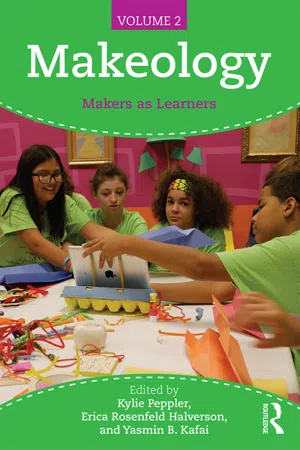
Makeology introduces the emerging landscape of the Maker Movement and its connection to interest-driven learning. While the movement is fueled in part by new tools, technologies, and online communities available to today's makers, its simultaneous emphasis on engaging the world through design and sharing with others harkens back to early educational predecessors including Froebel, Dewey, Montessori, and Papert. Makers as Learners (Volume 2) highlights leading researchers and practitioners as they discuss and share current perspectives on the Maker movement and research on educational outcomes in makerspaces. Each chapter closes with a set of practical takeaways for educators, researchers, and parents.
eBook - ePub
Makeology
Makers as Learners (Volume 2)
- 254 pages
- English
- ePUB (mobile friendly)
- Available on iOS & Android
eBook - ePub
Makeology
Makers as Learners (Volume 2)
About this book
Information
CHAPTER 1 Introduction to This Volume
DOI: 10.4324/9781315726496-1
White House Maker Faire
In February 2012, the US White House hosted its first-ever science fair showcasing the talent and ingenuity of the next generation of scientists, engineers, and innovators. Students—many winners from local and national science fairs, competitions, and state fairs—had brought their posters and exhibits, among them the extreme marshmallow cannon designed by Joey Hudy, of Anthem, AZ. The picture of President Obama testing the contraption shooting marshmallows across the State Dining Room—surely a first in its history—went around the world. More importantly, Hudy’s business card that read “Don’t be bored, make something,” inspired the President to encourage all students to become “makers of things, not just consumers of things.” In July 2014, the White House announced that it would also be hosting its very own Maker Faire, joining hundreds of mini and large Maker Faires around the world.
Introducing the Maker Movement
To date, much of the interest in the Maker Movement concerns how excitement can be leveraged to fuel the next generation of STEM (science, technology, engineering, and mathematics) innovators (Honey & Kanter, 2013). Such interest has ranged from White House Maker Faires (Kalil, 2010) to President Obama’s Educate to Innovate campaign (Obama, 2009). Though this potential holds promise, these volumes take a concerted effort to better understand making as a new domain unto itself, rather than in service of other learning outcomes. While connected to traditional disciplinary ways of understanding, we think making deserves to be understood and studied in its own right.
Open exploration, intrinsic interest, and creative ideas are but a few of the commitments at the core of today’s Maker Movement—a grassroots culture dedicated to hands-on making and technological innovation. Popularized by MAKE magazine, Maker Faires, and online communities like Etsy, Ravelry, and Instructables, the Maker Movement embodies Do-It-Yourself (DIY) production across a host of domains, ranging from textile crafts to electronics, advanced robotics to traditional woodworking (Peppler & Bender, 2013). Across these applications, the Maker Movement is propelled by (a) the introduction of new technologies, like 3D printers, laser cutters, and Arduino robotics, that allow for faster prototyping and new forms of digital fabrication; and (b) the rise of the Internet, which allows for the sourcing of parts as well as the widespread sharing of ideas (Dougherty, 2013).
At the same time, there is a growing grassroots movement behind the technology that reclaims the deeply held cultural values arcing back to the DIY culture of mid-20th-century America. While these practices still have a distinct place among 21st-century makers, the influx of new technologies reinvigorates these ideas through a capacity for “long tail” production that allows makers to produce at the appropriate scale (Anderson, 2008) and pushes the limits of what’s possible in traditional domains. This burgeoning and distributed community identifies making as an alternative to the consumer culture and seeks to hack, mod, tinker with, create, and reuse tools and materials.
Who, then, are makers? In practice, anyone who builds or adapts objects by hand, often with the simple pleasure of figuring out how things work, creating an aesthetic object, or seeking to solve an everyday problem, falls under this distinction. Makers frequently take pride in and desire to share projects and/or their creative processes with others, which is what fuels the larger communities of physical and online makerspaces, as well as pop-up events like world and regional Maker Faires. At the same time, the Maker Movement has begun to infiltrate the education enterprise. Schools are building makerspaces and FabLabs in their facilities and incorporating making into curricula. As with any instructional innovation, questions about the pedagogical value of making as a discipline are front and center, and researchers are beginning to wrap their heads around how people learn to make as well as how they make to learn.
Current research on the Maker Movement in education can be classified into three categories: understanding making as a set of designed learning activities, studying makerspaces as communities of practice, and exploring makers as identities of participation (Halverson & Sheridan, 2014). While there is clearly overlap among these three categories, it is useful to explore activities, communities, and identities independently, especially if we want to avoid reductive policy questions like, “Is making good for kids?” or “Should we put a makerspace in our school?” Rather, we should be asking questions like, “In which ways can making connect to learning?” “Who gets into making and who does not?” and “What affordances do different materials have for learning through making?”
We have organized this growing movement of makerspaces, activities, and materials for learning in two volumes. In the first volume, Makerspaces as Learning Environments, we covered the wide range of makerspaces that provide multiple pathways to learning, with participants creating projects that vastly differ in terms of scope, function, production time, and support received. This introduction to making and makerspaces described making in a variety of educational ecosystems, spanning nursery schools, K–12 environments, higher education, hip-hop communities, museums, afterschool spaces, and online learning environments and offering practical takeaways for parents, educators, and researchers along the way.
In this volume, Makers as Learners, we highlight leading researchers and practitioners in the field as they discuss and share current perspectives on the Maker Movement and research on educational outcomes in makerspaces. We discuss a range of perspectives on learning through making, including the role of tinkering in the process of teaching and learning; how adaptive expertise and identity development are supported through making; and how new and playful tools can be used to assess informal learning. Throughout, we consider linkages among learning outcomes, equity issues, and the social and historical uses of materials within makerspaces. This volume also highlights a key set of transformative tools and materials that heightens possibilities for learning and create consequential invitations for a broader and more diverse group of learners to participate. While not comprehensive of the range of making found in maker communities, this volume provides the reader with an innovative range of maker tools, materials, and processes that expand what it means to merge high and low technologies and to learn in and through making.
The Maker Movement and the Future of Learning
When it comes to promoting specific learning outcomes, the Maker Movement is a bit of a paradox. It simultaneously embodies a new and innovative grassroots approach to learning, yet it is well rooted in established theories and the time-honored truisms of high-quality education. Certainly, a central facet of the learning promoted by the Maker Movement is that it is interest driven; today’s Maker Movement encourages the making and sharing of artifacts with high personal and social significance, ranging from robotics, 3D-printed objects, high-tech fashion, hydroponic gardens, videogames, culinary oddities, textile crafts, and woodcrafts—in short, making and sharing nearly anything. As such, the Maker Movement presents unique and timely opportunities toward reimagining the future of learning in ways that will resonate with the time-honored traditions of a democratic education, yet pushes us forward to embrace the necessary changes inherent to the 21st century.
Core Issues and Challenges
With the advent of the Maker Movement, the focus on learning and learners has shifted to new contexts, activities, and artifacts. For instance, Piaget was one of the first who moved discussions about learning from the armchair of philosophy to observations of actual learners. He started by closely observing his own three children and then devising sets of experimental activities and clinical interviews (Elkind, 1968). With Skinner and colleagues, learning research moved into the laboratory, trying to establish laws of learning and schedules of reinforcements that would provide teachers with control over materials and feedback (Skinner, 1968). Then educational psychologists moved learning into classrooms, realizing that they needed to understand the contexts in which students and teachers operated (Bruer, 1993). A first turn away from schools came with Lave and Wenger’s (1991) understanding that much of learning doesn’t just happen in classrooms, but also in homes and workplaces. With Gee’s (2003) discussion of games as successful models of learning environments, digital media finally became an acceptable context in which to situate learning activities that are complex and collaborative. With each of these shifts, researchers and educators developed new perspectives on what learners do and how and where they engage in learning with others.
What the Maker Movement has to offer here in terms of learning opportunities is an emphasis on engaging the world through design and sharing with others by making learning visible and tangible. This connects to the efforts of many early predecessors, such as Friedrich Froebel’s building blocks (Brosterman, 1997), John Dewey’s real-life experiences (Dewey, 1938), Maria Montessori’s letter planes (1912), and Seymour Papert’s turtle (1980). The focus of hands-on learning is a welcome shift away from the focus on minds-on efforts that has been dominating so much of academic learning, particularly in the upper grades. While kindergarten and elementary school years still make extensive use of manipulatives and model building, this aspect of learning is largely absent when the focus is on printed materials, on or off the screen. Here the work of education writer Mike Rose on the learning in vocational trades (2004) illuminates how far our focus has shifted toward the mind, especially in our college-bound education tracks. Rose places equal value on the “intelligence” required in trades like carpentry, plumbing, and waitressing and provides compelling illustrations of how learning in everyday work is complex, collaborative, and challenging. Maker activities legitimize hands-on activities, often in conjunction with computational coding, illustrating that complexity and collaboration are not limited to talk but can also be situated in the building of models and artifacts that are shared with others. This connects to Seymour Papert’s notion of constructionism (1991), where the building of artifacts, be it a program, robot, or sand castle, that can be shared with others is seen as a particularly promising context for learning.
In some ways it can be argued that maker activities are the “shop class for the 21st century,” as computer science educators Mike and Ann Eisenberg (1998) proposed when they argued for an integration of coding and crafting, predating the actual Maker Movement by more than a decade. What is key here is not just a different notion of learning that connects minds-on and hands-on, but one that also brings back a different pedagogy where learners are engaged in projects that are more long-term, challenging, and personally meaningful. This interest in project-based learning, of course, is not new, drawing on Dewey’s legacy of situating learning in meaningful contexts. It had a quick but short-lived surge in the early 1990s when educators like David Perkins (1986) became interested in bringing design into education and many saw the emergence of web-based tools as an opportunity to engage students in making, albeit mostly on the screen. They saw classrooms as contexts where students would become designers (Harel, 1990; Kafai, 1995; Roth, 1998) of their own learning. These studies offer promising models and insights for educators interested in bringing making into schools.
Fast-forward to the 2010s and maker activities also offer a connection to interest-driven learning as promoted in the connected learning framework that describes learning as production-centered, openly networked, and conducted with peers (Ito et al., 2012). The key idea here is to leverage youths’ interests in using media toward making media, as a key form of ...
Table of contents
- Cover Page
- Half Title Page
- Title Page
- Copyright Page
- Table of Contents
- Foreword
- Acknowledgments
- Chapter 1 Introduction to This Volume
- Section 1 The Cultures and Identities of Makers
- Section 2 The Tools and Materials of Makers
- Section 3 Connecting Making to the Disciplines
- Closing
- About the Contributors
- Index
Trusted by 375,005 students
Access to over 1.5 million titles for a fair monthly price.
Study more efficiently using our study tools.
Frequently asked questions
Yes, you can cancel anytime from the Subscription tab in your account settings on the Perlego website. Your subscription will stay active until the end of your current billing period. Learn how to cancel your subscription
No, books cannot be downloaded as external files, such as PDFs, for use outside of Perlego. However, you can download books within the Perlego app for offline reading on mobile or tablet. Learn how to download books offline
Perlego offers two plans: Essential and Complete
- Essential is ideal for learners and professionals who enjoy exploring a wide range of subjects. Access the Essential Library with 800,000+ trusted titles and best-sellers across business, personal growth, and the humanities. Includes unlimited reading time and Standard Read Aloud voice.
- Complete: Perfect for advanced learners and researchers needing full, unrestricted access. Unlock 1.5M+ books across hundreds of subjects, including academic and specialized titles. The Complete Plan also includes advanced features like Premium Read Aloud and Research Assistant.
We are an online textbook subscription service, where you can get access to an entire online library for less than the price of a single book per month. With over 1.5 million books across 990+ topics, we’ve got you covered! Learn about our mission
Look out for the read-aloud symbol on your next book to see if you can listen to it. The read-aloud tool reads text aloud for you, highlighting the text as it is being read. You can pause it, speed it up and slow it down. Learn more about Read Aloud
Yes! You can use the Perlego app on both iOS and Android devices to read anytime, anywhere — even offline. Perfect for commutes or when you’re on the go.
Please note we cannot support devices running on iOS 13 and Android 7 or earlier. Learn more about using the app
Please note we cannot support devices running on iOS 13 and Android 7 or earlier. Learn more about using the app
Yes, you can access Makeology by Kylie Peppler, Erica Rosenfeld Halverson, Yasmin B. Kafai, Kylie Peppler,Erica Rosenfeld Halverson,Yasmin B. Kafai in PDF and/or ePUB format, as well as other popular books in Education & Education General. We have over 1.5 million books available in our catalogue for you to explore.