- 212 pages
- English
- ePUB (mobile friendly)
- Available on iOS & Android
eBook - ePub
About this book
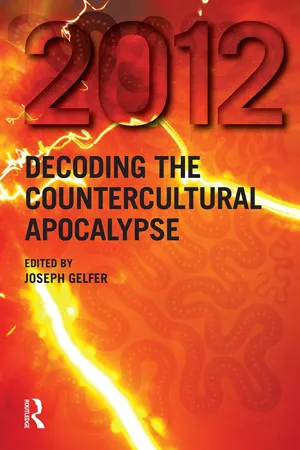
21 December 2012 was believed to mark the end of the thirteenth B'ak'tun cycle in the Long Count of the Mayan calendar. Many people believed this date to mark the end of the world or, at the very least, a shift to a new form of global consciousness. Examining how much of the phenomenon is based on the historical record and how much is contemporary fiction, the book explores the landscape of the modern apocalyptic imagination, the economics of the spiritual marketplace, the commodification of countercultural values, and the cult of celebrity.
Trusted by 375,005 students
Access to over 1.5 million titles for a fair monthly price.
Study more efficiently using our study tools.
Information
Topic
Teología y religiónSubtopic
Religión1 Introduction
Joseph Gelfer
The Road to 2012
Recently I was at my local cinema—the Sunshine Village Cinema, to be exact—in Melbourne's western suburbs. The air was a fug of noodles and KFC from the adjoining food court, the amusement arcade hammering noise like a battleground. The foyer was thick with hooded youths armed with super-sized drinks, plus a sprinkling of gold-class tickets holders on their way to their more exclusive foyer serviced with sparkling wine and nibbles. We were there to see John Cusack save the world in Roland Emmerich's blockbuster 2012, the one with the waves overtopping the Himalaya and engulfing a remote Buddhist monastery. It's a long way from Maya prophecy, on which the 2012 phenomenon is said to be based, to the Sunshine Village Cinema; a long way, even, from my own recent awareness of 2012. “How did you first hear of 2012?” is one of the first questions researchers of the subject tend to ask. Let me briefly sketch my own journey to this point.
I came to 2012 relatively late in the game, in 2003. I had read Daniel Pinchbeck's Breaking Open the Head (2002) in which the author documents his psychedelically-inspired awakening to a world beyond his previously rationalistic and journalistic mindset. It was a good book, and I looked the author up on the Internet, exchanged a few emails and began to partake in conversations with him and other readers on his discussion forum (it was in the forum that I first communicated with John Hoopes, who contributes a chapter to this book; I doubt either of us would have expected to be collaborating on this project six years later).1 For some time the forum was a vibrant little community. There were the usual range of inflammatory crackpots one finds on the Internet, but also a number of thoughtful people, sharing ideas around spirituality and sustainability. References to 2012 can be seen in the earliest threads on the forum, in which Pinchbeck highlights the 2012 predictions of (amongst others) José Argüelles and Terence McKenna, but it is one theme among many.
I enjoyed the forum enough to engage in 2005 on a magazine project with Pinchbeck which intended to provide a venue for the intellectually vigorous treatment of alternative spiritualities and the solutions they could provide for society (for some, in the build-up to 2012). Thanks to Pinchbeck's impressive connections, the project gathered some reasonable momentum. On the magazine's promotional flyer, the musician Sting praised it, framing it against “today's publishing world, [where] magazines pretending ‘hipness’ merely succeed in mirroring the unconscious nihilism of their corporate masters”; Mark Achbar, producer/co-director of the popular documentary movie The Corporation, said it promised to be “just what the Shaman ordered: a constant flow of positive strategies for a thriveable future.”
However, despite such ringing endorsements, the magazine became an example of how countercultural themes such as 2012 can become all-too-easily commodified. The magazine's business advisors began to shift the focus away from the sustainability content towards its financial sustainability. Before long, the magazine was part of a larger business plan which included a membership organisation designed to sell alternative lifestyle products and services, which went on to eclipse and spell the end of the magazine. There was only ever a prototype edition published of Evolver, which was distributed to potential investors and stakeholders; if you find a copy, you will see my name on the masthead as Contributing Editor. Preceding and during the development of Evolver, Pinchbeck became increasingly aligned with 2012 and his prophetic role within it, as outlined in his book 2012: The Return of Quetzalcoatl (2006). Neither the business strategies around the magazine nor the suggestion of prophetic revelation were particularly to my taste, so I withdrew to a position of interested observer.
In 2006, the academic study of 2012 got a boost in the form of Robert Sitler's paper “The 2012 Phenomenon: New Age Appropriation of an Ancient Mayan Calendar” in Nova Religio: The Journal of Alternative and Emergent Religions (also contained in this volume). Mayanists had been aware for some time that various individuals in what can loosely be described as “New Age” circles had been revisioning Maya prophecies, but Sitler was the first to write about it in a broader context: I read his paper with interest, and began to think more closely about 2012 as a field of research. A year later, I presented my first findings at a conference about how 2012 prophecy manifests in Australia (Gelfer 2007). A year later again, one of the conference organisers, Ibrahim Abraham, put me in touch with Pete Lentini at Monash University who was interested in 2012 (and also contributes to this volume). Between Robert Sitler, Pete Lentini, John Hoopes (who had gone on to contribute extensively to and even moderate the Internet forum Year 2012 on Tribe.net2) and myself, there appeared to be a growing momentum of academic interest in 2012 stretching beyond the study of the Maya, and hence this volume was born.
But why tell these stories? First, for the sake of disclosure. My contributions to Evolver historically aligns me in some ways with the 2012 phenomenon this book critiques. In the past, before my academic turn, I made a few dollars writing popular articles about themes intersecting with 2012 (Gelfer 2003, 2004) which even led to a picture of me appearing in the 2006 “13 Moon Synchronometer” (which enables readers to synchronise the Gregorian calendar with Argüelles’ Dreamspell calendar).3 More recently, the online incarnation of Evolver—Reality Sandwich—published an excerpt of my research in the area of masculinity and spirituality (Gelfer 2009). It is also important, I believe, to locate the researcher in the research, and go some way to qualifying the myth of academic objectivity. But more importantly, such stories and connections are the lifeblood of 2012. As the proceeding chapters show, the 2012 phenomenon is a complex mosaic of interrelated elements—a historical legacy here, a conversation there—which often come together via synchronicities that many see themselves as evidence of the prophetic nature of 2012. My own relationship with 2012 has been propelled by an equally diverse sequence of events: serendipitous literature discoveries, unusual online relationships, questions from students after a 2012 lecture, 2012 graffiti in a Melbourne laneway…4 I've often thought a diagrammatic representation of the 2012 phenomenon would be particularly fascinating to study: while this book highlights some of the connections such a diagram would make, it would also feature on it.
Chapter Outline
I have not sought to present a singular view on 2012 in this volume. While most of the contributions are rather sceptical in their reading of 2012, others are less so. As such, there are some internal contradictions. Some of these contradictions function at a broad level: for example, the value or problematic nature of using or appropriating indigenous motifs within non-indigenous spiritualities. Other contradictions are more specific and textual: for example, readers may be interested in comparing some of the statements in the main chapters about John Major Jenkins with his own concluding chapter contained within this volume.
We begin with an updated reprint of Sitler's paper “The 2012 Phenomenon” in which he offers an introduction to the Maya Long Count calendar, an interpretation of which provides the historical basis for 2012. In short, the current (thirteenth) cycle of the Long Count will end on 21 December 2012, and many people believe this will result in the end of the world, or mark a transition into a new form of global consciousness. Sitler then provides an introduction to some of the key leaders of the 2012 phenomenon; chief among these leaders is José Argüelles, who invented the Dreamspell calendar and who perceives himself to be a reincarnated Maya priest who has returned to close the current cycle of the Long Count (Argüelles' untimely death in 2011 meant he did not in the end close the cycle). Aside from Argüelles and a range of other leaders of both non-Maya and Maya origin, Sitler notes the work of John Major Jenkins as one of the most thorough of independent researchers in the 2012 field who has focused on the astronomical significance of the beginning of the Long Count. Sitler concludes with an overview of how various Maya understand themes of world renewal and apocalypse and how the broader uptake of 2012 has fed back into some Maya presentations of the same.
Mark Van Stone's chapter “Maya Prophecies, 2012 and the Problematic Nature of Truth” argues that while the whole 2012 phenomenon is based on the suggestion that a cycle of time will close on 21 December 2012 and usher in a New Order, the Maya perception of “truth” and inconsistencies between prophesies result in a focus on 2012 being problematic. For example, the Maya had no Bible: like the Classical Greeks and Romans, they were not wedded to, nor confined by a sacred scripture-from-on-high. Therefore they took their myths much less seriously than we do, and freely improvised variations, inversions, and even satires of their gods and myths. When modern interpreters look at the Maya Popol Vuh or the Long Count date 13.0.0.0.0, they often fail to consider the Mesoamerican's attitude toward “truth” and “accuracy,” which we might call “casual” or “flexible.” Further still, any reading of Maya prophecies must take into account that they are fragmented, contradictory, manipulated, and generally misunderstood. Finally, there is no clear Maya interpretation of destruction, renewal, or improvement connected to the coming 13.0.0.0.0 “end date” in Maya literature.
John Hoopes’ chapter “Mayanism Comes of (New) Age” provides what might be called a “pre-history” of the contemporary 2012 phenomenon. Hoopes defines the concept of “Mayanism” as an eclectic blend of New Age beliefs whose historic roots are to be found in the early 16th century Utopianism of Christopher Columbus and Sir Thomas More and 19th century Spiritualism. Fuelled by the commercially successful popularisation of myths about extraterrestrial visitations in the past and present, the persistence of a vibrant psychedelic counterculture, ongoing interest in shamanism and alternative medicine, and the ubiquitous Internet, the spread of the 2012 meme has created a context for the birth of new religious movements. These draw upon themes prevalent in science fiction and fantasy literature, role-playing games, cinema, pseudoscience and popular misconceptions about indigenous cultures of the Americas. The central belief of Mayanism is that the lost Utopia of an ancient civilisation can be revived in the future, bringing about a New World Order in which all illnesses of the spirit, the body, and the planet can be healed. Unfortunately, Hoopes argues that Mayanism thrives on ignorance and gullibility and is fraught with problems of elitism, neo-Fascism, anti-Semitism, and racism.
Pete Lentini's chapter “The 2012 Milieu? Hybridity, Diversity and Stigmatised Knowledge” continues this broadening of 2012 beyond the work of Mayanists. Lentini shows that although most commonly associated with Maya prophecies and astronomy, belief and/or hope in an apocalypse or major event occurring on 21 December 2012 is shared by a diverse collection of theological and other communities and subcultures, ranging from various New Age spiritualities, UFO, Planet X (Nibiru), angelic, lost civilisations, and anti-government conspiracy enthusiasts. In addition to maintaining a common credence that something profound will occur on that particular solstice, all groups advocate belief in, and promote the legitimacy of what Michael Barkun (2003) has identified as “stigmatised knowledge.” Moreover, these groups borrow different themes from each others' traditions on 2012's significance and events. Such interaction and cross-fertilisation suggests that the discourses that frame 2012 debates are not just recovered and rehabilitated ancient prophecies, but that they constitute continuously evolving contemporary narratives, developed by multiple streams of stigmatised knowledge, fostered through various media, and virtual and physical spaces that generate a plurality of perspectives, and form patterns of interaction akin to Colin Campbell's (2002) legendary cultic milieu. Lentini pursues this argument via an extensive case study of YouTube videos focusing on the theme of 2012.
Kristine Larsen's chapter “Chichén Itzá and Chicken Little: How Pseudosciences Embraced 2012” brings some hard science to the table, following Carl Sagan's (1997) interpretation of pseudoscience as that which contains untested and/or untestable propositions that are not subject to scientific testing but which are couched in scientific language. Larsen claims that the 2012 phenomenon bases much of its argument on pseudoscience such as: the catastrophic collapse of the earth's magnetic field, often in conjunction with extreme solar flare activity; a sudden shift of the earth's true poles, resulting in massive earthquakes, tsunamis and the eruption of supervolcanoes such as the Yellowstone Caldera; the collision with or influence upon earth by Planet X and other alleged planetary alignments in our region of space. Larsen concludes with an examination of the role the media plays in promoting pseudoscience by prioritising sensationalism over substance and confusing viewers as to the nature of their presenters' expertise.
Andrea Austin's chapter “Roland Emmerich's 2012: A Simple Truth” offers an early reading of the movie that for many will be their entry point to 2012. First, Austin notes the obvious biblical overtones of the movie through various visual pre-cursors before the presentation of the technologised arks (complete with exotic animals), in which a comparison is also drawn with medieval miracle plays. Second, the movie is situated within a broader typology of disaster movies that feed into the apocalyptic imagination. Austin concludes in upbeat territory, suggesting the movie, like the medieval miracle plays it echoes, is a vehicle for a positive folk message for its popular audience.
Graham St John's chapter “The 2012 Movement, Visionary Arts and Psytrance Culture” continues the more optimistic presentation of 2012. Inheriting ecstatic and reflexive countercultural trajectories, psychedelic trance (or psytrance) culture is a chief vehicle for the 2012 movement. St John addresses this development with attention to the interventions of both José Argüelles (who initiated the Planetary Art Network and its Dreamspell Calendar) and Terence McKenna (who invented the novelty theory Timewave Zero), whose ideas have been adopted within a contemporary visionary arts movement responsive to global ecological crisis. With culturally diverse international music and dance events, psytrance has become a staging ground for the interrelated quests for calendar change and new consciousness. Investigating how the inspired commitment toward cultural redress is mobilised within alternative culture, St John addresses the role of psytrance in this transnational revitalisation movement.
My own chapter “In a Prophetic Voice: Australasia 2012” picks up some of St John's themes and examines how they function in Australia and New Zealand. While largely an American phenomenon, 2012 also has a particular flavour when viewed regionally in Australasia, both in terms of how global 2012 writers view Australasia and how Australasian writers view themselves. Specifically, following Sitler (2006), I look at how indigenous spiritual themes are employed in an Australasian context, and the tension this creates between opening new possibilities for white Australasians and problematising indigenous political agency. I conclude with a look at some of the prophetic narratives which offer scenarios for Australasia in 2012, and speculate about the unique position the region may hold as the momentous date unfolds.
We conclude with a chapter from John Major Jenkins, the 2012 writer ide...
Table of contents
- Cover
- Half Title
- Title Page
- Copyright Page
- Table of Contents
- Contributors
- Preface
- 1 Introduction
- 2 The 2012 Phenomenon: New Uses for an Ancient Maya Calendar
- 3 Maya Prophecies, 2012 and the Problematic Nature of Truth
- 4 Mayanism Comes of (New) Age
- 5 The 2012 Milieu? Hybridity, Diversity and Stigmatised Knowledge
- 6 Chichén Itzá and Chicken Little: How Pseudosciences Embraced 2012 Kristine Larsen 86
- 7 Roland Emmerich's 2012: A Simple Truth
- 8 The 2012 Movement, Visionary Arts and Psytrance Culture
- 9 In a Prophetic Voice: Australasia 2012
- 10 Approaching 2012: Modern Misconceptions versus Reconstructing Ancient Maya Perspectives
- Notes
- Index
Frequently asked questions
Yes, you can cancel anytime from the Subscription tab in your account settings on the Perlego website. Your subscription will stay active until the end of your current billing period. Learn how to cancel your subscription
No, books cannot be downloaded as external files, such as PDFs, for use outside of Perlego. However, you can download books within the Perlego app for offline reading on mobile or tablet. Learn how to download books offline
Perlego offers two plans: Essential and Complete
- Essential is ideal for learners and professionals who enjoy exploring a wide range of subjects. Access the Essential Library with 800,000+ trusted titles and best-sellers across business, personal growth, and the humanities. Includes unlimited reading time and Standard Read Aloud voice.
- Complete: Perfect for advanced learners and researchers needing full, unrestricted access. Unlock 1.5M+ books across hundreds of subjects, including academic and specialized titles. The Complete Plan also includes advanced features like Premium Read Aloud and Research Assistant.
We are an online textbook subscription service, where you can get access to an entire online library for less than the price of a single book per month. With over 1.5 million books across 990+ topics, we’ve got you covered! Learn about our mission
Look out for the read-aloud symbol on your next book to see if you can listen to it. The read-aloud tool reads text aloud for you, highlighting the text as it is being read. You can pause it, speed it up and slow it down. Learn more about Read Aloud
Yes! You can use the Perlego app on both iOS and Android devices to read anytime, anywhere — even offline. Perfect for commutes or when you’re on the go.
Please note we cannot support devices running on iOS 13 and Android 7 or earlier. Learn more about using the app
Please note we cannot support devices running on iOS 13 and Android 7 or earlier. Learn more about using the app
Yes, you can access 2012 by Joseph Gelfer in PDF and/or ePUB format, as well as other popular books in Teología y religión & Religión. We have over 1.5 million books available in our catalogue for you to explore.