eBook - ePub
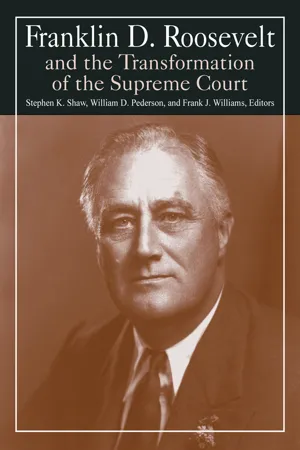
Franklin D. Roosevelt and the Transformation of the Supreme Court
- 232 pages
- English
- ePUB (mobile friendly)
- Available on iOS & Android
eBook - ePub
Franklin D. Roosevelt and the Transformation of the Supreme Court
About this book
Franklin D. Roosevelt appointed 10 justices to the U.S. Supreme Court - more than any president except Washington - and during his presidency from 1933 to 1945, the Court gained more visibility, underwent greater change, and made more landmark decisions than it had in its previous 150 years of existence. This collection examines FDR's influence on the Supreme Court and the Court's growing influence on American life.
I
The Supreme Court:
Image and Reality
Image and Reality
1
Franklin Roosevelt and the Supreme Court
A New Deal and a New Image
March 4, 1933, the last presidential inauguration day to be held in late winter rather than the now constitutionally mandated January 20 date, dawned bright and sunny for Franklin Delano Roosevelt’s swearing in as the thirty-second president of the United States. As FDR faced the crowd to deliver his stirring inaugural message of hope, one governmental symbol was conspicuously absent from the vista across the east lawn of the Capitol grounds. With the trees still devoid of foliage, Roosevelt would have been able to see clearly to the corner of First Street and Maryland Avenue, N.E., directly behind the Capitol. And just what would he have seen looking east from the stage erected on the Capitol steps? A half-completed structure that we now know as the Supreme Court building. It is indeed remarkably symbolic that the very institution that Franklin Roosevelt would attack after his 1936 reelection did not even have a separate home of its own at the beginning of his first presidential term.
Departing from previous scholarship on FDR and the Court, we focus on the concepts of symbols and images and their explanatory value in understanding the outcome of the clash between the president and the judiciary nearly sixty years ago. We borrow from Barbara Hinckley’s 1990 study of “the symbolic presidency” her definition of a political symbol as an object that “has a range of meaning beyond itself and that conveys an “emotional, moral, or psychological impact. This larger meaning need not be independently true, but will tap ideas people want to believe in as true.”1 Technically, the words image and symbol may be used interchangeably, but in our analysis, symbols contribute to the creation of images. For example, almost half-century ago, Judge Jerome Frank wrote about the traditional judicial wardrobe, which he wanted to see abolished: “The robe … gives the impression of uniformity in the decisions of the priestly tribe. Says the uniform black garment to the public mind: Judges attain their wisdom from a single superhuman source; their individual attitudes must never have any effect on what they decide.”2
Bolstering this priestly image was the erection of the “marble temple,” the Supreme Court’s first permanent and separate edifice, which was completed in 1935. Arguably, the majesty and solidity of the Court’s physical structure was emblematic of the tribunal’s ultimately successful emergence from the turbulent Roosevelt years. Moreover, the justices of the U.S. Supreme Court (on both sides of the New Deal battle) had clung tightly to their image of impartiality, fairness, and independence throughout the 1930s—even in their most contentious and politically charged decisions. In addition, the media transmitted that image to the public, whose favorable opinions toward the Court are evident in polling data from the era.
Admittedly, the Supreme Court had begun its life as the “least dangerous” and most obscure branch of the federal government and only gradually developed into its full partnership with the president and Congress. As historian Michael Kammen’s study of the Constitution in American culture relates, the Court was the unknown branch for much of the Republic’s first century. Yet when Americans did contemplate the Court, they often saw it inextricably bound with the Constitution—sometimes viewing the Court and Constitution as one in the same. To the extent that Americans developed reverence for the Constitution, they developed reverence for the Court.3
Nevertheless, image and reality of the Court collided during the New Deal crisis. The clash between the justices and FDR embodied two competing strands of the Court’s modern history. Inserting itself so boldly and obviously into the governmental process is said to have politicized the Court. In addition, the petty rivalries among justices in the 1940s, which were heavily publicized, humanized the Court. As political scientist Herman Pritchett described this phenomenon, the Court was now served by “justices without halos.”4
Yet if FDR’s Court-packing proposal represented the nadir of the Court’s sullied image, its rescue by Congress in defeating the plan helped to restore the tribunal’s revered status. Congress’s salvaging of the independent judiciary—ensuring that it was beyond the reach of the more political branches—was truly a “defining moment” in the Court’s history, to quote Chief Justice William H. Rehnquist.
The stories of the “Roosevelt Court,” the Court-packing scheme, and the antagonisms among the justices in the 1940s have been chronicled expertly elsewhere.5 In contrast, our examination of the public image of the Court during the New Deal era evaluates how the Court as an institution portrayed itself, how the justices presented themselves, how the media transferred these images to the public, and how the public perceived the Court at this critical juncture in its history.
How the Court Presented Itself: Edifice as Image
In the first 145 years of its life the Supreme Court of the United States led a truly nomadic existence. As a permanent exhibit at the Supreme Court notes, “Through the years, the Court was like a poor relation, with meeting space arranged almost as an afterthought.”6 In 1790 the Supreme Court met for the first time under the new Constitution in the then seat of the national government—New York City. The Court convened in the Exchange Building, which was a combination marketplace on the ground floor and meeting space on the upper level. At the end of 1790 the federal government’s locale moved to Philadelphia, and the Supreme Court’s first half of the 1791 term was spent in the Pennsylvania State House, now known as Independence Hall. The Court convened for the second half of its 1791 term in the newly completed Philadelphia city hall. Location was not a crucial issue for the Court, however, because during its first several terms it heard very few cases.
At the turn of the nineteenth century, the peripatetic national government finally settled in Washington, D.C., and a Capitol and executive mansion were the first governmental buildings erected. There were no separate plans for the Supreme Court, however. Architect Benjamin Henry Latrobe’s design for the Capitol building included a small room for the Court’s use; it would occupy several such niches as it was pushed from one chamber to another in the course of history.
The Court initially occupied a small room in the southwest corner of the Capitol’s north wing. Improvements on that wing of the Capitol included a new chamber for the Supreme Court in the building’s basement, where it moved for its 1810 term. Just four years later, however, the British stormed Washington during the War of 1812, and the Capitol was severely damage...
Table of contents
- Cover
- Half Title
- Title Page
- Copyright Page
- Table of Contents
- Introduction
- I: The Supreme Court: Image and Reality
- II: The Roosevelt Court, Law, and Politics
- III: Constitutional Law as Applied to Politics: The Roosevelt Legacy
- Cultural Chronology
- Biographical Digest
- Bibliography
- List of Editors and Contributors
- Index
Trusted by 375,005 students
Access to over 1.5 million titles for a fair monthly price.
Study more efficiently using our study tools.
Frequently asked questions
Yes, you can cancel anytime from the Subscription tab in your account settings on the Perlego website. Your subscription will stay active until the end of your current billing period. Learn how to cancel your subscription
No, books cannot be downloaded as external files, such as PDFs, for use outside of Perlego. However, you can download books within the Perlego app for offline reading on mobile or tablet. Learn how to download books offline
Perlego offers two plans: Essential and Complete
- Essential is ideal for learners and professionals who enjoy exploring a wide range of subjects. Access the Essential Library with 800,000+ trusted titles and best-sellers across business, personal growth, and the humanities. Includes unlimited reading time and Standard Read Aloud voice.
- Complete: Perfect for advanced learners and researchers needing full, unrestricted access. Unlock 1.5M+ books across hundreds of subjects, including academic and specialized titles. The Complete Plan also includes advanced features like Premium Read Aloud and Research Assistant.
We are an online textbook subscription service, where you can get access to an entire online library for less than the price of a single book per month. With over 1.5 million books across 990+ topics, we’ve got you covered! Learn about our mission
Look out for the read-aloud symbol on your next book to see if you can listen to it. The read-aloud tool reads text aloud for you, highlighting the text as it is being read. You can pause it, speed it up and slow it down. Learn more about Read Aloud
Yes! You can use the Perlego app on both iOS and Android devices to read anytime, anywhere — even offline. Perfect for commutes or when you’re on the go.
Please note we cannot support devices running on iOS 13 and Android 7 or earlier. Learn more about using the app
Please note we cannot support devices running on iOS 13 and Android 7 or earlier. Learn more about using the app
Yes, you can access Franklin D. Roosevelt and the Transformation of the Supreme Court by Stephen K. Shaw,William D. Pederson,Michael R Williams in PDF and/or ePUB format, as well as other popular books in Law & Education Administration. We have over 1.5 million books available in our catalogue for you to explore.