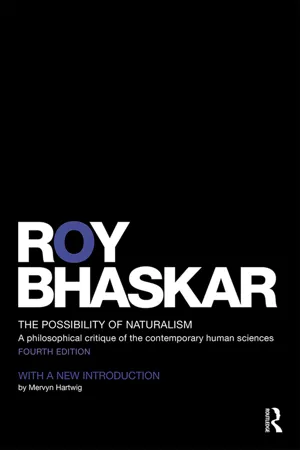
Since its original publication in 1979, The Possibility of Naturalism has been one of the most influential works in contemporary philosophy of science and social science. It is one of the cornerstones of the critical realist position, which is now widely seen as offering perhaps the only viable alternative to positivism and post positivism. This fourth edition contains a new foreword from Mervyn Hartwig, who is founding editor of the Journal of Critical Realism and editor and principal author of the Dictionary of Critical Realism.
eBook - ePub
The Possibility of Naturalism
A philosophical critique of the contemporary human sciences
- 194 pages
- English
- ePUB (mobile friendly)
- Available on iOS & Android
eBook - ePub
The Possibility of Naturalism
A philosophical critique of the contemporary human sciences
About this book
Information
Chapter 1
Transcendental Realism and the Problem of Naturalism
The Problem of Naturalism
In this book I want to situate, resolve and explain an old question that dominates philosophical discussions on the social sciences and invariably crops up, in one guise or other, in methodological controversies within them: to what extent can society be studied in the same way as nature?
Without exaggerating, I think one could call this question the primal problem of the philosophy of the social sciences. For the history of that subject has been polarized around a dispute between two traditions, affording rival answers to this conundrum. A naturalist tradition has claimed that the sciences are (actually or ideally) unified in their concordance with positivist principles, based in the last instance on the Humean notion of law. In opposition to positivism, an anti-naturalist tradition has posited a cleavage in method between the natural and social sciences, grounded in a differentiation of their subject-matters. For this tradition the subject-matter of the social sciences consists essentially of meaningful objects, and their aim is the elucidation of the meaning of these objects. While its immediate inspiration derived from the theological hermeneutics (or interpretative work) of Schleiermacher,1 the philosophical lineage of this tradition is traceable back through Weber and Dilthey to the transcendental idealism of Kant. But both traditions have older antecedents and wider allegiances. Positivism, in assuming the mantle of the Enlightenment, associates itself with a tradition whose Galilean roots lie in the new Platonism of the late Renaissance;2 while hermeneutics, finding early precursors in Herder and Vico3 and possessing a partially Aristotelian concept of explanation,4 has always flourished in the humus of romantic thought and humanist culture.5 Significantly, within the Marxist camp an exactly parallel dispute has occurred, with the so-called ‘dialectical materialists’ on one side, and Lukács, the Frankfurt School and Sartre on the other.
Now, with the partial exception of the ‘dialectical materialists’ (whose specificity will be considered later), the great error that unites these disputants is their acceptance of an essentially positivist account of natural science, or at least (and more generally) of an empiricist ontology. Consider, for example, Winch’s The Idea of a Social Science, probably the most influential tract written within the self-styled ‘analytical’ school. Winch, it will be remembered, wants to demonstrate an essential identity between philosophy and social science, on the one hand, and a fundamental contrast between social and natural science, on the other. When one examines his arguments for such a contrast one finds that they reduce, in essence, to just two. The first is an argument to the effect that constant conjunctions are neither sufficient nor (contrary to, for example, Weber) even necessary for social scientific explanation, which is achieved instead by the discovery of intelligible connections in its subject-matter.6 This may be granted. But the required contrast is only generated if one assumes that the discovery of intelligible connections in its subject-matter is not equally the goal of natural scientific explanation (or that the identification of constant conjunctions could be necessary and sufficient for this). Winch’s second argument is that social things have no existence, other than a purely physical existence, that is, as social things, apart from the concepts that agents possess of them.7 Besides leaving the ontological status of concepts unclear, once more the desired contrast only gets off the ground if one tacitly assumes that, with the privileged exception of thought itself, only material objects can properly be said to be ‘real’, that is, that in natural science esse est percipi. Winch’s anti-naturalism thus depends entirely on empiricist theories of existence and causality. Now if, as I shall argue shortly, science employs a causal criterion for ascribing reality, and causal laws are tendencies, his contrast collapses. Of course it does not follow from this that there will be no differences between the natural and the social sciences (or, for that matter, that Winch’s idea of a social science is entirely incorrect). But, by effectively ceding natural science to positivism, Winch precludes himself from locating them. The antinaturalist faction within Marxism typically makes the same mistake.
Now I think that recent developments in the philosophy of science (and in particular those that I have elsewhere systematized under the title of ‘transcendental realism’8) permit what the current crisis in the human sciences necessitates: a reconsideration of the problem of naturalism. Naturalism may be defined as the thesis that there is (or can be) an essential unity of method between the natural and the social sciences. It must be immediately distinguished from two species of it: reductionism, which asserts that there is an actual identity of subject-matter as well; and scientism, which denies that there are any significant differences in the methods appropriate to studying social and natural objects, whether or not they are actually (as in reductionism) identified. In contrast to both these forms of naturalism, I am going to argue for a qualified anti-positivist naturalism, based on an essentially realist view of science. Such a naturalism holds that it is possible to give an account of science under which the proper and more or less specific methods of both the natural and social sciences can fall. But it does not deny that there are significant differences in these methods, grounded in real differences in their subject-matters and in the relationships in which their sciences stand to them. In particular it will be shown that ontological, epistemological and relational considerations all place limits on the possibility of naturalism (or rather, qualify the form it must take); and that these considerations all carry methodological import. However, it will transpire that it is not in spite of, but rather just in virtue of, these differences that social science is possible; that here, as elsewhere, it is the nature of the object that determines the form of its possible science. So that to investigate the limits of naturalism is ipso facto to investigate the conditions which make social science, whether or not it is actualized in practice, possible.
It would seem clear that my first task is to establish the elements of an adequate account of natural science, in relation to which the possibility of social scientific knowledge can be reappraised. But such an undertaking seems immediately vulnerable to the objection that it is guilty of assuming what it is trying to prove. For how can conclusions taken from reflection on the natural sciences be transposed to the context of social science unless the truth of naturalism (that is, the essential comparability of the two domains) has already been presupposed? Now this objection rests on a misinterpretation of the modal status of my conclusions, which concern merely the possibility of a social science. Philosophy, indeed, can neither anticipate the results nor guarantee the success of a naturalistic science of society; what it can do is to specify the (ontological) conditions that make, and the (epistemological) conditions that must be satisfied, for such a project to be possible. Its realization is, however, the substantive task, and contingent outcome, of the practice of science itself.
But this objection pales into insignificance in the face of two logically anterior ones. What reason is there to suppose that a unitary account of scientific method, or rather of its essence, can be given, so that the question of whether or not it could embrace social science (that is, the problem of naturalism) can even be meaningfully posed? For surely, it might be said, science is just whatever scientists do, and their doings may be as varied as any randomly selected group of persons. Now this objection may be countered with a dilemma. For either there are real differences between the activities of scientists and bigamists, bimetallists and people whose surname begins with a ‘P’ in virtue of which the predicate ‘scientific’ is applicable to the former but not the latter; or else there are no grounds for consistently using the term ‘scientist’ to designate one rather than another group of people. On the second horn nominalism itself is impaled. But to fall back on the first is to concede the case for a real definition of science. Once achieved, such a definition will then allow us to discriminate between more and less scientific work within the ‘scientific community’; that is, to judge the activity by the concept, so giving us some critical purchase on science.
But why, given that the case for a real definition is conceded, should we presume that philosophy can provide it? Surely this task is best left to the scientists themselves, or perhaps to their scientists (that is, sociologists of science)? What business does a philosopher as such have pronouncing on science at all? Indeed, how can a philosopher, operating so it would seem by the exercise of pure reason alone, say anything at all about the world, without scientific naïveté or at least susceptibility to substantive scientific refutation? How, that is to say, is a philosophy of science possible?
How is a Philosophy of Science Possible?
What is the relation between science and philosophy? Do they compete with one another or speak of different worlds? Neither position is acceptable. To ignore the historical links between them would be folly. Indeed, no distinction between them can be drawn in the case of pre-Socratic thought, and no sharp one even in the seventeenth century. (It is salutary to remember that ‘metaphysics’ is merely the name that Aristotle’s literary executors, so to speak, gave to the work they classified after his physics,9 and that Hume fancied himself engaged in experimental science.10) It is only in Kant that one finds a clear, if ultimately untenable, non-reductionist distinction between philosophy and science. After Kant the status quo ante was, for the most part, restored: with a romantic and idealist strain, of varying quality, tending to cosmological speculation, very much in the old style; while an empiricist and positivist current proved increasingly unable to sustain an intelligible concept of either science or itself. In this impasse an offshoot of the latter, with conventionalist and pragmatist leanings, openly welcomed the breakdown of the philosophy/science distinction. On this view, they are to be distinguished, if at all, only by the generality of their questions (that is, their removal from the data of sense) – a distinction which may be a matter of degree (Quine) or kind (Lakatos).
Now there is a quota of truth in this picture, historically speaking. Philosophy has tended to develop in symbiosis with science. It can codify, and even motivate it; while science has given philosophy its essential analogies,11 as well as data for its results. However, no philosopher can argue with any confidence from the history of his subject to approval of the conception with which it seems to accord. Moreover, taken consistently, the Quine/Lakatos conception is ultimately subversive of any claims for philosophy. For once crude empiricist criteria of scientificity are abandoned there is no reason why philosophy, as so conceived, should not just be assimilated into science. For its results must be as potentially transient as, and cannot differ significantly in epistemological status from, substantive scientific theories. At most they can only be characterized by a relative immunity to revision – an immunity which, it would seem, must ultimately be justified, if it can be justified at all, on a posteriori grounds.
If philosophy is to be possible (and I want to contend that it is in practice indispensable) then it must follow the Kantian road. But in doing so it must both avoid any commitment to the content of specific theories and recognize the conditional nature of all its results. Moreover it must reject two presuppositions which were central to Kant’s own philosophical project, viz. that in any inquiry of the form ‘what must be the case for Ø to be possible?’ the conclusion, X, would be a fact about us12 and that Ø must invariably stand for some universal operation of mind. That is to say, it must reject the idealist and individualist cast into which Kant pressed his own inquiries.
In fact, if the general form of a philosophical investigation is into the necessary conditions for social activities as conceptualized in experience, then it must be recognized that both the activity and its conceptualization may be historically transient; that the activity may depend upon the powers that people possess as material things rather than just as thinkers or perceivers; and that its analysis may establish transcendental realist, rather than idealist, and so epistemically relativist, rather than absolutist (or irrationalist), conclusions. On this conception, then, both the premises and conclusions of philosophical arguments remain contingent facts, the former (but not the latter) being necessarily social, and hence historically transient. It is only in this relative or conditional sense that philosophy can establish synthetic a priori truths (truths about the world investigated by science). Philosophy, then, operates by the use of pure reason. But not by the use of pure reason alone. For it always exercises that reason on the basis of prior conceptualizations of historical practice, of some more or less determinate social form.
Thus conceived, philosophy can tell us that it is a condition of the possibility of scientific activities Ø and ψ that the world is stratified and differentiated, X and Y. But it cannot tell us what structures the world contains or how they differ. These are entirely matters for substantive scientific investigation. Scientific activities are contingent, historically transient affairs. And it is contingent that the world is as described in ‘X’, ‘Y’ and ‘Z’. But given Øi, X must be the case. A demonstration, or ‘deduction’, of this necessity (which may be termed ‘transcendental’) will normally consist of two parts: a straightforward ‘positive’ part, in which it is shown how X makes Ø intelligible; and a complementary ‘negative’ part (in general only analytically separable f...
Table of contents
- Cover
- Title
- Copyright
- Contents
- Introduction
- Foreword to the Third Edition
- Preface to the Second Edition
- Preface to the First Edition
- Acknowledgements
- Chapter 1 Transcendental Realism and the Problem of Naturalism
- Chapter 2 Societies
- Chapter 3 Agency
- Chapter 4 Philosophies
- Postscript
- Bibliography
- Index of Names
- Index of Subjects
Trusted by 375,005 students
Access to over 1.5 million titles for a fair monthly price.
Study more efficiently using our study tools.
Frequently asked questions
Yes, you can cancel anytime from the Subscription tab in your account settings on the Perlego website. Your subscription will stay active until the end of your current billing period. Learn how to cancel your subscription
No, books cannot be downloaded as external files, such as PDFs, for use outside of Perlego. However, you can download books within the Perlego app for offline reading on mobile or tablet. Learn how to download books offline
Perlego offers two plans: Essential and Complete
- Essential is ideal for learners and professionals who enjoy exploring a wide range of subjects. Access the Essential Library with 800,000+ trusted titles and best-sellers across business, personal growth, and the humanities. Includes unlimited reading time and Standard Read Aloud voice.
- Complete: Perfect for advanced learners and researchers needing full, unrestricted access. Unlock 1.5M+ books across hundreds of subjects, including academic and specialized titles. The Complete Plan also includes advanced features like Premium Read Aloud and Research Assistant.
We are an online textbook subscription service, where you can get access to an entire online library for less than the price of a single book per month. With over 1.5 million books across 990+ topics, we’ve got you covered! Learn about our mission
Look out for the read-aloud symbol on your next book to see if you can listen to it. The read-aloud tool reads text aloud for you, highlighting the text as it is being read. You can pause it, speed it up and slow it down. Learn more about Read Aloud
Yes! You can use the Perlego app on both iOS and Android devices to read anytime, anywhere — even offline. Perfect for commutes or when you’re on the go.
Please note we cannot support devices running on iOS 13 and Android 7 or earlier. Learn more about using the app
Please note we cannot support devices running on iOS 13 and Android 7 or earlier. Learn more about using the app
Yes, you can access The Possibility of Naturalism by Roy Bhaskar in PDF and/or ePUB format, as well as other popular books in Philosophy & Epistemology in Philosophy. We have over 1.5 million books available in our catalogue for you to explore.