- 328 pages
- English
- ePUB (mobile friendly)
- Available on iOS & Android
eBook - ePub
About this book
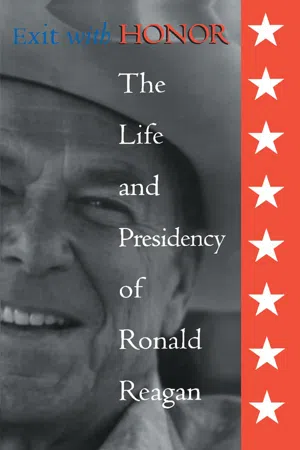
Few presidents have sparked as much interest in recent years as Ronald Reagan, already the subject of a large number of biographies and specialized subjects. This biography, based on recent research into the Reagan archives and synthesis of the large memoir literature, explores the shaping of his values and beliefs during his childhood in the American heartland, his leadership of the American conservative movement, and his successful political career culminating in the first two-term presidency since Dwight Eisenhower. Pemberton finds Reagan's personal career and ability to understand and communicate with the American people admirable, but finds many of the long-term effects of his presidency harmful.
Information
1
Growing Up in the Heartland, 1911–1937
From 1937 when Ronald Wilson Reagan starred in his first film in Hollywood until 1989 when he finished his second term as president, he remained a mystery even to his closest friends and associates. Historian Edmund Morris, Reagan’s official biographer, once told the president that after years of studying, observing, and talking to him, he remained an enigma. Reagan, in his best “aw shucks” manner, said, “But, I’m an open book.” “Yes, Mr. President,” Morris replied, “but all your pages are blank.”1
Reagan’s friends found that this most charming and seemingly open of men carefully guarded a private core that no one could penetrate. He struck most observers as rather passive, even lazy, and he never openly displayed any hunger for money, fame, or power. Yet he emerged from the poverty and obscurity of small-town Illinois to become a major world leader. He acquired a college education during the Great Depression, won regional fame in radio during the 1930s, and went on to become a movie and television star. He led Hollywood actors during the postwar Red Scare, established himself as the undisputed leader of the American conservative movement in the 1960s, served as governor of California for two terms, and won two terms as president of the United States, leaving office as one of the most popular chief executives in recent history. Reagan was a successful president, measured by his popularity and by his effect on history, yet even his strongest defenders admitted that he was dependent on his staff and that he knew little about the activities of the White House. Opponents and supporters alike puzzled over how a chief executive who was so disengaged from the work of his own administration achieved so much of what he set out to accomplish.
There were other puzzles. Observers noted the irony of Reagan, a long-time leader of the anticommunist movement in the United States, joining with Soviet premier Mikhail S. Gorbachev to bring the cold war to an end. Reagan completed the largest defense buildup in American history, yet he joined with Gorbachev to begin the process of removing whole categories of nuclear weapons from superpower arsenals. Reagan chroniclers often referred to him as the Great Communicator and searched for the sources of his seemingly effortless ability to touch deep chords in the hearts of Americans. Others struggled with the question of how a man who continuously reshaped himself to fit changing circumstances appealed to millions because he symbolized to them unchanging aspects of traditional American character.
The source of many of the mysteries surrounding Ronald Reagan appeared in his youth, when he was growing up in the Midwest. His paternal ancestors, the O’Regans, lived in county Tipperary in Ireland, where they and their peasant neighbors struggled to survive by working in fields owned by absentee landlords. They lived in a village, Doolis, whose filth and poverty horrified a member of the English Parliament who described it after he visited there in 1829. The family survived when the potato famine hit in 1845, but life remained hard. In 1852, twenty-three-year-old Michael O’Regan ran off to London with a local woman, Catherine Mulcahy. When they married in October 1852, Michael signed himself Reagan. In 1856 Michael and Catherine, Ronald’s great-grandparents, moved to the United States and homesteaded land in Carroll County, Illinois. Their son, John Michael Reagan, married Jenny Cusick and settled near Fulton, Illinois, where in 1883 John Edward “Jack” Reagan, Ronald’s father, was born. When he was six, Jack’s parents died from tuberculosis, and he was raised by his relatives.
Nelle Clyde Wilson, Ronald’s mother, was born near Fulton on 24 July 1883. Her father’s family came from Scotland, first settling in Canada and then moving on to the United States. On her mother’s side she was descended from an English immigrant who came to the United States at age sixteen and, after her parents died, worked as a domestic servant.2
Ronald Reagan’s parents shaped his values and taught him many of the skills that turned him into the Great Communicator. Jack received only a few years of elementary school education, but he was a street-smart, ambitious man, attuned to the commercial bustle of midwestern main streets. He was a superb shoe salesman, who dreamed of owning the largest shoe store in Illinois. Tall and handsome, he had a flair for the dramatic, a presence that turned heads, a gift with words, a genius for telling stories. He was a talented salesman, as his son would be, whose words could create an optimistic aura for his customers, a bright future that would be made even better by a shiny pair of new shoes, whose price faded into insignificance as Jack talked.
Jack Reagan was a “sentimental Democrat,” an Irish Catholic who during the Great Depression became an avid supporter of President Franklin D. Roosevelt. Jack detested the Ku Klux Klan and hated racism and bigotry. He supported working men and women and was suspicious of the power structure, especially when it was in the hands of Republicans. He held that all people were created equal, but he also believed that each individual shaped his or her own destiny and that success came through hard work and ambition.3
Jack was a restless man, moving from town to town pursuing success as a salesman. He met Nelle Wilson when they both worked at the same dry goods store in Fulton, Illinois. In November 1904 they married and in 1906 moved to the small town of Tampico, Illinois. There two children were born, John Neil on 16 September 1908 and Ronald Wilson on 6 February 1911. Neil and Ronald, “Moon” and “Dutch” to their family, knew little stability as they grew up. In 1914 Jack and Nelle moved to Chicago and then to a succession of small Illinois towns: Galesburg, Monmouth, back to Tampico, and finally in 1920 to Dixon, which Ronald would regard as his hometown.4
Ronald Reagan recalled his childhood as similar to “rare Huck Finn–Tom Sawyer idylls.” A later associate said that Reagan had the ability to create “little worlds” that existed only in his imagination. The Great Communicator could use these scenes to touch the hearts of listeners who re-sponded to his sunny vision of a way of life that no longer survived and, indeed, probably never had existed in the fashion that Reagan and his listeners remembered. Huck Finn did not describe his life in the idyllic terms that Reagan remembered. Huck’s mother was dead and his “pap” had abandoned him, returning only to abuse him and to steal his money. He fled down the Mississippi on a raft to escape his father, who had tried to kill Huck. His journey, usually taking place at night, exposed him to examples of child abuse, racial oppression, religious hypocrisy and superstition, and murderous psychopaths. After his friend Buck was hunted down and executed in front of him, Huck wrote: “I ain’t agoing to tell all that happened—it would make me sick again if I was to do that. I wished I hadn’t ever come ashore that night, to see such things. I ain’t ever going to get shut of them—lots of times I dream about them.”5
Reagan’s powerful imagination allowed him to transform reality, even Huck’s reality, into a vision that had a powerful appeal to himself and to millions of other Americans. Reagan rewrote his own life, as he rewrote Huck’s, to make it fit his image of small-town boyhood in the early twentieth century, and he turned his memory of the few dark sides of his childhood into positive experiences that taught him valuable lessons.
Despite Jack’s hard work and ambition, he never succeeded in achieving his dream of becoming an independent businessman. The small midwestern farming communities he lived in suffered from hard times in the decade after World War I, followed in the 1930s by the Great Depression. But Jack failed also because he was an alcoholic, a binge drinker who would go on drunken sprees that lasted for days. Jack was not known as the town drunk, but his drinking hurt his family and undermined his dream of owning a big shoe emporium.
Jack’s drinking provoked a crucial event in his son’s psychological development. One snowy evening Ronald, at age eleven, came home to find his father passed out in the front yard. He confronted the choice of either ignoring Jack and rushing inside to hide in bed, as he had done before in similar episodes with his drunken father, or of facing the humiliation of dragging Jack into the house. Ronald’s story of encountering his drunken father passed out in a snowstorm and confronting himself in a searing moment of character-defining crisis sounded suspiciously like a Hollywood movie scene. Still, in Ronald’s mind it became a critical moment in his psychological history. Always before he had let Nelle and Neil deal with Jack’s alcoholism; this time he dragged Jack inside their home and felt that he had taken a turn toward responsibility and maturity.6
While Jack pursued his elusive dreams, Nelle held the family together. A small, pretty woman with auburn hair and blue eyes, she was as intelligent and ambitious as Jack, but she focused her dreams for the future on her boys. She stretched her limited budget to keep the family fed and well clothed, drilled into her sons the value of education, read to them at night, and took the boys to church several times a week. She was a missionary in her community for the Disciples of Christ Church and had a reputation in Dixon for healing through prayer. Nelle had a flair for the theatrical, giving dramatic readings to church groups and acting in religious plays that she wrote herself from the material of everyday life.
She prayed often for Jack, but her prayers and her hatred for alcohol had little effect. While Nelle sometimes seemed to be a morally judgmental person who believed that people brought their troubles on themselves, she described Jack’s alcoholism as a disease and told her boys that they must not hold it against him. She taught Ronald that God had a plan for everyone and that everything happened according to God’s plan. This belief became a fundamental part of his makeup. Nelle was an optimistic and trusting woman who looked for the good in people. Ronald said she taught him to dream and to expect those dreams to come true.7
Ronald learned other things as well. Jack and Nelle were loving parents but not physically demonstrative, seldom kissing and hugging their children. There were mysteries in the Reagan household that Ronald did not understand until later: angry voices and cursing from Jack, hushed conversations or silences sometimes when Ronald entered the room, unexpected extended visits to his aunt’s home. Jack did not get deeply involved in his sons’ lives. He never attended Neil’s ball games or Ronald’s high school plays, and while Ronald felt secure in being loved, he developed a protective barrier between himself and other people. Children of alcoholics sometimes escape into “little worlds” of fantasy and become adept at role playing. Jack’s alcoholism and the tension it produced in his home was an additional force shaping young Ronald Reagan, and his own children would later feel this same distancing from their father.8
Looking back on the “Huck Finn” days of his youth, Reagan said, “Those were the happiest times of my life.” Nelle and Jack were poor. “Our family didn’t exactly come from the wrong side of the tracks, but we were certainly always within sound of the train whistles,” Ronald wrote. It was the kind of poverty that people of Reagan’s generation often idealized in looking back at their youths, of not being aware that they were poor, of being part of a community that provided help and support for its own members, without, in Reagan’s memory, intervention by government. Reagan’s life in Dixon seemed secure and wholesome as he looked back at it from the perspective of adulthood. His wife, Nancy Reagan, wrote, “To this day, Ronnie thinks that’s the way it should be, and it’s one reason he bristles at the idea of a large, impersonal government that takes care of the things neighbors once did for each other.”9
Reagan’s feeling of security was of a peculiar sort, dependent on selective memory. The Reagans were vulnerable to every change in the business cycle and to the long decline in midwestern family farming. They depended on the economic health of the small farming communities in the increasingly urban, industrial state of Illinois, and the family relied on Jack’s ability to make judicious career decisions and to control his alcoholism. It was an uncertain existence, seeming secure to the adult Ronald Reagan because he remembered only the portions that sustained his optimistic outlook on life.
Dixon was a self-contained farming town of just over eight thousand people, surrounded by rich, fertile land. A beautiful stretch of Rock River ran through the town, which was known for its parks, including Lowell Park where Ronald would win fame as a lifeguard. The house at 816 South Hennepin Avenue, later designated as the Reagan family home, was located in a pleasant middle-class neighborhood. It was a fairly large seven-room home, although when Ronald visited it in 1984 he asked, “Tell me, what did you do to shrink it?” The public library, Ronald’s school, and Nelle’s church were nearby. Life in Dixon “was as sweet and idyllic as it could be,” Reagan later wrote. But there was also a boring, stifling side to life in small midwestern communities. Reagan once remarked to a White House associate, “There was nothing in those towns. … Lord, that’s why I left.”10
As Jack moved his family from town to town, his sons attended four different schools in four years. They lived in five different homes after they settled in Dixon. Nancy Reagan believed that her husband’s “inwardness,” the distance that he maintained from everyone, including herself, was partly due to his lack of roots and stable friendships when he was a child. Reagan himself revealed a darker side to his youth: “Although I always had lots of playmates, during those first years in Dixon I was a little introverted and probably a little slow in making really close friends. In some ways I think this reluctance to get close to people never left me completely. I’ve never had trouble making friends, but I’ve been inclined to hold back a little of myself, reserving it for myself.” Later observers often assumed that this “inwardness” came from his need to maintain privacy after he became a movie star, but its roots went far back in his life.11
Ronald was a quiet child who would spend hours alone. He described himself as a loner, living in a “world of pretend,” where he “was allowed to dream.” The previous tenant of one of the family’s rented houses left behind a collection of bird eggs and butterflies, and young Ronald spent hours dreaming over the collections, as he did later with a prized array of lead soldiers. The hours he spent playing along the streams and in the forests and fields around Dixon left Reagan with a lasting love of the outdoors. When he learned to read at age five, he found access to a new world of imagination in Bible stories and later in the pretend worlds of Horatio Alger, the Tom Swift books, and the books of Edgar Rice Burroughs.12
One day when he was about thirteen, Ronald tried on his mother’s eyeglasses and shouted with delight and surprise at seeing a world that he had not known existed. Jack and Nelle quickly addressed his acute shortsightedness by buying him glasses, and Ronald found he could then play baseball and football. By his junior year in high school, he was nearly five feet, eleven inches tall and weighed 160 pounds. He won his greatest local recognition, however, not as a sports hero but as a lifeguard at Lowell Park, where the Rock River swept along the forested bluffs, creating dangerous currents. At age fifteen Reagan started working there as a lifeguard and in seven summers saved seventy-seven people, a number verified by contemporary newspaper accounts.13
He found additional avenues of success. He was football captain, drum major, class president, and a decent (low-B average) student. His mother had included him in her productions of dramatic “readings” and plays, which won him applause and approval. His high school English teacher, B. J. Fraser, introduced him to serious acting and taught him the basic lessons that carried him through Hollywood. He also fell in love with Margaret Cleaver, the intelligent and pretty daughter of Christian Church minister Ben H. Cleaver. “For almost six years of my life I was sure she was going to be my wife,” he wrote. “I was very much in love.” Life was good for him during his high school years and laid the foundation for him to become a secure adult, entirely comfortable with himself. He wrote the caption for his yearbook picture: “Life is just one grand, sweet song, so start the music.”14
Nelle Reagan’s church had a deep and lasting effect on Ronald. Many of the themes in Reagan’s famous speeches in the 1980s had been heard for one hundred and fifty years in the Christian Church (often interchangeably called the Disciples of Christ). It emerged in the early 1800s, growing from the ministries of liberal frontier Presbyterian reformers, such as Barton Warren Stone and Th...
Table of contents
- Cover
- Half Title
- Title Page
- Copyright Page
- Dedication
- Table of Contents
- Series Editor’s Foreword
- Preface
- Photographs follow page 144
- 1. Growing Up in the Heartland, 1911–1937
- 2. Finding Fame and Fortune in Hollywood, 1937–1966
- 3. The Turn toward Conservatism, 1947–1980
- 4. Governing California, 1967–1974
- 5. Changing the National Agenda, 1981
- 6. Managing Big Government, 1981–1985
- 7. Facing Defeats, Winning Victories, 1982–1989
- 8. Engaging the Soviets, 1981–1985
- 9. Coping with Scandal, Exiting with Honor, 1985–1989
- 10. Evaluating Reagan
- Notes
- Bibliography
- Index
Trusted by 375,005 students
Access to over 1.5 million titles for a fair monthly price.
Study more efficiently using our study tools.
Frequently asked questions
Yes, you can cancel anytime from the Subscription tab in your account settings on the Perlego website. Your subscription will stay active until the end of your current billing period. Learn how to cancel your subscription
No, books cannot be downloaded as external files, such as PDFs, for use outside of Perlego. However, you can download books within the Perlego app for offline reading on mobile or tablet. Learn how to download books offline
We are an online textbook subscription service, where you can get access to an entire online library for less than the price of a single book per month. With over 1.5 million books across 990+ topics, we’ve got you covered! Learn about our mission
Look out for the read-aloud symbol on your next book to see if you can listen to it. The read-aloud tool reads text aloud for you, highlighting the text as it is being read. You can pause it, speed it up and slow it down. Learn more about Read Aloud
Yes! You can use the Perlego app on both iOS and Android devices to read anytime, anywhere — even offline. Perfect for commutes or when you’re on the go.
Please note we cannot support devices running on iOS 13 and Android 7 or earlier. Learn more about using the app
Please note we cannot support devices running on iOS 13 and Android 7 or earlier. Learn more about using the app
Yes, you can access Exit with Honor by William E Pemberton in PDF and/or ePUB format, as well as other popular books in Politics & International Relations & Political Biographies. We have over 1.5 million books available in our catalogue for you to explore.