The Research Companion
eBook - ePub

The Research Companion

A practical guide for those in the social sciences, health and development

  1. 290 pages
  2. English
  3. ePUB (mobile friendly)
  4. Available on iOS & Android
eBook - ePub

The Research Companion

A practical guide for those in the social sciences, health and development

About this book

Have you ever wanted to know an effective and ethical way to:

Design a study?

Recruit participants?

Report findings?

And improve the quality and output of your research?

The Research Companion focuses on the practical skills needed to complete research in the social or health sciences and development. It covers the behind-the-scenes essentials you need to run an effective and ethical piece of research and offers clear, honest advice to help avoid typical problems and improve standards and outcomes. It addresses each stage of the research process from thinking of a research idea, through to managing, monitoring, completing and reporting your project, and working effectively and safely with participants and colleagues.

As well as covering theoretical issues in research, the book is full of links to other resources and contains practical tips and stories from researchers at all levels. This new edition is fully updated to reflect shifts in funding structures, open access, and online developments and has a link to a blog and friendly online community for readers to connect with diverse researchers all sharing experiences and offering practical advice.

The Research Companion brings hard-earned lessons from the real world to offer invaluable guidance to all students of the social and health sciences, from those just beginning their first research project, to experienced researchers and practitioners. It will be instrumental in raising readers' competence levels and making their research more accurate, ethical, and productive.
Frequently asked questions

Yes, you can cancel anytime from the Subscription tab in your account settings on the Perlego website. Your subscription will stay active until the end of your current billing period. Learn how to cancel your subscription.
At the moment all of our mobile-responsive ePub books are available to download via the app. Most of our PDFs are also available to download and we're working on making the final remaining ones downloadable now. Learn more here.
Perlego offers two plans: Essential and Complete
  • Essential is ideal for learners and professionals who enjoy exploring a wide range of subjects. Access the Essential Library with 800,000+ trusted titles and best-sellers across business, personal growth, and the humanities. Includes unlimited reading time and Standard Read Aloud voice.
  • Complete: Perfect for advanced learners and researchers needing full, unrestricted access. Unlock 1.4M+ books across hundreds of subjects, including academic and specialized titles. The Complete Plan also includes advanced features like Premium Read Aloud and Research Assistant.
Both plans are available with monthly, semester, or annual billing cycles.
We are an online textbook subscription service, where you can get access to an entire online library for less than the price of a single book per month. With over 1 million books across 1000+ topics, we’ve got you covered! Learn more here.
Look out for the read-aloud symbol on your next book to see if you can listen to it. The read-aloud tool reads text aloud for you, highlighting the text as it is being read. You can pause it, speed it up and slow it down. Learn more here.
Yes! You can use the Perlego app on both iOS or Android devices to read anytime, anywhere — even offline. Perfect for commutes or when you’re on the go.
Please note we cannot support devices running on iOS 13 and Android 7 or earlier. Learn more about using the app.
Yes, you can access The Research Companion by Petra M. Boynton in PDF and/or ePUB format, as well as other popular books in Psychology & Medical Theory, Practice & Reference. We have over one million books available in our catalogue for you to explore.
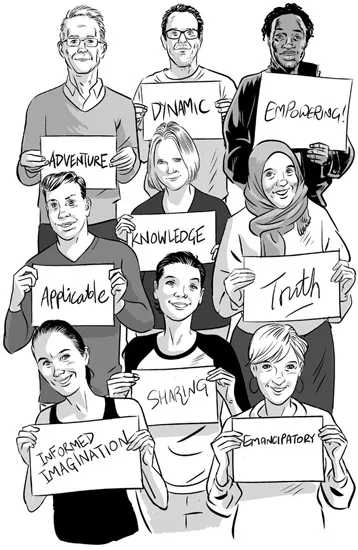
fig1_1
If you had to pick one word to sum up “research” what would it be? My friends and I share our answers


1
First steps

I wonder what you’re thinking as you begin this book? Chances are it might be not another book on research methods! And you wouldn’t be alone. When I proposed this book that was precisely the reaction of one of the reviewers, although luckily for me they went on to say they realised this text didn’t fit that category. It’s true, though; hundreds of books are available about methodologies for the social sciences, health and development, and the varied ways in which research “data” can be analysed. This one is different. My aim is to give you skills to make research easier, less stressful, and more efficient. I’ve done this through using existing research examples, by reflecting on my own experience, and through feedback from other researchers, which you’ll see throughout.1
I really enjoy completing research, and find working from a study idea through to a finished report, paper or intervention can be an amazing experience. One of the reviewers of this book pointed out that there is a tremendous amount of joy and pleasure to be gained from learning new skills, making research discoveries, solving tricky problems, or getting a significant result. And they are right. Research is a journey—one that can sometimes be tiring and difficult, but is equally likely to be enjoyable and empowering. Sometimes it just pays the bills, or is a necessary task to make sense of your world. It is the aim of this book to share that journey with you, to give you skills to get the most from your studies, and the opportunity to make your research story as positive as possible.

â–ș Why Use this Book?

You may have chosen this book because you are an undergraduate, postgraduate or doctoral student who needs to learn more about the practical aspects of carrying out research. You may be a member of a community who wants to commission or carry out some research—or maybe you’ve been approached by other researchers to work collaboratively on a study. Some of you will be graduates working as research assistants, or postdoctorates coordinating a study. You may be a volunteer, activist or working with a charity or NGO. Alternatively you may be a health, social care or development worker who needs to learn more about research to inform your profession. You may be teaching others how to undertake or report research, or you could be an experienced researcher bringing in grants and managing a research team. You could be working on research projects of any size, anywhere in the world. This book is aimed at all of you. If you are just starting out, the book will give you skills and confidence to get going; while it will help more experienced researchers manage their own work and help with the mentoring and support of any staff they are supervising. Most importantly it will help you carry out research in a way that protects your well-being, and that of any participants you encounter.
On that note, the aims and objectives of this book are to:
  • Give researchers skills to make research easier, less stressful, and more efficient
  • Assist researchers to complete more accurate, ethical, transparent and productive research
  • Improve the skills of researchers in terms of writing and presenting information
  • Ensure respectful and empowering treatment of participants and communities
  • Address the safety and well-being needs of researchers
  • Save researchers time and money, and help them work more efficiently
  • Encourage debate and discussion about the practicalities of research
  • Consider how social media, diverse and creative methods, and shared data can be used effectively
  • Make use of researchers’ experiences and stories to highlight common problem areas
  • Cover issues not commonly addressed in research methodologies texts or courses.

â–ș How is this Book Different?

The official explanation goes something like this. Social science research has traditionally focused on methods in order to teach ways of completing studies. Much of what we learn in research tends to be acquired in practice, and most information around research assumes rather than checks that people know how to conduct work; resulting in poor science, wasted time, and a negative effect on the morale of the researcher. If many of these practical issues were taught to researchers, higher-quality research could be completed, yet there seems to be a resistance among academics to sharing information they have learned.
The alternative story is as follows. As an undergraduate studying social psychology I got a grounding in methods that is probably similar to most people’s experience if they’ve been taught research in a Western academic setting. Once a week we’d spend three hours in a lab being taught about experiments, variables, and validity, and debating qualitative versus quantitative methods—with the latter usually faring better (see also Howitt & Cramer, 2014). We practised running studies on each other, and we helped our tutors with their research by participating in their studies. We didn’t really think about these ideas learned in “the lab”, or get a chance to apply them in the real world with real people, but we were given plenty of confidence that by knowing our methods off pat, we’d be able to carry out studies and collect data. I also spent three years studying statistics, where I learned, panicked about, and then promptly forgot the different types of statistical tests you could use on numerica...

Table of contents

  1. Cover
  2. Title
  3. Copyright
  4. Dedication
  5. Contents
  6. Acknowledgements
  7. 1 First steps
  8. 2 Planning research
  9. 3 Starting out
  10. 4 Completing research
  11. 5 Participants
  12. 6 Researcher safety and well-being
  13. 7 Once a study’s underway
  14. 8 Reporting findings
  15. 9 Endings
  16. References
  17. Index