- 352 pages
- English
- ePUB (mobile friendly)
- Available on iOS & Android
eBook - ePub
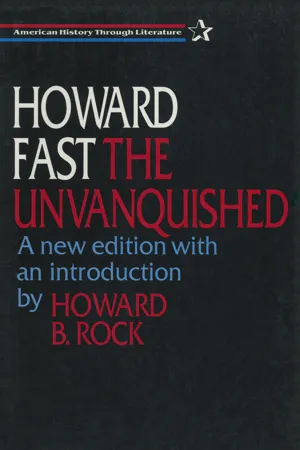
The Unvanquished
About this book
Originally published in 1942, The Unvanquished is the story of the Continental Army and George Washington in the desperate early months when the American Revolution faced defeat and disintegration. The book begins with the retreat across Manhattan's East River that saved the Continental Army after the Battle of Long Island. It ends with Washington's recrossing of the Delaware in the daring 1776 Christmas Eve raid on the Hessian camp at Trenton.
PART ONE
BROOKLYN
1
THE FOXHUNTER
WITH the heat running like warm water from the sides of the room, backed by three closed windows and a closed door, he slept badly and restlessly, waking up, closing his eyes firmly, dozing, prodded into consciousness, fighting consciousness because he was a man who slept well most of the time, rolling over from a wet spot on the pillow, dreaming, recalling, forgetting, finding a painful ache in all the packed, broad, slab-like pictures that went to make up his memory.
While the night candle next to his bed burned, dim under its sooty cover, he could look at his watch and mark the hours, one o’clock, half past one, two o’clock, surely five o’clock, ten minutes after two, until the candle burned down.
Sometime during that night, awakening, he became afraid, and his sweat turned cold. He shivered and trembled and sought reassurance in the deep pockmarks that covered his face. His eyes searched the unending dark, but there was no object, no end, no faint trickle of light through the tightly sealed windows. His fingers traced out the pockmarks, nose and chin and mouth and forehead and thinning hair and back to the pockmarks; and in the dark his sense of objects drifted away, the pocks deep holes, the nose a monstrous thing, the chin an ungainly wedge.
He rolled over, threw off the single blanket that covered him, and groaned, “Patsy, Patsy.” Then he buried his face in the wet pillow.
The grey dawn crept into the room and revealed him. He was awake and sitting up in the tangled disarray of his bed. His linen nightshirt had wrinkled and twisted itself up above his knees, and his long bony legs stuck out like the props of a scarecrow. He looked haggard from lack of sleep, older than he was, and incredibly thin.
He rolled over to the edge of the bed and shuffled his almost grotesquely large feet across the floor, seeking his slippers. When his toes found the soft caves of felt, he stood up, crouching for a moment with the instinctive gesture of a very tall man. He stretched and yawned before he went to a window and threw it open. The air outside was a little cooler, and he breathed deeply of it. It was still only half morning, still too early to know whether the day would be fair or foul, roofed with a blue sky or with angry clouds; but hot it would be with the sickening wet heat that was the prize of New York City and no other place in all the land.
After a few moments at the window, he told himself, “It will rain,” for out of the east came the faintest rumbling and grumbling of angry storm clouds; and he was sleepy enough to think no more of it than that, storm clouds, rain, mud, rubbing his eyes with his enormous hands, shuffling around the bed and sitting down in a spindle-legged chair.
As he sat, the thunder came again, but different, in staccato bursts that forecast ruin instead of rain; and the big man leaped out of his chair and lurched toward the window, losing his felt slippers, leaned out of the window and called, “Billy! Billy! Billy!”
He hadn’t a big voice, but he could make it snap like a lash. Pulling his nightshirt over his head, he stamped around naked, calling, “Billy! Billy!”
He was skin wound on bones, with broad shoulders and broader hips; clothes would cover his lankness and give his huge frame an impression of strength. When a colored man came running into the room, the first words were for clothes.
He was calm suddenly, dressing himself with the aid of the colored man. He sat on the edge of the bed, pulling on his stockings, his buff breeches, his high black boots; and as he wore the clothes, he became a different man, stronger, wiser, vaster. His long, skinny body assumed more human proportions as the huge knobs of bone disappeared under the broadcloth and linen. His thin red hair was combed from its disarray flat back against his head. Only his tired grey eyes remained to tell of the sleepless night.
He washed in a white china bowl and then got into his blue jacket. If he heard the rumbling thunder now, the fears and apprehensions it evoked were tight-locked under his uniform.
‘‘Shave you, sir?” the colored man asked.
“Later.”
“Two gentlemen waiting,” the colored man said.
“How long? Why didn’t you wake me, Billy? Haven’t you more sense than that?”
“Just a few minutes.”
“How long is a few minutes, Billy? You have less sense every day.”
“Maybe five minutes, sir.”
The big, bony, stooping man, fully dressed now in a buff and blue uniform, left the bedroom. As he entered another room which he called his office, he straightened up and threw back his shoulders with a visible effort.
That same buff and blue uniform had made a stir in Philadelphia something over a year ago. A tall, tall man, long-faced, shy, but very well dressed, had sat down with the Second Continental Congress, wrapped in his buff and blue and in the deepest mantle of silence, and had sat and sat and sat without ever saying a word. His silence became something physical and alive; everyone else wanted to talk, and everyone else did talk. Things were moving; it was revolution, and the world was dropping into pieces, and the pieces had to be sorted out, and when someone suggested a humble and dutiful petition to the King of England, John Adams roared, “Oh, the imbeciles! The fools! The damned, damned fools, with their talk of petitions!”
And in all the crazy riot of talk, the tall man in buff and blue said nothing, heard everything, and kept his quizzical grey eyes fastened more or less intently upon the meeting.
“Who is he?” a member from Massachusetts asked.
“Nobody important.”
“In that uniform?”
“Well, he’s nobody important; he’s a farmer from Virginia. His name’s Washington.”
“Washington?”
“Wash-ing-ton.”
“Who ever heard of a name like that?”
“That’s his name. He’s rich.”
The member from Massachusetts nodded, a merchant himself, putting the uniform at forty pounds, the lace at three, the shoes at four. “He never speaks?” he inquired.
“No.”
“Just sits there?”
“Yes.”
“Washington—” the member from Massachusetts said thoughtfully.
And John Adams told his cousin Sam, “I like him.”
“Why?”
“He knows how to keep a still tongue.”
“Maybe he’s got nothing to say,” Sam suggested.
“No—people who have nothing to say spend all their time talking about it,” John said. “That man Washington, he’s said nothing and he’s chairman of four military committees. Nobody ever heard of George Washington of Virginia, but they look at the uniform and they look at the way he holds his head and they hear how much money he’s worth, and then they vote for him without thinking any more about it.”
“How much is he worth?” Sam asked.
“As much as any man in America.” Sam grinned and said, “Commander in chief?” “Why not? Look at the way he wears his uniform, the way he sits on his horse.”
“Some won’t like it,” Sam Adams said slowly, thinking of a people’s revolution, but also of what it meant to be as rich as any man in America.
“The North won’t like it, but the South will. We already have the North, and now we need the South, to be more precise, Virginia.”
“I wasn’t thinking of that,” Sam said. “I was thinking of Hancock. He wants like all the devils in hell to lead this business.”
“You want it too, don’t you?” John Adams asked, squinting at his cousin.
“I can’t wear a uniform,” he replied sourly. “Still there’ll be hell to pay for Hancock.”
“Let it then. I’m going to nominate this Washington.”
And now, nominated, appointed more than a year, this tall, forty-four-year-old planter, foxhunter, farmer, still found it difficult to think of himself as a general.
With a curt nod he greeted the two men who were waiting for him, and nodded for them to speak. They hadn’t slept either; their eyes were red and their faces were dirty and their clothes were limp with sweat. They were from General Putnam, they told him.
“Billy,” he said, “get these gentlemen something to drink.” And he told them, “Sit down, gentlemen. You’ve come a long way and it’s hot. Sit down.”
His judgment was quick and certain and damning, because they were afraid, one of them a boy of eighteen or nineteen and the other a sallow man in his thirties, but both of them afraid and dirty and tired, dressed in old homespun and linen shirts that had once been white but were now muddy brown. The big man thought: “What am I looking at? A lieutenant and a captain, or a major and a colonel?” His army! They were Yankees with clumsy movements and nasal New England accents, and he had to cover his contempt by staring at the grained wood of the table where he sat. He had a physical abhorrence of physical fear; it was something twined in and out of the whole fabric and pattern of his life. He had always been a sickly man, and he had the sickly man’s intimate knowledge of death; fear to him was real and black and terrible, and for that reason, being almost without the habit of introspection, he despised fear in others.
In these two, the messengers from General Putnam, fear was as hot and wet as the day itself. It slid from their lips as they poured out their story. They had come over from Brooklyn.
How had they come?
They stared at him amazed, not comprehending how his mind needed details, hundreds of little details for him to piece together, meaningless details when the world was falling apart.
They had rowed across in a skiff. They couldn’t get a boatman. The younger one began to blubber; you would think with a message from General Putnam, they could get someone to row the boat.
“When was that?” the big man cried. “When did it start, you fools? Answer me!” He pulled out his watch; it was six o’clock.
That was what the younger one was trying to tell him, blubbering that they couldn’t get a boatman, that they had to row themselves. The sallow man thrust out his palms in proof and showed the blisters. He had never rowed a boat before. He hadn’t enlisted to row boat; he wasn’t a sailor. They had run all the way fron the landing; well, he hadn’t enlisted for that, to row boats and to run his fool head off.
“Get out of here!” the foxhunter roared. “Both of you—get out of here!”
He sat at the table while Billy brought in some breakfast, while through the open window came the distant rumble of cannon.
He shouldn’t have lost his temper at those two, he told himself. His temper was a hot iron on hairsprings, an outpouring of all the inhibitions bound up so tightly inside of him. It was something he had wheedled and flailed and coaxed and beaten all of his life; and until he had come up here to the North to take command of the army, he had believed it under control, flung back, hammered down and tight in chains.
Before that taking of command, he could clearly remember the last time he had lost himself. It had been during a clear, glorious afternoon at Mount Vernon, when he sat in his saddle with the pack sprayed out in front of him, looking for game, a fox or a deer or a hare, with his horse’s hoofs drumming sweet music and the smell of green things on the cool breeze. The pack raised a scent, but he reined in, his eyes on a flight of dark birds silhouetted in the sky over the Potoma...
Table of contents
- Cover
- Half Title
- Title Page
- Copyright Page
- Dedication
- Table of Contents
- Series Foreword by Paul Finkelman
- Introduction by Howard B. Rock
- Part One: Brooklyn
- Part Two: Manhattan Island
- Part Three: Westchester
- Part Four: Jersey
- An Afterword
Trusted by 375,005 students
Access to over 1.5 million titles for a fair monthly price.
Study more efficiently using our study tools.
Frequently asked questions
Yes, you can cancel anytime from the Subscription tab in your account settings on the Perlego website. Your subscription will stay active until the end of your current billing period. Learn how to cancel your subscription
No, books cannot be downloaded as external files, such as PDFs, for use outside of Perlego. However, you can download books within the Perlego app for offline reading on mobile or tablet. Learn how to download books offline
We are an online textbook subscription service, where you can get access to an entire online library for less than the price of a single book per month. With over 1.5 million books across 990+ topics, we’ve got you covered! Learn about our mission
Look out for the read-aloud symbol on your next book to see if you can listen to it. The read-aloud tool reads text aloud for you, highlighting the text as it is being read. You can pause it, speed it up and slow it down. Learn more about Read Aloud
Yes! You can use the Perlego app on both iOS and Android devices to read anytime, anywhere — even offline. Perfect for commutes or when you’re on the go.
Please note we cannot support devices running on iOS 13 and Android 7 or earlier. Learn more about using the app
Please note we cannot support devices running on iOS 13 and Android 7 or earlier. Learn more about using the app
Yes, you can access The Unvanquished by Howard Fast in PDF and/or ePUB format, as well as other popular books in History & Early American History. We have over 1.5 million books available in our catalogue for you to explore.