Communication Theory Through the Ages presents communication theory as a journey through history by way of asking engaged questions. Encouraging intellectual vitality, the authors show students step by step how theoretical ideas are interconnected and lead to an increasingly complex understanding of communication. Students will be motivated to ask questions as they encounter historical figures, social events, and artifacts, resulting in a richer understanding of the biographical, cultural, and social context for communication theories.
- 340 pages
- English
- ePUB (mobile friendly)
- Available on iOS & Android
eBook - ePub
Communication Theory Through the Ages
About this book
Information
1
The Wonder of Time
Key concepts:
Acoustic space, a priori, ars memoriae, axiology, chronemics, corroboree, empire, erasure, horizontal communication, Global Village, master narrative, media, mediatization, message, mobility, modernity, monochronic time, myth, nihilism, nostalgia, ontology, oral, polychronic time, post-modernity, ritual, ritual view, Self, semantic, semiotic, simulacrum, survivance, time-biased media, totemism, tradition, transmission view, vertical communication, writing.
Key names:
Aristotle, Jan Assmann, St. Augustine, Francis Bacon, Roland Barthes, Giordano Bruno, James Carey, Jean-François Champollion, Émile Durkheim, Albert Einstein, Michel Foucault, Johannes Gutenberg, Jürgen Habermas, Eric Havelock, Martin Heidegger, Heraclitus, Thomas Hobbes, Ivan Illich, Harold Innis, Fredric Jameson, Immanuel Kant, Friedrich A. Kittler, Jean-François Lyotard, Guglielmo Marconi, Marshall McLuhan, Lewis Mumford, Isaac Newton, John Peters, Plato.
1. RUNNING OUT OF TIME?
Take a look at the image of the clock in Figure. 1.1.
It looks so cute: one might think it comes from a children’s cartoon. Unfortunately, it doesn’t. This is the Doomsday Clock that shows a symbolic countdown to the world’s end. Created in 1947, the clock has been adjusted more than 20 times by the Bulletin of the Atomic Scientists in consultation with its Board of Sponsors, which includes 16 Nobel Laureates. Just recently, the minute hand has been moved again and today the clock is closer to midnight than it has been during the past 20 years. It stands at two minutes to midnight. If you don’t quite agree with the opinion of the Science and Security Board of the Bulletin of the Atomic Scientists, you can go to its website and take a poll that asks one question: “What time do you think the Clock should read?” Chances are, though, you won’t suggest moving the clock back too far. The situation is truly critical: the world faces many complex problems, such as nuclear power and nuclear weapons, and climate disruptions from global warming, all of which are threatening the whole of humanity.
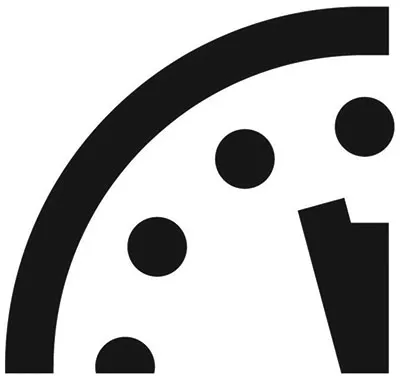
Figure 1.1 Doomsday Clock icon.
Now what does this have to do with communication? First, and most importantly, the planet is being destroyed by humanity itself. All global problems are the result of concrete human beings who can’t communicate successfully with one another and reach an agreement, be it peace talks, political negotiations, or international treaties on climate change. And, second, the information about the critical state of the world must be better communicated to everyone. So-called ‘risk communication’ research addresses social and ecological systems characterized by high levels of uncertainty and complexity, e.g. environmental and health issues. So-called ‘crisis communication’ focuses on PR problems faced by companies and organizations. And yet, clearly more effort is needed to communicate the message that “modern man is the victim of the very instruments he values most” and that “we have conjured up a genius capable of destroying our civilization” (Mumford, 1944, p. 393). Today the situation is much more critical and so this message must be communicated more clearly and forcefully.
2. TIME AND COMMUNICATION
The role of time in communication has, of course, been noted. Communication is usually conceptualized as a process, i.e., “an activity that has many separate but interrelated steps that occur over time” (Ruben & Stewart, 2006, p. 15). The communication process is viewed as “time dependent because no two communication events are the same” (Heath & Bryant, 2000, p. 53); hence, communication is considered to be an ever-changing process. Also, time is identified as a type of nonverbal communication and studied through chronemics, which is concerned with how people communicate through the use of time. However, the importance of time in communication goes much further. In fact, the conceptualization of time in communication theory is considered to be “perhaps more demanding than any other single factor” (Fisher, 1978, p. 222).
There are at least two main reasons why time enjoys a special status in communication theory. First, the starting point in understanding communication is ontological; we must ask the question ‘What is the nature of communication?’ In the words of Martin Heidegger, “the central range of problems of all ontology is rooted in the phenomenon of time” (Heidegger, 1966, p. 16). And, second, we can understand communication only if we look at its axiology, i.e., identify the values behind human actions, which, of course, change over time. That is why, as William Shakespeare famously put it, “our virtues lie in the interpretation of time” (Coriolanus, iv, 7). Thus, we can gain insights into the most fundamental aspects of communication only by paying close attention to the role that time plays in it.
While one can wear a watch in one’s pocket or look at a clock, time itself is not a physical object: it is an experience. When we experience time, we respond to the motion of the world in various ways. The importance of this experience can’t be overemphasized: “Motion . . . is, in perceptual terms highly salient. . . After all, survival depends on our ability to detect motion” (Evans, 2004, p. 202). When we experience the world, we try to understand how phenomena succeed one another, e.g. whether one occurs before or after another, or whether they seem to occur at the same time. Thomas Hobbes declared that time is “a phantasm produced by a body in motion” (Robertson, 1886, p. 97).
When we experience time, we routinely use such concepts as ‘now’, ‘an hour’, ‘two years ago,’ etc. Time, as such, however, is not just a general concept; it is a pure form of sensible intuition, or what Immanuel Kant called (along with space) a priori, i.e., ‘before the experience’. He writes:
For we should not observe things to co-exist or to follow one another, did we not possess the idea of time a priori. It is, therefore, only under the presupposition of time, that we can be conscious of certain things as existing at the same time (simultaneously), or at different times (successively)
(Kant, 1888, p. 29)
Time is what makes our experience possible in the first place; it precedes and underlies experience a priori. All our concepts, thus, such as ‘now’, ‘an hour’ or ‘twenty years ago’ have meaning only because ultimately they rely on time as an a priori intuition.
Time appears mysterious and intangible because it is not a physical being among beings. It is, indeed, not an object, but rather “a mobile image of eternity” (Plato, Timaeus, 37d). In other words, we imagine time; it is a product of our imagination. Let’s see how time has been conceptualized and has affected communication through the ages.
You must have heard the phrase: ‘The Medium is the Message’. This phrase is the title of the first chapter of Marshall McLuhan’s book Understanding Media. The Extensions of Man (1994). McLuhan was influenced by Harold Innis – another Canadian scholar. Both theorists are considered the founders of the Toronto School of Communication which was interested in the impact of media and technologies on society. Based on their ideas, the history of communication is conceptualized in terms of various stages when certain media would arise and shape the way people understand and organize their world (e.g. Poe, 2011).
Media are often viewed as figure, not ground; in other words, we tend to think of media as something that stands out, e.g. newspapers, radio and television, Internet sites, etc., rather than something that forms the very basis or infrastructure of our lives. Meanwhile, because “forgetting seems to be a key part of the way infrastructure works” (Peters, 2015, p. 36), we must remember that media are the very foundational framework (ground) of our being. Simply put, since we can’t communicate by telepathy, we need a medium – an intermediary agency – between others and ourselves. McLuhan understood the importance of media very well; in the phrase ‘the medium is the message’, however, ‘the message’ can’t be equated with content that supposedly changes depending on the medium in which it is expressed; for example, the expression ‘it is raining’ does not have two different ‘contents’ (messages) if it is pronounced orally or written down. Rather, the message of a medium is the sum total of all the changes in the world that it creates: it is our life transformed by a new medium. As McLuhan reminds us, technologies are active processes that reshape both people and other technologies (McLuhan, 1962).
This view of media is very broad and somewhat equivocal: “in effect, all of McLuhan’s reasoning is dominated by a series of equivocations very troubling to a theoretician of communication, because the differences between the channel of communication, the code, and the message are not established” (Eco, 1986, p. 234). We must, therefore, clearly differentiate between these terms. The message is content (to be) communicated. The code is a system of units with rules for their combination. The channel is a medium through which a message is communicated. For instance, what you’re reading now is a message; created with the help of English as a code; and communicated through a print medium (if you’re holding a paper book in your hands) or an electronic medium (if you’re reading it on an electronic device such as a computer or an iPhone). It is important to note that a medium can be any intermediary agency between people that allows them to communicate with one another, e.g. fire or sand.
2.1. The Signs of the Time
We will use different expressions for the ‘medium’ and the ‘message’. In place of the ‘medium’ we will speak of the ‘The Signs of the Time’, i.e., anything that captures meaning and preserves it through time, e.g. songs, dance, paintings, tombs. It is easy to see how this expression covers the medium as such, e.g. human voice or paint; codes, e.g. music or body language; and messages with various meanings, e.g. a song about love.
All such ‘Signs of the Time’ are meaningful marks and thus semantic and semiotic in nature. Both ‘semantic’ (relating to meaning) and ‘semiotic’ (relating to signs) go back to the Greek sēma (‘mark’, ‘sign’). The crucial prerequisite for successful communication is “the recognition of the sēma ‘sign’” (Nagy, 1996, p. 203); an example is a scene from Homer’s Odyssey: “Penelope’s ‘recognizing’ . . . the sēmata [plural of sēma] specified by the disguised Odysseus as the clothes given to the real Odysseus by Penelope herself” (ibid.). While the origins of semiotics lie in medical science, the signs used in human communication, unlike natural symptoms such as a rash, are conventional and so can be understood only in specific cultural contexts. That is why “the recognition of the sēma implicitly requires an act of interpretation” (ibid.). When we talk about the Signs of the Time, we will look at how they are recognized and interpreted.
We have mentioned ‘tombs’ as a Sign of the Time. This may not be the first thing that comes to mind when thinking about meaningful marks; and yet, the Greek sêma also meant ‘a tomb’ and ‘a grave’ and can be considered one of the oldest meaning-storage devices (Peters, 2015, p. 145). Indeed, as long as we can recognize certain structures as tombs and interpret them (e.g. is the tomb a burial of a king or a tribal leader?), the dead are communicating with us through time. It can be said that they have lived to tell the tale – even through death! All Signs of the Time tell a certain tale.
2.2. Telling a Tale
Just as we will speak of the ‘Signs of the Time’ in place of the ‘medium,’ we will use ‘tale’ in place of the ‘message’. First, a ‘tale’ means a narrative of real or imaginary events, a story: thus it has a broad meaning. It is important to note that “time becomes human to the extent that it is articulated through a narrative mode, and narrative attains its full meaning when it becomes a condition of temporal existence” (Ricoeur, 1984, p. 52). In other words, humans telling tales and time go hand in hand. Second, a ‘tale’ means a recital of events or happenings; in other words, it is an imaginative interaction in which people can actively participate. And, third, the archaic meaning of ‘tale’ is ‘a tally or reckoning, a total’; in this sense, ‘tale’ stands for anything that matches another thing and is used for an account or reckoning (including the reckoning of time). Overall, the meaning of ‘tale’ is something like ‘an account of things in their due order’; thus, a certain ‘medium’ tells a certain ‘tale’ or creates a certain ‘message’.
So we will use the expression ‘the Signs of the Time’ in place of the ‘medium’ and ‘Telling a Tale’ in place of the ‘message’. It must be emphasized that our view of their relationship is not deterministic. We do not claim that the medium is the message; rather, we speak of the medium and the message. Let us see how people have dealt with time through the ages by creating certain signs that tell a certain tale.
3. LIVING THE DREAMING
Let us begin with the so-called ‘Tribal Stage’ that McLuhan in The Gutenberg Galaxy (1962) identified as the first era in the social evolution of modern humanity, which covers the period from the time that people acquired oral speech to the beginnings of literacy. The word ‘tribal’ has a number of negative connotations, associated with primitiveness, crudity, backwardness and superstition. ‘Tribal’ people are often portrayed as savage and irrational: after all, these are the people whose beliefs are centered on the veneration of various objects (totems) such as plants or animal skins. It was assumed, for instance, “that Aboriginal inhabitants were already doomed to a timeless, un-evolving fate” (Leane, 2010, p. 36), leading to the colonization of the indigenous people there. The same reasoning was used to support colonization in other places such as Africa, Americas and New Zealand.
And yet, the words ‘tribal’ and ‘totemism’ are very complex in meaning and have deep historical roots. The word ‘tribal’ came to denote ‘modern ethnic groups or races of people’ only in the 16th century. The roots of the word go back much further, meaning ‘a dwelling’, ‘being’, ‘existing’, ‘coming to be’ and ‘happening’. Similarly, the word ‘totemism’ is derived from the term ototeman in the Ojibwe language, meaning ‘brother-sister kin’, with ‘kin’, in its turn, going back to the root that means ‘to produce,’ ‘give birth’ and ‘beget’. In this light, such meanings can’t be ‘crude’ and ‘backwater’; in fact, we could perhaps learn something from them.
So, how fair is it to talk about the tribal cultures being ‘doomed’ and in need of ‘rescuing’? What is really meant by their ‘timeless’ nature? The Tribal Stage clearly deserves more attention with a special focus on the role of time in communication. To that end, let us look at the culture of Australian aboriginals. It makes good sense to focus on Australian aboriginals as an exemplar of the Tribal Stage: after all, the Australian aboriginal culture is said to be the oldest continuous living culture in the world. Significantly, the word ‘aborigines’ is derived from ‘ab origine’ and literally means ‘from the beginning’.
3.1. The Signs of the Time
In the p...
Table of contents
- Cover Page
- Half Title
- Title Page
- Copyright Page
- Dedication
- Praise
- Table of Contents
- Acknowledgments
- Foreword
- 1 The Wonder of Time
- 2 The Wonder of Polis
- 3 The Wonder of God
- 4 The Wonder of the Body
- 5 The Wonder of the Mind
- 6 The Wonder of Language
- 7 The Wonder of Culture
- 8 The Wonder of Information
- 9 The Wonder of Community
- 10 The Wonder of Space
- Bibliography
- Index
Trusted by 375,005 students
Access to over 1.5 million titles for a fair monthly price.
Study more efficiently using our study tools.
Frequently asked questions
Yes, you can cancel anytime from the Subscription tab in your account settings on the Perlego website. Your subscription will stay active until the end of your current billing period. Learn how to cancel your subscription
No, books cannot be downloaded as external files, such as PDFs, for use outside of Perlego. However, you can download books within the Perlego app for offline reading on mobile or tablet. Learn how to download books offline
We are an online textbook subscription service, where you can get access to an entire online library for less than the price of a single book per month. With over 1.5 million books across 990+ topics, we’ve got you covered! Learn about our mission
Look out for the read-aloud symbol on your next book to see if you can listen to it. The read-aloud tool reads text aloud for you, highlighting the text as it is being read. You can pause it, speed it up and slow it down. Learn more about Read Aloud
Yes! You can use the Perlego app on both iOS and Android devices to read anytime, anywhere — even offline. Perfect for commutes or when you’re on the go.
Please note we cannot support devices running on iOS 13 and Android 7 or earlier. Learn more about using the app
Please note we cannot support devices running on iOS 13 and Android 7 or earlier. Learn more about using the app
Yes, you can access Communication Theory Through the Ages by Igor E Klyukanov,Galina V Sinekopova in PDF and/or ePUB format, as well as other popular books in Languages & Linguistics & Communication Studies. We have over 1.5 million books available in our catalogue for you to explore.