![]()
1
Negotiating state and society in Singapore
Rethinking historical narratives
Jason Lim and Terence Lee
Celebrating 50 years
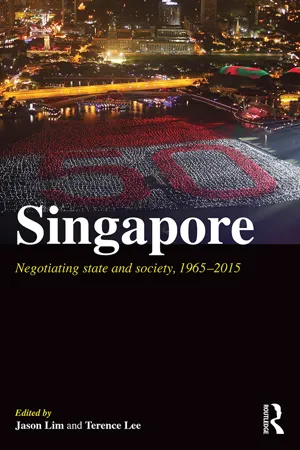
On Sunday, 9 August 2015, the Republic of Singapore celebrated its 50th year of independence as part of a long weekend of festivities and celebratory events. With Friday, 7 August, declared a one-off public holiday, along with Monday, 10 August, also a public holiday by default, Singaporeans were encouraged to participate in the unprecedented nationwide celebration. In fact, the entire year of 2015 – codenamed SG50 – was dedicated as the year to commemorate Singapore’s Golden Jubilee. Planning for SG50 started back in 2013 for the city-state to mark this important milestone in its national history. An organising committee was formed to coordinate a mega concert called Sing50 that showcased 50 songs in different genres and in the four official languages sung by local artistes past and present.1 The concert held at the National Stadium on 7 August 2015 not only celebrated local music, it evoked poignant memories for the audience when an elegy to the nation’s late founding prime minister Lee Kuan Yew was played by an orchestra, accompanied by images of Lee on large screens.2 Indeed, the passing of Lee Kuan Yew earlier in the year – on 23 March 2015 – and the unprecedented week of national mourning that followed meant that SG50 took on a heightened level of significance in Singapore that no one could have predicted.
Even without factoring the legacy effect of Lee Kuan Yew into the picture, the Singapore government had already intended SG50 to be an unforgettable celebratory year, ideally one that would renew Singaporeans’ allegiance to their country. To this end, a commemorative birth certificate was unveiled on 13 October 2014 by Ms Grace Fu, minister in the Prime Minister’s Office, to be issued to all babies born in Singapore in 2015.3 When President Tony Tan visited London in late October 2014, he urged Singaporeans abroad to join in the celebrations regardless of where they were residing.4 A SG50 website (www.singapore50.sg/) was set up to explain that the SG50 logo, comprising a ‘little red dot that we’ve come to know as home’, was designed to ‘celebrate the Singapore spirit – signifying that our dreams are not limited by the physical size of our island nation’. Visitors to SG50 were urged to download the logo and ‘use it to show your love in your own way’.5 But in a somewhat typically Singaporean fashion, the use of the SG50 logo was circumscribed by ‘brand rules’ that underscore the need to ‘treat it with dignity and respect, and in accordance with Singapore laws’. Even so, the branding of ‘SG50’ had its fair share of misappropriation by businesses seeking to exploit the logo for personal gains.
The SG50 Steering Committee was chaired by Minister of Education Heng Swee Kiat, with Minister for Culture, Community and Youth Lawrence Wong as the SG50 Programme Office head. The appointment of two younger generation ministers, who were only elected into parliament at the general election (GE) of 2011, as leaders of the SG50 celebrations is symptomatic of the message of renewal that the government was ultimately seeking to relay in 2015.6 Other committee members were also carefully selected, comprising other ministers, business people, professionals, academics and musicians. Members of both genders and different races were represented on the committee. However, there was no obvious presence of any opposition party members on the committee. Celebrations to mark 50 years of independence started with the New Year’s Day Countdown on 31 December 2014, with a calendar of events that would continue throughout 2015, climaxing with what became seen as one of the grandest – if not the most spectacular – National Day Parade ever witnessed in Singapore on 9 August 2015.
At a press conference in June 2014 to publicise the SG50 programme, Heng Swee Kiat mused that there would be three themes to the celebrations – ‘one is about reflecting on our past, and it’s about celebrating our present and committing to the future’.7 It is hoped that this book will be useful to Singaporeans in enabling them to reflect more critically on their past, as well as to non-Singaporeans in helping them understand more about some of the discourses that have shaped modern Singapore, many of them not so well articulated in the public domain. After 50 years of independence, we contend that it is time to consider the challenges Singapore has faced and overcome since independence. Reflecting on the past will help establish a roadmap for the future of Singapore, which we present as another – a more considered, albeit less emotive – way of embarking on national renewal.
Looking at the members and programme of the SG50 Steering Committee, it is clear that memory, heritage and the arts would play a prominent part in the national celebrations. In addition, there was the constant reminder of the need to promote Singapore’s ‘national identity’, rooted in the city-state and associated with such diverse entities as food, music, the arts and places of interest. In addition to the National Day Parade on 9 August 2015, the permanent galleries of the National Museum were overhauled (and scheduled to be re-opened by September 2015), and a new national gallery was slated for completion in November 2015. The SG50 celebrations would continue through the 28th Southeast Asian (SEA) Games in June 2015 and the 8th ASEAN (Association of Southeast Asian Nations) Para Games in December 2015, both of which had Singapore playing host. Senior Minister of State (Law and Education) Indranee Rajah called the collective SG50 activities a celebration of ‘the essence of Singaporean-ness and the journey we’ve made as Singaporeans’.8
While the 50th year of independence should indeed have been celebrated, it is the exclusion of what has been described as ‘the essence of Singaporean-ness’ and the ‘journey’ Singaporeans had embarked on after 1965 that draws our attention. History and memory have become the new political battlegrounds of independent Singapore. In his National Day Broadcast of 1969, then prime minister Lee Kuan Yew said:
History is valuable as a guide to the future. It provides insights into the nature and potentials of various peoples, because both the innate qualities and the cultural characteristics of a people do not change easily or quickly.9
However, at the point of independence on 9 August 1965, the new country had plans to curb unemployment, promote industrialisation and ensure social cohesion. School subjects such as General Science and Technical Studies were regarded as holding the keys to Singapore’s future. In an earlier work, Jason Lim noted that the Singapore government did not see history as a subject worth promoting.10 The history curriculum was revamped with the publication of a new two-part text-book Social and Economic History of Modern Singapore in 1983. The new curriculum was launched by then Minister of State (Education) Dr Tay Eng Soon, who noted that:
It will focus the students’ attention on the growth of Singapore from a tiny trading port to a modern metropolis. And it will trace this development in terms of the social and economic conditions of the people who came to live and work here.11
The push for Singaporeans to understand the country’s history usually arises from a belief that younger Singaporeans remain ignorant of the country’s past. In his speech, Dr Tay also noted the danger of ‘utilitarian-minded’ Singaporeans dismissing the study of history, since ‘if we do not know our own national history, then one day indeed we as a nation would be in danger of being dead and gone’.12
However, the People’s Action Party (PAP) government has been careful to emphasise that only the ‘facts’ of history need be known. History should remain static, with specifically chosen ‘facts’. There should be no debate about what really matters in history: perspective. The template of history must include the achievements of the PAP since its first electoral victory in June 1959. Official histories published by government ministries and statutory boards have both marginalised (or ignored) the achievements of pre-1959 governments and ignored the political opposition in post-1965 Singapore. While Singapore: An Illustrated History published by the Ministry of Culture in 1984 lists some of the anti-colonial struggles of the Labour Front government (1955–1959) and features some snapshots of opposition figures in the 1970s and 1980s, subsequent official publications give the impression that Singapore is, and has always been, a one-party state.13 Indeed, history is seen as an arena of uncontested ‘facts’. In 1984, then second deputy prime minister S. Rajaratnam told his audience at the Pre-University Seminar that, since events of the past could not be changed, ‘the “who, what, when and where” presentation of history can be no more than a carefully disguised plagiarism’.14
The dissemination of carefully selected ‘facts’ and their use in a fixed template reveals the government’s desire for ‘cultural control’, i.e. over public history and personal memory.15 While Singapore should no doubt celebrate its 50th National Day, the government has sought to ensure that Singaporeans do so by reflecting on the good works of the PAP. All the programmes of the SG50 Steering Committee either highlight the PAP government’s achievements or encourage a ‘feel good’ factor through the promotion of nostalgia. That nostalgia would then be contextualised within ‘the bigger picture’ of socio-economic progress, the result of workable government policies. The editors and authors in this volume disagree with this approach to understanding Singapore history and society. We are reminded that, in the first of six lectures delivered at Cambridge University in 1961, the noted historian Edward Hallett Carr argued that ‘history means interpretation’.16 This book thus sets out to look at the history of Singapore since independence from different perspectives. History is not a dead subject; it is constantly changing as previously unknown documents are brought to light, old government records are released for research use and old issues are revisited in order to get a different perspective of society, culture and politics. We contend that history is not about the ‘truth’ of the past or unchanging ‘facts’. In the changing political atmosphere in Singapore, the national past is now being re-studied and retold. The result is an ongoing debate about how the past should be remembered, if not re-evaluated.
Thus, the aim of this book is to re-evaluate issues in Singapore’s contemporary history so that those with an interest in Singapore – and the region around it – can derive a nuanced understanding of contemporary Singapore society. There are contributions by twelve Singapore scholars, both established and emerging, and each writer takes a close look at a specific issue that has affected Singapore and Singaporeans since independence in August 1965. For each issue, there will be a government perspective that has already been publicised in newspapers, broadcast media and publications. Each writer revisits the selected issue and offers a new interpretation or perspective. The aim of the book is not to put a dampener on the achievements of the PAP government since independence but to look at how certain policies enacted by the government could have affected Singaporeans in a different manner and possibly resulted in a different contemporary Singapore. Before we introduce the contents of the chapters in the book, we contextualise the narratives that collectively make up the nation ‘Singapore’ by recounting Singapore’s official history.
A very short version of Singapore’s official history
Singapore’s modern history can be considered to have started when Sir Thomas Stamford Raffles, an official with the British East India Company (EIC), landed on the shores of the island in January 1819. In 1826, Penang, Malacca and Singapore formed the Straits Settlements. In 1867, the administration of the Straits Settlements was transferred to the Colonial Office in London. The period from 1867 to 1941 was one of unprecedented economic growth and large-scale immigration. These new migrants also brought with them social, educational, business and religious practices inherited from their homelands. By the time of the 1849 census, the Chinese constituted the ethnic majority in Singapore at 53 per cent; this figure rose to 75 per cent by the time of the 1931 census.17 The growth of the tin and rubber industries in Peninsula Malaya gained greater importance with British ‘intervention’ in the Malay States between 1874 and 1914. With the Great Depression in the 1930s, the British colonial government attempted to slow down the rate of Chinese immigration into Singapore, but the island continued to be of interest to the British government in London. A large naval base was built in the...