- 224 pages
- English
- ePUB (mobile friendly)
- Available on iOS & Android
eBook - ePub
About this book
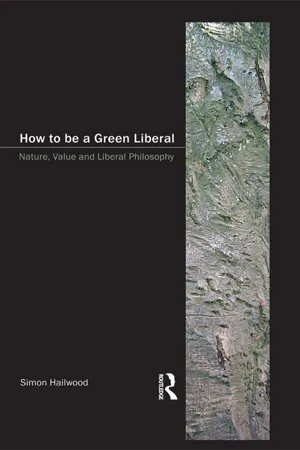
It is often claimed by environmental philosophers and green political theorists that liberalism, the dominant tradition of western political philosophy, is too focused on the interests of human individuals to give due weight to the environment for its own sake. In "How to be a Green Liberal", Simon Hailwood challenges this view and argues that liberalism can embrace a genuinely 'green', non-instrumental view of nature. The book's central claim is that nature's 'otherness', its being constituted of independent entities and processes that do not reflect our purposes, is a basis for value and can be incorporated within liberal political philosophy as a fundamental commitment alongside human freedom and equality. Hailwood argues that the conceptual resources already exist within mainstream liberalism for a thoroughly non-instrumental perspective. Adopting a rigorous philosophical approach Hailwood tackles a wide range of themes across environmental ethics, including holistic theories, deep ecology, eco-feminism and eco-anarchism, as well as issues in value theory and political philosophy more generally. In making the case for liberalism's green credentials "How to be a Green Liberal" is a formidable challenge to recent green political theory and will be required reading not only for students of political philosophy but for all those interested in the natural world and man's relationship to it.
Information
CHAPTER 1
Introduction
1.1 Being green
If or when man-made environmental calamities bite more deeply it is likely that so will the tendency to blame liberalism as the dominant tradition of Western political philosophy. Therefore it is politically and culturally important, as well as philosophically interesting, to identify and emphasize any green resources latent within that tradition. In this book I shall argue for a green form of liberal political philosophy, and seek to show how a green perspective can and should be developed within liberal political theory.
An important preliminary question is this: what should we take “green” to mean in this context? First of all I take being green to involve the denial of a purely instrumentalist view of non-human nature. To be green in this sense is to reject what John Gray has called “normative individualism”: the view that “nothing has ultimate value except states of mind or feeling, or aspects of the lives of human individuals”.1 So, again, to say that a green liberalism is possible is to claim, contrary to much prevailing wisdom, that liberalism need not be saddled with what Richard Sylvan called the “sole value assumption”:
According to this major assumption, which underlies prevailing Western social theory, humans are the only things of irreducible (or intrinsic) value in the universe, the value of all other things reducing to or answering back to that of humans in one way or another.2
There is, however, a bit more to being green, as I understand it here, than rejecting a purely instrumental attitude towards the non-human. In effect, this is rejected also by those seeking to overcome “speciesism”, who claim, for example, that any sentient “subject of a life” is worthy of a respectful treatment appropriately marked by granting rights to such treatment,3 or that any sentient being capable of forming preferences should be taken into account in overall utility calculations.4 And these sorts of claims can plausibly be seen as extensions of different variants of liberalism.5 But there remains an important sense in which these theories are nevertheless committed to a normative individualism. The value of everything else is referred back to the interests or preferences of sentient biological individuals, it’s just that only some of these happen to be human. Whatever merits such claims have in themselves, it remains true that many of the natural items to which environmentalists attach direct, non-instrumental importance – plants, species, rivers, forests, mountain ranges, ecosystems and so on – are not sentient, or even biological individuals, at all. In order to capture this, I will take being green to involve rejecting normative individualism in this context as well as in its purely anthropocentric sense.6
It would be a mistake, though, to characterize being green generally as a matter of overcoming anthropocentrism. A number of writers have warned recently against adopting non-anthropocentrism as a basic commitment within environmental ethics and green political theory.7 In some of its senses, anthropocentrism – human centredness – is ineliminable and benign. So to march beneath the banner of non-anthropocentrism is to invite confusion at the least, and possibly the strategically disastrous impression that the green theorist does not care all that much for human beings in general, or has not noticed that some human beings are a great deal more culpable than others in the production of environmental ills. What is ruled out by the green perspective adopted in this book, however, is human centredness in the sense of seeing the value of the world as entirely derived from, or reducible to, our commitments to ourselves, other people or human interests in general (including future generations of human beings). This form of anthropocentrism, that of the sole value assumption, I will generally refer to as “instrumentalism”. It is obvious that our duties to each other and ourselves require that we recognize the instrumental importance to us of wider nature. But I am taking it that to be green is to recognize also its non-instrumental significance; that it is not just there as a resource for human beings to use or enjoy with more or less foresight.8 Still, being green, as I am understanding it, cannot be equated with being non-anthropocentric because it involves some inescapable, even welcome, forms of anthropocentrism.9 On the other hand, notions like human chauvinism, racism or speciesism are not satisfactory alternatives to the troublesome notion of anthropocentrism. They tend to be about the arbitrary discounting of non-human interests, but, as just indicated above, that still involves a kind of normative individualism that excludes adequate – direct, non-instrumental – consideration of aspects of nature that have no interests.10 I reserve “green” then for views that (i) are non-instrumentalist, and so say that humanity and human interests are not the be-all and end-all – concern for non-human nature should not enter into our consideration only in so far as it serves our interests for it to do so – and (ii) do not confine direct, non-instrumental concern to biological individuals with interests.
1.2 Being green matters
It might be thought excessively tendentious to restrict being green in this way. Given that other approaches might sanction the same, or very similar, practical measures vis-à-vis the natural world, declaring that they are not really green might seem a trivial semantic snub. If we unpack all the ways that present and future humanity depend on the rest of nature as a physical, aesthetic, recreational, medical and spiritual resource, then we see that a purely instrumentalist starting point can take us far down the road of environmental protection. Presumably even further when we also consider, in non-speciesist fashion, the instrumental value of things relative to non-human interests.
One cannot respond adequately to this just by asserting that it is not really green to aim at (what many would call) green outcomes for say “brown” (purely human instrumentalist) reasons. It simply begs the pragmatic response, “Well, so what? If what one cares about is the state that nature is in, then surely it is the practical consequences for nature of our actions and policies, rather than the mode of reasoning or evaluation that justifies the action or policy, that matters.”11 However, even if this response is taken to be decisive in theory, in practice it remains true that there are greens about who insist on rejecting a purely instrumentalist view of wider nature. Given this, it remains a worthwhile task to show how such a perspective may be embraced by liberal political philosophy. And given that there are plenty of liberals about, it would at least be interesting if some progress could be made in showing that, in the light of their other commitments, they should be green, especially if the liberal commitments in question are usually taken to exclude such progress. There will be much more on this issue in what follows. But consider now that the pragmatic response just sketched is not decisive in principle. There is the question of what non-human nature means to us.12
What if (part of) what X means to us is that it is something owed respect for its own sake, independently of instrumental considerations? It surely matters whether this is the meaning X has, and it matters independently of any consideration of the consequences for it of it having this meaning for us, as against the consequences for it of having a different meaning (say that of a highly prized, because very useful, perhaps irreplaceable, instrument). It seems to matter in much the same way as it matters whether one views political society as a kingdom of means, or as a kingdom of ends. Say I conceive of society only as a kingdom of means: other people, and my relationships with them, including those involved in political institutions, have significance to me only as means to securing my self-interest. Say also that I can be brought to believe that the most rational, clear-eyed view of my self-interest requires me to support exactly the same liberal political institutions, rights distributions and principles of justice as if I viewed others as fellow members of a kingdom of ends. Still, it matters in which of these two ways I view others. Consider cases of the following kinds: imagine a society in which standard liberal democratic rights and liberties are enforced internally and generally adhered to, but only because it is believed that this is what God has decreed, and eternal punishment awaits the disobedient ones; or because it is believed that a foreign superpower will deliver nuclear annihilation otherwise; or because it is believed that very powerful international trading interests will deliver economic ruin otherwise. One might say that it does not matter if individuals in such societies are effectively “forced to be free”, what matters is that they live in a liberal democratic society, and it makes no practical difference whether or not this is the kind of political organization they would go for in the absence of external threats. But I take it that such a view would not quite capture what “liberal democracy” means to (at least many) liberals.
The point I am labouring here is that it does matter what the motivating reasons are for protecting X (independent nature or liberal democracy, say). It matters whether X is valued instrumentally or non-instrumentally, even if the consequences for it are exactly the same in both cases; it matters at least partly because of the different meaning X has for valuing agents in the two cases. But, of course, once we see this then we see that it is extremely unlikely that the practical consequences for X will be the same whether it is valued instrumentally or non-instrumentally. The difference in meaning between the two cases consists partly in differences in the onus of justification of actions related to, or aimed at, X. If X is valued only instrumentally as a means to Y, then the onus is on those objecting to its being used, exploited, interfered with, en route to Y, to show that a better route to Y, or to some weightier end, involves leaving X alone. But if X is valued non-instrumentally this is not the case; the onus then is on those who would use it as a means to something else, to justify doing so. Certainly, when X is a human being, and so is viewed non-instrumentally, it does not follow that X can never properly be used, manipulated or interfered with. Rather, it means that sufficient justification is required. Similarly with non-human nature: to reject a purely instrumental view does not mean that nature can never be used (as if that was even possible), but that a sufficient justification is required. This seems to be right, and certainly at the level of principled discussion and policy-making about the natural environment, a shift from instrumental to non-instrumental valuation would probably have a profound effect.13
I am taking it that (really) being green involves rejecting the suggestion that non-human nature (not just biological individuals) has meaning only as an instrument, perhaps even a beautiful and irreplaceable instrument. Obviously, this is consistent with the anthropocentric recognition that nature is also of great instrumental importance to humanity.14 Indeed, another important consideration here is that instrumental reason may be buttressed by non-instrumental reason. If X is valued non-instrumentally as an end, as well as instrumentally as a means to some other end Y, then its being valued is (relatively) immune to changing circumstances, such as a better means to Y being discovered. X’s status as a valuable object is more stable in that sense. An example of this is John Rawls’s distinction between political liberalism supported as the basis of an “overlapping consensus” (a plurality of views converge on it as an end in itself) or as a modus vivendi (an expedient means to desired cooperation or security). A modus vivendi is less stable because the rationale for it can be undermined by such events as a change in the balance of power between the involved parties.15 In the case of nature’s value, a green suspicion is that purely instrumental considerations are unlikely to yield the same outcomes for nature as non-instrumental ones, at least in the longer term, precisely because they do not give any weight to nature for its own sake. We might say that, unless buttressed with non-instrumentalist considerations, a purely instrumental approach can manage only (something like) a modus vivendi with nature, the rationality of which is contingent on the circumstances,16 particularly a relatively low level of technological capability to control what are now natural processes, or produce artificial or virtual analogues of particularly enjoyable parts of nature.17 We need to respect independent nature at the moment. But in the future?
For example, this suspicion seems to tell even against Marcel Wissenburg’s “restraint principle”, perhaps the most important and successful element of his recent attempt to incorporate environmental considerations with liberal theory.18 The restraint principle is a revamped version of Rawls’s (revamped) just savings principle,19 and expresses the idea that intergenerational justice requires maximum restraint in the use of both natural and artificial “capital”. The restraint principle says:
no goods shall be destroyed unless unavoidable and unless they are replaced by perfectly identical goods; if that is physically impossible, they should be replaced by equivalent goods resembling the original as closely as possible; and if that is also impossible, a proper compensation should be provided.20
On the face of it, this seems to be a very strict principle, placing radical restrictions on the present generation(s) that protect the interests and preferences of distantly future generations. However, the (reasonable in themselves) qualifications in the restraint principle – “unless unavoidable”, “unless they are replaced by”, “if”, “physically impossible”, “as closely as possible”, “if that is also impossible, a proper compensation” – may well raise reasonable suspicions from a green perspective. What is or is not “possible”, and what may or may not count as a “proper compensation” in these terms, depends in large part on the state of technology, and humanity’s changing capacity to supply artificial means to desired ends, means currently supplied by nature. In the extreme case:
You say you (would) derive great satisfaction from encountering the natural world, real wildlife and all? Well, step up and enter my Experience Machine! For a small (well actually pretty large) fee, you too can have the satisfying experience of an encounter with the natural world! What do you mean it is not the same? It would not be really real? I promise you that your subjective experience will be real, and once you are plugged in to our new deluxe model you will quite forget where you “really” are, and be completely unaware of any artificiality until the program ends. Or your money back. And besides, so what if it is artificially produced? Surely what really matters is your subjective satisfaction.21
1.3 Dismal instrumentalism
It is certainly true that green political theory and environmental ethics should not completely divorce, and place in opposition, concerns for non-human nature and legitimate anthropocentric concerns,22 including anxieties about the impact of environmental problems on human welfare. At least, green thought aiming at a positive impact should try to avoid alienating the public and politicians in this way. Notwithstanding this, in the context of buttressing instrumental with non-instrumental reason, it is worthwhile considering also that much eco-political theory, like much environmental thought and action generally, takes as its point of departure a set of very gloomy facts and predictions about the current or impending environmental catastrophe. This has various elements: soil erosion; global warming and climate change (rise in sea level, destruction of agriculture, Atlantic conveyor switch-off turning much of northwest Europe into tundra, etc.); a huge reduction in biodiversity (we are living through one of the few “mass extinction” events known to science); ozone depletion and so on. Call this the “gloomy story”: it tends to make environmentalism a gloomy subject. This is not to say the story is false, or unimportant, of course. But what transforms it into something unremittingly dismal (making it the new truly “neo-Malthusian dismal science”, as it were) is the focus on the consequences for humanity of the environmental crisis. This is why it counts as a crisis: it is a very bad thing for us. The tendency, then, is to argue that if we don’t radically transform o...
Table of contents
- Cover
- Half Title
- Title Page
- Copyright Page
- Table of Contents
- Acknowledgements
- 1 Introduction
- 2 Nature’s otherness
- 3 Against blueprinting
- 4 Liberal landscape
- 5 Some objections
- Notes
- Bibliography
- Index
Trusted by 375,005 students
Access to over 1.5 million titles for a fair monthly price.
Study more efficiently using our study tools.
Frequently asked questions
Yes, you can cancel anytime from the Subscription tab in your account settings on the Perlego website. Your subscription will stay active until the end of your current billing period. Learn how to cancel your subscription
No, books cannot be downloaded as external files, such as PDFs, for use outside of Perlego. However, you can download books within the Perlego app for offline reading on mobile or tablet. Learn how to download books offline
Perlego offers two plans: Essential and Complete
- Essential is ideal for learners and professionals who enjoy exploring a wide range of subjects. Access the Essential Library with 800,000+ trusted titles and best-sellers across business, personal growth, and the humanities. Includes unlimited reading time and Standard Read Aloud voice.
- Complete: Perfect for advanced learners and researchers needing full, unrestricted access. Unlock 1.5M+ books across hundreds of subjects, including academic and specialized titles. The Complete Plan also includes advanced features like Premium Read Aloud and Research Assistant.
We are an online textbook subscription service, where you can get access to an entire online library for less than the price of a single book per month. With over 1.5 million books across 990+ topics, we’ve got you covered! Learn about our mission
Look out for the read-aloud symbol on your next book to see if you can listen to it. The read-aloud tool reads text aloud for you, highlighting the text as it is being read. You can pause it, speed it up and slow it down. Learn more about Read Aloud
Yes! You can use the Perlego app on both iOS and Android devices to read anytime, anywhere — even offline. Perfect for commutes or when you’re on the go.
Please note we cannot support devices running on iOS 13 and Android 7 or earlier. Learn more about using the app
Please note we cannot support devices running on iOS 13 and Android 7 or earlier. Learn more about using the app
Yes, you can access How to be a Green Liberal by Simon A. Hailwood in PDF and/or ePUB format, as well as other popular books in Philosophy & Ethics & Moral Philosophy. We have over 1.5 million books available in our catalogue for you to explore.