A Sociology of Crime has an outstanding reputation for its distinctive and systematic contribution to the criminological literature. Through detailed examples and analysis, it shows how crime is a product of processes of criminalisation constituted through the interactional and organizational use of language.
In this welcome second edition, the book reviews and evaluates the current state of criminological theory from this "grammatical" perspective. It maintains and develops its critical and subversive stance but greatly widens its theoretical range, including dedicated chapters on gender, race, class and the post-als including postcolonialism. It now also provides questions, exercises and further readings alongside its detailed analysis of a set of international examples, both classical and contemporary.
It doesn’t matter where we start, so let’s jump right in. Crime is readily at hand. Check the news feed on your cell phone. What crime stories are being reported there? On New Year’s Eve 2015, the Flipboard daily edition had the following headlines, among others: “Security Raised at New Year Celebrations Amid World Terror Fears”; “Ramadi residents fleeing ISIS: ‘They want to use us as human shields’”; “TCU QB Boykin charged with felony assault, suspended”; “Bill Cosby Accuser Beth Ferrier on His Arrest for Decade-Old Alleged [Sexual Assault].” In August 2016, Canadian supermarket checkout stands announced “Canada’s New Crime Wave” on the front page of Maclean’s (“Canada’s National Magazine”). In the last days of the 2015 Canadian federal election campaign, as this writing was under way, the national news spoke of radio and print ads put out by Prime Minister Stephen Harper’s Conservatives targeting Justin Trudeau’s Liberals, saying that the latter would, if successful in winning the election, make marijuana available for sale to children and would bring prostitution in the form of brothels to residential neighbourhoods.1 The ads were being released in areas of the country with large South Asian populations.
The early part of the election campaign was dominated by the trial of Mike Duffy, a Harper-appointed senator, former journalist and Canadian national media celebrity who, in July 2014, was charged with 31 offences including bribery, and fraud and breach of trust in relation to C$90,000 in expenses that he claimed inappropriately as a senator.2 Throughout the campaign, calls persisted for a national inquiry into “missing and murdered aboriginal/indigenous women.”3 The end of the campaign was distinguished by the display of tough-on-crime Harper holding a rally fronted by the Ford brothers. Rob Ford was the mayor (and thereby chief magistrate) of Toronto, known world-wide for his admitted addiction to crack cocaine; he had been investigated by police.4 One could multiply such examples with equivalent cases from the United States, the United Kingdom, Australia and New Zealand, indeed from virtually every country in the world.
Local news in Halifax, Nova Scotia, where the writing of this book was being done, was reporting the testimony of a police officer at the murder trial of Dennis Oland, charged with killing his father, Richard Oland. The family were founders of Moosehead Beer. The officer was saying that he was urged to lie on the stand by a more senior officer.5 Those subscribing to truthout.org would have found in their email inbox the following blurb heralding one of the articles in this daily news digest: “According to a new lawsuit, two psychologists earned more than $80 million for developing a set of brutal interrogation methods and supervising their use on detainees in secret overseas CIA prisons, which led to the death of one man and the traumatization of two others”; they were accused of being in a “‘criminal enterprise’ with [the] CIA over torture.”6.
You can confirm the ready availability of crime by going to the website of your local newspaper or radio or TV station and scrolling through the headlines, or by browsing the channel guide on your television. Crime stories and crime shows abound (although they might more appropriately be called “police” shows). The business pages of the major dailies are a particularly rich source, while the big chain bookstores still display a shelf called “True Crime.” You can ask yourself whether crime has or has not been the topic of at least one conversation you’ve already had today, whether in person, by phone or text or online. Perhaps it was about that assault at the university residence, or the episode of some crime show or movie you watched last night. Or perhaps the last book you read for pleasure was a “police procedural,” a crime thriller or detective story. You may be able to recount details of the last mass shooting reported in the United States, recall the names of notorious serial killers or put a face to the last African American shot dead by a white police officer in the land of the free; US police killed 1,126 people in 2015, killing blacks at twice the rate as whites.7 You know how to call the police, and may well have seen the inside of your local courthouse. You are familiar with the uniformed security officers you see everywhere, who look like police and have quasi-police powers, not to mention the security cameras at every turn. Where you live may be a “neighbourhood watch” community, and you may have received a recorded phone message informing you of some local crime concern. You lock your doors at night. You will recognize police cars and police officers (on foot, on bikes, on horses, on motorcycles) when you see them on the streets and highways you frequent, or at televised funerals for “fallen officers,” at memorial parades and ceremonial events or during seasonal roadside “blitzes” for drinking and driving. You may have been kettled (contained) by them at a protest or demonstration. You may recall the visit of a police officer to your school or your child’s school. You will probably have an opinion about the desirability of capital punishment, the criminalization of abortion, the legalization of marijuana (see also Potter and Kappeler 1998: vi). You may have strong feelings about terrorism, violent crime, “pedophiles,” gangs, the War on Drugs, cyberstalking, solitary confinement, drinking and driving, sexual assault, criminals who “get off easy,” mandatory minimum sentences, whether “Black Lives Matter,” home invasions, Oscar Pistorius.8 These feelings may have been stoked by the election platform of one or other of the political parties vying for your vote recently. The notice board in the shop where you bought coffee this morning may have sported a poster like this one advertising a play: “Hard Boiled: A Sal Dali Crime Tale.” Or, on the surface of the paved trail where you run each day, there may look back at you in stark, hard-to-remove capital letters the slogan, “MEAT IS MURDER.”
Moreover, you yourself may have been the victim of crime. Your house or car may have been broken into, your purse snatched, your corner store held up, your local bank robbed, your credit card or other form of identity stolen, your property vandalized, your person assaulted, your village or town destroyed. If it hasn’t happened to you, you will probably know of a relative, friend, neighbour or local resident who has been victimized by such an act, or you will have seen it on the news.
Such an experience may, in fact, have prompted you to be interested in crime, interested enough to have picked up or uploaded this book, perhaps even bought a copy of it (thank you). In that case, you are probably taking a university course with crime, law or justice in its title. And the course may well be part of a program in criminology or criminal justice or sociology or legal studies of the sort that is popular in colleges and universities. Such a course may afford you contact with one or another component of the criminal justice system (CJS) – the laws, police, courts, probation offices and correctional institutions in all their various forms. You may be taking such a course while in prison. You may be familiar with institutions ancillary to the CJS such as crime prevention councils, legal aid, victims’ and other legal services, youth or community justice initiatives, shelters for battered women, rape crisis centres, organizations such as Citizens Concerned With Crimes Against Children, ex-offenders’ support organizations such as the Elizabeth Fry and John Howard societies, advocacy groups such as Mothers Against Drunk Driving (MADD) or Victims of Crime. Moreover, you are almost certainly an offender yourself.
“What? I’m not a criminal,” you say. Well, think about it for a minute. There’s all the underage drinking you’ve done, whether or not you were drunk and disorderly in public or drove (a car or boat) under the influence of alcohol or drugs or without a licence. Unless the criminal law has been recently changed where you are, then your possession and use of marijuana and/or its derivatives in other than very small quantities is almost certainly a criminal offence, not to mention any dealing you may be involved with. But if you are not smoking dope, you are most probably illegally downloading copyrighted material from the internet, which is called piracy. Then there’s the impersonation or fraud you committed with the fake ID, the money or goods you stole from work, the tax evasion you practise or are party to – you know, being paid by your family’s business for work you never did so as to lower your parents’ taxes. One of the two authors of this book was caught travelling on a French train with his step-daughter’s expired Eurail pass. Some of you will have committed more serious offences such as assault, including, if you are male, sexual assault, or theft or causing property damage. If we add in what are sometimes called quasi-criminal offences, notably breaches of your jurisdiction’s version of the Province of Ontario’s Highway Traffic Act, which includes speeding and other traffic offences, then virtually nobody escapes the label of criminal (see Tisdale 1998).
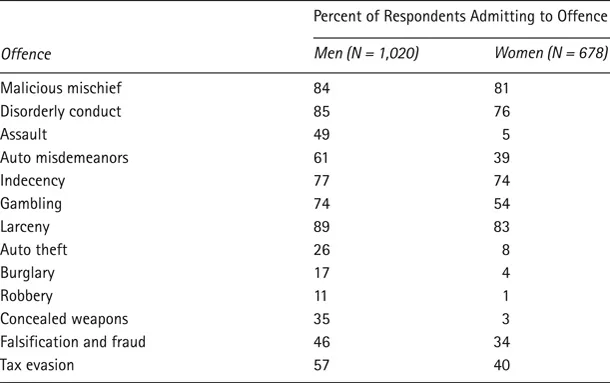
Students in Eglin’s sociology of crime course, in informal surveys conducted more or less annually through the 2000s, reported their participation in crime at the following roughly average rates (for selected offences): drinking and driving, 40 per cent; drinking/drunk in public, 65 per cent; drinking under age, 85 per cent; indecent behaviour, 50 per cent; disturbing the peace, 30 per cent; theft, 60 per cent; damage (vandalism), 40 per cent; forgery, 55 per cent; piracy, 65 per cent; drug offences, 70 per cent; assault, 15 per cent. The point was made most famously in the table reproduced in Figure 1.1 from Wallerstein and Wyle’s 1947 US study as reprinted in Thomas Gabor’s (1994) appropriately named book Everybody Does It! Crime by the Public, in which he documents the point at length.
Figure 1.1 Members of the public admitting to lawbreaking
Source: Gabor (1994: 55). Original source: Wallerstein and Wyle (1947: 110).
Wallerstein and Wyle state:
Perhaps the principal conclusion to be drawn from this study is the revelation of the prevalence of lawlessness among respectable people … From this angle the punitive attitude of society toward the convicted offender becomes not only hypocritical but pointless.
(Wallerstein and Wyle 1947: 118)
Except, of course, that not only do you not think of yourself as a criminal, you’ve never actually been apprehended for such an offence (although more than a few of you certainly have), let alone been charged, tried, convicted or sentenced for such an offence, so that it may be said of you that you got away with it. The label was never applied. “Getting away with” crime is very much part of the crime landscape. Indeed, the fact that crime may be got away with means that it is not a naturally self-revealing thing. It must be shown to be such. While we are inclined to think that an action in itself is or is not criminal, we are prepared to allow that it must be identified, observed, apprehended or detected as such; such that if that labelling does not occur in any particular instance, we do not become “criminal” in any socially meaningful sense. So, although we may retain the sense that our action was, indeed, a criminal one, and that we did indeed get away with it, it does not follow that we think of ourselves as criminals. So there are crimes and there are criminals. The two do not necessarily equate.
We know, too, that for an action to be found to be a crime, in the end it must be shown to have been committed with criminal intent (although there are exceptions like drinking and driving). The gun could have gone off accidentally, the child could have been too young to appreciate the gravity of the act, the adult may not have been criminally responsible by virtue of mental illness, mental handicap or having been forced. The act could have been in self-defence. The homicide may have been justifiable if carried out by, say, a uniformed soldier in combat. Accusations can be false, identities mistaken, evidence tainted, witnesses hostile, charges withdrawn, sentences can be inadequate or excessive, convictions wrongful. Crime, in short, is a contested category, and we know it.
Whether you are interested in crime or not, you know that many people in society cannot help but be “interested” in it as it is their job to engage with it on a daily basis. A considerable range of occupations deals with crime, from police to Supreme Court Justices, from legal secretaries to crime scene investigators, from narcotics divisions to war crimes units, from crime beat reporters to prison guards, from academic criminologists to Ministry of the Attorney-General researchers and so on. Some types of crime are engaged in by some people on a more or less occupational basis like drug trafficking and drug dealing, armed robbery, safe cracking, shoplifting, contract killing, burglary, living off the avails of prostitution, human trafficking, assassination of official enemies, state terrorism, accounting fraud, bribery of officials and so on. See, for example, The New Confessions of an Economic Hit Man by John Perkins (2016) or “The bribe factory” (2016).9
Crimes, then, have perpetrators or offenders, the ones who commit the offence, and victims, the ones who suffer the loss attending the offence. We allow, though, that some crimes may be thought of as “victimless,” as the only one harmed, if anyone, appears to be the offender him-or herself. And some may acquire the status of what Joseph Gusfield, referring to drinking and driving, calls “moral fault without censure”: “at the level of public attention there is the persistent and shrill cry for more punishment; at the level of daily events there is the negotiation between lawbreakers and law enforcers and the continued existence of prohibited acts” (Gusfield 1981: 132). Taking this a step further, Eglin will never forget regularly witnessing a posse of Mexican police standing waiting to go on (or come off) shift, quite oblivious to cars driving past them using the off ramp to drive on to the periferico (a major highway) at the Plateros exit in Mexico City; or another group of such police quite openly and nonchalantly guarding an illegal casino set up in the middle of the Cuernavaca Fair in 2004 (Cuevas Villalobos 2004).
Nevertheless, crimes, we say, are wrongs. They are not morally neutral. When such acts occur, they are not mere matters of interest but, depending on their nature and gravity, they elicit moral condemnation, not only from their victims but from society generally. They demand redress, we say, in the form of punishment of the offender or restoration of the victim’s loss or both. And we have institutions specifically designed to provide those remedies. That “loss” can be in the form of terrible physical or emotional damage suffered by the victim, which may last for years in the form of post-traumatic stress disorder (PTSD). The offence caused by the crime to the integrity of the victim’s person can be extended to their home or other possessions, to their family and friends. A “wave” of offences in a particular area may occasion a crime ...
Table of contents
Cover
Half Title
Title Page
Copyright Page
Dedication Page
Contents
List of figures and boxes
Preface
1 Sociology
PART I Positively undertaken
PART II Interpretatively turned
PART III Politically challenged
PART IV Epistemically undermined
References
Index
Trusted by 375,005 students
Access to over 1.5 million titles for a fair monthly price.
Study more efficiently using our study tools.
Frequently asked questions
Yes, you can cancel anytime from the Subscription tab in your account settings on the Perlego website. Your subscription will stay active until the end of your current billing period. Learn how to cancel your subscription
No, books cannot be downloaded as external files, such as PDFs, for use outside of Perlego. However, you can download books within the Perlego app for offline reading on mobile or tablet. Learn how to download books offline
Perlego offers two plans: Essential and Complete
Essential is ideal for learners and professionals who enjoy exploring a wide range of subjects. Access the Essential Library with 800,000+ trusted titles and best-sellers across business, personal growth, and the humanities. Includes unlimited reading time and Standard Read Aloud voice.
Complete: Perfect for advanced learners and researchers needing full, unrestricted access. Unlock 1.5M+ books across hundreds of subjects, including academic and specialized titles. The Complete Plan also includes advanced features like Premium Read Aloud and Research Assistant.
Both plans are available with monthly, semester, or annual billing cycles.
We are an online textbook subscription service, where you can get access to an entire online library for less than the price of a single book per month. With over 1.5 million books across 990+ topics, we’ve got you covered! Learn about our mission
Look out for the read-aloud symbol on your next book to see if you can listen to it. The read-aloud tool reads text aloud for you, highlighting the text as it is being read. You can pause it, speed it up and slow it down. Learn more about Read Aloud
Yes! You can use the Perlego app on both iOS and Android devices to read anytime, anywhere — even offline. Perfect for commutes or when you’re on the go. Please note we cannot support devices running on iOS 13 and Android 7 or earlier. Learn more about using the app
Yes, you can access A Sociology of Crime by Stephen Hester,Peter Eglin in PDF and/or ePUB format, as well as other popular books in Social Sciences & Criminology. We have over 1.5 million books available in our catalogue for you to explore.