- 288 pages
- English
- ePUB (mobile friendly)
- Available on iOS & Android
eBook - ePub
About this book
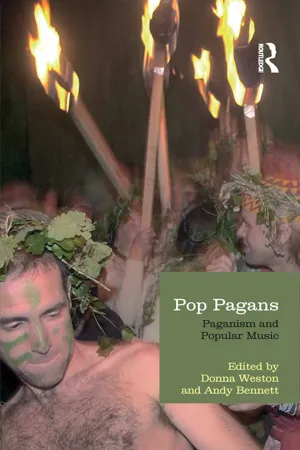
Paganism is rapidly becoming a religious, creative, and political force internationally. It has found one of its most public expressions in popular music, where it is voiced by singers and musicians across rock, folk, techno, goth, metal, Celtic, world, and pop music. With essays ranging across the US, UK, continental Europe, Australia and Asia, 'Pop Pagans' assesses the histories, genres, performances, and communities of pagan popular music. Over time, paganism became associated with the counter culture, satanic and gothic culture, rave and festival culture, ecological consciousness and spirituality, and new ageism. Paganism has used music to express a powerful and even transgressive force in everyday life. 'Pop Pagans' examines the many artists and movements which have contributed to this growing phenomenon.
Information
1. TOWARDS A DEFINITION OF PAGAN MUSIC
Donna Weston and Andy Bennett
In 1993, the first international Pagan studies conference was held, bringing together scholars from all over the world in fields as diverse as psychology, theology and ecology. In Researching Paganisms, published in 2004, Blain, Ezzy and Harvey cite multiplicity as central to the discipline of Pagan studies, and note that just as contemporary Paganisms are still evolving, so are the methodologies and approaches of those who choose to study them. Popular music studies is one area in which Pagan studies activity is only just emerging, yet – as seen in a Pagan history of celebration and story-telling through music – it is a voice through which Paganism might readily be expressed. Indeed, as this book explores, popular music has already proved a highly effective medium for the articulation of Pagan ideology and aesthetics. A diverse range of genres, from folk through punk and Goth to heavy metal, frequently embodies images and discourses drawn from Paganism. Similarly, a number of popular music artists profess a deep-seated investment in and expression of Paganism and Pagan identity through their music.
Depending on the interpretation, Paganism is a religion, a worldview, a way of life and even a human trait. This multiplicity varies according to modes of perception, reception and dissemination, and is represented in the range of topics discussed in the chapters of this book. This multiplicity is also reflected in the range of readers to whom this book will appeal: in the broad sense, it will be of benefit not only to those with an interest in Paganism and Pagan studies, but it will also raise questions for those engaged in studies of religion, particularly popular religion. As Catherine Albanese notes, “to suggest that religion is somehow implicated in the production of the popular is to nod toward that other thorny growth among academic problems regarding it – the meaning of popular religion” (Albanese 1996: 733). The topic will evidently be of interest to those with an interest in popular music studies in general; however, the subject raises interesting specific questions regarding intent versus interpretation, and of insider/outsider, emic/etic points of view – or any combination of the above along that continuum.
By investigating a group of popular music practices and cultures from a Pagan studies perspective, this book brings the two fields together in original ways that shed new light on both. It is intended that the readership of this book will be drawn from both Pagan studies and popular music studies – indeed, anyone with an interest in music and religion, and how the two connect. Because of the diverse background of that readership, a short discussion of what we mean by Pagan, and where popular music fits into that context, would seem a logical starting point.
PAGANISM
The distinction between Pagan and Neo-Pagan can be problematic, with the former sometimes used to describe pre-Christian Paganism, and the latter reconstructions ofthat religion. Contemporary Pagans may, however, reject the “Neo-” prefix as disconnecting Paganism from its past. In recognition of personal interpretations of these terms, for the purpose of this book authors have been allowed to choose the descriptor with which they feel most comfortable. Other variations may also arise – Andy Letcher, for example, prefers “pagan” (with a lower case “p”) to refer to Pre-Christian paganism, and Pagan (upper case) to refer to contemporary practices, while Neo-Pagan is claimed to be the US equivalent of the latter. York uses the term “geoPaganism” to describe an unstructured, and somewhat unconscious, veneration of nature that is characteristic of what he calls “folk religion” (York 2003). He differentiates this from “recoPaganism”, which he describes as more deliberate attempts to reconstruct the rituals of a Pagan past, such as is exemplified by “NeoPaganism” for example; both are subsumed under the broad Paganisms umbrella. Michael York leans towards a fluid definition, noting that what we might recognize as Pagan identities are in fact sharing selectively from a common pool, a list of Pagan characteristics.
Primarily, Pagan identity is constructed as a continuation of a religious tradition that, while having been suppressed – sometimes violently – during its history, can claim a pedigree extending long before the advent of Christianity, and at least to the Classical era. However, the difficulty in studying – and defining – Pagan religions lies partly in the fact that they are not organized systematically on a large scale, but rather consist of smaller local, national and international networks, groups and organizations, and also individual or sole practitioners, often networking through the internet. Paganism is evolving, fluid and non-codified, and has no orthodox form; indeed, Harvey (1997) suggests it is not an “ism” at all, but rather a broad movement. How, then, might a definition of these Paganisms be expressed? York proposes one definition: “Paganism is an affirmation of interactive and polymorphic sacred relationship by individual or community with the tangible, sentient and nonempirical” (York 2003: 161). Harvey (1997) defines it as a “polytheistic Nature religion” and an “ecological spirituality”. A theme of interconnectedness links both of these descriptions, to which can be added animistic beliefs, polytheism and anthropomorphism, and a reverence for tradition, antiquity and ancestry. To this definition can also be appended the consistent expression of a veneration of “place”. Paganism is rooted in the sacredness of place and, by extension, the divine in nature. York lists as characteristics “polytheism, animism, humanism, magic, organic and numinous qualities, pantheism or at least a quasi-pantheistic immanence of deity” (York 2003: 60).
“Paganism” is a term that encompasses pre-Christian European religions and many contemporary Pagan religions such as Wicca, Heathenism and Druidry. Its revival owes much to the ideologies of the Romantic era, through which nature was idealized, the “peasant” held up as representative of an idyllic lifestyle lived in harmony with nature, and the “noble savage” seen to be the connection to a lost utopia. Rousseau himself theorized an ancient polytheistic, nature-based religion, which he believed could be found again, offering an antidote to the ills of contemporary society. Contemporary Paganism also owes much to the folklore revival of this period, the volk, or people seen to have much in common with the idealized peasant. Folklore has informed much Pagan ritual since. Because of its history, modern Paganism is characterized by a blend of old and new practices – mostly Western, but also drawing on indigenous and Eastern belief systems. The Romans used the term Paganus to refer to rural dwellers, “people of place”, those whose customs and rituals were intrinsically tied to their locality – and hence, to land. In English language usage, and within the context of the Christian hegemony, the term has come to mean anything from non-Christian to non-believer, and has often taken on negative or pejorative connotations. This definition of Paganism is sometimes reflected in the ways in which many Pagans construct their identity as oppositional to dominant Christian belief systems, by which some contemporary Pagans “have crafted a history for themselves that specifically links them to the marginalized and the oppressed” (Magliocco 2004: 187).
These kinds of binaries are, however, not useful ways by which to understand Paganism. This book is based on the concept of Paganism as more of a continuum – not a set of constructed beliefs that refer to nature, the earth and so on, but arising from the point of view of the earth manifesting in various culturally specific contexts, and which may be informed by phenomena held sacred to Pagans such as land, place, and nature. Sabina Magliocco describes how one Pagan community member describes Paganism as “somehow innate or essential, its seeds already present in childhood” (Magliocco 2004: 57), and notes that “the idea of Paganism as something natural or inherent is common in the movement” (ibid.: 58). Viewed in this way, Paganism can be seen more as something instinctual – a human condition – and therefore arguably as more mainstream than might immediately be obvious.
Considering Paganism – and Pagan studies – in this way removes the essentializing characteristics that problematize oppositional constructions of Pagan identity. By examining popular music and its practitioners through a Pagan “looking glass”, and from a Pagan studies perspective, we can gain an understanding that not only emphasizes commonalities rather than difference, but that offers new insights into the production and consumption of popular music that are not evident in current approaches. This means understanding people through their connections to land or place, the ways in which they interact with it and how it informs their culture, not from an outside point of view but rather from one of mutual understanding. It means understanding “others” through the Pagan lens of “feeling” rather than the more distanced eye of observation and analysis, of being “in” the world of the music studied rather than “outside looking in”.
PAGANISM AND MUSIC
As in many cultures, music plays an important role in Pagan practice. It is often the focal point of the many Pagan gatherings and festivals that occur throughout the world, some of which are specific music festivals. It can play a role in many aspects of Pagan ritual and is an important vehicle for the expression of Pagan beliefs. Pagan songs can express solidarity, or reinforce common Pagan beliefs. Magliocco (2004: 93–197) gives the example of “The Burning Times” by Charlie Murphy, the lyrics of which link European witches to Pagan religion, and describe their execution – usually by burning – as a “war against women”, specifically by the Catholic Church. That memory of the burning times galvanizes contemporary Pagans is the theme of “We Won’t Wait any Longer”, by the late Gwydion Pendderwen, in which Pagans are survivors, ready to “rise again and reclaim what is theirs”. It would be impossible to describe any one style of music that is specifically Pagan, and the diversity of Pagan music and music employed by Pagans is indeed representative of the range of popular music in general. However, the importance of music to Pagan culture is best evidenced through analysis of its presence in the one place that unites nearly all Pagans: online. The internet provides a vibrant virtual community for Pagan practitioners, and in many ways has contributed to the growth of the religion, connecting like-minded people and offering “Pagan advocacy and support networks operating at both national and international level”, such as the Pagan Federation, the Circle Network, the Lady Liberty Network and the World Congress of Ethnic Religions (Strmiska 2005: 45). A survey of Pagan music sites on the internet reveals the diversity of the ways in which music and Paganism intersect. At the time of writing (2011), a YouTube search of the phrase “Pagan music” gave 545 hits, mostly original music from the English-speaking world, although Russia and Lithuania also made an appearance. The search also resulted in some instructional and more explanatory videos. The same search on Google resulted in 178,000 hits, which contained a combination of blogs, forums, online stores and more regular websites, while a search for “Pagan radio” resulted in 151,000 hits. A survey of these sites paints a telling picture of the importance of music to Pagan culture, while the variety of ways in which it is presented demonstrates the diversity of its membership.
Pagan Music and Poetry is one example of the kind of Pagan forum that offers members opportunities to discuss and share Pagan art and music. It is part of the Tribe.net network of websites, where members discuss topics of interest to them – this is part of a collection of “Tribes” dedicated to Pagan culture and is the one dedicated most prominently to music and the arts. It contains reviews, interviews and extensive forum discussions.1 The Pagan Dance Pagan Music Forum is dedicated to a “love of spiritual dance, Paganism, Wicca, drumming, inkubus sukkubus, and all other Pagan music”, and describes its target membership as those who are looking to find spirituality through music and dance, with a focus on Pagan music. The majority of the content is available to members of the forum only.2 The Pagan Wheel describes itself as “all about Pagan Music”, and is a blog dedicated to Pagan music of all kinds. It contains comprehensive forums and links, as well as CD reviews, and musician and band profiles. It also contains announcements of Pagan music events and gigs.3 The Bardic Blog is the blog of Welsh musician Damh the Bard. It includes entries describing the Pagan music festivals and gigs in the United Kingdom that he attends, as well as Pagan music articles of interest. What he describes as Wiccan and Druidic music is most prominent.4
While the above examples show the ways in which Pagan music is discussed, its dissemination relies on sites such as that of Folk Records, a traditional and Slavic Pagan folk record label that offers free downloads of the bands on its roster as well as information on Slavic music and the Pagan culture of pre-Christian Russia, including a description of the different prominent genres of modern Slavic music that uphold traditional Slavic culture and Pagan spirituality.5 Arula Records is a distribution and record company; its website consists of descriptions of the Pagan music on the label, and the artists who make it, alongside a catalogue and online store.6 Serpentine Music Productions is a large Pagan music record label and distributor. The website is quite comprehensive, and the Pagan Music Library section contains links to blogs and articles on Pagan music.7 Independent Pagan Music, Literature and Arts Label UK is an independent label based in Wiltshire in the United Kingdom. The site contains a catalogue of its affiliated artists, and various other in...
Table of contents
- Cover Page
- Half-Title Page
- Title Page
- Copyright Page
- Table of Contents
- Contributors
- Foreword
- Part I: Histories
- Part II: Genres
- Part III: Performance
- Part IV: Communities
- Bibliography
- Discography and filmography
- Index
Trusted by 375,005 students
Access to over 1.5 million titles for a fair monthly price.
Study more efficiently using our study tools.
Frequently asked questions
Yes, you can cancel anytime from the Subscription tab in your account settings on the Perlego website. Your subscription will stay active until the end of your current billing period. Learn how to cancel your subscription
No, books cannot be downloaded as external files, such as PDFs, for use outside of Perlego. However, you can download books within the Perlego app for offline reading on mobile or tablet. Learn how to download books offline
Perlego offers two plans: Essential and Complete
- Essential is ideal for learners and professionals who enjoy exploring a wide range of subjects. Access the Essential Library with 800,000+ trusted titles and best-sellers across business, personal growth, and the humanities. Includes unlimited reading time and Standard Read Aloud voice.
- Complete: Perfect for advanced learners and researchers needing full, unrestricted access. Unlock 1.5M+ books across hundreds of subjects, including academic and specialized titles. The Complete Plan also includes advanced features like Premium Read Aloud and Research Assistant.
We are an online textbook subscription service, where you can get access to an entire online library for less than the price of a single book per month. With over 1.5 million books across 990+ topics, we’ve got you covered! Learn about our mission
Look out for the read-aloud symbol on your next book to see if you can listen to it. The read-aloud tool reads text aloud for you, highlighting the text as it is being read. You can pause it, speed it up and slow it down. Learn more about Read Aloud
Yes! You can use the Perlego app on both iOS and Android devices to read anytime, anywhere — even offline. Perfect for commutes or when you’re on the go.
Please note we cannot support devices running on iOS 13 and Android 7 or earlier. Learn more about using the app
Please note we cannot support devices running on iOS 13 and Android 7 or earlier. Learn more about using the app
Yes, you can access Pop Pagans by Donna Weston,Andy Bennett in PDF and/or ePUB format, as well as other popular books in Theology & Religion & Ethnomusicology. We have over 1.5 million books available in our catalogue for you to explore.