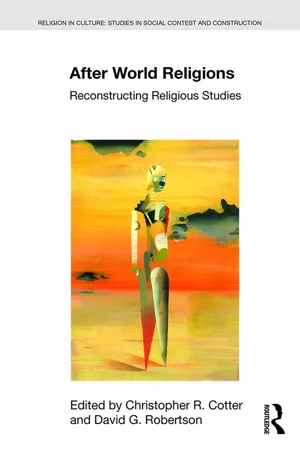
The World Religions Paradigm has been the subject of critique and controversy in Religious Studies for many years. After World Religions provides a rationale for overhauling the World Religions curriculum, as well as a roadmap for doing so. The volume offers concise and practical introductions to cutting-edge Religious Studies method and theory, introducing a wide range of pedagogical situations and innovative solutions. An international team of scholars addresses the challenges presented in their different departmental, institutional, and geographical contexts. Instructors developing syllabi will find supplementary reading lists and specific suggestions to help guide their teaching. Students at all levels will find the book an invaluable entry point into an area of ongoing scholarly debate.
eBook - ePub
After World Religions
Reconstructing Religious Studies
- 204 pages
- English
- ePUB (mobile friendly)
- Available on iOS & Android
eBook - ePub
About this book
Information
1
Introduction
The World Religions Paradigm in contemporary Religious Studies
Christopher R. Cotter and David G. Robertson
Let us take the old saying, divide et impera, and translate it somewhat freely as ‘classify and conquer.’
(Müller 1873, 122–123)
The history of the study of religion is the dramatic story of the complex relationship between European Enlightenment concepts about the nature of religion and the violent reality experienced by people and cultures all over the world who were conquered and colonized by Europeans.
(Chidester 1996, xiii)
Classify and conquer: taxonomies and power
In the Preface to his The Order of Things (1973), Michel Foucault – French philosopher, social theorist, literary critic and turtleneck-wearer – cites Jorge Luis Borges’ essay ‘The Analytical Language of John Wilkins’ (1942) in order to problematize scholars’ uncritical use of taxonomies. Borges’ essay (whose title refers to a seventeenth-century philosopher who proposed a universal language with a grammar based on taxonomic classification) presents an alternative taxonomy, ostensibly drawn from an ancient Chinese encyclopedia, Celestial Emporium of Benevolent Knowledge, which organizes animals into fourteen categories:
1 Those that belong to the emperor
2 Embalmed ones
3 Those that are trained
4 Suckling pigs
5 Mermaids
6 Fabulous ones
7 Stray dogs
8 Those that are included in this classification
9 Those that tremble as if they were mad
10 Innumerable ones
11 Those drawn with a very fine camel hair brush
12 Et cetera
13 Those that have just broken the flower vase
14 Those that, at a distance, resemble flies
(in Foucault 1973, xv; cf. McCutcheon 2014, 142).
To most, this seems like an arbitrary or even ridiculous system of classification. The point that Foucault is making, however, is that objectively it is no more arbitrary than any other system, simply less familiar because we have not internalized its rules.
If we were to ask the reader for today’s date, they would almost certainly reply (at time of writing) ‘Friday, the thirteenth of February 2015’.1 They would be far less likely to reply ‘23 Rabi II 1436’, ‘Cycle 78, year 31, month 12, day 25’ or ‘13.0.2.3.4’. Yet none of these ‘is’ the ‘real’ date any more than any of the others, but rather they reflect different cultural contexts. Moreover, they encode particular epistemological and cosmological assumptions, and when examined critically, issues of power. According to Critical Theory, the criteria by which such distinctions are made do not describe reality, but rather the assumptions of those making them. These taxonomies therefore represent the intersection of knowledge and power – what Foucault would call a particular ‘episteme’ (1973, xxii). Such arrangements are neither universal, natural nor eternal, but claim to be – and when fully internalized, will appear to be.
This volume is concerned with perhaps the most obvious example of such a taxonomy in the discourse on religion, the World Religions Paradigm (WRP). The WRP typically includes ‘the Big Five’ (where does that term come from?) of Christianity, Islam, Judaism, Hinduism and Buddhism – and moreover, almost always presented in that Abrahamocentric order – increasingly with additional ‘catch-all’ categories such as ‘indigenous religions’ or ‘new religions’ included.
The publication of The Norton Anthology of World Religions in 2014 demonstrates how entrenched this taxonomy is for both the public and, more problematically, academia. Indeed, with university Religious Studies (RS) departments becoming more and more structured around a series of area studies scholars rather than method and theory specialists or generalists, the question of which ‘traditions’ are to be represented is arguably more important than ever. In this introduction we lay out, first, the development of the WRP as a classificatory schema, and second, the robust critique that it has sustained in recent decades. This will be necessarily brief, but aims to offer a useful ‘potted history’ for students and their teachers, while pointing towards the sources through which the critique can be pursued fully. Discussion then turns to contemporary problems with putting this critique into practice within introductions to the academic study of religion, before providing a brief overview of the chapters that follow.
Given that the history of the WRP is intimately tied up with the history of RS itself, it is fitting that we begin our discussion with the development of the category ‘religion’.
You can’t say ‘World Religions Paradigm’ without saying ‘religion’ …
The WRP is intimately bound up with the development of the category of ‘religion’2 and its ‘semantically parasitic’ other (Fitzgerald 2007, 54), the ‘secular’. A discussion of these categories will help contextualize the way in which the WRP was formed, and explain the origin of the very notion that a plurality of ‘religions’ existed that could be placed within a paradigm. As Brent Nongbri notes,
the particular concept of religion is absent in the ancient world. The very idea of ‘being religious’ requires a companion notion of what it would mean to be ‘not religious,’ and this dichotomy was not part of the ancient world.
(2013, 4)
Sweeping through history, the term ‘religio’ can be encountered in a Roman context, primarily in relation to the rites and traditions connected with the ancestors (King 1999, 35–36). According to Brent Nongbri, it makes an appearance in early Latin comedies, where it appears to mean something more along the lines of ‘scruples’ or ‘manners’, and was not associated with gods until around the first century BCE (Nongbri 2013, 27). In the writings of Lucretius (99–c. 55 BCE) for example, ‘religio’ seems to refer to something almost the same as our modern ‘superstition’; people could become overcome by ‘religio’ because of wrong ideas or ‘excessive concern’ regarding gods (2013, 28). Among the Latin Christians, Tertullian, etc., we encounter the ‘religio’ or ‘religiones’ (worship practice/practices) of Christians, and the religiones of others, where the term is deployed in a manner more akin to a racial or ethnic discourse of the modern day (2013, 29). Augustine’s ‘de vera religio’ – ‘on true religion’ – is similarly suggestive of a meaning of ‘worship’; ‘our religio is not the religio of other gods, of idols’, ‘our religio is the religio of the one god’, etc. (2013, 30–31).
In the medieval period, however, we see the emergence of the twin concepts ‘religiosus’ and ‘saecularis’ as indicative of different types of ecclesiastical vows (Nongbri 2013, 5). To be ‘religious’ meant to pursue a monastic life, while ‘secular’ designated those in the ‘ordinary’ clergy working within the world outside the monastery (Asad 1993, 39). According to Charles Taylor, this development of a religious/secular binary highlighted a perceived distinction between ‘ordinary’ or ‘profane’ time, as opposed to ‘spiritual’ or ‘God’s’ time, and ‘reflected something fundamental about Christendom’, the view that ‘a less than full embedding in the secular [was …] essential to the vocation of the church’ (1998, 32; in Knott 2005, 64). However, it is at the dawn of the Enlightenment period, and the beginning of the colonial encounter, that these terms begin to take on forms more familiar to us today.
Timothy Fitzgerald’s Discourse on Civility and Barbarity (2007) features an extended discussion of the writings of an English vicar named Samuel Purchas, which he utilizes – along with other case studies – to build a convincing case that until the early Enlightenment/colonial period ‘there was arguably no concept in the English language either of “a religion” or of “secular neutrality”’, but that ‘[r]eligion almost always has meant Christian Truth and civility, and was invariably contrasted with barbaric superstitions’ (2007, 283). According to Fitzgerald, in 1615 Purchas had
not only referred to the ‘religions’ of India, China, Japan, the Americas, and many other parts of the world, but had attempted to analyse and describe them …. His usage, however, was ironic, since in his understanding ‘religion’ meant Christian (or more precisely Protestant Christian) Truth, and when applied to others the term ‘religions’ really meant its opposite, superstitions, and thus pagan and irrational misunderstandings. Yet arguably we can see a wobble in his text between irony and straightforward generic usage.
(2007, 9)
Samuel Purchas, then, stands in a long line of male authors who were encountering and theorizing the ‘other’ for the first time, and from a perspective of normative Christianity. Indeed, in some of the earliest accounts of the ‘New World’ (see J. Z. Smith 1998, 269) we read of ‘natives’ who went ‘without shame, religion or knowledge of God’ (Eden 1553), or who ‘observ[ed] no religion as we understand it’ (Cieza de León 1553). As Jonathan Z. Smith simply but forcefully states, ‘the question of the “religions” arose in response to an explosion of data’ (1998, 275) and thus by the late 1700s it made linguistic sense for Thomas Jefferson to state that there are ‘probably a thousand different systems of religion’ of which ‘ours is but one of that thousand’ (1787, 267). The seeds had been sown from which the Victorian Science of Religion – and the WRP – would spring, and to which discussion shall shortly turn.
Owing in no small part to the intellectualization and individualization of the Protestant Reformation, at the same time as the notion of distinct ‘religions’ emerges, we begin to see the emergence of the idea of religion as a private, personal, and individual affair, as a matter between the individual ‘believer’ and ‘God’. We see, for example, in Thomas Hobbes’ Leviathan (1651) an outspoken example of this ‘independent ethic, in which religion in general, and “Christian religion” in particular, was located in the private sphere, the realm of conscience, apart from the public sphere of the state’ (Knott 2005, 66). For Hobbes,
The maintenance of civil society depend[s] on justice, and justice on the power of life and death, and other less rewards and punishments residing in them that have the power of the Commonwealth; it is impossible a Commonwealth should stand where any other than the sovereign hath a power of giving greater rewards than life, and inflicting greater punishment than death.
(1651, 275)
Here we begin to see the development of the secular as the ‘default’ state from which ‘religions’ deviate, something that will be of particular significance when we discuss the legacy of the WRP below.
‘Mixed motivations’: the Science of Religion
The Victorian ‘Science of Religion’ was at its core an attempt to produce a typology of ‘religions’, as per Linnaeus’s classification of the natural world or Darwin’s proposition of the evolutionary links between the species. Indeed, ‘[o]nly an adequate taxonomy would convert a “natural history” of religion into a science’ (J. Z. Smith 1998, 276). As F. Max Müller, one of the most influential scholars behind the development of the WRP, framed the question, ‘How is the vast domain of religion to be parcelled out?’ (1873, 123). Terence Thomas describes the emerging Science of Religion as a ‘situation of mixed motivations’ (2000, 74), with three significant factors – scientific (and particularly Darwinian), theological and colonialist – which shall each be discussed below.
In popular discourse, and distressingly often academic discourse also, ‘science’ is constructed as a disinterested, objective account of an underlying reality. This argument originates with Victorian positivists like Auguste Comte, and has been repeated by many RS scholars, who ‘claim that the methodologies used in this discipline are objective and neutral in that they neither presuppose nor preclude any particular religious commitment’ (King 1999, 47). Twentieth-century philosophy has made it clear, however, that such objectivity is difficult and perhaps impossible to achieve. Indeed, the institution of ‘science’ itself exists within particular social, cultural and political contexts. The ‘Science of Religion’ is a perfect case in point. How these scholars defined ‘religion’ and how these definitions were used to create typologies did not dispassionately describe ‘reality’, but rather simultaneously reflected and reinforced the presuppositions – and therefore the concerns – of those with the power to make such proscriptions. Their typologies did not disinterestedly describe religions, but implicitly ranked them.
For C. P. Tiele, the ‘World Religions’ – Buddhism, Islam and, of course, Christianity – were those which had ‘found their way to different races and peoples and … profess the intention to conquer the world’ (1884, 368). Their supposed dynamism set them apart from the other ‘ethical religions’, such as Judaism and Taoism, which were characterized by being founded on ‘holy’ scriptures or laws, but are ‘generally limited to a single race or nation’ (1884, 366). These were in turn superior to the ‘nature religions’ which were divided into ‘polydaemonistic magical religions’, ‘organized’ or ‘unorganized magical religions’, and ‘anthropomorphic polytheism’ (ibid.). For Tiele, the ‘ancient faiths and primitive modes of worship’ must either ‘reform themselves as the model of the superior religion’ (i.e. the World Religions), or inevitably ‘draw nearer and nearer to extinction’ (1884, 369). Tiele’s typology is therefore both Darwinian and unambiguously theologically normative.
Müller, however, inverted this evolutionary trajectory, seeing religions as degenerating from the purity of their inspired origins towards populist superstition and mythology, which he described as ‘the dialectic life of religion’ (1873, 274). He singled Hinduism out for particular criticism, describing it as ‘a half-fossilised megatherion walking about in the broad daylight of the nineteenth century’ (1873, 279). The emphasis on texts reflected Müller’s linguistic training, but perhaps less obviously, his Protestant German upbringing: his insistence on the purity of inspired texts was also an implicit critique of priestly, ritualistic Catholicism and its supposed idolatrous materiality.
Tiele and Müller’s versions differ in significant respects from one another, both in the evolutionary trajectories and in which religions were singled out for praise or scorn (Christianity again the exception, with Müller describing Christianity as ‘the fulfilment of the hopes and desires of the whole world’ (1873, 148–9)). Yet they have in common that each utilized an ostensibly scientific model derived from Protestant Christianity, which prioritized ‘belief’ and ‘doctrine’ as preserved in texts as the sine qua non of ‘religion’ (Lopez Jr. 1998, 21). On the colonial frontiers, this meant that either it was thought that there simply was no religion there (Chidester 1996), or these contexts were constructed as exemplifying a ‘primal’ or ‘primitive’ form of religion (Cox 2007). In other cases where the traditions could not be so easily marginalized, they would be constructed according to Protestant norms, notably in the case of Hinduism, where the role of the Vedas was exaggerated and the suppo...
Table of contents
- Cover Page
- Half Title page
- Series Page
- Title Page
- Copyright Page
- Contents
- Preface
- List of Contributors
- Foreword: Before the ‘After' in ‘After World Religions' – Wilfred Cantwell Smith on the meaning and end of religion
- Introduction The World Religions Paradigm in contemporary Religious Studies
- Subversive pedagogies: data and methods
- The problem of ‘religions' Teaching against the grain with ‘new age stuff'
- ‘Not a task for amateurs' Graduate instructors and Critical Theory in the World Religions classroom
- The Critical embrace Teaching the World Religions Paradigm as data
- Alternative pedagogies: power and politics
- Religion as ideology Recycled culture vs. world religions
- Doing things with ‘religion' A discursive approach in rethinking the World Religions Paradigm
- Looking back on the end of religion Opening re Marx
- The sacred alternative
- Innovative pedagogies: methods and media
- The Desjardins diet for World Religions Paradigm loss
- Narrating the USA's religious pluralism Escaping world religions through media
- Archaeology and the World Religions Paradigm The European Neolithic, religion and cultural imperialism
- Complex learning and the World Religions Paradigm Teaching religion in a shifting subject landscape
- Afterword On utility and limits
- Index
Trusted by 375,005 students
Access to over 1.5 million titles for a fair monthly price.
Study more efficiently using our study tools.
Frequently asked questions
Yes, you can cancel anytime from the Subscription tab in your account settings on the Perlego website. Your subscription will stay active until the end of your current billing period. Learn how to cancel your subscription
No, books cannot be downloaded as external files, such as PDFs, for use outside of Perlego. However, you can download books within the Perlego app for offline reading on mobile or tablet. Learn how to download books offline
Perlego offers two plans: Essential and Complete
- Essential is ideal for learners and professionals who enjoy exploring a wide range of subjects. Access the Essential Library with 800,000+ trusted titles and best-sellers across business, personal growth, and the humanities. Includes unlimited reading time and Standard Read Aloud voice.
- Complete: Perfect for advanced learners and researchers needing full, unrestricted access. Unlock 1.5M+ books across hundreds of subjects, including academic and specialized titles. The Complete Plan also includes advanced features like Premium Read Aloud and Research Assistant.
We are an online textbook subscription service, where you can get access to an entire online library for less than the price of a single book per month. With over 1.5 million books across 990+ topics, we’ve got you covered! Learn about our mission
Look out for the read-aloud symbol on your next book to see if you can listen to it. The read-aloud tool reads text aloud for you, highlighting the text as it is being read. You can pause it, speed it up and slow it down. Learn more about Read Aloud
Yes! You can use the Perlego app on both iOS and Android devices to read anytime, anywhere — even offline. Perfect for commutes or when you’re on the go.
Please note we cannot support devices running on iOS 13 and Android 7 or earlier. Learn more about using the app
Please note we cannot support devices running on iOS 13 and Android 7 or earlier. Learn more about using the app
Yes, you can access After World Religions by Christopher R Cotter,David G. Robertson in PDF and/or ePUB format, as well as other popular books in Theology & Religion & Comparative Religion. We have over 1.5 million books available in our catalogue for you to explore.