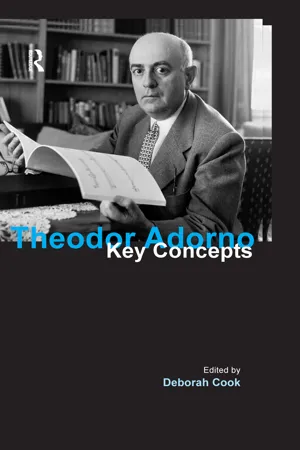
- 224 pages
- English
- ePUB (mobile friendly)
- Available on iOS & Android
eBook - ePub
About this book
Adorno continues to have an impact on disciplines as diverse as philosophy, sociology, psychology, cultural studies, musicology and literary theory. An uncompromising critic, even as Adorno contests many of the premises of the philosophical tradition, he also reinvigorates that tradition in his concerted attempt to stem or to reverse potentially catastrophic tendencies in the West. This book serves as a guide through the intricate labyrinth of Adorno's work. Expert contributors make Adorno accessible to a new generation of readers without simplifying his thought. They provide readers with the key concepts needed to decipher Adorno's often daunting books and essays.
Information
Adorno’s intellectual history and legacy
ONE
Theodor W. Adorno: an introduction
Deborah Cook
Adorno's professional life was bound indissolubly to the Institute for Social Research, which opened on 22 June 1924 in Frankfurt-amMain, Germany. At its inception, Institute members engaged in interdisciplinary studies devoted to the theory and history of socialism and the labour movement. However, after the first director, Carl Grünberg, resigned, Max Horkheimer took his place in 1930, giving the Institute a new orientation. In his inaugural address, Horkheimer stated that the work undertaken by the Institute would examine “the connection between the economic life of society, the psychical development of individuals, and the changes in the realm of culture in the narrower sense (to which belong not only the so-called intellectual elements, such as science, art, and religion, but also law, customs, fashion, public opinion, sports, leisure activities, lifestyle, etc.)”.1 Using both empirical research and philosophy, the Institute would develop a theory of contemporary society by analysing its prevailing tendencies, with the ultimate goal of transforming society along more rational lines.2
However, with the victory of Hitler’s National Socialist Party in 1930, the Institute — nicknamed Café Marx3 — would not remain in Frankfurt much longer. It was closed and its property confiscated by the Gestapo in 1933 on the grounds that it had communist leanings.4 Having taken the precaution of placing the Institute’s funds in Holland in 1931,5 Horkheimer had the resources needed to establish a branch of the Institute at Columbia University in New York in 1934, where he was soon joined by Friedrich Pollock, Herbert Marcuse and Leo Löwenthal. As they were settling in the United States, Adorno was studying at Oxford with the philosopher Gilbert Ryle, who agreed to supervise a thesis he proposed to write on Husserl.6 Although he was associated officially with the Institute in 1935, it was not until 1938 that Adorno left for New York with his new wife Gretel.
Adorno, who studied composition with Alban Berg in Vienna in the 1920s, had already published a number of essays on music.7 Upon his arrival in New York, Horkheimer arranged for him to work with Paul Lazarsfeld in New Jersey as head of the music section of the Princeton Radio Research Project which was funded by the Rockefeller Foundation. Until 1940, Adorno was responsible for conducting empirical research into the psychological value of radio music for listeners.8 But, by this time, it was glaringly apparent to the émigrés, some of whose family and friends were suffering horribly under Nazism, that anti-Semitism was rife in many other countries. In the early 1940s, then, Adorno began to study anti-Semitism, following the lead of Horkheimer in "The Jews and Europe”.9
In a letter to the secretary of the Institute’s Geneva office, Horkheimer declared in 1939 that all his earlier work was a prelude to a book he planned to write on dialectical logic.10 He confided to Pollock as early as 1935 that Adorno was the ideal collaborator for this project.11 By 1938 the project had become more concrete. Adorno reported to Walter Benjamin that Horkheimer was eager to “begin work on a book on the dialectic of the Enlightenment”.12 Yet this work really only began after the Institute moved most of its resources from New York to Los Angeles in 1941. Dedicated to Pollock, to mark his fiftieth birthday, the book was completed in the spring of 1944; it first appeared in 1947 in Holland under the title Dialektik der Aufklärung.
Dialectic of Enlightenment opens with a strident warning. If enlightenment was supposed to emancipate humanity, today the “fully enlightened earth radiates disaster triumphant” (DE, C: 3; J: 1). The first chapter tries to show that, for all its attempts to supersede the mythic worldview, enlightenment is just an outgrowth of myth and ends by reverting to it. Compulsively forcing natural objects into explanatory schema in order to dominate them, enlightenment confuses “the animate with the inanimate, just as myth compounds the inanimate with the animate” (DE, C: 16; J: 11). Allowing nothing to escape its conceptual grasp, enlightened thought not only exhibits an overwhelming fear of nature, but it continues to be driven by nature. The modern employment of reason makes nature “audible in its estrangement” because its very attempt to master nature shows only that reason remains enslaved to it (DE, C: 39; J: 31).
This theme of our embeddedness in nature, which is central to the later work of Adorno as well, is elaborated throughout Dialectic of Enlightenment. In an excursus on the Odyssey, the emergence of reason is itself traced back to the dawn of history. Bound to the instinct for self-preservation, reason developed as a means to the end of thwarting the powers of nature. Endorsing Freud’s claim in Civilization and its Discontents that human history consists in the renunciation of instinct, Adorno and Horkheimer also observe that rational control over nature was achieved only by delaying the gratification of instincts, or by repressing them altogether. Mastery over nature
practically always involves the annihilation of the subject in whose service that mastery is maintained because the substance which is mastered, suppressed, and disintegrated by self-preservation is nothing other than the living entity, of which the achievements of self-preservation can only be defined as functions — in other words, self-preservation destroys the very thing which is to be preserved.
(DE, C: 55; J: 43)
Since survival instincts have propelled much of Western history, the official history of Europe conceals a subterranean history that “consists in the fate of the human instincts and passions repressed and distorted by civilization” (DE, C: 231; J: 192). Indeed, while greatly indebted to Marx, Adorno focused not just on economic conditions in the West, but on human psychology as well. As Martin Jay explains, “the unexpected rise of an irrationalist mass politics in fascism, which was unforeseen by orthodox Marxists”, justified the incorporation of psychology into a critical account of society. Yet, even after the defeat of National Socialism, “psychological impediments to emancipation” remained in “the manipulated society of mass consumption that followed in its wake”.13 Concern about these impediments is forcefully expressed in a chapter of Dialectic of Enlightenment called “Enlightenment as Mass Deception”, where the psychology underlying fascist propaganda is compared to the psychotechnology of the Hollywood-based culture industry. Extensive use is also made of psychoanalysis in the following chapter on anti-Semitism.
Nevertheless, it was not just the attempt to understand fascism and the culture industry that made Freud indispensable. What particularly recommended Freud to Adorno was his endorsement of the idea that nature and history are dialectically entwined. Originally advancing this idea in a 1932 lecture called “The Idea of Natural History” (INH: 260), Adorno later supported it by citing The German Ideology, where Marx declared that nature and human history would always qualify one another (ND: 358). But Adorno points out that Freud too described history as natural. On the one hand, Freud derived “even complex mental behaviours from the drive for self-preservation and pleasure”. On the other hand, he never denied that “the concrete manifestation of instincts may undergo the most sweeping variations and modifications” throughout history.14 Consequently, Freud’s instinct theory not only helped Adorno to explain phenomena such as Nazi Germany and the culture industry, but also to elaborate in psychological terms on Marx’s dialectical view of the relationship between nature and history.
Admittedly, Adorno was neither an orthodox Marxist nor an orthodox Freudian, and he never fully addressed the problem of reconciling Marx and Freud. Yet he examined the impact of capitalism on the psychological development of individuals in most of his work. According to Adorno, the rise of capitalism had fostered widespread social and psychological pathologies such as authoritarianism, narcissism and paranoia. And, as early as 1927, Adorno argued that these pathologies can be overcome, not by psychoanalysis, but only by completely transforming capitalist society.15 Since psychopathologies have social roots, often connected to the predominance of exchange relations in human life, they can be dealt with effectively only by abolishing this predominance.
Yet Adorno distanced himself from both Marx and the orthodox Marxism of the former Soviet Union in his 1942 essay “Reflections on Class Theory”. Since Marx’s prediction about the concentration and centralization of capital was realized, capitalism had changed —particularly with respect to the composition of classes. Consisting of relatively independent entrepreneurs during the earlier phase of liberal capital, the bourgeoisie forfeited much of its economic power as monopoly conditions developed. The economically disenfranchised bourgeoisie and the proletariat now form a new mass class distinct from the class comprising the dwindling owners of the means of production (CLA: 99). In a Hegelian remark about the Aufhebung — the preservation and sublation — of classes under monopoly capital, Adorno states that Marx’s concept of class must be preserved because “the division of society into exploiters and exploited, not only continues to exist but gains in force and strength”. But the concept must be sublated “because the oppressed who today, as predicted by [Marxist] theory, constitute the overwhelming majority of humankind, are unable to experience themselves as a class” (CLA: 97, tr. mod.).
So, while class stratification persists, classes themselves have changed, and the subjective awareness of belonging to a class has evaporated. Marx’s theory is no longer straightforwardly applicable to conditions today precisely because he was right about the emergence of monopoly conditions. Adorno also takes issue with Marx’s theory of impoverishment, arguing that impoverishment can be understood only in a metaphorical sense because workers today have far more to lose than their chains. Compared to the situation of workers in nineteenth-century England, the standard of living of workers in the West has improved owing in part to the establishment of the welfare state. The work day is now shorter, and workers enjoy “better food, housing and clothing; protection for family members and for workers in their old age; and an increase in average life expectancy”. Hunger no longer compels workers “to join forces and make a revolution” (CLA: 103, tr. mod.).
Borrowing a phrase from “The Communist Manifesto”, Adorno argues that, with the welfare state, the ruling class effectively secures “for ‘slaves their existence within slavery’” in order to ensure its own. Impoverishment now refers to the “political and social impotence” of individuals who have become pure objects of administration for monopolies and their political allies (CLA: 105). Survival depends on adaptation to a constantly changing and inherently unpredictable economic system. Adaptation is reinforced by the sophisticated psychotechnology of the culture industry and the prevailing positivist ideology which glorifies existing states of affairs. By these means, the needs of the new mass class are made to harmonize with commodified offers of satisfaction. Conformity to socially approved models of behaviour now appears more rational than solidarity (CLA: 97). This also helps to explain why prospects for revolutionary change have faded.
Some commentators claim that Adorno adopted Pollock’s state capitalism thesis, which argues that there has been a transition in Western countries “from a predominantly economic to an essentially political era”.16 Yet, while acknowledging that political power had increased in the West, Adorno agreed with Marx’s insistence on the primacy of the economy. At best, Pollock’s thesis signalled ominous trends in other Western countries. What really changes with monopoly capitalism is that the ruling class becomes anonymous: it disappears “behind the concentration of capital”. Capitalism now appears to be “an institution, the expression of society as a whole”. Pervading almost every aspect of human life, the fetish character of commodities, which transforms relations between people into relations between things, ends in the socially totalitarian aspect of capital (CLA: 99). As Stefan Müller-Doohm remarks, the pervasiveness of reification today provides an answer to a question posed in the preface to Dialectic of Enlightenment, namely why humanity is sinking into a new kind of barbarism, rather than entering into a truly human state.17
The urgency of this question did not abate when Adorno returned to Frankf...
Table of contents
- Cover Page
- Half Title page
- Title Page
- Copyright Page
- Table of Contents
- Contributors
- Acknowledgements
- Abbreviations
- Part I: Adorno's intellectual history and legacy
- Part II: Adorno's philosophy
- Chronology
- References
- Index
Trusted by 375,005 students
Access to over 1.5 million titles for a fair monthly price.
Study more efficiently using our study tools.
Frequently asked questions
Yes, you can cancel anytime from the Subscription tab in your account settings on the Perlego website. Your subscription will stay active until the end of your current billing period. Learn how to cancel your subscription
No, books cannot be downloaded as external files, such as PDFs, for use outside of Perlego. However, you can download books within the Perlego app for offline reading on mobile or tablet. Learn how to download books offline
Perlego offers two plans: Essential and Complete
- Essential is ideal for learners and professionals who enjoy exploring a wide range of subjects. Access the Essential Library with 800,000+ trusted titles and best-sellers across business, personal growth, and the humanities. Includes unlimited reading time and Standard Read Aloud voice.
- Complete: Perfect for advanced learners and researchers needing full, unrestricted access. Unlock 1.5M+ books across hundreds of subjects, including academic and specialized titles. The Complete Plan also includes advanced features like Premium Read Aloud and Research Assistant.
We are an online textbook subscription service, where you can get access to an entire online library for less than the price of a single book per month. With over 1.5 million books across 990+ topics, we’ve got you covered! Learn about our mission
Look out for the read-aloud symbol on your next book to see if you can listen to it. The read-aloud tool reads text aloud for you, highlighting the text as it is being read. You can pause it, speed it up and slow it down. Learn more about Read Aloud
Yes! You can use the Perlego app on both iOS and Android devices to read anytime, anywhere — even offline. Perfect for commutes or when you’re on the go.
Please note we cannot support devices running on iOS 13 and Android 7 or earlier. Learn more about using the app
Please note we cannot support devices running on iOS 13 and Android 7 or earlier. Learn more about using the app
Yes, you can access Theodor Adorno by Deborah Cook in PDF and/or ePUB format, as well as other popular books in Philosophy & Aesthetics in Philosophy. We have over 1.5 million books available in our catalogue for you to explore.