- 240 pages
- English
- ePUB (mobile friendly)
- Available on iOS & Android
eBook - ePub
Introducing Philosophy of Mathematics
About this book
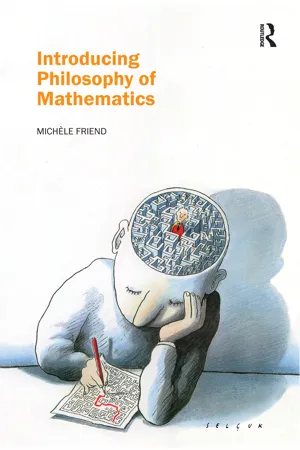
What is mathematics about? Does the subject-matter of mathematics exist independently of the mind or are they mental constructions? How do we know mathematics? Is mathematical knowledge logical knowledge? And how is mathematics applied to the material world? In this introduction to the philosophy of mathematics, Michele Friend examines these and other ontological and epistemological problems raised by the content and practice of mathematics. Aimed at a readership with limited proficiency in mathematics but with some experience of formal logic it seeks to strike a balance between conceptual accessibility and correct representation of the issues. Friend examines the standard theories of mathematics - Platonism, realism, logicism, formalism, constructivism and structuralism - as well as some less standard theories such as psychologism, fictionalism and Meinongian philosophy of mathematics. In each case Friend explains what characterises the position and where the divisions between them lie, including some of the arguments in favour and against each. This book also explores particular questions that occupy present-day philosophers and mathematicians such as the problem of infinity, mathematical intuition and the relationship, if any, between the philosophy of mathematics and the practice of mathematics. Taking in the canonical ideas of Aristotle, Kant, Frege and Whitehead and Russell as well as the challenging and innovative work of recent philosophers like Benacerraf, Hellman, Maddy and Shapiro, Friend provides a balanced and accessible introduction suitable for upper-level undergraduate courses and the non-specialist.
Information
Table of contents
- Cover
- Half Title
- Title
- Copyright
- Contents
- Acknowledgements
- Preface
- 1. Infinity
- 2. Mathematical Platonism and realism
- 3. Logicism
- 4. Structuralism
- 5. Constructivism
- 6. A pot-pourri of philosophies of mathematics
- Appendix: Proof: ex falso quod libet
- Glossary
- Notes
- Guide to further reading
- Bibliography
- Index
Trusted by 375,005 students
Access to over 1.5 million titles for a fair monthly price.
Study more efficiently using our study tools.
Frequently asked questions
Yes, you can cancel anytime from the Subscription tab in your account settings on the Perlego website. Your subscription will stay active until the end of your current billing period. Learn how to cancel your subscription
No, books cannot be downloaded as external files, such as PDFs, for use outside of Perlego. However, you can download books within the Perlego app for offline reading on mobile or tablet. Learn how to download books offline
We are an online textbook subscription service, where you can get access to an entire online library for less than the price of a single book per month. With over 1.5 million books across 990+ topics, we’ve got you covered! Learn about our mission
Look out for the read-aloud symbol on your next book to see if you can listen to it. The read-aloud tool reads text aloud for you, highlighting the text as it is being read. You can pause it, speed it up and slow it down. Learn more about Read Aloud
Yes! You can use the Perlego app on both iOS and Android devices to read anytime, anywhere — even offline. Perfect for commutes or when you’re on the go.
Please note we cannot support devices running on iOS 13 and Android 7 or earlier. Learn more about using the app
Please note we cannot support devices running on iOS 13 and Android 7 or earlier. Learn more about using the app
Yes, you can access Introducing Philosophy of Mathematics by Michele Friend in PDF and/or ePUB format, as well as other popular books in Philosophy & History & Philosophy of Mathematics. We have over 1.5 million books available in our catalogue for you to explore.