eBook - ePub
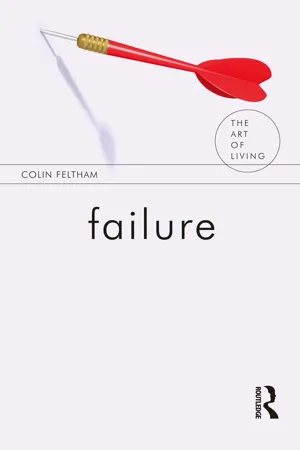
Failure
About this book
Failure, success's ugly sister, is inevitable - cognitively, biologically and morally. We all make mistakes, we all die, and we all get it wrong. A chain of flaws can be traced through all phenomena, natural and human. We see impending and actual failures in individual lives, in marriages, careers, in religion, education, psychotherapy, business, nations, and in entire civilizations. And there are chronic and imperceptible failures in everyday domains that most of the time we barely notice, often until it is too late. Colin Feltham expores what constitutes failure across a number of domains. He takes guidance from the work of such diverse philosophers and thinkers as Diogenes, Epictetus, Augustine, Schopenhauer, Kierkegaard, Heidegger, Sartre, Camus, Cioran and Ricoeur, while also drawing on the insights of artists and writers such as van Gogh, Arthur Miller, Philip Larkin, Samuel Beckett, Charles Bukowski and Philip Roth. Precursors and partial synonyms for failure can be seen in the concepts of hamartia, sin, fallenness, non-being, false consciousness and anthropathology. Philosophy can help us but is itself, in its reliance on language and logic, subject to inherent flaws and failures. It is the very pervasiveness yet common denial of failure which makes it a compelling topic that cries out for honest analysis. We live in a time when the cliche of failed Marxism may be segueing frighteningly (for some) into the failure of 'selfish capitalism', in a time of geopolitical uncertainty and failure to address the dire need for agreement and action on climate change. But many of us are also painfully aware of our own shortcomings, our own weakness of will and lack of authenticity. Trying to identify where the lines may be drawn between individual responsibility, social policy, and historical and biological dark forces is a key challenge in this fascinating book.
Information
1. Origins, meanings and nuances of failure
Why does anyone feel like a failure? Where do we get our ideas from about the nature of success and failure? Why does failure sometimes seem so pervasive? And why do some philosophers find themselves having to begin their enquiries with topics of failure and disappointment? The contemporary philosopher Simon Critchley, for example, throws around these themes on the first page of his Infinitely Demanding:
Something desired has not been fulfilled, … a fantastic effort has failed. … Absolute knowledge is beyond the ken of fallible, finite creatures like us. … We seem to have enormous difficulty in accepting our limitedness, our finiteness, and this failure is a cause of much tragedy.
(2008: 1)
For Critchley the failures of religion and politics are uppermost but here I shall begin our look at failure both more personally and more widely.
Let’s hear Arthur Schopenhauer’s head-on portrayal of human life as a failure:
We begin in the madness of carnal desire and the transport of voluptuousness, we end in the dissolution of all our parts and the musty stench of corpses. And the road from the one to the other goes, in regard to our well-being and enjoyment of life, steadily downhill: happily dreaming childhood, exultant youth, toil-filled years of manhood, infirm and often wretched old age, the torment of the last illness and finally the throes of death.
([1851] 1970: 54)
I shall unpack this dismal and entropy-focused account of specifically human experience further in Chapters 2 and 5. But let’s keep in mind from now on the qualities and charges of madness, down-hillwardness, toil, infirmity, wretchedness, torment and death that make this life resemble, for Schopenhauer, a penal colony rather than being a basis for human flourishing.
Some lucky souls seem to be born well, experience a minimal mismatch with their environment, thrive in love, work and health and have little use for failure as part of their vocabulary. Some are perhaps dominant and insensitive types who oppress and inflict failure on others rather than experiencing it themselves. But some of us experience painful dissonances, perhaps for a lifetime: friction with parents, failure at school, broken relationships, lots of struggle, poverty, illness and bad luck. As if it isn’t bad enough to find yourself in this last category, when you cast around for comfort, explanations and solutions, the books, people and institutions you engage with may disappoint you; they may tell you success is in your hands and you are free to change or transcend your situation. Your thoughts, mood and personality could turn you towards religious hope for an afterlife, or towards suicidal depression, towards anarchistic anger and terrorism, towards an absurdist position such as that of Albert Camus or Samuel Beckett, the contemptuous pessimism of Schopenhauer, the stillness and insight of the Buddha, the amused nihilism of E. M. Cioran, or the Stoicism of ancient philosophers or modern-day cognitive behavioural therapists.
If, like me, you have a deeply sceptical disposition and a restless mind that is averse to belonging to any belief club, you may search for and be momentarily detained by nuggets of intellectual interest but the winds of doubt and nihilism sweep you ever onwards. Thinkers as diverse as Friedrich Nietzsche and Jiddu Krishnamurti have spurned the systematization of enquiry. A philosopher of art such as John Roberts argues that “the productiveness of the error in art operates in defiance of the programmatic, systematic or unitary ideal” (2011: 209). Stoicism, Cynicism and Epicureanism have their attractions but seem to demand inhumanly heroic ascetic actions and mental self-discipline that most us cannot command. Existentialism, similarly aligned with a personalized philosophy of living rather than the more abstract forms of philosophy, yet seems at least partly to fail the tests of my gut scepticism and of scientific data. A great deal of evolutionary, genetic and neurological essence surely does precede my own existence and limits my freedom. We may be time-bound beings facing death but we are also offered time transcendence by some oriental philosophies and religions, and “amortality” (Epicurean or otherwise) is currently a fashionable hypothesis. The Kantian club insists on moral value and effort in all circumstances, yet the recognition of contingency, of moral luck and pervasive tragedy, seriously challenges the Kantian position. Every philosophy, however attractive, is flawed. Indeed, Emmanuel Levinas famously and ironically declared that “the best thing about philosophy is that it fails” (Kearney 1984: 63).
Where should I look to help me understand failure? Simple introspection is one well-tried route. Anecdotal and objective evidence are further promising sources of aid. We might begin with an analysis of the generic concept of failure, or we might, like Michel Foucault, examine it via the lens of historical and contemporary culture. My epistemological radar picks up a variety of suggestive data. If we want to seriously investigate the fault lines that run through our own lives, we might allow that failure doesn’t necessarily begin at home, in our own agency and culpability. Epicureans began their philosophical quests in cosmology and were far from alone in seeking patterns of behaviour that extend from cosmos to human being. Consider the following contemporary partial description of the formation of “our cosmic neighbourhood”: “The asteroid belt between Mars and Jupiter consists of what is thought to be a failed process of planet formation. It failed, because the enormous gravity exerted by Jupiter would have torn apart any incipient planet that emerged in that area” (Spier 2011: 66). Cosmologists may now infer, then, that this asteroid belt was destined to become a planet but the process was aborted owing to greater inhospitable forces. Fallibility may be said to be an intrinsic aspect of becoming for all phenomena. It was not viable for this asteroid belt to become a planet in the circumstances prevailing so it became something else. One thing simply leads to another. For those who believe in God the creator, however, everything must have been designed to be what it was and is. God as an all powerful engineer could not have been thwarted by anything as trivial as enormous planetary gravity. God as an aesthetic perfectionist would not have settled for a failed process and outcome.
The same problems of inference are at work today when we ask whether a physically deformed baby was failed by God or destined by a quirk of fate to be different from the human biological norm; or if we are wrong to consider this baby “deformed” when it is simply different; indeed, whether our very perceptual and interpretative apparatuses oblige us to append labels instead of seeing and accepting “what is”.
At one level we can infer that failure (or imperfection, or error) was an ever-present possibility; at another we shall insist that failure or imperfection is always about interpretation. Whether discussing an asteroid belt, the extinction of dinosaurs, a tsunami or earthquake that abruptly kills thousands, human diseases or one’s own idiosyncratic struggles against adversity, we might say that these are all part of a richly diverse, unfolding cosmos and biosphere: ours not to reason why, the overall and ultimate design and purpose all in God’s hands. The Hindu concept of karma offers an explanation of sorts for evolution and misfortune, based on adjustments for moral merit, but it is frankly not satisfying for all of us. Or some will say, even without God in the picture, that we must accept many things we do not like, respect differences and learn to improve where possible. For Plato, this world we inhabit is clearly imperfect and subject to decay, while in another, more real realm there is perfection. This of course parallels dualistic religious worldviews of “this life” (which is inferior and disappointing in some way) and a hereafter or heaven (which is perfect and a vindication). Also, we cannot ignore the question whether failure is the necessary and equal undertow of success in all matters or a mere sign of necessary risk on the road to inevitable success. Perhaps our utopian aspirations, always enmeshed with negotiations with failure, will eventually be realized.
The earth’s environment is not a neutral ecology but one that generates considerable risk, cruelty, pain and premature death along the way. It may not properly be called a failure but it has its design flaws and we can at least imagine a world in which less suffering and failure was necessary. Herbert Marcuse (1987) made natural scarcity (or Ananke) a central plank in his argument concerning human repression and unhappiness. However much progress we have made as a species, and however much we personally aim for success and happiness and argue against determinism, we know we cannot evade some misfortunes. I am frankly dismissing crude creationist accounts here. One might simply say that they have failed to satisfy modern rational criteria for convincing explanation and have failed to adapt to evidence that has emerged since biblical explanations were created.
Homo sapiens has evolved from earlier primates. We have not by any means shed all the limitations or design flaws of our mammalian cousins; we have certainly made some improvements but we have also incurred some losses in the process, the most glaring being that probably very few of us could survive for very long in wholly natural conditions. Yet humans are often bedevilled by a sense that something preciously natural has been sacrificed in the course of our evolution towards cultural dependency. And to add to our discomfort, our existentialist philosophies suggest that we collude in lives of inauthenticity, bad faith and sickness unto death.
Before language no concept of failure-as-such can have existed for human beings but observations and experiences of failure in its broadest sense must have been common enough. Hunger, accidents, disease, predation, extreme weather and natural catastrophes, along with witnessing human deaths and rotting carcasses, would have signalled to our ancestors that all was not as they would wish it to be. However close to conditions of paradise early humans ever came, threats were never far away and vigilance was always necessary. Later, with the advent of agriculture and primitive technologies, humans would have begun to experience periodic breakdowns in their plans. Design imperfections led to learning to make improvements but all such efforts were, and remain, fallible. Language was essential in all this but it too contained flaws: words not yet invented, the birth of complex deception and misunderstanding. Vigilance, planning and the drive to survive and succeed have been constant; but equally entropy has been ever present: our best-laid plans are always subject to breakdown. We can argue that humanity intends to improve (succeeding and failing in due proportion) on natural hazardousness but that nature is indifferent. Willem Drees’s book Is Nature Ever Evil? (2003) provides copious examples of exactly how “evil” or flawed nature is. The reversal of an anthropathological or original sin account might be that nature is often blind, inefficient and cruel and the human being, however fallible, will gradually overcome these original flaws of nature. Indeed, this is the standard scientific and optimistic science-fiction view: we will anticipate earthquakes, asteroids and drought, and bio-colonize currently barren planets.
Early theologies refined narrative accounts of the causal chain between the omnipotent God’s perfect creation and humans’ disobedience, which brought original sin, suffering and death into existence. Hindu theology offered causal (karmic) explanations for suffering in relation to the many natural forms in creation. Buddhism identified suffering as a universal phenomenon, closely linked with human desire and dissatisfaction. Early philosophers – the Presocratics, Socrates, Plato and others – began to focus more closely and logically on human agency and human institutions in their imperfect and improvable forms. Concepts similar to sin (hamartia, tragic flaw, or missing the mark, and akrasia, weakness of will) arose. With Aristotle came the beginnings of formal knowledge and science. All subsequent philosophy has sought to improve on the understanding of previous philosophy and, along with science, has gradually eroded many religious views. Yet all attempts at perfect understanding and knowledge are fallible, all limited by human intelligence. Curiosity necessarily entails enquiry into how and why things go wrong or are not in line with our wishes or certainties. Human beings have been driven by their environment and consciousness to discover reasons for existence, injustice, sin (or error, or failure), evil and death, among other challenges.
In my own view, religious explanations for the human condition have had their place but their credibility decreases steadily with the rise of much more compelling explanations. Ultimately, religion fails to explain human development and behaviour and appears not to be capable of correcting it; indeed, it may add to our flaws. Philosophy, relying on reason, has been freer to consider other explanations but it too often fails in many ways to show its relevance or potency, operating instead as if detached from brute reality. Postmodernist writers tell us that no one can legitimately pronounce on life as if disembodied, with “a view from nowhere”, but we persist in such detached exercises.
I realize even as I write these words, however, that the intellectual terrain is so extensive that neither I nor (probably) anyone else can have the expertise to grasp all the data accurately. We all have imperfect or flawed intellects and academic research and its jargon becomes more specialized by the day. Our tendency is to multiply theories, hang on to redundant theories and fiercely defend our own self-serving theories against others rather than seriously attempt rapprochement (we have marked epistemological failures) and all human knowledge is fallible and ever changing. Science itself is flawed in spite of its remarkable discoveries: like all human endeavours, science goes wrong, as evidenced in accidents, ethical breaches, fraud, misappropriation of dangerous findings and products. Also, as Simon LeVay puts it, “for every brilliant scientific success there are a dozen failures” (2009: vii). Far more than a dozen, one would think. But many sciences, and some humanities subjects, generate new material evidence and hypotheses that far surpass the backward-looking nature of so much theology and some philosophy.
There are many names for our human folly and destructiveness, from original sin and evil to alienation, universal neurosis and “man’s inhumanity to man”. There is much speculation, and always has been among theologians and philosophers, about the origins and causes of, and possible remedies for, our ills. “Unde hoc malum?” Where does this wrongdoing come from? The question is an old one (Jacobs 2008: xv). We can, I believe, paraphrase this with no loss or distortion of meaning as “Where do our pervasive moral flaws and associated shared failures come from?” Academics are arguably obsessed with points of evidence, detail and classification, which tend to narrow enquiry into slow-moving, discipline-specific channels and prevent broad, socially significant and urgent enquiry and remedies. Put differently, the scholarly tradition stemming from Aristotle fails to appreciate and address the enormity and urgency of the question, and it too often gets left to an unsatisfactory mixture of folk psychology and religious opinion and dogma.
Here I perhaps need to insert a plea for patience. I am very aware from a psychotherapeutic perspective that most individuals want explanations for what they assume is their own unique form of suffering and, even more than this, they crave solutions. Quite naturally we are chiefly concerned with our own environment and being but in this regard we are often somewhat myopic. While we may demand that any therapy or philosophy of living should yield short-term personal dividends, we risk failed understanding if we impatiently dismiss explanations that place the “unique me” and contemporary humanity in the deepest context of evolution and history. This is not mere historical waffle but an account that lives on in us in our genes and behaviour. Schopenhauer did not have sophisticated cosmological and evolutionary data available to him with which to investigate the possible origins of our human condition and even until quite recently many philosophers have shied away from engagement with Darwinian themes. The foundations of much Western philosophy lie in and require a faith in reason as cerebral freedom and an aversion to anything that implies we are determined by brute forces and have only illusory freedoms. Eastern traditions are arguably more comfortable with concepts of fatalism and illusion.
Evolutionary psychology and its incipient applied forms of psychiatry and psychotherapy argue that many of our stubborn, self-defeating traits result from deep-seated behavioural orientations laid down thousands of years ago. We evolved like all animals needing food and sex for survival. We evolved in small groups heavily reliant on social factors. Some degree of natural territoriality, kin preference, xenophobia, aggression, gender-role division, leadership and subordinate roles is inherent in our nature. We did not evolve to be entirely trusting, altruistic, cooperative, rational and so on, and we have difficulty adapting to modern lifestyles. Obviously we have adapted a great deal over thousands of years but we cannot shake off certain “primitive drives”. We evolved physically by slow adaptation from existing anatomical foundations. For example, our mammalian ancestors walked on all fours and the human spine has that same original purpose. We have succeeded in walking upright but the common backache attests to our imperfect design, and there are many more examples of a mismatch between our origins and our current behaviour. Gary Marcus (2008) refers to all such mismatching features as “kluges” (an engineering term referring to clumsy but once-effective solutions to problems of adaptation) and sees no reason to draw a barrier between physical and mental evolutionary mismatches. The point is that all such imperfect adaptations form the basis of human flaws and failures.
There is considerable agreement among cognitive psychologists and some philosophers that many of our common perceptions, beliefs and behaviours are based on flaws in thinking and even physiology. We rarely see what is actually in our visual field but an edited version of it, owing to blinking, limitations of the fovea (where visual acuity is far greatest), saccades (necessarily jerky eye movements) and general inattention. We like to believe we are fair-minded and make good judgements, a majority believing, for example, that we are better than average drivers, more competent than others, more reliable and so on: all these are known as egotistic illusions. Psychological experiments seem to demonstrate repeatedly what distorted memories we have: “over the past three decades psychologists have demonstrated beyond any doubt that memory is staggeringly fallible and suggestible” (Lawton 2011: 39). Similar observations extend to serious doubts about the existence of free will. Yet, it is argued, we need all such illusions to maintain our sense of integrity and executive control.
Such hypotheses are hard to prove and much disliked within liberal cultures. The very assertion of anything that smacks of “determinism” can call forth vitriolic criticism. These kinds of hypothesis seem to suggest that human nature is intractable and worthy of only the most pess...
Table of contents
- Cover
- Half Title
- The Art of Living Series
- Title Page
- Copyright Page
- Dedication
- Table of Contents
- Acknowledgements
- Introduction
- 1. Origins, meanings and nuances of failure
- 2. Failure across the lifespan
- 3. Collective human folly, sin and error
- 4. The tragic arts
- 5. Being a failure
- 6. Learning from failure
- Postscript
- Further reading
- References
- Index
Trusted by 375,005 students
Access to over 1.5 million titles for a fair monthly price.
Study more efficiently using our study tools.
Frequently asked questions
Yes, you can cancel anytime from the Subscription tab in your account settings on the Perlego website. Your subscription will stay active until the end of your current billing period. Learn how to cancel your subscription
No, books cannot be downloaded as external files, such as PDFs, for use outside of Perlego. However, you can download books within the Perlego app for offline reading on mobile or tablet. Learn how to download books offline
Perlego offers two plans: Essential and Complete
- Essential is ideal for learners and professionals who enjoy exploring a wide range of subjects. Access the Essential Library with 800,000+ trusted titles and best-sellers across business, personal growth, and the humanities. Includes unlimited reading time and Standard Read Aloud voice.
- Complete: Perfect for advanced learners and researchers needing full, unrestricted access. Unlock 1.5M+ books across hundreds of subjects, including academic and specialized titles. The Complete Plan also includes advanced features like Premium Read Aloud and Research Assistant.
We are an online textbook subscription service, where you can get access to an entire online library for less than the price of a single book per month. With over 1.5 million books across 990+ topics, we’ve got you covered! Learn about our mission
Look out for the read-aloud symbol on your next book to see if you can listen to it. The read-aloud tool reads text aloud for you, highlighting the text as it is being read. You can pause it, speed it up and slow it down. Learn more about Read Aloud
Yes! You can use the Perlego app on both iOS and Android devices to read anytime, anywhere — even offline. Perfect for commutes or when you’re on the go.
Please note we cannot support devices running on iOS 13 and Android 7 or earlier. Learn more about using the app
Please note we cannot support devices running on iOS 13 and Android 7 or earlier. Learn more about using the app
Yes, you can access Failure by Colin Feltham in PDF and/or ePUB format, as well as other popular books in Philosophy & Ethics & Moral Philosophy. We have over 1.5 million books available in our catalogue for you to explore.