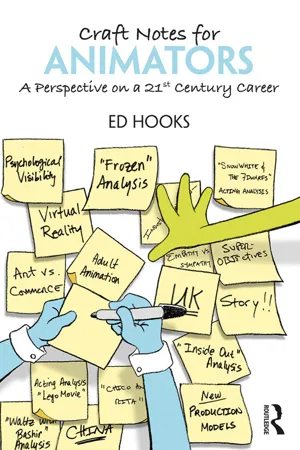
If Disney's Snow White and the Seven Dwarfs represented the Animation industry's infancy, Ed Hooks thinks that the current production line of big-budget features is its artistically awkward adolescence. While a well-funded marketing machine can conceal structural flaws, uneven performances and superfluous characters, the importance of crafted storytelling will only grow in importance as animation becomes a broader, more accessible art form. Craft Notes for Animators analyses specific films – including Frozen and Despicable Me – to explain the secrets of creating truthful stories and believable characters. It is an essential primer for the for tomorrow's industry leaders and animation artists.
- 162 pages
- English
- ePUB (mobile friendly)
- Available on iOS & Android
eBook - ePub
About this book
Information
Part 1
Infancy
“The infant learns to dream what is imaginable and to train his expectations on what promises to prove possible.”
Erik Erikson1
An actor knows that you learn more about a character by looking at what is hidden – at secrets and longings – than by focusing on what is displayed. That is why I have long been interested in Walt Disney, not only for the way he led his animators in pioneering empathetic performance in Snow White and the Seven Dwarfs but because of the man himself. Animators today, in the early years of the 21st century, are in an analogous situation to Disney’s in the mid-1930s, the period during which he put Snow White into production. Now, as then, the industry has reached a plateau. In the mid-’30s, when the industry was in its infancy, animation was generally thought of as “cartoons,” and everybody knew for certain that cartoons were short in length and were best suited to be curtain raisers for feature-length live-action movies. Today, we have a thriving and immensely profitable feature animation industry, and everybody knows for certain that animated movies are best suited for children and that they make a powerful marketing tool. Then, as now, Walt Disney’s studio selected and played the tune to which the rest of the industry danced. The big difference, of course, is that Walt died in 1966 and is no longer at the helm. The Disney Company today is the North Star of the animation industry, but its priorities have reversed since the time when Walt was running things. He personally placed a strong emphasis on storytelling, and merchandising was a secondary consideration. In 2016, the Disney Company is all about money making, “tent-pole” films, franchises, spinoffs and merchandising. Storytelling, while important, tends toward boilerplate and lacks creative inspiration. For the Disney Company, as well as its imitator studios, animated films have become entertainment widgets, commodity and an essential element in giant commercial enterprises. That is why now, as the industry becomes less Hollywood-centric, more international and transitions into its maturity, it is an opportune time to revisit its infancy. Walt Disney was not only a pioneer; as it has turned out, he is also a guide.
Many biographical articles, books and filmed documentaries about Walt Disney’s life and accomplishments are referenced in the bibliography of this book. They mostly highlight career landmarks, early business struggles, the development of animation itself and his ultimate financial success, but I keep coming back to the fact that he literally signed his movies, putting his name in the title. It wasn’t Snow White and the Seven Dwarfs; it was Walt Disney’s Snow White and the Seven Dwarfs and Walt Disney’s Pinocchio. He did this even though he balked at giving screen credit to anybody else, including the animators who made the movies (“I’m sorry that we can’t give individual credit, but every subject is the product of a hundred minds. It is purely an organization creation”).2 Also, the name of the company was changed from Disney Brothers Studio to the Walt Disney Studio in 1926. Given that Walt and his brother Roy were equal partners, this change tends to raise an eyebrow. The net result was that Walt Disney personally placed himself – and himself alone – above the title. What motivated him to accomplish so much? His artistic contributions were Shakespearean in scope.
To the 1950s American public, he was the kindly, good-humored, generous “Uncle Walt” who showed up on television each week, but if you scratch the surface even a little bit, you discover that this persona was largely an act. In fact, he was an often-frazzled workaholic, pushing himself so hard that he experienced at least one full-tilt nervous breakdown, in 1931 (“I guess I was working too hard and worrying too much. I was expecting more from my artists than they were giving me, and all I did all day was pound, pound, pound. Costs were going up; each new picture we finished cost more to make than we had figured it would … so I cracked up. I became irritable and I couldn’t sleep. I reached a point where I couldn’t even talk over the telephone without crying. I was an emotional flap.”).3 Walt Disney was the fourth of five children, born in Chicago in 1901 into financially precarious circumstances during an era in American history when there was no social safety net at all – no unemployment insurance or Social Security, no support for families fallen on hard times. His emotionally distant, stern father, Elias, struggled to support the family, trying his hand at a half-dozen different blue-collar professions – machinist on the railroad, construction worker, newspaper and milk delivery, farmer and carpenter. Elias was politically a socialist, an enthusiastic supporter of Eugene Debs, which is an interesting factoid given that Walt Disney’s legacy would one day be footnoted for his extreme right-wing, anti-union, anticommunist political views. Perhaps more significant than anything else, Elias never had much use for cartoons. He didn’t consider drawing pictures to be a worthy occupation for a grown man. This raises the question of whether part of Walt’s motivation to succeed was a need to please his dad. Walt’s mother, Flora, was a mostly silent, long-suffering and mediating figure in the Disney home. A former grammar-school teacher, she did the best she could for her large family, which often lived in homes that had neither indoor heating nor electricity. The Disney house was traditional in every sense: Flora took care of the kids, and Elias brought home the bacon. Their childrearing philosophy was straightforward: “Spare the rod, spoil the child” (Proverbs 13:24). Walt expressed an early interest in cartooning and then, after some early professional fits and starts, migrated to Los Angeles in 1923. In 1925, he and his brother Roy made a $400 down payment on the Hyperion Avenue plot of land upon which would be built the first Disney Animation Studio. He married Lillian Marie Bounds, one of the ink-and-paint girls in that first Disney Studio, and they raised two daughters, one of whom was adopted. He was a lifelong chain smoker – unfiltered Lucky Strikes mostly – which no doubt hastened his death from lung cancer at age 65 in 1966.
He became the CEO of an industry-defining animation studio, but he was personally not much of an animator. He could not even draw a presentable image of Mickey Mouse! He was a high school dropout who, for all of his ultimate financial success, was never ostentatious. He never lived in a mansion or dressed in expensive suits. He didn’t own a yacht or buy his own South Seas island. His one extravagance was the scale-model steam engine he built to ride around in circles in his own back yard. According to one of Disney’s most astute biographers, Neal Gabler, even Walt’s wife, Lillian, could not understand why the family was so frequently scraping for money. After all, she said, he was the world-famous Walt Disney!4 He showed one face to the public – confident, empathetic, good-humored, hard working – but saw quite a different one when he looked in the mirror. And yet, nobody in the history of the United States more precisely enunciated the American character. Walt’s values were our values, and the movies he produced were a conduit from him to us.
Super-objectives and psychological visibility
Constantin Stanislavsky, cofounder of the Moscow Art Theatre, was the “father” of modern, naturalistic acting. He taught his students to search within their characters for a “super-objective,” a kind of connecting thread that holds together smaller, more shorter-term objectives. Why, for example, does a person choose a career in automotive design instead of chemistry or agriculture? Why does one person choose the life of a forest ranger and another become a game show host? What is the driving force, the super-objective? Why are you reading this book instead of Popular Mechanics? What is your secret self? What is your dream? Who else, other than you, knows what your dream is? You can think of a super-objective as a kind of interior, soulful itch that you cannot quite scratch, but you never stop trying.
Former US president Bill Clinton was disgraced by sexual indiscretions while still in office, a situation that can help us understand the concept of super-objective: The specific event that led to congressional investigations and ultimately to impeachment proceedings had to do with his involvement with Monica Lewinsky, a young White House intern. Why, do you think, did he become entangled with her? Why would one of the most powerful and highly respected men in the world risk losing everything for a cheap sexual experience? If he really wanted sexual activity, there were “safer” ways to accomplish it. US presidents and, indeed, powerful men throughout history have been sexually active outside marriage, and everybody has looked the other way. In Clinton’s case, he carried on his affair in the White House Oval Office, a hallowed room in US history. Also, the affair was rather exploitive because of the great age difference between Clinton and Lewinsky. Again, why? One would think this kind of thing would be the very definition of political suicide, utter stupidity. If a strong actor were hired to portray Bill Clinton, as will certainly be the case one of these days, he would have to justify that affair with Monica Lewinsky. The simple explanation is that men will be men, and this was mere opportunism. A more satisfying explanation would be found in a super-objective. Consider this: On some very deep level, Clinton needed to feel powerful as a man, and none of his vast political victories and exalted accomplishments was satisfying that need. Here he was, a man who rose from a trailer-park childhood to be one of the most powerful people in the world, but, on a profound level, none of this scratched the itch. What he needed was to be adored in the personal and fawning way that his White House intern adored him. Literally, he required hands-on adoration in order to feel powerful. And he was willing to risk everything he had achieved in order to get that. This is the motivating power of a super-objective. And very few of us are really in tune with our super-objectives for the simple reason that they are super-submerged. A super-objective is the underlying motivation for all other, more tangible, objectives. What was Walt Disney’s super-objective? We can speculate about it, but we will never know for certain. My guess is that, because his father so casually dismissed his sensitive and artistic nature, Walt felt a lifelong need to prove that he was worthy of Elias’s admiration and respect. The subject of super-objectives is interesting in itself, and you can find a lot of information about it online. I suggest you begin with a BBC-sponsored web page: www.bbc.co.uk/education/guides/zxn4mp3/revision/7.
Another useful psychological concept in this context is “psychological visibility.” The idea is credited to psychologist Nathaniel Brandon, who wrote, “When we encounter a person who thinks as we do, who notices what we notice, who values what we value, who tends to respond to different situations as we do, not only do we experience a strong sense of affinity with such a person but we also can experience our self through our perception of that person”5 A quest for psychological visibility is applicable also to an individual’s work, especially in the arts. All artists are expressing themselves in very personal and revealing ways. In fact, the novelist Leo Tolstoy, in What Is Art?, defined art as one person’s attempt to communicate an idea plus his feelings about that idea. If emotions and ideas are not present, he contended, it isn’t art at all. Despite the fact that Walt Disney denied until his death that he was an artist, that is arguably precisely what he was. He liked to say he was simply “curious” about how things worked and that he enjoyed working with his hands, but that does not explain how and why he selected the Grimm brothers fairy tale Snow White and the Seven Dwarfs as the launchpad for the first feature-length cartoon in history.
Walt Disney was communicating ideas and feelings and searching for psychological visibility. He was so successful at it that few people even realized what he was doing. In life, all of us present to the world an image of ourselves that we consider will get us the most mileage. This is our “public persona,” our personality. The fact is, though, that a persona functions like the tip of an iceberg. Only 15 percent of an iceberg shows above the water line; 85 percent is out of sight. People looking for psychological visibility display what they consider to be their most admirable traits.
But without knowing that below-the-water-line 85 percent, you don’t fully know the person. Each of us longs to be acknowledged and, we hope, respected for our values, for who we are. Each time Disney put his name in the title of a movie, he was saying to the world, in effect, “This is who I am. I created this, and the person I am stands revealed.” What we are doing in this book is looking for that 85 percent Walt might not have been so eager to display. That is where we will likely find the most satisfying explanations for his genius.
The DeMolays
Walt Disney was practically a founding member of DeMolay International, an offshoot of the Freemasons, the world’s oldest and largest fraternity. Nine of the 56 signers of America’s Declaration of Independence and 39 of the signers of the US Constitution were Freemasons, including Benjamin Franklin, John Hancock and George Washington. Its members are committed to self-improvement, charity, devotion to family and country and, above all else, belief in a Supreme Being. The DeMolays are more or less junior trainees for later participation in Freemasonry. Disney joined the organization in Kansas City, Missouri, when he was 19 and is officially member #120. He was so dedicated to the organization during his lifetime, in fact, that his name appears today in the ultra-exclusive DeMolay Hall of Fame, along with those of several astronauts, the actor John Wayne, a number of business titans and at least one US president, Bill Clinton. Most Disney biographers don’t emphasize Walt’s association with the DeMolays because, despite all its good works, the organization is also quite restrictive. It is open only to boys between 11 and 21 years of age (no girls), is historically all white (no blacks) and includes only deists (no secularists), and those deists are usually Christian (no Jews). The reason it is relevant to our discussion is that the DeMolay creed so closely matches the values that Walt Disney came to personify and to popularize, and he was already expressing those values when he was only 19 years o...
Table of contents
- Cover
- Title
- Copyright
- Dedication
- Contents
- Acknowledgments
- Introduction
- Part 1 Infancy
- Part 2 Adolescence
- Part 3 Adulthood
- Bibliography
- Index
Trusted by 375,005 students
Access to over 1.5 million titles for a fair monthly price.
Study more efficiently using our study tools.
Frequently asked questions
Yes, you can cancel anytime from the Subscription tab in your account settings on the Perlego website. Your subscription will stay active until the end of your current billing period. Learn how to cancel your subscription
No, books cannot be downloaded as external files, such as PDFs, for use outside of Perlego. However, you can download books within the Perlego app for offline reading on mobile or tablet. Learn how to download books offline
Perlego offers two plans: Essential and Complete
- Essential is ideal for learners and professionals who enjoy exploring a wide range of subjects. Access the Essential Library with 800,000+ trusted titles and best-sellers across business, personal growth, and the humanities. Includes unlimited reading time and Standard Read Aloud voice.
- Complete: Perfect for advanced learners and researchers needing full, unrestricted access. Unlock 1.5M+ books across hundreds of subjects, including academic and specialized titles. The Complete Plan also includes advanced features like Premium Read Aloud and Research Assistant.
We are an online textbook subscription service, where you can get access to an entire online library for less than the price of a single book per month. With over 1.5 million books across 990+ topics, we’ve got you covered! Learn about our mission
Look out for the read-aloud symbol on your next book to see if you can listen to it. The read-aloud tool reads text aloud for you, highlighting the text as it is being read. You can pause it, speed it up and slow it down. Learn more about Read Aloud
Yes! You can use the Perlego app on both iOS and Android devices to read anytime, anywhere — even offline. Perfect for commutes or when you’re on the go.
Please note we cannot support devices running on iOS 13 and Android 7 or earlier. Learn more about using the app
Please note we cannot support devices running on iOS 13 and Android 7 or earlier. Learn more about using the app
Yes, you can access Craft Notes for Animators by Ed Hooks in PDF and/or ePUB format, as well as other popular books in Media & Performing Arts & Acting & Auditioning. We have over 1.5 million books available in our catalogue for you to explore.