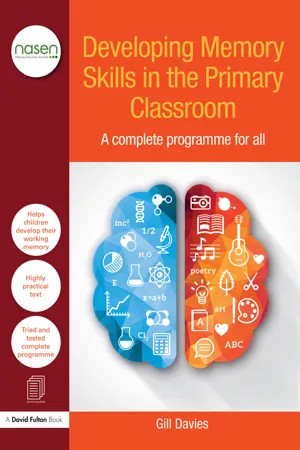
Developing Memory Skills in the Primary Classroom
eBook - ePub

Developing Memory Skills in the Primary Classroom

A complete programme for all

  1. 144 pages
  2. English
  3. ePUB (mobile friendly)
  4. Available on iOS & Android
eBook - ePub

Developing Memory Skills in the Primary Classroom

A complete programme for all

About this book

How can we help children to develop their working memory?

The memory demands in the classroom for children are high; they are constantly bombarded by new knowledge in multiple topic areas, given series of instructions to complete and expected to both learn and demonstrate their mastery of knowledge and skills on a daily basis. Developing Memory Skills in the Primary Classroom is a highly practical book that contains all the guidance and resources a school needs to boost their pupils' working memory. Proven to have a positive impact on pupils, this tried and tested complete programme combines teaching pupils memory strategies with opportunities to practice those strategies within a small group, the classroom and at home. The resources provided by this book include:

  • a variety of photocopiable games and activities
  • extensive teaching notes
  • a range of sample letters to parents/carers
  • essential information sheets
  • bespoke baseline assessment tools
  • a detailed programme that can be run by a teaching assistant under the guidance of the SENCo.

This text provides a clear link between working in the classroom and with parents in the home, making it a one-stop resource for any teacher, SENCo, teaching assistant or parent wanting to help children develop their working memory.

Frequently asked questions

Yes, you can cancel anytime from the Subscription tab in your account settings on the Perlego website. Your subscription will stay active until the end of your current billing period. Learn how to cancel your subscription.
At the moment all of our mobile-responsive ePub books are available to download via the app. Most of our PDFs are also available to download and we're working on making the final remaining ones downloadable now. Learn more here.
Perlego offers two plans: Essential and Complete
  • Essential is ideal for learners and professionals who enjoy exploring a wide range of subjects. Access the Essential Library with 800,000+ trusted titles and best-sellers across business, personal growth, and the humanities. Includes unlimited reading time and Standard Read Aloud voice.
  • Complete: Perfect for advanced learners and researchers needing full, unrestricted access. Unlock 1.4M+ books across hundreds of subjects, including academic and specialized titles. The Complete Plan also includes advanced features like Premium Read Aloud and Research Assistant.
Both plans are available with monthly, semester, or annual billing cycles.
We are an online textbook subscription service, where you can get access to an entire online library for less than the price of a single book per month. With over 1 million books across 1000+ topics, we’ve got you covered! Learn more here.
Look out for the read-aloud symbol on your next book to see if you can listen to it. The read-aloud tool reads text aloud for you, highlighting the text as it is being read. You can pause it, speed it up and slow it down. Learn more here.
Yes! You can use the Perlego app on both iOS or Android devices to read anytime, anywhere — even offline. Perfect for commutes or when you’re on the go.
Please note we cannot support devices running on iOS 13 and Android 7 or earlier. Learn more about using the app.
Yes, you can access Developing Memory Skills in the Primary Classroom by Gill Davies in PDF and/or ePUB format, as well as other popular books in Education & Education General. We have over one million books available in our catalogue for you to explore.

Information

Table of contents

  1. Cover
  2. Title
  3. Copyright
  4. Contents
  5. Preface
  6. 1 Working memory
  7. 2 Classroom strategies to support memory
  8. 3 The memory programme: the importance of measuring impact
  9. 4 The memory programme: getting started
  10. 5 Introduction to the memory programme: memory strategies
  11. 6 Naming and rehearsal
  12. 7 Visualisation
  13. 8 Visualisation and repetition
  14. 9 Keywords for meaning
  15. 10 Keywords and visualisation
  16. 11 Chaining and linking
  17. 12 Visualisation and linking
  18. 13 Visual organisers for information
  19. 14 Chunking
  20. 15 Applying memory strategies
  21. 16 Review and application of strategies
  22. 17 Resources
  23. 18 Photocopiable pages for games and activities
  24. References
  25. Index
  26. Activities and resources index