eBook - ePub
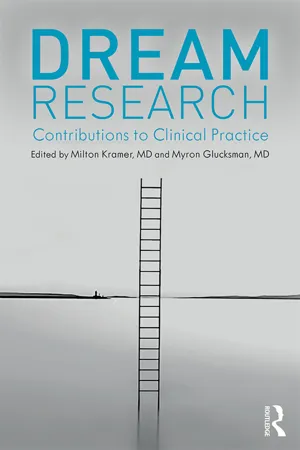
Dream Research
Contributions to Clinical Practice
- 234 pages
- English
- ePUB (mobile friendly)
- Available on iOS & Android
eBook - ePub
Dream Research
Contributions to Clinical Practice
About this book
This edited volume shows the relationship between dream research and its usefulness in treating patients. Milton Kramer and Myron Glucksman show that there is support for searching for the meaning of dream as experiences extended in time. Dreaming reflects psychological changes and is actually an orderly process, not a random experience. Several chapters in this book explore interviewing methodologies that will help clients reduce the frequency of their nightmares and thus contribute to successful therapy.
Information
1
Establishing the Meaning of a Dream
EMERITUS PROFESSOR OF PSYCHIATRY COLLEGE
OF MEDICINE, UNIVERSITY OF CINCINNATI
OF MEDICINE, UNIVERSITY OF CINCINNATI
The dream process is an experience that the dreamer has during sleep that cannot be observed while it is occurring. Therefore, content-related dream research is not research of the dream experience but of the dreamer’s report of that experience. In this essay I summarize my research; I do not review the work of others in the various areas covered, as I did in my book The Dream Experience (Kramer, 2007).
The first question that should be asked is, does the dream exist? I will report the four studies (Kramer, Czaya, Arand, & Roth, 1974; Kramer, Winget, & Roth, 1975; Taub, Kramer, Arand, & Jacobs, 1978; Kramer, Kinney, & Scharf, 1983) that my colleagues and I have done support the existence of the dream as a valid experience that occurs during sleep and is extended in time. We collected reports from REM sleep awakenings at six time points into the REM period. In the first study, subjects rated the dream on a number of variables (Kramer et al., 1974); in the second study, independent judges did so (Kramer et al., 1975). Both ratings showed a significant effect of time for four variables: recall, emotion, anxiety, and pleasantness. A trend analysis showed they were all linear. However, emotion showed a quadratic (stepwise) change: 10 minutes was different than 5; 20 minutes was not different than 10, but was from 30. There was an intensity increase up to 10 minutes, a plateau between 10 and 20, and then a rise to 30 minutes. We replicated (Johnson, Kramer, Bonnet, Roth, & Jansen, 1980) a study by Azerinsky (1971) that showed a 20-minute eye movement cycle during REM sleep. This suggests a relationship between eye movement distribution and reported dream content intensity.
The third study supporting the existence of the dream as an experience during sleep involved comparing a report of a dream and a nightmare from the same subjects (Taub et al., 1978). A similar group of subjects gave a report of what they thought a nightmare was like (a confabulated nightmare). The experienced dream reports were mainly similar but on some dimensions significantly different. The dreams were friendlier, and they had less apprehension and fewer misfortunes than the nightmares. Confabulated nightmares compared to experienced nightmares had more aggression, movement activity, intensity and misfortune, and they had less friendliness. Subjects reported confabulated nightmares in half the words of both experienced nightmares and ordinary dreams. The similarity of experienced dreams and their difference from a confabulated dream further suggests an experience is occurring.
In the fourth study, we provided a stimulus during REM sleep in an attempt to have it incorporated into the dream experience (Kramer et al., 1983). During REM sleep we played either a familiar or unfamiliar name in the subject’s own recorded voice. We found that the familiar name was incorporated into the subjects’ dream reports more often than the unfamiliar name. The familiar name was five times more likely to be incorporated than the unfamiliar (59% vs 11%). The name was mentioned in the dream report about as far into the report as the time into REM sleep when the stimulus was given. The subjects did not report hearing the name. Apparently during sleep an ongoing experience is occurring that the dreamer is reporting on awakening.
The second question to be asked is, does the dream report give a reasonable approximation of the dream experience? We did a number of dream studies that support the veridical nature of the dream report. The first and second studies described earlier (Kramer et al., 1974, 1975) found that the rise and fall of affect across the REM period coincides with the pattern of eye movement cycles during REM sleep (Azerinsky, 1971; Johnson et al., 1980). In a group that slept 20 consecutive nights in the laboratory, we were able to distinguish those dream reports collected early in the series from those collected toward the end of the series (Kramer, Roth, & Cisco, 1977). We were also able to show a greater incorporation of known names into dream reports and also show that the names appeared at approximately the correct time into the dream report (Kramer et al., 1983). We also found that dream intensity across the REM period has a time pattern identical to that of the eye movement cycles, that external influences (starting and stopping an activity) can be distinguished in dream reports, and that stimuli are incorporated into the dream report at approximately the time during the REM period when it was introduced. These findings all support the view that the dream report does reflect the dream experience.
Now we know that the dream is an experience during sleep that is extended in time and that the dream report does adequately reflect the experience. If we are to explore dreaming scientifically, we need to be able to collect the dream report and establish that it can be reliably and validly evaluated.
The factors that influence the collection of dreams are (1) the place where the dream is experienced and reported, (2) the method of awakening, (3) the interpersonal nature of the reporting, (4) the style of collection, (5) the stage of sleep, and (6) the type of subject reporting (Kramer, Winget, & Roth, 1975). We did a study of dream recall that showed the following classical factors influencing recall even in schizophrenic patients: recency, primacy, length, and dramatic intensity (Trinder & Kramer, 1971).
We wanted to compare the reliability of quantifying dream report content to scoring sleep physiology to see if they were discordant or comparable. We did a reliability study by having two judges score seven parameters of sleep physiology every 30 seconds for eight hours of two sleep records (polysomnograms) for 11 subjects for 15 consecutive nights (Roth, Kramer, & Roehrs, 1977). The average reliability for sleep physiology across all parameters scored was 92.5%. The mean successive night-to-night correlation of sleep stages for time data was 0.28 and for percentage data was 0.44. Next, we had 14 college-age subjects sleep for 20 consecutive nights and awakened them for dream report collection from the first four REM periods of each night (Kramer & Roth, 1979). The blinded reports were scored by two judges on the characters, activities, and descriptive elements scales of the Hall–Van de Castle system (Hall & Van De Castle, 1966). The overall percentage agreement on each dream report was 91% on all three scales. The mean dream content of each night of sleep was correlated with the successive night’s sleep. The average overall correlation was 0.46. It is striking that the reliability of scoring of sleep and dream reports is essentially the same: 92.5% and 91%, respectively. The stability of measurement across 2 weeks is also nearly identical: 0.44 and 0.46. The choice to study sleep physiology versus dreaming is one of interest, not that one is science and the other is not. We found the frequency of items on the Hall–Van de Castle dream scoring system that were scored on laboratory-collected reports to be the same as on reports that were not collected in the laboratory (Sandler, Kramer, Fishbein, & Trinder, 1969; Sandler, Kramer, Trinder, & Fishbein, 1970). In addition, the frequency of items showed excellent validity (Kramer, Roth, & Palmer, 1976). We summarized a total of 123 dream content scoring systems and provided tables illustrating what has been found using them (Winget & Kramer, 1979). We also demonstrated the validity of dream reports in our finding of content differences where we believed there were psychological differences for demographic variables, for example, or for gender, age, marital status, and social class (Winget, Kramer, & Whitman, 1972), or for mental illness variables such as schizophrenia and major depression (Kramer, Baldridge, Whitman, Orenstein, & Smith, 1969).
For dreams to have the possibility of having meaning, dream reports should reflect content differences where we have reason to believe psychological differences exist. Indeed, that is the case both at a group and individual level. There are group differences among demographic variables, namely sex, age social class, race, and marital status (Winget et al., 1972). The dreamer’s sex is the major organizer of dream content. In a later study, we found 35 non-laboratory studies that showed male/female differences in dream content (Winget & Kramer, 1979). Men reported more unpleasant dreams, including dreams of mutilation, and women reported more intimacy. The Hall–Van de Castle (1966) dream content norms were derived from 500 dreams from 100 college-age males and 500 from 100 college-age females, and they compare the frequency and proportions of various categories. The systematic and large number of male/female content differences is striking. Women have more characters in their dreams; men have more males in their dreams, while women have an equal percentage of characters of each sex. Men have more physically aggressive encounters, women more friendly interactions. Sexual interactions are not common in dreams, but when they do occur they are three times as common in men’s dreams as in women’s. Emotions are found more often in women’s dreams. Women’s dreams are set indoors, and men’s are set outdoors. A laboratory study of 20 consecutive nights of 11 men and women who had their REM dreams collected (594 from the former and 596 from the latter) found that 11 of 45 scales showed significant differences between men and women (Kramer et al., 1983). Women had more thinking and intensity references; men had more male characters, strangers, auditory activity, achromatic colors, large sizes, and crooked or curved references. In our population study based in Cincinnati, Ohio, we asked a stratified, random sample of subjects to tell a dream (Winget et al., 1972). We found nine content differences between male and female subjects. Women had more dreams with characters, friendly social interactions, emotions, indoor settings, and references to home and family. Men had increases on the following scales: aggression, achievement striving with success, castration anxiety, and overt hostility. The four studies that I have just reviewed clearly support dream content differences between men and women. Interestingly, many of the differences are replicated across studies.
We found 20 non-laboratory dream content studies that deal with the age of the dreamer showing changes across the lifespan from 2 to 92 (Winget & Kramer, 1979). Unpleasant dreams decrease in frequency between the ages of 1 and 4, and again between the ages of 9 and 12. Children’s dreams include less aggression than adults. Anxiety decreases with age, while sex differences in aggression increase with age. Adolescents have more destructive themes, castration threats, and concern with personal safety than do adults. Dream content changes between ages 3 and 15 mirror waking cognitive development. Older adults, over 65, have more dreams involving lost resources, helplessness, or weakness. In our Cincinnati population survey, we found that references to death and death anxiety were directly correlated with age (Winget et al., 1972). Guilt anxiety was highest among young adults aged 21–34. Young adults are concerned with right and wrong while the elderly are concerned with decline and dying. Nonetheless, age appears to be less important in determining dream content than the sex of the dreamer as described earlier.
We calculated the socioeconomic class of our population sample based on the education and income of the respondents and then divided the group into three classes: lower, middle, and upper middle (Winget et al., 1972). We found that the dreams of upper-middle class respondents had fewer characters, less death anxiety, and fewer premonitions. Misfortune was more common in the dreams of the lower two classes. For white respondents in the upper-middle class there was less total anxiety and fewer dreams with home and family themes than for other respondents. In this survey, the upper-middle class has a less troubled dream life than the lower classes.
We found very few dream content differences related to the race or marital status of the dreamer (Winget et al., 1972). The dreams of black men included more castration anxiety and penis envy. The dreams of white respondents had more covert hostility directed outward. The dreams of widows had the most death anxiety. Subjects who were formerly married and were widowed, divorced, or separated dreamed more of family members from the family of marriage rather than their family of origin, and they had more premonition dreams.
From a demographic point of view, the main determinant of dream content is the sex of the dreamer, with a moderate contribution from age and social class, and only a minimal contribution from their race or marital status. The frequencies in our population study (Winget et al., 1972) are similar to what Hall and Van de Castle (1966) reported from their study of college-age dreamers. The differences from Hall–Van de Castle may be attributable to the population study having shorter dreams and a wider age range.
We would expect to find dream content differences at the group level for dreamers who suffer from major psychiatric illnesses such as schizophrenia, depression, or dementia. This would further support that dreams may be seen as meaningful and that a search for meaning can be seen as a more reasonable undertaking.
We collected and examined the most recent dream reports from 40 schizophrenic patients, 40 psychotically depressed, and 40 medical patients in a Veterans’ Administration hospital; all were male (Kramer, Baldridge, Whitman, Ornstein, & Smith, 1969). The dream reports were examined for plausibility, hostility direction, and major character type. The typical dream report of the paranoid schizophrenic patient finds him in an implausible situation in which he is being attacked by a stranger. The psychotically depressed patient typically reports dreaming of a family member, usually in a plausible situation. Hostility is present about half the time, and this is as likely to be addressed toward others as toward the dreamer. The non-psychotic medical patient reports dreaming of being with a friend in a plausible situation that is rarely hostile. If it is hostile, he is as likely to be the expresser as the recipient of the hostility.
The dreams of patients with depression (Kramer, Whitman, Baldridge, & Lansky, 1966; Kramer, Whitman, Baldridge, & Orenstein, 1968) and schizophrenia (Kramer, Clark, & Day, 1973; Kramer & Roth, 1973; Kramer, Trinder & Roth, 1972; Kramer et al., 1969) show systematic changes concomitant with improvement in their waking condition. Depressed patients with improvement show a decrease in hostility and anxiety and an increase in heterosexuality and motility scale scores. When improved, the schizophrenic patients showed more concise and better organized dreams with proportionally fewer aggressive interactions compared with friendly ones, fewer emotions, and more success and good fortune. In our REM dream studies, the most frequent characters in the dreams of depressed patients were family members, and in the dreams of schizophrenics were strangers (Kramer et al., 1969). These results were similar to our non-laboratory studies. We also found that schizophrenics had more groups of people in their dreams than depressed patients. Both groups showed change in their dreams as they improved clinically.
We compared small groups of mildly, moderately and severely brain damaged subjects in the laboratory and collected reports of their REM dreams (Kramer & Roth, 1975). Our only statistically significant finding is that patients with severe brain damage had more characters in their dreams than did patients with mild brain damage. In addition, age and severity of damage decreased recall of dreams. Compared to the Hall–Van de Castle norms, the dreams of the middle-aged group with brain damage had more family members, more friendly social interactions, and fewer aggressive interactions. They also did not include emotions. Age and brain damage are associated with changes in dream content.
The studies I have reviewed so far show that dreams have differences at the group level in situations that we know have psychological difference. I will proceed to demonstrate differences that exist at the individual level (Kramer, Hlasny, Jacobs, & Roth, 1976). Judges were able to correctly sort a group of 75 REM dream reports into five groups of 15—one group for each normal subject. They did the same for 65 REM dream reports from five schizophrenic subjects, sorting them correctly into groups of 13. This supports the view that dreams of different individuals are indeed distinguishable from each other. We then gave our judges15 REM dream reports, three from each of five nights, from each of 10 college students and from five schizophrenic patients. The judges were asked to sort each packet of dreams into sets of three dreams each. They were able to do this successfully for the students and the patients. This showed that dreams were different night to night for each individual. Finally, we asked our judges to properly order the position of the REM dreams within a night, using 50 sets of three dreams from the college students and 34 sets of three dreams from the patients. This attempt was not successful.
During the same study we were able t...
Table of contents
- Cover
- Title
- Copyright
- Dedication
- CONTENTS
- Contributors List
- Introduction: The Contribution of Dream Research to the Clinical Enterprise
- 1 Establishing the Meaning of a Dream
- 2 Teaching Dream Interviewing for Clinical Practice
- 3 The Continuity Between Waking and Dreaming: Empirical Research and Clinical Implications
- 4 Dream Incubation: Targeting Dreaming to Focus on Particular Issues
- 5 Finding Gender Differences in Dream Reports
- 6 Friends and Friendliness: Could They Be the Clue in Psychiatric Patients’ Dreams?
- 7 Dreams: Thinking in a Different Biochemical State
- 8 The Digital Revolution in Dream Research
- 9 The Manifest Dream Report and Clinical Change
- 10 The Hill Cognitive–Experiential Model: An Integrative Approach to Working With Dreams
- 11 Posttraumatic Nightmares: From Scientific Evidence to Clinical Significance
- 12 Nightmare Therapy: Emerging Concepts From Sleep Medicine
- 13 Positive Aspects of the Classic Nightmare
- 14 The Contrasting Effects of Nightmares, Existential Dreams, and Transcendent Dreams
- 15 Cross-Cultural Aspects of Extraordinary Dreams
- 16 Lucid Dreaming: Metaconsciousness During Paradoxical Sleep
- 17 Reality: Waking, Sleeping, or Virtual?
- Index
Trusted by 375,005 students
Access to over 1.5 million titles for a fair monthly price.
Study more efficiently using our study tools.
Frequently asked questions
Yes, you can cancel anytime from the Subscription tab in your account settings on the Perlego website. Your subscription will stay active until the end of your current billing period. Learn how to cancel your subscription
No, books cannot be downloaded as external files, such as PDFs, for use outside of Perlego. However, you can download books within the Perlego app for offline reading on mobile or tablet. Learn how to download books offline
Perlego offers two plans: Essential and Complete
- Essential is ideal for learners and professionals who enjoy exploring a wide range of subjects. Access the Essential Library with 800,000+ trusted titles and best-sellers across business, personal growth, and the humanities. Includes unlimited reading time and Standard Read Aloud voice.
- Complete: Perfect for advanced learners and researchers needing full, unrestricted access. Unlock 1.5M+ books across hundreds of subjects, including academic and specialized titles. The Complete Plan also includes advanced features like Premium Read Aloud and Research Assistant.
We are an online textbook subscription service, where you can get access to an entire online library for less than the price of a single book per month. With over 1.5 million books across 990+ topics, we’ve got you covered! Learn about our mission
Look out for the read-aloud symbol on your next book to see if you can listen to it. The read-aloud tool reads text aloud for you, highlighting the text as it is being read. You can pause it, speed it up and slow it down. Learn more about Read Aloud
Yes! You can use the Perlego app on both iOS and Android devices to read anytime, anywhere — even offline. Perfect for commutes or when you’re on the go.
Please note we cannot support devices running on iOS 13 and Android 7 or earlier. Learn more about using the app
Please note we cannot support devices running on iOS 13 and Android 7 or earlier. Learn more about using the app
Yes, you can access Dream Research by Milton Kramer, Myron L Glucksman, Milton Kramer,Myron Glucksman in PDF and/or ePUB format, as well as other popular books in Psychology & Mental Health in Psychology. We have over 1.5 million books available in our catalogue for you to explore.