
Frameworks for Market Strategy
eBook - ePub

Frameworks for Market Strategy

European Edition

  1. 592 pages
  2. English
  3. ePUB (mobile friendly)
  4. Available on iOS & Android
eBook - ePub

Frameworks for Market Strategy

European Edition

About this book

Frameworks for Market Strategy helps students understand how to develop and implement a market strategy and how to manage the marketing process. Marketing activity is the source of insight on the market, customers, and competitors and lies at the core of leading and managing a business.

To understand how marketing fits into the broader challenge of managing a business, Capon and Go address marketing management both at the business and functional levels. The book moves beyond merely presenting established procedures, processes, and practices and includes new material based on cutting-edge research to ensure students develop strong critical thinking and problem-solving skills for success. In this European edition, Capon and Go have retained the strong framework of the book, but have updated the cases, examples, and discussions to increase the book's relevance for students outside the USA. Key features include:

• A strong strategic focus, teaching students how to analyze markets, customers, and competitors to plan, execute, and evaluate a winning market strategy

• Practical examples from a range of contexts, allowing students to develop the skills necessary to work in for-profit, public, or non-profit firms

• Emphasis on understanding the importance of working across organizational boundaries to align firm capabilities

• Full chapters devoted to key topics, including brand management, digital marketing, marketing metrics, and ethical as well as social responsibilities

• Focus on globalization with a chapter on regional and international marketing

• Multiple choice, discussion, and essay questions at the end of each chapter

Offering an online instructor's manual and a host of useful pedagogy – including videos, learning outcomes, opening cases, key ideas, exercises, discussion questions, a glossary, and more – this book will provide a solid foundation in marketing management, both for those who will work in marketing departments, and those who will become senior executives.
Frequently asked questions

Yes, you can cancel anytime from the Subscription tab in your account settings on the Perlego website. Your subscription will stay active until the end of your current billing period. Learn how to cancel your subscription.
No, books cannot be downloaded as external files, such as PDFs, for use outside of Perlego. However, you can download books within the Perlego app for offline reading on mobile or tablet. Learn more here.
Perlego offers two plans: Essential and Complete
  • Essential is ideal for learners and professionals who enjoy exploring a wide range of subjects. Access the Essential Library with 800,000+ trusted titles and best-sellers across business, personal growth, and the humanities. Includes unlimited reading time and Standard Read Aloud voice.
  • Complete: Perfect for advanced learners and researchers needing full, unrestricted access. Unlock 1.4M+ books across hundreds of subjects, including academic and specialized titles. The Complete Plan also includes advanced features like Premium Read Aloud and Research Assistant.
Both plans are available with monthly, semester, or annual billing cycles.
We are an online textbook subscription service, where you can get access to an entire online library for less than the price of a single book per month. With over 1 million books across 1000+ topics, we’ve got you covered! Learn more here.
Look out for the read-aloud symbol on your next book to see if you can listen to it. The read-aloud tool reads text aloud for you, highlighting the text as it is being read. You can pause it, speed it up and slow it down. Learn more here.
Yes! You can use the Perlego app on both iOS or Android devices to read anytime, anywhere — even offline. Perfect for commutes or when you’re on the go.
Please note we cannot support devices running on iOS 13 and Android 7 or earlier. Learn more about using the app.
Yes, you can access Frameworks for Market Strategy by Noel Capon,Frank Go in PDF and/or ePUB format, as well as other popular books in Business & Business General. We have over one million books available in our catalogue for you to explore.

Information

Publisher
Routledge
Year
2016
Print ISBN
9781138889187
eBook ISBN
9781317496755

Section IV

IMPLEMENTING THE MARKET STRATEGY

For complimentary material, see Axcess Capon codes at www.axcessvids.com
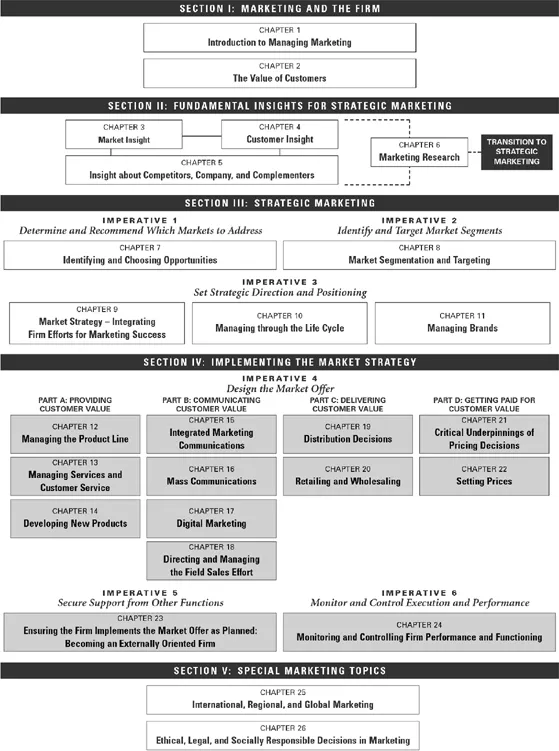
Implementing the market strategy comprises 13 chapters, Chapter 12 through Chapter 24. [411v] The section embraces the second three Marketing Imperatives: Imperative 4: Design the Market Offer; Imperative 5: Secure Support from Other Functions; Imperative 6: Monitor and Control.
The largest group of chapters – Chapters 12 through 22 – address Imperative 4. We organize the material on designing the market offer into four parts.
Part A, Providing Customer Value, comprises three chapters. Chapter 12, Managing the Product Line, considers firm products as elements in a product portfolio, each with specific roles, together with several product-related issues. Chapter 13, Managing Services and Customer Service, focuses on product/service differences and highlights the importance of customer service. Chapter 14, Developing New Products, introduces the stage/gate process for developing new products.
Part B, Communicating Customer Value, comprises four chapters. Chapter 15, Integrated Marketing Communications, frames an integrated communications strategy. Chapter 16, Mass Communications, focuses on advertising, and other non-personal communications approaches. Chapter 17, Digital Marketing, concerns the fast-growing field of digital media. Chapter 18, Directing and Managing the Field Sales Effort, discusses six core tasks for developing and implementing the sales strategy.
Part C, Delivering Customer Value, comprises two chapters. Chapter 19, Distribution Decisions, focuses on how firm products reach consumers/end users. Chapter 20, Retailing and Wholesaling, delves more deeply into especially important channel intermediaries.
Part D, Getting Paid for Customer Value, also comprises two chapters. Chapter 21, Critical Underpinnings of Pricing Decisions, focuses on pricing fundamentals. Chapter 22, Setting Prices, deals with specific pricing issues.
Imperatives 5 and 6 each merit a single chapter. Chapter 23, Ensuring the Firm Implements the Market Offer as Planned, addresses Imperative 5, focusing on building an externally oriented firm. Chapter 24, Monitoring and Controlling Firm Performance and Functioning, considers Imperative 6 and shows how to maintain the firm’s planned trajectory.
Frameworks For Market Stragegy
front_matter

Part A

PROVIDING CUSTOMER VALUE

IMPERATIVE 4

Design the Market Offer

12
MANAGING THE PRODUCT LINE

For complimentary material, see Axcess Capon codes at www.axcessvids.com

LEARNING OUTCOMES

When you have completed this chapter, you will be able to:
Understand the importance of managing the product line as a portfolio.
Apply alternative approaches to managing product portfolios.
Manage key interrelationships among products.
Address pressures for product proliferation and product-line simplification.
Manage both diverse and complementary product lines.
Deal with important product issues like bundling, counterfeiting, evolving the product line, extending product life, product quality, and secondary market products.
Anticipate concerns about product safety, packaging, and disposal of products and packaging.

OPENING CASE: AXE/LYNX

Axe has been helping young males get the girl since Unilever (Anglo/Dutch) launched the brand in France (1983). The Axe male-grooming brand was not just a new product, but initiated a new product class of male health and personal care products, now including brands like Domestos, Lux, Mentadent. Because of trademark issues, Unilever was unable to use the Axe name in several countries. Hence, Axe is Lynx in Australia, China, Great Britain, Ireland, and New Zealand.
Unilever’s R&D team works with a panel of expert noses to create Axe products; the initial goal was to develop a fragrance that helped men smell and feel their best. Unilever used a semiotic freshness audit, comprising a mix of content analysis, client data mining, and desk research to identify different aspects of freshness to stimulate and inspire the innovation process.
In addition to substantial laboratory development and testing, Unilever also tests each aroma on the target audience – real women. Most fine fragrance designs employ differently weighted molecules; some evaporate faster than others, so a scent evolves. By contrast, fragrance expert Ann Gottlieb explains that Axe is much more in your face: she explains, “It’s an instant-delivery kind of product.”
The initial Axe product was an aerosol deodorant body spray. Unilever added to the product line and extended the Axe brand to embrace deodorant stick and deodorant roll-on. Unilever also offers anti-perspirant products – Axe Dry – aerosol spray and stick.
From inception, Unilever implemented an annual fragrance variant to keep Axe/Lynx fresh and up to date; the annual variant has been a key element in Axe/Lynx’s success. Axe/Lynx deodorant variants have evolved by combining seductive scents with the latest Unilever technology – from the irresistible chocolate-inspired Dark Temptation fragrance to the stimulating Axe/Lynx Rise. The number of Axe/Lynx fragrant variants is well into double figures, and each Axe/Lynx scent sells about three times the volume of an average fine fragrance.

Case
Question

Consider gender and lifestyle issues in the contemporary youth culture. As a product aimed at young males, what specific benefits does Axe/Lynx offer? What tangible and intangible aspects of the Axe/Lynx product line must Unilever manage?
Much of Axe/Lynx’s success – 60 percent share of the male health and personal care market, ...

Table of contents

  1. Cover
  2. Half Title
  3. Title Page
  4. Copyright Page
  5. Dedication
  6. Table of Contents
  7. Preface
  8. Acknowledgements
  9. Concluding Statement
  10. Section I Marketing and the Firm
  11. Section II Fundamental Insights for Strategic Marketing
  12. Transition to Strategic Marketing
  13. Section III Strategic Marketing
  14. Section IV Implementing the Market Strategy
  15. Section V Special Marketing Topics
  16. Concluding Comment
  17. Answers
  18. Glossary
  19. Notes
  20. Index