![]()
This chapter will look at what is contained within the Mathematics curriculum. What does the National Curriculum say, what is in a typical GCSE specification, and what do these both imply for the teaching of Mathematics? It will look at the breadth of topics within the Mathematics curriculum, mainly at Key Stages 3 and 4, and consider how this very content-heavy subject can become more manageable in its delivery and improve student outcomes. It will consider the standing of the UK in world league tables for Mathematics education and the implications of this for the UK.
What is contained within the Mathematics curriculum?
This is, of course, a question that needs a whole book to be answered, and I will not attempt to cover all aspects of the National Curriculum and what it means you will have to teach in one chapter. What I do want readers of this book to understand from this chapter is the breadth and range of topics that are covered, and what this will imply for you as a teacher. In your use of Mathematics as a degree student, or in the workplace, there will be many things that you will need to teach that you have not utilised for a very long time. It is essential that, as you start out in your teaching career, you understand what there is to cover and start to identify any gaps that you might have in your subject knowledge.
It will seem an odd to thing to do, but I am going to start the chapter with a quick set of ten questions, of a type that has a single-step calculation needed for an answer and that you might use as a recap at the start of a lesson. The idea of this is not to set your heart racing but to give you a glimpse, right from the start, of the breadth of the Mathematics curriculum.
I have used these ten questions with groups of teachers who are not mathematicians, and it is incredible to notice what a sense of fear and dread fills the room as soon as you mention that they are going to do some maths. Each question is displayed for at most 30 seconds, and participants must answer at speed. Giving yourself at most 2 minutes for all ten … go!
ACTIVITY: THE FEAR FACTOR
1 16 × 25
2 2/5 of 45
3 Solve 2x − 5 = 14.
4 3, 4, 5, 8. What is the mean of these four numbers?
5 Simplify a2 × a3.
6 Increase 60 by 20%.
7 0.3 × 0.2
8 Simplify 12/18.
9 −2 − −5
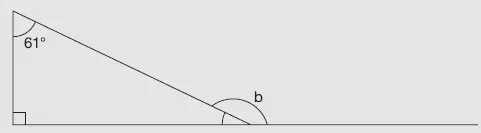
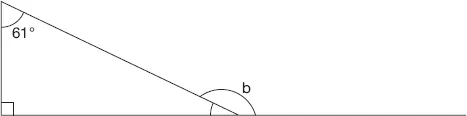
10 Calculate angle b in the figure.
How did you fare?
I would hope that you found that set of questions fairly simple, but what does it tell us about the Mathematics curriculum? Each of the ten questions could be simple questions at the lower end of GCSE or the earlier stages of the secondary curriculum. However, what I want to demonstrate, despite the apparent simplicity of these ten questions, is what each might imply for you as a teacher.
Why would this list of fairly straightforward sums be so daunting to so many non-mathematicians? Indeed, is this what makes the subject so scary to so many young people? Let us take each question in turn and consider a few things.
(1) 16 × 25
How did you work this out? Was it 16 × 100 ÷ 4? Or did you use a formal column method, or perhaps a Chinese grid method. As competent mathematicians, we approach this question in a way that suits the numbers involved. However, in doing so, we are using a sophisticated understanding of multiplication and are choosing our problem-solving method accordingly.
(2) 2/5 of 45
The vast majority of people (young and old alike) would be far less daunted if this question were merely one-fifth of 45. Although many can see how one-fifth requires the total to be split into five, when two-fifths is added to the complexity, this makes them perform all sorts of weird and wonderful calculations.
(3) Solve 2x − 5 = 14.
We will tackle in Chapter 6 the question of language in Mathematics. As those skilled in its art, we know the difference between a question that says ‘solve’ and one that says ‘simplify’ or ‘evaluate’. These words are key triggers to what you then need to do. We need to make these explicit to our students.
(4) 3, 4, 5, 8. What is the mean of these four numbers?
Students are generally very happy with the concepts of mean, median and mode, although still see the mean as the one that is the average! This question is generally well done, but is a reminder that language is important and worth considering. Also, how do students fare on a tabular presentation of data, when asked to calculate the mean, if they have learned that it is ‘add them all up and divide by how many there are’?
(5) Simplify a2 × a3.
Not too complex, but a reminder of the many rules and protocols that are required for Mathematics success. These can be learned by rote, but are far better learned with an understanding of why.
(6) Decrease 60 by 20%.
The calculation may not be hard, but many leave it at 12 and forget the decrease part. As a next step, why would you want students to learn this by doing 60 × 0.8 on their calculator, rather than using a mental method? This is one example of where they cling to a method learned earlier, when things become more complex, only to find that their method has its limitations.
(7) 0.3 × 0.2
My bet is that, although almost all could do 3 × 2, many cannot do this. How do we build that concept of place value in all that we do?
(8) Simplify 12/18.
It might be that students recognise the highest common factor and cancel by a factor of 6. However, it is most likely that they will divide by two to get
, but many will not then progress to ⅔. How do you get students to consider their answer and ensure it is as accurate and correct as it can be, even after they have performed a calculation that, in essence, is not incorrect?
(9) −2 − −5
The Achilles heel of even some exceptional A Level mathematicians – negative numbers. To be treated with due care and respect at all times!
(10) Calculate angle b.
Finally, a reminder that Mathematics is about shape and geometry, as well as number and algebra.
So, from just ten short questions of simple Mathematics, I hope that you can see just how complex this subject can be and how we must carefully consider how we teach it to dispel that oft-heard cry of ‘I can’t do Maths’.
The breadth of the topics within the Mathematics National Curriculum
One of the greatest challenges within Mathematics is the mountain of individual things that there are to learn. Let’s just stop and think a moment about how many different topics a GCSE student needs to cover:
A | angles |
B | bearings |
C | cosine rule |
D | diameter |
E | expansion of brackets |
F | fractions |
G | geometric series |
H | hypotenuse |
I | indices |
J | Julia sets (I had to stretch beyond the GCSE syllabus for this letter, I am afraid, and I just couldn’t resist this one.)... |