- 248 pages
- English
- ePUB (mobile friendly)
- Available on iOS & Android
eBook - ePub
About this book
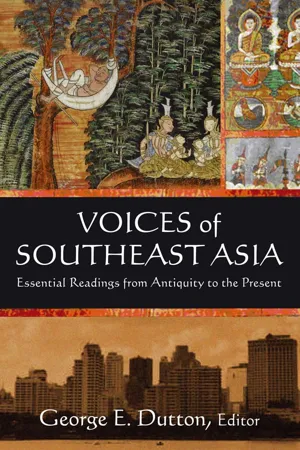
Spanning more than a millennium, this anthology gathers literary sources from across the entire region of Southeast Asia. Its 24 selections derive from a variety of genres and reflect the diverse range of cultural influences the region has experienced. The literary excerpts illustrate the impact of religious and ideological currents from early Buddhism to Islam and Roman Catholicism. The selections reveal how cultural influences from South Asia, China, the Arabic world, and Europe arrived in Southeast Asia and left their marks in the realms of literature, society, and culture. The readings include religious works, folklore, epic poems, short stories, and the modern novel. They range from the Cambodian medieval version of the Ramayana to the 16th century Javanese tales to modern Thai short stories and include selections from Cambodia, Thailand, Indonesia, Laos, Philippines, and Burma.
Information
Prince Samuttakote
~ Seventeenth Century, Thailand ~
PHRA MAHARATCHAKHRU
Siam (later Thailand) had been influenced by Theravada Buddhism much like its Burmese neighbor. Its rulers were also powerful patrons of Buddhism and its institutions, and the Thai literary traditions were strongly influenced by Buddhist tales and by the larger patterns of South Asian epics. The epic poem Prince Samuttakote was composed beginning in the second half of the seventeenth century, during the reign of King Narai (r. 1656–1688). This was a period often regarded as the “Golden Age of Thai Literature.” The tale is a distinctive localization of a particular Buddhist literary tradition, with its origins in the Jataka tales, the numerous stories about the previous lives of the Buddha. These tales are a core element of the popularization of Buddhism across mainland Southeast Asia, where few people would have read, or even seen, the canonical Buddhist scriptures (the Tipitaka), but many would have heard, read, or seen illustrations from the Jataka tales. In essence, these tales of the various incarnations of the Buddha before his enlightenment have a powerfully didactic nature, suggesting the types of actions and avoidances that might lead one closer to enlightenment, or at the very least to a better reincarnation.
The tale of Prince Samuttakote belongs to a mainland Southeast Asian variant of the Jataka tradition, for it is not derived from the “canon” of Jataka tales, but rather is part of a collection of “apocryphal” Jataka tales found only in Thailand, Burma, Laos, and Cambodia. Tradition has it that these tales had their origins in the Chiang Mai region of what is today northwestern Thailand, though Hudak notes that the content and form of these tales suggests an Indic origin. In any case, this particular tale is a dramatic adaptation of one of these Jataka tales into poetic form, and was probably designed for live performance. Although there is no definitive evidence regarding its composer, the poem was said to have been written by Phra Maharatchakhru, who was apparently a teacher and adviser to King Narai, though he may have previously served the king’s father. Maharatchakhru died before he could complete the poem, which then may have been continued by King Narai himself before finally being taken up again and completed in the middle of the nineteenth century.
The excerpts below are from the first portion of the epic, composed in the second half of the seventeenth century. It first describes a contest arranged by the King of Romyaburi seeking to identify the most eligible mate for his daughter, and then the marriage that follows once the proper suitor has been identified. In a sequence echoing the Khmer Reamker, and thus the Indian Ramayana itself, the centerpiece of the contest involves the handling and use of a bow of magical power. As in the Ramayana, a single man, in this case Prince Samuttakote, has the ability to pick up and use the bow, and in so doing marks himself as the suitor selected by the fates to have the princess’s hand. At this point, however, the story veers away from the Ramayana, for the failed suitors do not take their defeat lightly. Instead, they coordinate their efforts and gather an army to challenge the prince, refusing to accept his triumph. Prince Samuttakote rallies his own forces and vanquishes his jealous rivals on the battlefield. The selection concludes with the marriage between the prince and princess.
The tale reveals the deep literary and spiritual influences that have come to Southeast Asia from the Indian Subcontinent. At the same tim...
Table of contents
- Cover
- Half Title
- Also Available from M.E. Sharpe, Inc.
- Title Page
- Copyright Page
- Table of Contents
- Introduction
- Map of Southeast Asia
- Kawi Inscription from Java
- Shwegugyi Pagoda Inscription
- Viet Dinh U Linh Tap
- The Maniyadanabon
- Truyen Ky Man Luc
- Sejarah Melayu
- Prince Samuttakote
- Reamker
- Tale of Kieu
- Glass Palace Chronicle
- Babad Dipanagara
- Rantjak Dilabueh
- Noli Me Tangere
- Letters of a Javanese Princess
- Dumb Luck
- Oil
- Return
- Not Out of Hate
- Letters from Thailand
- Sacrifice
- Tales of the Demon Folk
- An Umbrella
- The Water Nymph
- Painting the Eye
- Bibliography
- About the Editor
Trusted by 375,005 students
Access to over 1.5 million titles for a fair monthly price.
Study more efficiently using our study tools.
Frequently asked questions
Yes, you can cancel anytime from the Subscription tab in your account settings on the Perlego website. Your subscription will stay active until the end of your current billing period. Learn how to cancel your subscription
No, books cannot be downloaded as external files, such as PDFs, for use outside of Perlego. However, you can download books within the Perlego app for offline reading on mobile or tablet. Learn how to download books offline
Perlego offers two plans: Essential and Complete
- Essential is ideal for learners and professionals who enjoy exploring a wide range of subjects. Access the Essential Library with 800,000+ trusted titles and best-sellers across business, personal growth, and the humanities. Includes unlimited reading time and Standard Read Aloud voice.
- Complete: Perfect for advanced learners and researchers needing full, unrestricted access. Unlock 1.5M+ books across hundreds of subjects, including academic and specialized titles. The Complete Plan also includes advanced features like Premium Read Aloud and Research Assistant.
We are an online textbook subscription service, where you can get access to an entire online library for less than the price of a single book per month. With over 1.5 million books across 990+ topics, we’ve got you covered! Learn about our mission
Look out for the read-aloud symbol on your next book to see if you can listen to it. The read-aloud tool reads text aloud for you, highlighting the text as it is being read. You can pause it, speed it up and slow it down. Learn more about Read Aloud
Yes! You can use the Perlego app on both iOS and Android devices to read anytime, anywhere — even offline. Perfect for commutes or when you’re on the go.
Please note we cannot support devices running on iOS 13 and Android 7 or earlier. Learn more about using the app
Please note we cannot support devices running on iOS 13 and Android 7 or earlier. Learn more about using the app
Yes, you can access Voices of Southeast Asia by George Dutton in PDF and/or ePUB format, as well as other popular books in Literature & Asian Literary Collections. We have over 1.5 million books available in our catalogue for you to explore.