- 258 pages
- English
- ePUB (mobile friendly)
- Available on iOS & Android
eBook - ePub
About this book
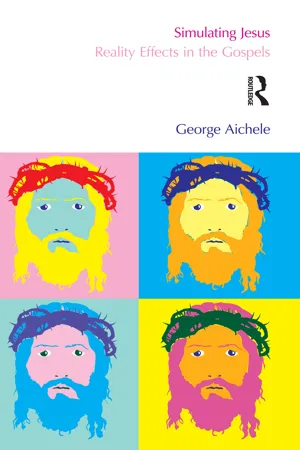
Can the different pictures of Jesus in the New Testament be reconciled? Or are they simply simulations, the products of a virtual Gospel? 'Simulating Jesus' argues that the gospels do not represent four versions of one Jesus story but rather four distinct narrative simulacra, each of which is named "Jesus". The book explores the theory and evidence justifying this claim and discusses its practical and theological consequences. The simulations of Jesus in each of the gospels are analysed and placed alongside Jesus simulacra elsewhere in the Bible and contemporary popular culture. 'Simulating Jesus' offers a radical understanding of Scripture that will be of interest to students and scholars of biblical studies.
Information
VIRTUAL BIBLE, VIRTUAL GOSPEL
Chapter 1
VIRTUALITY AND THE BIBLE
Within every book there lies concealed a book of nothing. Don't you sense it when you read a page brimming with words? The vast gulf of emptiness lying beneath the frail net of letters. The ghostliness of the letters themselves. (Wharton 2001: 75–76)
Simulation is precisely this irresistible unfolding, this linkage of things as if they had a meaning, so that they are no longer controlled or regulated except by artificial montage and non-sense. (Baudrillard 1992)
Virtual, Actual, Real
The Bible has always been virtual. This does not mean that the Bible is somehow unreal or incomplete, nor does it describe another Bible, a Bible that is somehow “other” than the one that people read. The virtual Bible is the only Bible that we know, and the virtuality of the Bible is perhaps its most important feature. This virtuality is not at all unique — we live in a world composed of many virtualities — but the relation of the Bible’s virtuality to anything actual is very specific and rich with ideological overtones. In addition, since the Bible has had and continues to have a huge impact upon the world by way of its virtuality, the Bible’s virtuality is more important than are many other virtualities.
I am writing here about the Christian Bible, the Old and New Testaments. There is also a virtual Bible in Judaism, but it is quite different from the Christian one, and not merely because of the evident canonical differences. In Judaism, the physical texts of the scriptures tend to be valued more highly than they are in Christianity, which generally treats the physical text itself as a dispensable channel through which an important message is transmitted.1 For Christians, the Bible’s virtuality is more important than its actuality. As a result, there are significant differences of belief between Christians and Jews concerning questions of translation, interpretation, and canon, among other matters. The impact of these differences on the virtual Bibles of Judaism and Christianity deserves study, but that is not the topic of this book.
According to Katherine Hayles, “Virtuality is the cultural perception that material objects are interpenetrated by information patterns” (1999: 13–14). Hayles claims that “we participate in the cultural perception that information and materiality are conceptually distinct and that information is in some sense more essential, more important, and more fundamental than materiality” (1999: 18, see further her discussion on 248–251). In other words, virtuality entails what Jacques Derrida calls logocentrism, which is the idea that the meaning (or signified) of any sign is more important than its physical form and material signifier (1976: 12–15). This does not mean that the virtual is unreal or merely mental. Gilles Deleuze argues that the virtual object corresponds to a desire for reality which “governs and compensates for the progresses and failures of … real activity” (1994: 99).2 Thus the virtual is neither unreal nor optional; on the contrary, “The virtual … is the characteristic state of Ideas: it is on the basis of its reality that existence is produced, in accordance with a time and a space immanent in the Idea” (Deleuze 1994: 211, emphasis added).3 For Deleuze, the “Idea” is neither a Platonic form nor an object of consciousness. Instead it is the theater or scene in which reality is staged. Virtuality is a relation to wholeness or totality — that is, a relation to sense, or connotation. Apart from its virtuality, the Bible has (or makes) no sense.
In other words, existence or reality insofar as we know it at all is not simply anything or everything that is actual. Our knowledge of reality is derived from empirical sensation, but there can be no sensation, at least at the human level, that is not informed by virtual structures of consciousness.4 The newborn infant may experience William James’s “blooming, buzzing confusion” of unfiltered sensation, but that is not understood as reality. Virtuality is the means and the meaning through which we encounter the real, and without which there is no “real.” “A different, virtual mental image would correspond to a different description, and vice versa. … [E]ach time description has obliterated the object, at the same time as the mental image has created a different one” (Deleuze, 1989: 44, see also 66–67). According to Deleuze, your idea of reality and the only reality that you know at any given moment is reciprocally determined by the virtual and the actual. The virtual is “real without being actual, ideal without being abstract” (1994: 208, quoting Proust). Virtuality belongs to the realm of ideology because it creates the illusion of reality. It makes the meaning of things and events seem obvious and “natural” (Barthes 1974: 206).
For Deleuze, there is no option of escape from virtuality into a direct encounter with actuality. Virtuality is indispensible. Still, we do best when we pursue what Deleuze calls “lines of flight,” by which we break free — but only temporarily and relatively — from our ideological entrapments. Lines of flight are the ways by which we escape for a moment from the order of a cosmos and of our separate selves, or indeed from anything (any virtuality) that “makes sense.” They offer a kind of liberating schizophrenia.5 Yet even lines of flight do not lead to direct encounters with actuality.
Suppose that we are each reading a text. What makes the text that I am reading the same as, or different from, the one that you are reading? Is it physical qualities of the signifiers, or less tangible qualities of the signified meaning? If the latter, are you reading the same book today that you read yesterday, or last year, if the same physical text now means more (or other) than it did then, as it almost always does? If the former, what entitles two readers who disagree about the meaning of a text to think that they are discussing “the same text,” even if they are both reading, side by side, from a single copy? In addition, if letter for letter equivalence of the signifiers makes two texts “the same,” then you still must trust in the reliability of your memory and the stability and finally the sanity of the physical world — that is, that reality as you know it is not like that of Alice in Wonderland, and that signifiers cannot change in the blink of an eye once they are written. Perhaps that is not so difficult for you, but you cannot do even that much without virtualities (the strength of personal memory, the laws of logic and physics, and finally the semiotic values of the signifiers). However, if neither the signifier nor the signified provides an entirely satisfactory answer to the question, then perhaps you need to consider a third possibility: that the “identity” of a text is nothing other than its virtuality.
Suppose that you find a book lying in the street. Its covers and title page are missing. How do you identify it? The reader gets her idea or concept of the Bible from having seen Bibles, perhaps in bookstores or churches, or from having read one or more Bibles, or maybe just from having heard people talk about the Bible. Nevertheless, apart from the virtual Bible, the reader would have no concept of “the Bible,” and then she would not know what to look for in order to identify a Bible. She would have no idea of the difference between Bible and non-Bible. This may seem paradoxical or even contradictory (you cannot perceive something unless you already know it), but indeed this is how we learn any concept (or Idea, as Deleuze would say). As a baby you entered a world that was for you a blooming, buzzing confusion but was itself already organized by others as a virtuality or system of ideas, and through your experiences you have gained some mastery of those ideas.
Writing, Canon, and the Bible
Digital and perhaps especially online versions of the Bible make readers particularly aware of its virtuality today, but the virtuality of the Bible is not limited to such texts. Instead, the Bible’s virtuality is closely bound to the fact that the Bible has always been a writing. As Edmund Husserl says: “The important function of written, documenting linguistic expression is that it makes communications possible without immediate or mediate personal address; it is, so to speak, communication become virtual” (1978: 164, emphasis added). Writing makes possible the formation of ideal objects that remain the same across time and space, but as Derrida notes, commenting on Husserl’s words, “That virtuality … is an ambiguous value: it simultaneously makes passivity, forgetfulness, and all the phenomena of crisis possible” (1978: 87, Derrida’s emphases).
As Walter Benjamin says, discussing the writings of Franz Kafka, “Reversal is the direction of learning which transforms existence into writing” (1968: 138). No text can speak for itself, but written text inevitably escapes its author’s control and falls into the hands of a reader, who may be anyone, as Socrates recognized long ago in the Phaedrus (1973: 95–99).6 Ancient peoples knew that once oral stories were written down, they had been profoundly changed. Socrates says that “The productions of painting look like living beings, but if you ask them a question they maintain a solemn silence. The same holds true of written words; you might suppose that they understand what they are saying, but if you ask them what they mean by anything they simply return the same answer over and over again” (Plato 1973: 97 [sec. 275]).
Written text especially indicates a loss or transformation of reality, and it compensates with its own virtual objects. Writing offers a surrogate for memory, and thus even when it preserves the formulas,images, or sequences typical of oral culture, it threatens a loss of cultural self-identity and challenges the very order of the universe. Socrates attacks writing as a “conceit of wisdom” that results in ignorance. The oral text exists only in the living presence of its speaker, but a written text cannot provide its own explanation. Writing removes the text from memory, and it leaves the reader with the task of deciphering inert letters, signifiers that are in themselves meaningless. Socrates argues that the written text cannot speak for itself and must be “rescued” by its “parent,” the spoken word.
Any text (oral, written, or electronic) is a machine that makes meaning, or rather, it is part of an intertextual machine through which readers or hearers or viewers make whatever meanings they can. However, unlike oral communication, writing/reading inevitably produces virtualities, which in turn produce the crisis that both Socrates and Derrida talk about. As Roland Barthes says of the alphabetic letter, “a letter, at one and the same time, means and means nothing, imitates nothing and yet symbolizes, dismisses both the alibi of realism and that of aestheticism” (1985: 116, his emphases). All writing is copied and therefore false.
In writing, semiosis is less tightly controlled than in oral language. “[T]he letters which form a word, though each of them is rationally insignificant …, keep searching, in us, for their freedom, which is to signify something else” (Barthes 1985: 117, his emphases).7 The meaningful connection between signifier and signified is neither tight nor exclusive, and it is always artificial. This connection must itself be explained, or in other words, it must be established. The message is not simply received; it must be understood — that is, it must become virtual — and this inevitably requires yet other signs which themselves must also be explained, and so on. The realm of meaning is divided into signifiers and signifieds, but this division is constantly collapsing, for every signifier may also be signified, and every signified may be itself the signifier of yet another signified. The semiotic channel is deconstructed, and instead of a well-controlled flow of meaning there is a flood. Semiosis flows without limit, in both the direction of the signifier and that of the signified, and both the First Signifier and the Last Signified of any utterance become illusions hovering over semiotic abysses. Umberto Eco, following C. S. Peirce, notes that
signification … by means of continual shiftings which refer a sign back to another sign or string of signs, circumscribes cultural units in an asymptotic fashion, without ever allowing one to touch them directly, though making them accessible through other units. (1976: 71)
As a result, meaning is elusive and fluid, and connotation runs wild (de Man 1979: 208). There is no absolute signifying anchor to which a proper meaning could be attached.
This unlimited semiosis characterizes every text, but it is particularly problematic in relation to written texts, and it becomes an especially serious challenge to any text that is desired to have a definite and authoritative meaning — that is, any scripture, any text that is believed to transmit the “Word of God.” The value of writing as a means to communicate leads to the need to authenticate and stabilize that same writing. The semiotic function of the biblical canon is to control the understanding of the included texts, to establish an authoritative structure that defines for its Christian readers a single, coherent message. As Yvonne Sherwood says:
A deeply ingrained cultural sense of the Bible as the “Word of God,” or at the very least a homogeneous canon, means that we expect that separate textual voices will be gathered into a single consciousness … This book, of all books, is expected to process life into a gigantic metanarrative, to frame the world in a Great, all-encompassing Code. (2000: 217)
Although individual written texts cannot speak at all by themselves, the canon of scriptures forms an authorized and complete set of texts that is supposed to speak for itself, at least in the hands of the faithful. For Christian readers, all of the biblical books “speak” clearly together, expressing “a single consciousness.” Readers either accept that consciousness, or they reject it.
In other words, the Bible is not simply a collection of sacred writings, but it is a powerful intertextual mechanism. According to Julia Kristeva, “The term inter-textuality denotes this transposition of one (or several) sign system(s) into another … its ‘place’ of enunciation and its denoted ‘object’ are never single, complete, and identical to themselves, but always plural, shattered, capable of being tabulated” (1984: 59–60, her emphasis). Meaning is never neatly packaged in any text, to be unwrapped and displayed by careful exe-gesis, but rather meaning is stretched between texts, as they are brought together in the various understandings of actual readers — that is, through eise-gesis.
Intertextuality presents another form of the paradox of virtuality that was noted above: you cannot read the text unless you have already understood it, or in more traditional language, there is no understanding without pre-understanding. Every reading is intertextual: every text is always read in the light of other texts, which themselves were read in the light of yet other texts, and so on.8 As Roland Barthes says, “as it turns out in any true inter-textuality … what is henceforth displaced is the work’s responsibility: it is no longer consecrated by a narrow ownership (that of its immediate creator), it journeys in a cultural space which is open, without limits, without partitions, without hierarchies” (1985: 153–154). In contrast to the oral text, as Socrates noted, the written text cannot be controlled by its original “owner,” the author.
Intertextuality and unlimited semiosis stand in a peculiar tension with one another. Although Deleuze and Félix Guattari do not use these terms, the tension between these concepts appears again and again in their writings. Deleuze and Guattari describe this tension as a machine:
A machine may be defined as a system of interruptions or breaks. … Far from being the opposite of continuity, the break or interruption conditions this continuity; it presupposes what it defines or cuts into as an ideal continuity. The machine produces an interruption of the flow only insofar as it is connected to another machine that supposedly produces this flow. And doubtless this second machine in turn is really an interruption or break, too. … In a word, every machine functions as a break in the flow in relation to the machine to which it is connected, but at the same time is also a flow itself, or the production of a flow, in relation to the machine connected to it. (1983: 36, their emphasis)
There are only breaks and flows of semiosis. Unlimited semiosis produces and disperses texts, and therefore it makes intertextuality possible. In turn, intertextuality breaks or interrupts the potentially endless flows of semiosis. Intertextuality provokes and di...
Table of contents
- Cover Page
- Half-Title Page
- Series Title Page
- Title Page
- Copyright Page
- Dedication
- Table of Contents
- Acknowledgments
- Preface
- Part I. Virtual Bible, Virtual Gospel
- Part II. Four Jesuses
- Part III. Canonical Reality Effects
- Bibliography
- Index of References
- Index of Names
Trusted by 375,005 students
Access to over 1.5 million titles for a fair monthly price.
Study more efficiently using our study tools.
Frequently asked questions
Yes, you can cancel anytime from the Subscription tab in your account settings on the Perlego website. Your subscription will stay active until the end of your current billing period. Learn how to cancel your subscription
No, books cannot be downloaded as external files, such as PDFs, for use outside of Perlego. However, you can download books within the Perlego app for offline reading on mobile or tablet. Learn how to download books offline
Perlego offers two plans: Essential and Complete
- Essential is ideal for learners and professionals who enjoy exploring a wide range of subjects. Access the Essential Library with 800,000+ trusted titles and best-sellers across business, personal growth, and the humanities. Includes unlimited reading time and Standard Read Aloud voice.
- Complete: Perfect for advanced learners and researchers needing full, unrestricted access. Unlock 1.5M+ books across hundreds of subjects, including academic and specialized titles. The Complete Plan also includes advanced features like Premium Read Aloud and Research Assistant.
We are an online textbook subscription service, where you can get access to an entire online library for less than the price of a single book per month. With over 1.5 million books across 990+ topics, we’ve got you covered! Learn about our mission
Look out for the read-aloud symbol on your next book to see if you can listen to it. The read-aloud tool reads text aloud for you, highlighting the text as it is being read. You can pause it, speed it up and slow it down. Learn more about Read Aloud
Yes! You can use the Perlego app on both iOS and Android devices to read anytime, anywhere — even offline. Perfect for commutes or when you’re on the go.
Please note we cannot support devices running on iOS 13 and Android 7 or earlier. Learn more about using the app
Please note we cannot support devices running on iOS 13 and Android 7 or earlier. Learn more about using the app
Yes, you can access Simulating Jesus by George Aichele in PDF and/or ePUB format, as well as other popular books in Theology & Religion & Biblical Criticism & Interpretation. We have over 1.5 million books available in our catalogue for you to explore.