- 200 pages
- English
- ePUB (mobile friendly)
- Available on iOS & Android
eBook - ePub
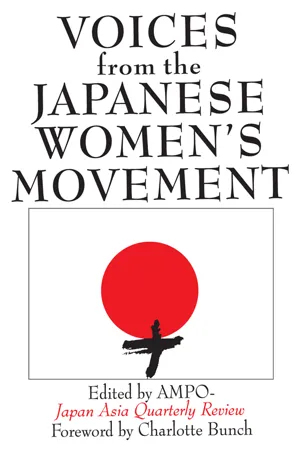
Voices from the Japanese Women's Movement
About this book
An insider's view of the world of contemporary Japanese women.
Information
II
Issues Facing Women
4
Economic Development and Asian Women
Matsui Yayori
“It is said that the 21st century will be the century of Asia. Japan has become a global economic power; the NIEs (newly industrialized economies—South Korea, Taiwan, and Hong Kong) have achieved outstanding economic development; China and Macao have accelerating economic growth; and Mongolia is moving toward a market economy.
The economic energy of East Asia is having an impact on the lives of people of the world through the filling of the world market with the wealth and abundance of its products. This emergence of Asia is capturing great interest all over the world.
However, it is questionable whether the current type of economic development based on the free market system improves quality of life, gender equality and the advancement of women. … Deeply rooted gender-role divisions limit women’s participation in policy decision-making in every sphere including economics, politics, society, education, mass media and culture. We maintain that gender equality is still far from being realized.”
This statement comes from the East Asian Women’s Declaration, which was adopted at the First East Asian Women’s Forum held in Japan in October 1994 in preparation for the 1995 Beijing Women’s Conference.
Women in the NIEs—National Borders
Women of Southeast Asia have organized a workshop entitled “Women in NICs, Near NICs, and Aspiring NICs” (NICs, or newly industrializing countries, is equivalent to NIEs) in March 1995 as preparation for Beijing. They recognized a need to examine the impacts of the development process on women’s life. In the Asia-Pacific region, where countries have followed a single model of economic development since the end of the Cold War. Some of the issues they pointed out, which concern women in the entire region, were sex tours and trafficking in women, migrant workers working outside of their own countries, changes in gender-based roles in families, the feminization of unemployment and poverty, the influence of war and peace on women, and environmental degradation/industrial pollution/women’s health.
International Trafficking in Women
International criticism mounted in the 1970s against Japanese men taking sex tours to other Asian countries. Since the 1980s, however, the problem has changed to one of Asian women being trafficked into Japan. Thai women, as is reported in Chapter 11, have been the greatest victims.
The number of Thai women being sent into Japan’s sex industry skyrocketed during the same period that their country’s economic growth rate went into double digits. Thailand’s economic development model encourages foreign investment, is city-centered, promotes industrialization, and is export oriented. It has widened the gap between rich and poor and between city and countryside. In contrast to the prosperity in Bangkok, life in the rural areas have been impoverished. Many farmers are burdened with unbearable debt and find themselves forced into selling their daughters into the sex industry.
Tourism Promotion and AIDS
In Thailand the promotion of tourism as a means to acquire foreign currency, along with consumerism, has played a key role in the unprecedented growth of prostitution. Along with this, HIV infection has spread at an explosive rate; women have been victimized by the epidemic. It has spread especially quickly among young girls, who are unlikely to have contracted it before they were sold into prostitution. This demand for safe young girls is so strong that girls from neighboring countries such as Burma, Laos, Cambodia and southern China have also become victims.
In fact, trafficking in women and girls has become a serious problem all throughout Asia, where everything has come to be seen as a commodity in the free market economy. Women are being sold from Thailand and the Philippines to Japan, Taiwan, Korea, and Hong Kong; from Bangladesh to Pakistan; from Sri Lanka to the Gulf nations. Trafficking in women for the purpose of organized prostitution has become global, and the victims are becoming younger.
The Meaning of Violence Against Women
Since the UN Decade for Women (1976–85), violence against women has emerged as one of the main themes of women’s movements internationally. “Women’s human rights” were officially spelled out for the first time in Vienna at the 1993 World Conference on Human Rights, and violence against women became a focus of the debate. The UN Declaration on the Elimination of Violence Against Women was adopted later that year, and in it three categories of violence were described: in the family, in the community and by the state. Trafficking in women, along with rape and sexual harassment, was classified as violence in the community, and governments have been asked to take action.
The international women’s movement made a tremendous achievement when it succeeded in getting domestic violence, which was long considered a private matter and therefore neglected, to be considered a serious violation of women’s human rights. Violence inflicted by husbands against their wives takes place in every society. Traditionally, however, the public sector has been hesitant to intervene, under the rationale that the problem was a personal matter between the husbands and wives. The thinking was that maltreating people outside the family was a crime, but that harming one’s wife was tolerable.
Women in Europe and North America were the first to take up domestic violence as an issue, and we have gotten far enough now that governments have been forced into taking some action. In Asia, in addition to domestic violence in general, traditional and religious practices sometimes act as unique forms of domestic violence against women; in Asia cultures of silence compel women to hide their misery, out of both shame and fear.
The Asian Pacific Regional Conference on Inter-familial Violence
In December 1994, the United Nations International Children’s Emergency Fund (UNICEF) held its “Asian-Pacific Regional Conference” in Cambodia on interfamilial violence against women. The reality of violence against women in Asia and measures to combat it were discussed, and plans of action were put forward.
Women are exposed to violence even before they are born, and the violence lasts throughout their lifetimes. In India, where parents are reluctant to have daughters for fear that they will not be able to afford dowries, and in China, where a preference for boys has become magnified by the one-child policy, selective abortions and infanticide are widespread. Girls are subject to sexual abuse, and married women are not safe from violence inflicted upon them by their husbands. In extreme cases, such as dowry-related murders in India, thousands of young wives are burned to death or driven to suicide by greedy husbands. Dowry killing is almost a traditional practice, but the sudden increase in recent years may be a consequence of a rapidly spreading consumerism.
One detailed report from Cambodia illustrates how the legacy of genocide from the Pol Pot era continues to haunt Cambodian society. In some men, the trauma of the massacre is manifested as violence inflicted against their wives. The population imbalance between men and women that emerged from the killings has weakened the position of women in general; there have even been cases of men abusing their wives after meeting new women.
At the end of the conference, the Phnom Penh Declaration was adopted, appealing for the creation of a new society without any form of violence.
Development as Structural Violence
In addition to gender violence, the impact of unequal economic development—a form of structural violence—presents serious problems for women. The Asia Pacific Forum on Women, Law and Development (APWLD) organized a Women’s Tribunal in December 1994 at Chulalongkorn University in Thailand. Eight women who were victims of serious human rights violations were invited to give testimony about their experiences, and they used their testimony to question the present model of economic development.
One farmer from northeast Thailand talked about the struggle against the Pak Mun Dam by local farmers. The dam was built despite their protests, and because of the dam they can no longer catch fish to eat. Hundreds of farmers asking for proper compensation were met by police violence at the dam site shortly before the APWLD tribunal.
The farmer concluded her testimony at the tribunal by stating angrily that “men in the village now have to leave the village and earn money elsewhere. Women have been left behind, and are struggling to survive. All we can say to development is a big ‘NO.’”
Pak Mun is one of many projects planned along the 4,200-kilometer Mekong River. International financial institutions and multinational corporations are developing resort sites, dams and other big projects, neglecting the needs of local people. As a result, the 50 million or so people living along the Mekong in Thailand, Burma, Vietnam, Laos, Cambodia, and China face the danger of extinction. Some Japanese citizens who are deeply concerned about the Mekong development, in cooperation with people from the affected area, have recently started “Mekong Watch” activities.
The struggle against big dams is gaining momentum in many places such as Narmada in India, Kedung Ombo in Indonesia, and Bakun in Sarawak, Malaysia. Women have played an important role in all these movements.
Rainforest Destruction and Indigenous Women
Similarly, women’s power has been the driving force behind protests against the destruction of forests, as can be seen in the Chipko movement in India. Southeast Asia, like Brazil and Central Africa, has many rich rainforests. Unfortunately, however, commercial logging has swept through the Philippines, then Indonesia, and now onto Borneo Island, quickly destroying the rainforests and threatening extinction for indigenous peoples. In addition to Japan, the world’s largest importer of timber, the NIEs like Korea and Taiwan have extracted massive volumes of tropical hard wood from Sarawak.
Indigenous people—as entire families, men, women, and children—have struggled against logging by blockading roads. The men have been arrested, and the women left with the struggle for survival. One woman from Sarawak who visited Japan at the invitation of a Japanese NGO working on rainforest protection criticized the wasteful, consumer-oriented lifestyle in Japan, pleading, “Do not cut down any more trees. We cannot survive without our forest. Japanese people make furniture and other items with the trees from our forest, and then discard them without giving it a second thought.”
Resort Development for Whom?
The Women’s Tribunal also pointed out how indigenous people in Asia and the Pacific have been victimized by rapid economic development. The women from the Cordillera in the Philippines reported on the troubles they faced when they lost their livelihoods due to mine development sponsored by foreign capital.
Another source of hardship for indigenous people is tourist development. As a way of earning foreign currency, ASEAN nations have adopted tourism promotion policies, starting with “Visit Thailand Year” in 1987. Billions of people from the wealthy North have traveled to the countries of the South in search of the four s’s—sun, sea, sex, and sports. The numbers of tourists from Japan have increased as well, partly because of the strong yen, reaching 13 million in 1994. For 60 to 70 percent of these travelers, the destination is the Asia-Pacific region. Visitors from the NIEs, and especially Korea and Taiwan, are also increasing rapidly.
For local people, however, tourism brings devastation; they are forced to relocate, the natural environment is destroyed, their culture is commercialized, and prostitution becomes rampant. This kind of tourist development is often financed by international financial institutions, private capital, and ODA (official development assistance) from Japan and other nations. In Hawaii and Guam, most hotels and golf courses have been built with Japanese capital; in Indochina, where tourist development has been promoted along with the free-market economy, Chinese capital from NIEs such as Thailand has played a major role.
In response to this, movements against golf courses have spread throughout Southeast Asia. In Indonesia, for instance, farmers continue to resist the confiscation of their farmlands for a planned golf course. Female farmers have played an active role in this movement. The damage to indigenous peoples living near beaches and in remote mountain areas suitable for resort sites is particularly serious. The Chaorei of Phuket Island, Thailand, the Chamoro of Guam Island, and the “Aborigines” in Taiwan’s mountain areas, are some of the peoples whose lands and cultures, which are the source of their identities, are in danger of destruction. Women are also being brought into the sex industry in the resorts. Some indigenous people have begun to organize in order to take control of tourism in their own community and to keep foreign capital at bay.
Shrimp Cultivation and Women
Another shocking testimony at the Women’s Tribunal concerned shrimp cultivation in Bangladesh. Shrimp farming has been promoted there under the government’s policy to acquire foreign currency and the Structural Adjustment Program imposed by the World Bank, and the southern shore area has been transformed into a large cultivation area.
This change ignited protests among local farmers, whose lands were scheduled to be taken away. In 1991, village women organized a demonstration against the shrimp dealers, who responded by hiring armed personnel. These guards shot one woman to death and injured dozens of others.
Shrimp cultivation has spread along many Asian shores. It destroys mangrove forests, deprives farmers of their lands, and threatens the very survival of local people. For instance, near General Santos, a port town in the southern Mindanao in the Philippines, U.S.-based Dole, an agribusiness multinational, has expanded its shrimp cultivation in the area, driving Islamic Moro fishermen away from their villages in the process. In order simply to survive, many women have gone to Gulf nations as migrant workers, and some have returned, without income, after having suffered sexual abuse and/or nonpayment of wages.
In another case, a plan was created in 1994 to use Japanese ODA to build a modern port to allow for the speedy export of marine products to Japan, and area fishermen were displaced, despite their resistance. One young Moro woman who is now working to organize women in the General Santos area said, “The Ramos administration aims to make the Philippin...
Table of contents
- Cover
- Half Title
- Title Page
- Copyright Page
- Table of Contents
- About the Contributors
- Foreword
- Introduction: Looking Toward Beijing
- I. The Women’s Movement
- II. Issues Facing Women
- III. Voices of Women
- Index
Trusted by 375,005 students
Access to over 1.5 million titles for a fair monthly price.
Study more efficiently using our study tools.
Frequently asked questions
Yes, you can cancel anytime from the Subscription tab in your account settings on the Perlego website. Your subscription will stay active until the end of your current billing period. Learn how to cancel your subscription
No, books cannot be downloaded as external files, such as PDFs, for use outside of Perlego. However, you can download books within the Perlego app for offline reading on mobile or tablet. Learn how to download books offline
Perlego offers two plans: Essential and Complete
- Essential is ideal for learners and professionals who enjoy exploring a wide range of subjects. Access the Essential Library with 800,000+ trusted titles and best-sellers across business, personal growth, and the humanities. Includes unlimited reading time and Standard Read Aloud voice.
- Complete: Perfect for advanced learners and researchers needing full, unrestricted access. Unlock 1.5M+ books across hundreds of subjects, including academic and specialized titles. The Complete Plan also includes advanced features like Premium Read Aloud and Research Assistant.
We are an online textbook subscription service, where you can get access to an entire online library for less than the price of a single book per month. With over 1.5 million books across 990+ topics, we’ve got you covered! Learn about our mission
Look out for the read-aloud symbol on your next book to see if you can listen to it. The read-aloud tool reads text aloud for you, highlighting the text as it is being read. You can pause it, speed it up and slow it down. Learn more about Read Aloud
Yes! You can use the Perlego app on both iOS and Android devices to read anytime, anywhere — even offline. Perfect for commutes or when you’re on the go.
Please note we cannot support devices running on iOS 13 and Android 7 or earlier. Learn more about using the app
Please note we cannot support devices running on iOS 13 and Android 7 or earlier. Learn more about using the app
Yes, you can access Voices from the Japanese Women's Movement by Ampo Japan Asia Quarterly Review in PDF and/or ePUB format, as well as other popular books in Social Sciences & Public Affairs & Administration. We have over 1.5 million books available in our catalogue for you to explore.