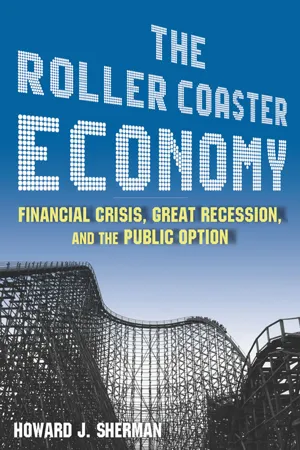
eBook - ePub
The Roller Coaster Economy
Financial Crisis, Great Recession, and the Public Option
- 197 pages
- English
- ePUB (mobile friendly)
- Available on iOS & Android
eBook - ePub
About this book
Written by one of the foremost experts on the business cycle, this is a compelling and engaging explanation of how and why the economic downturn of 2007 became the Great Recession of 2008 and 2009. Author Howard Sherman explores the root causes of the cycle of boom and bust of the economy, focusing on the 2008 financial crisis and the Great Recession of 2008-2009. He makes a powerful argument that recessions and the resulting painful involuntary unemployment are inherent in capitalism itself. Sherman clearly illustrates the mechanisms of business cycles, and he provides a thoughtful alternative that would rein in their destructive effects.
Part I
Problems of the Roller Coaster Economy
1
Boom, Bust, and Misery
The Curse of Capitalism
When Alice was in Wonderland, it was a topsy-turvy place that Alice found very confusing. The present capitalist market economy, much like Alice’s Wonderland, often seems topsy-turvy and confusing to most people, perhaps never more so than today.
Right now, as this book is written in 2009, millions of Americans have lost their jobs and go without a secure income. More than 1 million U.S. homeowners are facing foreclosure and the loss of their homes. Thousands of businesses are going bankrupt, mostly small businesses, but also some very large ones.
You might think from these facts that the economy produced too much, hired too many workers, and created too many companies. But millions of people in the United States need more to eat, more clothes, and more shelter. In 2007, more than 37 million people, some 12.5 percent of the U.S. population, lived in poverty without enough money to get by on. Those numbers go up every day as the economy spirals downward.
If so many people urgently need so many things, why does the economy act like it has produced too much? Why do unsold clothes pile up on store shelves, cars sit in showrooms, and houses stand empty, when so many go without?
These same topsy-turvy contradictions appear in the global economy. Economies across the globe—not just the U.S. economy, but also the European, Japanese, and even the red-hot Chinese and Indian economies—are cutting back production. European finance employees, Japanese electronics employees, Chinese garment workers, and Indian software employees are losing their jobs as their economies slow and the world export market dries up.
But there is great need for more production. In 2005, 1.4 billion people, about one-quarter of the population of the developing world, lived in extreme poverty, making do on less than US$1.25 a day. Half the population of sub-Saharan Africa, 380 million people, continues to live in extreme poverty. The poverty-stricken and many others need more food, more clothing, and more shelter.
The world economy has enormous capacity to produce. Instead of producing more, however, economies across the globe are producing less. They are firing their employees.
It is this strange, contradictory, topsy-turvy state of affairs that reminds us of Alice’s Adventures in Wonderland (Carroll 1901). Alice would find that the economic system reduces production when many people urgently need more goods and services. She would think this is strange and mysterious, and perhaps as topsy-turvy as Wonderland.
Resolving the Mystery
The first step in solving this mystery is to recognize that the economy has not produced more than people need. The economic output is only more than people have the money to buy at a price that yields a profit.
Today’s housing and mortgage crisis makes that clear. In the fall of 2008, homelessness reached record levels all across the United States. In Massachusetts in September 2008, for example, 2,000 families lived in shelters. Another 574 families could not find shelter space and were temporarily housed elsewhere. At the same time, 18.6 million housing units in the United States stood empty. U.S. housing prices were down nearly 20 percent from their peak in late 2005. Sales of new homes had just about dried up. And housing starts, the building of new homes, reached their lowest level since record keeping began in 1947. Only in a topsy-turvy world could Massachusetts and every other state scramble to provide shelter to a record number of homeless families while millions of homes lie empty.
For some people, these contradictions are not so bothersome. Take Wall Street Journal columnist Holman Jenkins. How would he “shake off the mortgage mess”? That is easy: demolish unoccupied houses. Unsold houses, figures Jenkins, “go rancid on the shelf, souring the values of the nation’s entire housing stock,” pulling down its price. Destroying unsold houses would, he argues, reduce the supply of housing and drive up housing prices (Jenkins 2008). Jenkins’s reasoning is the quintessential example of the market economy’s upside-down logic. Jenkins is more obsessed with driving the price of houses back up than with the plight of the homeless. How else could he advocate destroying unoccupied houses to make those that remain on the market more expensive, while many families go without a home?
Unemployment is another example of the topsy-turvy nature of the economy. Employees lose their jobs because the commodities they produce go unsold. But without a job or income, they too will lack the money they need to purchase the goods they badly need. And then yet more employees will lose their jobs. The number of unemployed climbs by millions as the economy produces less and less, and employs fewer and fewer workers and professionals. All the while, the millions of people without jobs would be happy to work to produce the goods that they so desperately need.
How can this strange mystery be solved? This question is of vital importance to people all over the world. This book seeks to unravel the mystery of how vast numbers of people are unemployed while millions of people urgently need more food, clothing, and shelter. This book was written both to explain the mystery and to discuss ways to change this topsy-turvy economy for the better.
Recession and Depression
In economic expansions, American production rises while unemployment falls. Every expansion in American history, however, has been followed by an economic contraction. If the contraction is relatively mild by historical standards, it is called a recession. If it is more severe, it is called a depression. The difference can best be explained by a joke first made by President Harry Truman: If your friend loses her job, he said, it is a recession; if you lose your job, it is a depression. When the contraction lasted ten years and official unemployment went up to 25 percent in the 1930s, it was called the Great Depression.
The term “depression” was commonly used before World War II to refer to any economic contraction. From 1948 to 2001, there were ten minor contractions. Conservatives did not like the term “depression” because it reminded everyone of the horrors of the Great Depression which they would rather forget, while denying that the economy had any basic problem. So conservatives invented the term “recession” to convey the idea that the problem was mild and temporary. Eventually the term “recession” was widely used.
Now, in 2009, America is in the most violent contraction since 1929. It is even larger than the recession of 1982, which had been the biggest one since the 1930s. Conservatives want to call it a recession. But that word is not strong enough for most people. Paul Volcker, a past chair of the Federal Reserve System, has called it a “Great Recession” (Volcker 2009, p. 1).
A “Great Recession” reflects actuality a lot better than just the term “recession.” The Great Recession of 2007 to 2009 reflected new economic structures that have arisen in the last thirty years and have born a bitter fruit. More people have lost their jobs than in any other contraction since the Great Depression. Although it is not in the same class with the Great Depression, this Great Recession is bigger than any of the previous recessions in many ways. Americans have witnessed a deep contraction with an entirely different quality. An elephant is not just a bigger horse; it is qualitatively different.
Moreover, this contraction represented dramatic changes in the economic structure. The structure of the economy means the building blocks of which it is built and how they fit together. No contraction since the Great Depression has caused such a strong financial crisis. No other recession has seen millions of foreclosures that meant the end of the American dream of owning a house. No other recession has had so many large corporations teetering close to bankruptcy.
But there was also a financial crisis in the middle of the Great Recession. This crisis has been building for decades as the whole economic structure slowly changed. So the most accurate description of the 2007 to 2009 situation would be a Great Recession with a Financial Crisis. That is too big a mouthful, so the book will use the term “Great Recession” for the period 2007 to 2009. The expansion that preceded the Great Recession should be called the expansion of 2001 to 2007 during the Bush administration, but it will be called the Bush expansion for short. Part II of this book will discuss the extent to which the Bush administration influenced the major variables.
Three questions will be explored in this book. First, why did the most recent expansion turn into a Great Recession? Second, what were the structural changes that led to the crisis of 2008? Third, in the last chapter, the question is what to do about it. That is, what changes have to be made in the structure of the U.S. economy to stop this sort of thing from happening ever again?
The Curse of Unemployment
In the first half of 2009, unemployment in the United States rose by half a million every month. The auto industry has been especially hard-hit. Of the big three, General Motors (GM) sold the lowest number of vehicles in forty-nine years in 2008. Both GM and Chrysler, the third largest auto company, went bankrupt in 2009. Despite these massive job losses, some politicians and economists in the United States blamed unemployment on the people, rather than the businesses that fired them. Former senator Phil Gramm, a politician with a PhD in economics, said in July 2008 that the United States had “become a nation of whiners” and dismissed the downturn as nothing more than a “mental recession” (see Cooper 2008).
Conservative economic think tanks, such as the Heritage Foundation, insisted that the rising unemployment was not attributable to corporations firing employees. Rather, corporations were creating fewer new jobs because of high taxes. For them, the important way to cure the problem of unemployment was cutting business taxes. There was no need to extend unemployment benefits (see Sherk 2009).
This pro-corporate apology and dismissal of recessions are not new. “Absolutely sound” was President Calvin Coolidge’s assessment of the economy and the stock market in 1929. In the fall of 1929, Hoover’s secretary of the Treasury, Andrew Mellon, reassured one and all that “there is no cause to worry. The high tide of prosperity will continue.” Finally, in mid-October 1929, no less than Irving Fisher, the preeminent U.S. economist of his day, proclaimed that “stock prices have reached what looks like a permanently high plateau” (see Galbraith 1988, pp. 15, 26, 41, and 70).
A few days later the stock market crashed, and the U.S. economy sank into a depression that was to last a decade. By 1933, at least 25 percent of the labor force was unemployed and another 25 percent was on involuntary part-time work or was so discouraged that ...
Table of contents
- Cover Page
- Half Title Page
- Title Page
- Dedication
- Copyright Page
- Contents
- Preface and Acknowledgments
- Part I Problems of the Roller Coaster Economy
- Part II Diagnosing the Roller Coaster
- Part III Diagnosis and Cure of the Roller Coaster Economy
- References
- Index
- About the Author
Trusted by 375,005 students
Access to over 1.5 million titles for a fair monthly price.
Study more efficiently using our study tools.
Frequently asked questions
Yes, you can cancel anytime from the Subscription tab in your account settings on the Perlego website. Your subscription will stay active until the end of your current billing period. Learn how to cancel your subscription
No, books cannot be downloaded as external files, such as PDFs, for use outside of Perlego. However, you can download books within the Perlego app for offline reading on mobile or tablet. Learn how to download books offline
Perlego offers two plans: Essential and Complete
- Essential is ideal for learners and professionals who enjoy exploring a wide range of subjects. Access the Essential Library with 800,000+ trusted titles and best-sellers across business, personal growth, and the humanities. Includes unlimited reading time and Standard Read Aloud voice.
- Complete: Perfect for advanced learners and researchers needing full, unrestricted access. Unlock 1.5M+ books across hundreds of subjects, including academic and specialized titles. The Complete Plan also includes advanced features like Premium Read Aloud and Research Assistant.
We are an online textbook subscription service, where you can get access to an entire online library for less than the price of a single book per month. With over 1.5 million books across 990+ topics, we’ve got you covered! Learn about our mission
Look out for the read-aloud symbol on your next book to see if you can listen to it. The read-aloud tool reads text aloud for you, highlighting the text as it is being read. You can pause it, speed it up and slow it down. Learn more about Read Aloud
Yes! You can use the Perlego app on both iOS and Android devices to read anytime, anywhere — even offline. Perfect for commutes or when you’re on the go.
Please note we cannot support devices running on iOS 13 and Android 7 or earlier. Learn more about using the app
Please note we cannot support devices running on iOS 13 and Android 7 or earlier. Learn more about using the app
Yes, you can access The Roller Coaster Economy by Howard J Sherman in PDF and/or ePUB format, as well as other popular books in Economics & Finance. We have over 1.5 million books available in our catalogue for you to explore.