![]()
Part I
Strategic
![]()
1 Strategy and leadership
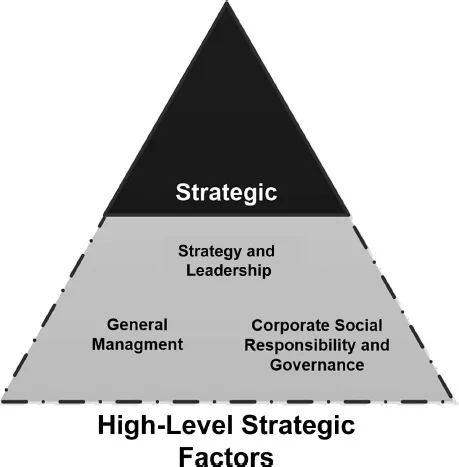
Welcome to Step 1 of the 10 Step MBA for Safety and Health Practitioners! We begin with Strategy and Leadership, arguably one of the most important lessons in your path to power as an OSH professional. This Step relates to the first of the three themes within the OSH Practitioner Transformation Model on the need to “be strategic”. Strategy concepts will alter the way you look at your organisation, providing you with frameworks and tools needed for OSH direction, while leadership skills will ensure that you can implement these approaches in practice. So, let’s not delay any further. It’s time to start your journey of transformation as an OSH practitioner!
On completion of Step 1, you will be able to:
- Explain what is meant by strategy and the importance of making trade-offs
- Appreciate the importance of analysis and diagnosis to effectively develop a vision and strategy for OSH
- Create a framework and road map for executing an OSH strategy
- Understand how to build and maintain agility within your OSH strategy
- Recognise the links between strategy and leadership and the different types of OSH leadership.
Strategy
What should be the first question you ask when embarking on a journey to enhance OSH performance? The answer is simple – ‘What is our OSH strategy?’. Unfortunately, the focus for many OSH professionals when addressing OSH performance is to begin with the OSH policy and associated management arrangements. Although an OSH policy and management arrangements are important, and in many jurisdictions legal requirements, they will not provide all the answers to addressing the challenge of generating continual improvement in OSH performance―for this you will need a strategy!
What is strategy?
Strategy has always been a vogue term in business. Executives proffer that strategies are needed before rushing head-first into tactical decision making; however, they sometimes struggle to understand the nature and content of effective strategies. Fundamentally, strategy is about making choices, typically concerning what you want to do and how this will be achieved. From a wider business perspective, this may include what products and/or services are offered and how business decisions are executed. Strategy also involves making trade-offs as we cannot do everything.
In relation to strategy formulation, it is important to recognise that key choices are made at different levels of an organisation. When developing an OSH strategy an understanding and alignment with strategies existing at these various organisational levels may address:
- Corporate Strategy – defining organisational purpose and values, decisions on which business to be in, how diversified the organisation should be, where to invest and where to divest, how to allocate capital, how to manage the relationships between the different geographies (where applicable) and business units
- Business Unit Strategy – considering market positioning, strategic objectives for growth, return on investment, profitability, cash generation and collection
- Functional Strategy – understanding how functions contribute towards the translation of corporate and business unit strategy, managing resources, establishing performance criteria and performance improvement targets.
| 91% of respondents either “agreed”, or “strongly agreed” that I am confident that I can think strategically on OSH matters. |
All organisations wish to improve OSH performance, but there are many choices to be made in determining what interventions to implement. Our OSH Practitioner Insight Survey indicated that most OSH practitioners believe they can think strategically on OSH matters. So where should you start when it comes to preparing an OSH strategy? Well, many organisations look at what they did last year and replicate the same! Indeed, time pressures and budgetary constraints can make it difficult to allocate sufficient resources for strategy development, but periodically it is important to take a step back and undertake some exploratory work before building your OSH strategy.
| Remember that strategy is about making choices and that the essence of your OSH strategy is often more about the things that you decide not to do. |
Diagnosis before development
It is difficult to build your organisation’s OSH strategy without some level of diagnosis. You would not like it if you went to the doctors and treatment was prescribed before any tests had been carried out! The established links in research between OSH culture and performance (Health & Safety Executive, 2002) suggest that a good starting point in understanding the OSH priorities and barriers within your organisation is to undertake a survey of OSH cultural maturity.
It is important to determine the maturity of your organisation’s existing OSH culture, as this can represent a key determinant in ensuring the successful implementation of OSH interventions. A number of excellent proprietary models are available to assist in the process of evaluating OSH culture, including the Health & Safety Laboratory’s (HSL) Safety Climate Tool (Health & Safety Laboratory, n.d.). This tool includes a range of statements related to the OSH climate of your organisation to which participants are required to confirm the extent to which they agree or disagree with the statements. The outcome is unique insights into perceptions of your OSH culture supported by suggestions for improvement.
Although these types of tools can be useful in determining the pillars of your OSH strategy, it is important that the following points are considered:
- Tailor questions to address industry/organisational specific requirements
- Acquire a representative demographic sample, including different levels of the organisation (e.g. senior management, middle management, frontline workers, etc.) and make-up of the labour force (e.g. employees, contract labour, agency workers, etc.)
- Provide the survey in alternative languages with translation support for workers who do not speak English as a first language
- Use alternative forms of survey delivery to ensure a high completion rate (e.g. email link, face to face sessions, etc.)
- Follow up with interviews and other focused study groups to determine high priorities and barriers.
The growth of on-line survey tools, such as Survey Monkey (Survey Monkey, n.d.), also means that options are available for creating your own tailored surveys, at a much lower cost. So, with a little thought and effort you can undertake your own studies of the prevailing OSH culture to understand what to do next. When information relating to your OSH culture is coupled with OSH performance data and consideration of OSH risks and opportunities you will be in possession of all the building blocks necessary to define your OSH vision.
Building your organisation’s OSH vision
Once you have completed a diagnosis of the existing situation, the next step in creating an effective OSH strategy invariably involves defining a vision. Without the need to name and shame organisations, a quick trawl through any search engine will quickly find proclamations of visions for ‘world class OSH performance’; but a vision should be something that you can see – hence the term vision!
Furthermore, you should know when the vision has been achieved and it should reach out to everyone within the organisation at a personal level to influence desired behaviours. The ability to describe the future you desire in terms that employees can understand is a crucially important part of defining an OSH vision. It helps people visualise the journey you want them to take and ensure the decisions they make are consistent with that vision.
The term ‘zero’ is commonly adopted into OSH visions – zero harm, target zero and beyond zero. Indeed, a vision that incorporates zero can be a powerful and aspirational goal; however, take time to consider the context of your organisation to determine whether the attainment of zero harm is feasible. Due to concerns regarding the unintended consequences of zero based visions, many organisations are now moving towards more positive and value based OSH visions, driven by progressive thinking, such as “safety differently”, coined by Sydney Dekker (2014). These new approaches centre on the belief that people are the solution and not the problem when it comes to driving improvements in OSH performance (see Step 4 on Organisational Behaviour and Human Resource Management for further discussion on moving from a performance based organisation to a learning organisation).
| Don’t fall into the trap of a ‘copy and paste’ zero harm vision. Take time to understand OSH priorities and barriers and create a vision appropriate for your business. |
Once a vision has been formalised it needs to be communicated effectively to the workforce. Training provides an ideal opportunity to communicate the vision; however, it should be reinforced periodically using other forms of communication, such as posters, leaflets and text messages, always with involvement from top management, to ensure that the critical messages remain in the minds of the workforce. These initiatives will help in developing employee commitment and ownership of the OSH vision and will increase the chances that the vision will be achieved in practice.
Developing a strategic road map
An effective OSH strategy should provide clear direction in terms of the activities required to achieve your OSH goals; however, the creation of a glossy and compelling vision is not enough – you need to ensure that this is supported by a clear implementation plan that lays out the journey required to achieve your vision, detailing associated actions, priorities, time-frames and responsibilities.
Innovation in OSH strategy
In 2015, Laing O’Rourke, one of the UK’s largest contractors, starting trialling an innovative new OSH strategy. The organisation had become sceptical of the ‘zero’ vision for OSH and decided that a different approach was needed and in June 2015 formally rolled out the new strategy across the Australia business.
Central to the OSH strategy are three key principles:
- 1 People are the solution, not the problem – people putting processes into practice must not only have the competence, but the confidence to make the right decisions.
- 2 Safety is the presence of positives, not the absence of negatives – bright spots should be identified and replicated across the organisation.
- 3 Safety is an ethical responsibility, not a bureaucratic activity – safety management is about protecting people from harm, not protecting companies from litigation.
Laing O’Rourke’s new OSH strategy is a great example of a willingness to embrace change and a new direction when analysis indicated the current approach had stalled.
It is important to have the courage to make changes when current strategies are not working, so make sure you don’t fall into the trap of letting OSH strategy stagnate.
Achieving an aspirational vision may be regarded as unrealistic by the workforce, particularly if the organisation is currently suffering from poor levels of OSH performance. In this type of situation, change needs to be broken down into more manageable phases to instil the confidence among the workforce that OSH goals are realistically attainable. Presenting a vision as a journey, as opposed to a short-term requirement may help in developing the mind-set that gradual improvements in OSH performance may ultimately lead to accomplishing the goal.
In line with this approach, a road-map can be created, incorporating sub-goals. These more concrete and proximal sub-goals may help prompt initial movement towards the ultimate destination. Often the most difficult aspect of any change effort is i...