- 288 pages
- English
- ePUB (mobile friendly)
- Available on iOS & Android
eBook - ePub
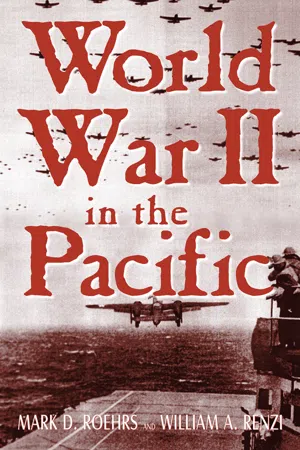
World War II in the Pacific
About this book
World War II laid the groundwork for much of the international system that exists today, especially in the Pacific Rim. This brief but comprehensive survey of the War in the Pacific incorporates both United States and Japanese perspectives, providing a global approach to the Asian theater of the conflict. Drawing on decades of new scholarship and written in an engaging, narrative style, this book traces United States-Japanese relations from the late nineteenth century to the war's end in 1945. It covers every aspect of the war, and gives special attention to ongoing historical debates over key issues. The book also provides new details of many facets of the conflict, including expansionism during the 1930s, events and policies leading up to the war, the importance of air power and ground warfare, military planning and strategic goals, the internment of Japanese-Americans in the U.S., Allied plans and disputes over Russian participation, the decision to drop the atomic bomb, and conditions for surrender.
1
Rising Sun
______________
Japan Comes of Age
The year 1868 was as dramatic and important in Japanese history as the year 1941. For that year the boy emperor, Meiji, guided by a small group of warlord-noblemen, or genro, established the Japanese capital in Tokyo and began modernization of Japan. The motives that impelled the Japanese to begin industrialization were diverse. The traditional explanation on the American side of the Pacific has been that U.S. commodore Matthew Perry’s arrival in 1853 had significant influence on Japan’s decision to terminate its isolation. However, the internal factors that motivated the Japanese to abandon their traditional isolationism were more numerous and complex. Along with the arrival of the Americans were more pressing threats to the old order, including longstanding rivalries between various daimyos within the Tokugawa shogunate, as well as the regional ambitions of European powers, most dramatically demonstrated by the devastating British victory over China in the opium wars and the arrival of the Russian empire on Japan’s Pacific seaboard. Russia’s subsequent founding of the port of Vladivostok—its name may be literally translated as “rule over the East”—on the Sea of Japan, which had heretofore been a virtual Japanese lake, gave credence to Japanese fears of European intentions in Asia. Further, any influence the United States might have had was doubtless terminated by the U.S. Civil War, which seemed to Japan to demonstrate American weakness and incompetence.
The shogunate government, or bakufu, decision to sign a trade treaty with the Americans in 1858 may have provided the final impetus for its enemies’ decision to revolt. Led by samurai of the Choshu and Satsuma daimyos, anti-bakufu forces denounced accommodation with the Westerners and called for reverence to the emperor and expulsion of the barbarians. In an ironic twist, the Tokugawa leadership, which had been the leading advocate of tradition- alism and Confucian values, became associated with modernism and pro-Western sympathy. Attacks in 1864 on British and American shipping by forces from the Choshu faction resulted in reprisals and bombardment of coastal defenses, but not wholesale invasion and war, as had happened in China. Anti-Western demonstrations and the assassination of several prominent Westerners as well as members of the bakufu followed, but also failed to remove the “barbarian influences” from Japan.
Powerful samurai from numerous daimyo realized the futility of continued resistance to the Americans and Europeans and instead embraced the military and economic technology of the West as a means of self-strengthening. Cries of “rich country, strong army” replaced the calls for expulsion of the barbarians. Support for the bakufu was nearly nonexistent by the time samurai from Choshu and Satsuma called for the shogun’s surrender of political leadership. The actual transfer of power from the bakufu to the rebels; then, was relatively bloodless. Consent of the young Meiji emperor justified the change and also ensured that rebel samurai would carry out the functions of government in his name.
The Meiji Restoration
The Meiji Restoration, as it came to be called, was a combination of traditional and modern elements. While adopting the technology and economics of the West, Meiji leaders were careful to preserve many of the values and traditions of Japan’s heritage. A significant portion of the Japanese population found the changes wrought over the course of the next twenty-five years to be painful. In the end, no group was more affected than the very samurai who had begun the modernization. The samurai, Japan’s traditional warrior class, had begun the process of transformation from standing military oligarchy to bureaucratic functionaries during Tokugawa’s reign. Years of peace had already served to change many of the samurai into administrators and civil servants of the local daimyo. The restoration accelerated the completion of this process. One of the first orders of business of the new government was to break up the old daimyos, destroy the domain castles, and create a new provincial political order with centrally appointed governors. Thus, the emperor, not the local samurai, now became the focus of popular loyalty. Many of the petty samurai—those without extensive landholdings or political influence—were pensioned off and sent into unofficial retirement. These former samurai had the benefit of education and many opted to become teachers, artists, or bureaucratic officials. All of these were considered honorable professions, but they lacked the prestige associated with the samurais’ former warrior status. The retirement system was suspended in 1876 when, in order to reduce government expenses, lifetime pensions were replaced by a onetime lump-sum payoff.
While the samurai class may have disappeared during the Meiji period, the spirit of the warrior caste did not. In fact, the leading political officials continued to be drawn from the samurai class and strove to prop up the faltering system on several occasions. It was, however, the adoption of conscript armies, more than any other element, that threatened to reduce the status of the samurai and was most hotly debated by the original restoration conspirators.
In 1873, debate coalesced around the question of Japan’s relations with its nearest neighbor, Korea. Samurai from the Choshu and Satusuma regions, many of whom had initially been instigators of the restoration, called for a military campaign on the peninsula to open economic opportunities for Japan and to restore the position and respect of the samurai class. The government refused to endorse the venture, and in 1877 opposition samurai led by Saigo Takamori launched a desperate and ultimately futile revolt against the bureaucracy they had been instrumental in creating. The uprising ended with the siege of Kumamoto Castle and the victory of recently recruited conscript soldiers over the highly skilled but outnumbered samurai professionals. This marked the effective end of the samurai as a class, but the samurai spirit and warrior code (bushido) were adopted by future armies of Japan and remained a point of great national pride and reverence for future generations.
Another significant characteristic of the Japanese path to modernization included the leaders’ refusal to become financially indebted to Western nations, though they were not adverse to borrowing heavily from Western technology. The Japanese had collected and studied Western science books throughout the seventeenth and eighteenth centuries, using their semi-annual contact with Dutch traders at the port of Nagasaki. After the “opening” of Japan to foreign commerce in the years following Perry’s visit, Japan imported numerous Western experts and translated volumes of European texts. Japan imported technology and technicians from the West and sent its own students to Western universities to learn modern science and engineering. When the Japanese students returned, or Japanese technicians had been sufficiently trained by Western instructors, the Westerners were politely dismissed and technological progress continued independently. As a result, Japan experienced a remarkable lack of “brain drain” from these overseas ventures. Most Japanese students were anxious to return home to develop their skills, often forgoing more lucrative opportunities in the countries of their education.
As well as studying Western technology, Japanese leaders adopted the rhetoric of the Western enlightenment. Japanese city dwellers also began to mimic the tastes and fashions of European culture, often disparaging their country cousins as uncultured yokels. At the same time, however, the Japanese leaders reminded the people of the innate superiority and morality of traditional Japanese values and culture. One of the primary elements of enlightenment and nationalist thought adopted by the Japanese was the emphasis on education. While domestic institutions of higher education obviously served the needs of the growing industrial technological sector and staffed the increasing numbers of bureaucratic positions, the government also emphasized compulsory elementary education. The Imperial Rescript on Education issued in 1890 stressed learning directed at becoming a proper citizen and a proper Japanese, paying special attention to the uniqueness of Japanese culture and the Japanese people. Surprisingly, it even advocated the need for gender equity in education, though this was not observed before the mid-twentieth century. According to government leaders of the day, Japan had much to learn from the West technologically, but little morally.
Japan also borrowed heavily from Western models in its development of a new political structure. Peasant uprisings and political discontent led to calls for a constitution, which the leaders duly provided. Ito Hirobumi, the primary author of the Japanese constitution, borrowed heavily from the Bismarckian German model, which vested primary governing powers in the cabinet while also allowing for the creation of a representative body. The constitution was not a contract between the government and the governed, but rather a gift from the emperor to his subjects. As such, it contained clauses calling for a popularly elected parliament along with the directive that the decisions of that body would be subject to the will of the cabinet. The cabinet consisted of advisers to the emperor on both civilian and military issues as well as foreign affairs. Members were selected most often, not surprisingly, from the ranks of the former samurai leaders of the restoration, collectively known as the genro. The prime minister, again generally a member of the genro, was selected by the emperor and instructed to form a cabinet to carry out the imperial will. If the government failed to perform its assigned task, a new one was formed. The result of this situation saw the same individuals returned repeatedly to a variety of posts within the cabinet system. The generation of leaders who initiated the Meiji Restoration were relatively young at its inception and survived to oversee the first four decades of the transition. Despite frequent reshuffling, few new members and fewer new ideas were introduced before the opening of the twentieth century.
The growth and development of Japan’s modern industrial base, like that of most industrialized nations, was accomplished on the backs of the peasantry. Unlike the case of industrialization in the Western world, however, the Japanese central government brought modern technology to a population that had just been liberated from several centuries of unbridled military despotism. The need for speed and efficiency in Japan’s modernization dictated that industry would have to be supported and even directed by the central government to ensure the greatest productivity and discourage overlapping efforts. Japanese industry did not grow up in a laissez-faire or free trade environment, but rather was guided and stimulated by direct contact with the Meiji leaders and government. This support was enabled by a rather heavy tax burden imposed on Japan’s traditional economic base, the farming peasantry. Japan’s peasants were generally freeholders and the tax burden imposed in the 1870s and after—required in currency rather than rice, as had been the traditional norm—drove many peasants to poverty and often resulted in violent anti-government uprisings. Contact with the West, however, created greater demand and increased prices for such agricultural goods as silk, silkworms, and tea, and benefited certain sections of the peasantry, so that unrest was rarely widespread or unified.
The development of heavy industry followed the British model and eventually expanded from small shops of thirty employees or fewer to large factories with hundreds of workers. Early industries included textiles, mines, and railroads. The government took a special interest in the growth of the steel industry and supported expansion and standardization of the nation’s railroad network. Government subsidies and guaranteed contracts, trading inexpensive production of military equipment for rights to all technological innovations, ensured that preferred companies grew with almost no internal or external competition. As the collaboration between select industries and the government grew, leaders of those industries branched into other areas— most often investment banking—and took advantage of the Meiji government’s reluctance to purchase loans from foreign agencies to extend credits to the government themselves. These interconnected industries that depended on government support and in turn provided financial backing to the government were known as zaibatsu. The zaibatsu were (and remain, post-1945) targets of numerous foreign complaints about unfair trade practices, but they helped Japan achieve an economic miracle, accomplishing a total modernization of the industrial base in less than half a century. By the last decade of the nineteenth century, Japan had emerged as a rival to the Western powers for an economic stake in China and throughout Asia.
In less than fifty years Meiji’s genro and their followers had industrialized the country. They had also copied the best of each European nation’s contribution to modern society. The Japanese navy was built on the British model; the army was modeled on that of imperial Germany. From the United States very little was copied, for the simple reason that the recent Civil War made it seem unwise to do so. Meiji demolished isolation and brought the Japanese into the twentieth century. But the Japan that the genro modernized had been a feudal military dictatorship, and significant echoes of this remained.
The First Sino-Japanese War
Japan terminated its isolation and entered the world arena in the late nineteenth century. This period was the heyday of Western imperialism, when all of the great powers were engaged in conquering Africa and Asia. The Japanese adopted an imperialist agenda, but they did so rather late in the game. In a certain sense, it might be argued that World War II in the Pacific was, at least in the first instance, nothing more than the logical extension of nineteenth-century imperialism, albeit long after the rest of the world had begun to abandon imperialism as being overly aggressive, immoral, and, more importantly, unprofitable.
Japan’s most important early colony was Korea. The Japanese engaged the Chinese in a rivalry for control of that strategic peninsula. Chinese military leader Yuan Shikai hoped to reduce Korea to a dependent state of the Manchu government and helped sponsor anti-Japanese revolts in Korean cities. The Japanese considered an independent or Japanese-controlled Korea imperative to their national security, often referring to the peninsula as “a dagger pointed at the heart of Japan.” When the Japanese demanded that China put a stop to these uprisings the Chinese refused to yield. Japan used the revolts as a pretext to invade and attacked Chinese forces in Korea in July 1894, declaring war four days later. Most outside observers felt that China would easily hand the upstart Japanese a well-deserved bloodying, but the poorly trained and undisciplined Chinese armies retreated. Early defeat threatened to become a total rout when the capture of Beijing and collapse of the Chinese government were threatened by the end of the year. China’s government indicated a willingness to negotiate and the Japanese accepted, fearing that a total dissolution of China would encourage a Western scramble to divide up the spoils. The ensuing negotiations produced the Treaty of Shimoneseki of March 1895. China gave Japan the right to exploit Korea as well as ceding outright several other territories, including Formosa.
Many Westerners, including the United States, viewed the Japanese victory as a positive development and hoped that the Japanese could impose some order on the chaos developing in East Asia. However, three European powers—France, Germany, and especially Russia—were determined to exploit or at least preserve the Korean peninsula for themselves. In 1895 these three powers informed the Japanese that Korea could not become a literal Japanese conquest. The “Triple Intervention,” as the Japanese named it, constituted a body blow to Japanese prestige. Here for the first time was undeniable proof that the other great powers would not acknowledge Japan as an equal, at least not in the realm of colonial ambitions. The resultant shock was great in Japan and only encouraged further Japanese conquests.
Japan’s inability to confront the coalition of European powers involved in the “Intervention,” and the subsequent belief that Japan’s modernization would not readily be acknowledged, caused political leaders to adopt a cooperative strategy for dealing with the West. When unrest in China culminated in the Boxer Rebellion in 1900, some 22,000 Japanese troops joined with American and European forces in protecting foreign legations in China and putting down the uprising. The Japanese troops received universal acclaim for their discipline and efficiency during the affair. The Japanese joined with the United States in hoping to restrict Russian influence in China, and not only participated in the suppression of the Boxers but further pleased the Americans by supporting the Open Door notes of 1899 and 1900. Relatively late entry into the race for China’s markets and resources left both the Americans and the Japanese on the outside, looking in at the European imperialists who had already laid claim to much of China’s coastal wealth. The Open Door plan promised access to those regions without the necessity of displacing the previous tenants, a situation that promised to benefit both new Pacific powers richly. Although, unlike the Americans, while the Japanese preferred to attempt peaceful means first, they were prepared to open the mainland markets by force if it proved necessary.
The “Open Door” was especially attractive to the industrially rich but resource poor Japanese. Japan consists of four home islands roughly the size of the state of Idaho. The islands have absolutely no natural resources, except for meager coal deposits and some “white coal,” or hydroelectric power. From the Japanese standpoint in 1900, therefore, interest in the resources of continental Asia represented a version of what Americans termed Manifest Destiny. The regions surrounding Japan contained the iron ore, rice, rubber, tin, coal, oil, and other resources needed by Japanese industry in order to thrive. The governments of those areas, China included, were weak and poorly organized so that the Japanese could not enter into reliable trade arrangements with them to secure these goods. Nor were the native inhabitants putting those resources to good use. From the Japanese point of view it only made sense for an efficient, well-managed Asian power to exploit the bounty rather than allow the Europeans to take it for themselves. The Japanese even pictured the...
Table of contents
- Cover
- Half Title
- Title Page
- Copyright Page
- Table of Contents
- Preface to the Second Edition
- Preface to the First Edition
- Acknowledgments
- Introduction
- 1. Rising Sun
- 2. The Road to Pearl Harbor
- 3. Planning Operation Hawaii
- 4. From Pearl Harbor to the Java Sea
- 5. Coral Sea and Midway
- 6. First Allied Land Victories
- 7. The Marianas and the Philippines
- 8. Submarines, Firebombs, and Survival
- 9. The China—Burma—India Theater
- 10. The Final Campaigns
- 11. Allied Endgame
- 12. Japan Surrenders
- Index
- About the Authors
Trusted by 375,005 students
Access to over 1.5 million titles for a fair monthly price.
Study more efficiently using our study tools.
Frequently asked questions
Yes, you can cancel anytime from the Subscription tab in your account settings on the Perlego website. Your subscription will stay active until the end of your current billing period. Learn how to cancel your subscription
No, books cannot be downloaded as external files, such as PDFs, for use outside of Perlego. However, you can download books within the Perlego app for offline reading on mobile or tablet. Learn how to download books offline
Perlego offers two plans: Essential and Complete
- Essential is ideal for learners and professionals who enjoy exploring a wide range of subjects. Access the Essential Library with 800,000+ trusted titles and best-sellers across business, personal growth, and the humanities. Includes unlimited reading time and Standard Read Aloud voice.
- Complete: Perfect for advanced learners and researchers needing full, unrestricted access. Unlock 1.5M+ books across hundreds of subjects, including academic and specialized titles. The Complete Plan also includes advanced features like Premium Read Aloud and Research Assistant.
We are an online textbook subscription service, where you can get access to an entire online library for less than the price of a single book per month. With over 1.5 million books across 990+ topics, we’ve got you covered! Learn about our mission
Look out for the read-aloud symbol on your next book to see if you can listen to it. The read-aloud tool reads text aloud for you, highlighting the text as it is being read. You can pause it, speed it up and slow it down. Learn more about Read Aloud
Yes! You can use the Perlego app on both iOS and Android devices to read anytime, anywhere — even offline. Perfect for commutes or when you’re on the go.
Please note we cannot support devices running on iOS 13 and Android 7 or earlier. Learn more about using the app
Please note we cannot support devices running on iOS 13 and Android 7 or earlier. Learn more about using the app
Yes, you can access World War II in the Pacific by William A. Renzi,Mark D. Roehrs in PDF and/or ePUB format, as well as other popular books in History & Education Administration. We have over 1.5 million books available in our catalogue for you to explore.