eBook - ePub
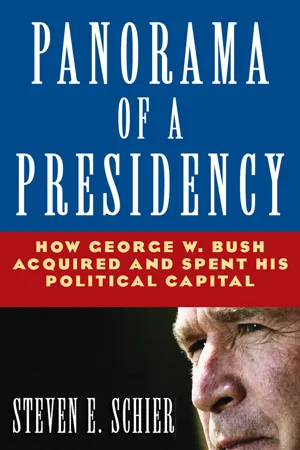
Panorama of a Presidency
How George W. Bush Acquired and Spent His Political Capital
- 208 pages
- English
- ePUB (mobile friendly)
- Available on iOS & Android
eBook - ePub
About this book
As the controversial presidency of George W. Bush draws to a close, this work provides the first dispassionate, even-handed assessment of Bush's years in office. Widely respected scholar and author Steven E. Schier goes beyond the perspective of contemporary political commentary, and draws on wide-ranging literature about presidential history and strategy to carefully identify both the unique and the familiar aspects of George W. Bush's presidency. "Panorama of a Presidency" examines Bush's innovative electoral and governing strategies, ambitious foreign and domestic policy initiatives, and the bitterly divisive consequences of his mode of governance. As the first analysis to place the George W. Bush presidency in a broad historical and theoretical context, the book will be an essential foundation for any future studies on the topic.
Information
| 1 | THE PRESIDENCY |
George W. Bush’s conduct of the presidency has spawned strong affirmative and negative evaluations. Discussion of this presidency in print and blogs touts him as a visionary president or denounces him as deserving of impeachment. The truth probably lies at a distance from either of these evaluative poles. What concepts help us understand this presidency? A consideration of four dimensions may help in appraising Bush’s terms of office—his authority, power, skills, and the events occurring during his presidency. Does Bush’s tenure fit a given “type” of presidency similar to those of some of his predecessors? Bush can be “typed” in terms of four aspects of increasingly narrower scope—the historical and institutional context of his presidency, Bush’s response to the institutional challenges he confronted, his governing style in addressing institutional challenges, and Bush’s presidential personality. Examining the dimensions of presidential authority, power, skills, and events will help us illuminate George W. Bush’s presidential “type.” We begin with the dimensions of broadest scope, those of presidential power and authority.
Power, Authority, and Regime Construction
The Bush presidency operated within the broad framework of American institutional development. A study of this development understands the political order as “the formative constructions of politicians in power” (Orren and Skowronek 2004, 92). At any given point in time, the decisions of power holders alter the course of institutional behavior and political alignments: “Political order is circumstantial, something that officials within government institutions will create or not, sustain or not, depending on their own interests, on the available resources and on the obstacles to change” (2004, 92). As political leaders create political order, they produce “constructions of broad consequence” to the political system (2004, 9). American presidents have great potential to maintain or disrupt the national political order. The grand ambitions motivating the George W. Bush presidency—creating a GOP electoral majority, pursuing a more militarily assertive foreign policy, and reconfiguring taxation and entitlement spending—aimed to create constructions of extensive consequence.
These big plans are best understood in terms of the power and authority a president seeks to exercise. Power involves the resources, formal or informal, that a president has in a given period to accomplish his goals. Success with power involves husbanding the resources of the office and deploying them strategically (Skowronek 1997, 18). Powers are both formal and informal. Formal powers are numerous and widely exercised by recent presidents, growing from constitutional authority, federal law, and court interpretation. They include the executive powers of appointment, budget preparation, and issuance of executive orders; legislative powers of the veto, pocket veto, and delivery of the annual State of the Union address; and judicial powers of appointment and pardons. The president’s foreign affairs powers are vast, including duties as chief diplomat, negotiator of treaties and executive agreements, appointer of military and diplomatic officials, and commander-in-chief of the armed forces. The modern presidency, originating under Franklin Roosevelt in the 1930s and 1940s, has grown considerably in budget, staff, and formal powers.
Presidential powers are subject to variable application, and one source of this variance is the theory of executive power that a particular president adopts. Raymond Tatalovich and Thomas Engeman identified several approaches to the exercise of presidential power (Tatalovich and Engeman 2003). Early presidents often followed the Jeffersonian conception of the presidency, holding that presidents had no powers beyond those explicitly granted in Article II of the Constitution; no “implied” powers existed (2003, 33). Alexander Hamilton, in contrast, argued that the general grants of power to the president in Article II must include implied powers “because it is impossible to foresee or define the extent and variety of national exigencies, of the correspondent extent and variety of the means which may be necessary to satisfy them.” (Hamilton, Jay, and Madison 1961, 147). At the furthest extreme from Jefferson lay the expansive theory of “prerogative power,” first enunciated by political philosopher John Locke. Locke claimed that in emergencies, the prerogatives of office permit the executive to “act according to discretion for the public good, without prescription of law, and sometimes even against it” (Locke 1965, 422). The constitutional dangers of such an approach are conspicuous and no president has formally adopted it in practice. Twentieth century presidents frequently followed the “stewardship” theory of the presidency, first enthusiastically espoused and practiced by Theodore Roosevelt: “My belief was that it was not only his right but his duty to do anything that the needs of the nation demanded unless such action was forbidden by the Constitution or the laws” (Roosevelt 1925, 357). George W. Bush consistently adopted the “stewardship” theory of presidential power, resulting in charges from critics that he had exercised power beyond the Constitution in a Lockean “prerogative” fashion.
In addition to formal powers, a president’s informal power is situation-ally derived and highly variable. Informal power is a function of the “political capital” presidents amass and deplete as they operate in office. Paul Light defines several components of political capital: party support of the president in Congress, public approval of the president’s conduct of his job, the President’s electoral margin and patronage appointments (Light 1983, 15). Richard Neustadt’s concept of a president’s “professional reputation” also figures into his political capital. Neustadt defines this as the “impressions in the Washington community about the skill and will with which he puts [his formal powers] to use” (Neustadt 1990, 185). In the wake of 9/11, George W. Bush’s political capital surged, and the public, the Washington political elites, and Congress granted him a broad power to prosecute a war on terror. By the later stages of Bush’s troubled second term, beset by a lengthy and unpopular occupation of Iraq and an aggressive Democratic Congress, he found that his political capital had eroded. His informal powers proved variable, not stable, as is invariably the case for presidents.
Presidents usually employ power to disrupt the political order they inherit so as to reshape it according to their own agendas. Stephen Skowronek argues that “presidents disrupt systems, reshape political landscapes, and pass to successors leadership challenges that are different from the ones just faced” (Skowronek 1997, 6). Given their limited time in office and the often hostile political alignments present in Washington policymaking networks and among the electorate, presidents must force political change if they are to enact their agendas. In recent decades Washington power structures have become more entrenched and elaborate (Drucker 1995) while presidential powers—through increased use of executive orders and legislative delegation (Howell 2003)—have also grown. The presidency has more powers in the early twenty-first century than in former years, but also faces more entrenched coalitions of interests, lawmakers, and bureaucrats whose agendas often differ from that of the president. This is an invitation for an energetic president—and that description fits George W. Bush—to engage in major ongoing battles to impose his preferences.
At the center of the conflict lies the desire of presidents to create political “regimes” supported by popular approval and constitutional understandings (Schier 2004, 3). A regime is a stable authority structure that reworks Washington power arrangements to facilitate its own dominance. Presidential power is intimately tied to presidential authority, defined as the “expectations that surround the exercise of power at a given moment; the perception of what it is appropriate for a given president to do” (Skowronek 1997, 18). Authority, to Skowronek, rests on the “warrants” drawn from the politics of the moment to justify action and secure the legitimacy of changes. The more stable a president’s grant of authority, the easier his exercise of power. If a president claims more authority than he actually possesses, however, he invites challenges from rivals that can reduce his authority and power. During Bush’s final years in office, Democrats energetically disputed his assertions of authority regarding Iraq war policy and his executive privilege power to shield aides from testifying before Congress.
Two of the consequential presidents in American history—Lincoln and Franklin Roosevelt—received large grants of authority from the dominant political regimes that they created in national government. A successful political regime can order events according to its own schedule, displacing the ability of permanent Washington to order events through its residues of power. It is a battle between presidential authority and other long-standing power centers in Washington. The ideal authority situation for any president is the entrenched dominance of a political regime in national politics and institutions with which he is affiliated. Dominant regimes in American history have invariably been partisan regimes.
George W. Bush’s central project was the promotion of a conservative Republican(GOP) political regime. This seems a grandiose ambition and it is undoubtedly a big goal, best understood in terms of the following definition by Robert C. Lieberman:
Regimes appear at a variety of levels, from formal institutions (such as the structure of Congress and the administrative state) to the social bases of politics (such as party alignments and coalitions and patterns of interest representation); from ideas (such as prevailing beliefs about the proper role of government) to informal norms (such as patterns of congressional behavior). Nested within these broadly defined institutional arrangements are commitments to particular policies that become the touchstone for political action and conflict for leaders and would-be leaders over the course of a generation or more. (Lieberman 2000, 275)
George W. Bush pursued “regime change” in all of these aspects. Politically, the administration sought persistent GOP electoral majorities through the tactic of ensuring high turnout among the party’s base voters. This delivered a reelection victory for Bush in 2004. The 2006 election highlighted the shortcomings of this strategy, however, as many political independents deserted the GOP and facilitated a Democratic takeover of Congress. A second tactic of the Bush White House involved courting certain target groups in the electorate for conversion—in 2004, this included women, Latinos, African Americans, and Jews. The increased support from these groups in 2002 and 2004 melted away in 2006. Central ideas of the regime included an emphasis upon employing market forces in public policy (from market-driven environmental protection policies to private Social Security accounts), economic stimulus through recurrent tax cuts, and an aggressive foreign and military policy driven by a doctrine of preemption to forestall international terrorist threats. Institutionally, these policies would be facilitated by partisan GOP majorities in the House and Senate, and enhanced presidential control over the executive branch through expansive use of executive orders and reorganization, many spawned by national security concerns (Schier 2004, 3–4). The arrival of a Democratic Congress in 2007 greatly curtailed these policy and institutional activities of the administration’s regime builders.
Could this broad regime initiative prevail? That turned on the magnitude of the impediments Bush faced with his project. Skowronek labels Bush an “orthodox innovator” who sought to finish the incomplete regime construction begun by Ronald Reagan in the 1980s. To Skowronek, Reagan’s attempts to shape a regime “fell far short of the mark in revitalizing national government around his new priorities and opening a more productive course for development” (1997, 428). This was because of the “institutional thickening” that recent presidents have supposedly confronted, defined as “a pattern of greater institutional resilience in the face of these presidents’ order-shattering authority, of an ever-thicker government that can parry and defect more of their repudiative thrust” (1997, 413). The permanent Washington of lawmakers, bureaucrats, judges, and interest groups was able to make Reagan’s attempted conservative regime change more rhetorical than real. Further, as a “highly personalized candidate-centered politics” developed in the late twentieth century, the ability to maintain a dominant partisan electoral coalition also waned (Skowronek 2001, 15).
How successful was Reagan’s regime building project? Answering this illuminates the results of George W. Bush’s regime change efforts. At the mass level of partisan alignments, Reagan did not induce lasting GOP dominance, but Republican electoral successes beginning in 1994 did result from campaigns based on the Reagan agenda of strong defense, tax cuts, and governmental limitation. Reagan began, but did not complete, a conservative electoral transformation. He did alter defense policy and foreign policy greatly during his term. Though Democrat Bill Clinton pursued an alternative foreign policy approach in the 1990s, George W. Bush has adopted a national security approach based on heavy defense spending very much in the Reagan mold. Domestically, Bush has followed Reagan in cutting taxes, permitting large budget deficits and seeking Social Security reform. Both Reagan and Bush appointed conservative federal judges and Supreme Court justices in an attempt to broaden the institutional reach of a right-leaning regime. The policy continuities do reveal an underlying “orthodoxy” guiding the two presidencies. But did Reagan fall “far short” of regime construction, as Skowronek asserts, and were Bush’s prospects limited as well?
Some evidence suggests that Skowronek overstated the institutional resistance that recent presidents have faced. A recent study by Daniel M. Cook and Andrew J. Polsky revealed aggressive and successful efforts by the Reagan administration to transform education and environmental policy, two areas accorded a relatively low priority by the White House. “We find that the Reagan administration made surgical use of the tools under its control to disrupt key targets in the old order and empower policy seekers within the Republican coalition … The record compiled under the Reagan administration contravenes the claim that contemporary American political institutions have so thickened as to be impervious to reconstructive episodes” (Cook and Polsky 2005, 600). These tools included budget control, personnel appointments, and reorganization through executive orders. Reagan’s accomplishments, both within education and environmental policy and overall, suggest considerable progress toward constructing a conservative GOP regime, though not complete attainment of that goal.
Presidential regime construction becomes impossible only if institutional resistance to presidential initiatives grows as presidential powers do not. A major strategy of the George W. Bush presidency was the expansion of the formal presidential prerogatives regarding confidentiality and executive power. This approach was one of the pillars of the administration’s regime construction efforts. The Bush administration made progress in creating a conservative political regime because the Reagan administration did not fall so “far short” in their regime construction endeavors that the project could not be resuscitated by a successor some twelve years later. Journalists by 2004 had identified several elements of a reigning conservative GOP regi...
Table of contents
- Cover
- Half Title
- Title Page
- Copyright Page
- Dedication
- Table of Contents
- Preface
- 1. The Presidency
- 2. Public Politics
- 3. Washington Governance
- 4. Domestic Policy
- 5. Foreign Policy
- 6. Legacies
- Appendix
- Bibliography
- Index
- About the Author
Trusted by 375,005 students
Access to over 1.5 million titles for a fair monthly price.
Study more efficiently using our study tools.
Frequently asked questions
Yes, you can cancel anytime from the Subscription tab in your account settings on the Perlego website. Your subscription will stay active until the end of your current billing period. Learn how to cancel your subscription
No, books cannot be downloaded as external files, such as PDFs, for use outside of Perlego. However, you can download books within the Perlego app for offline reading on mobile or tablet. Learn how to download books offline
Perlego offers two plans: Essential and Complete
- Essential is ideal for learners and professionals who enjoy exploring a wide range of subjects. Access the Essential Library with 800,000+ trusted titles and best-sellers across business, personal growth, and the humanities. Includes unlimited reading time and Standard Read Aloud voice.
- Complete: Perfect for advanced learners and researchers needing full, unrestricted access. Unlock 1.5M+ books across hundreds of subjects, including academic and specialized titles. The Complete Plan also includes advanced features like Premium Read Aloud and Research Assistant.
We are an online textbook subscription service, where you can get access to an entire online library for less than the price of a single book per month. With over 1.5 million books across 990+ topics, we’ve got you covered! Learn about our mission
Look out for the read-aloud symbol on your next book to see if you can listen to it. The read-aloud tool reads text aloud for you, highlighting the text as it is being read. You can pause it, speed it up and slow it down. Learn more about Read Aloud
Yes! You can use the Perlego app on both iOS and Android devices to read anytime, anywhere — even offline. Perfect for commutes or when you’re on the go.
Please note we cannot support devices running on iOS 13 and Android 7 or earlier. Learn more about using the app
Please note we cannot support devices running on iOS 13 and Android 7 or earlier. Learn more about using the app
Yes, you can access Panorama of a Presidency by Steven E Schier in PDF and/or ePUB format, as well as other popular books in Politics & International Relations & Labour Economics. We have over 1.5 million books available in our catalogue for you to explore.