![]()
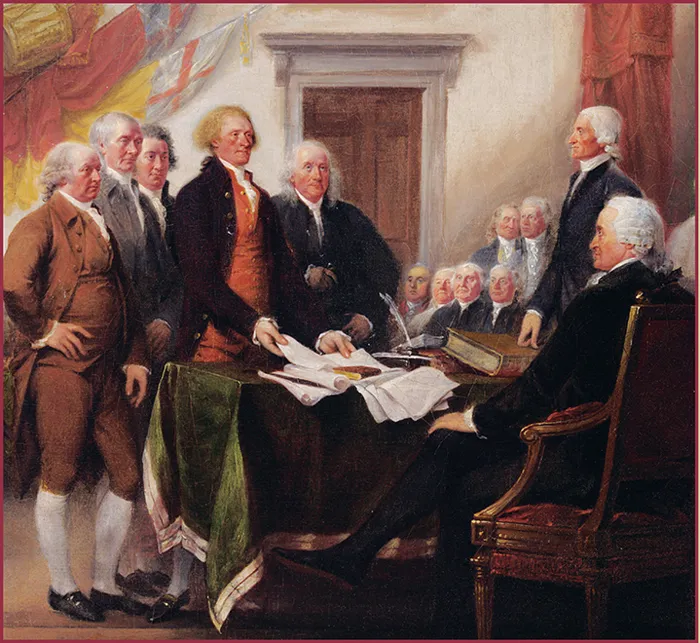
Detail from The Declaration of Independence, July 4, 1776. John Trumbull, 1819
The committee assigned to draft the Declaration of Independence in 1776 presents the document to John Hancock, president of the Continental Congress in Philadelphia. Shown in this detail from Trumbull’s historical painting are (left to right) John Adams, Roger Sherman, Robert R. Livingston, Thomas Jefferson, and Benjamin Franklin.
CHAPTER ONE
A Natural Genius for Art
[My] taste for drawing began to dawn early [and] for several years [the] floors were constantly scrawled with my rude attempts.
—John Trumbull
Nineteen-year-old Charlie Loring Elliott was full of hope when he visited the New York City studio of America’s most famous artist in 1830. Elliott had come from western New York State to ask Colonel John Trumbull to accept him as a pupil in portrait painting.
Colonel Trumbull was a handsome, dignified gentleman in his seventies. He was a former officer in the Revolutionary War with fine manners and an old-fashioned formality. The Colonel, as he was known, had painted a number of the nation’s most famous pictures. These were scenes from the American Revolution of more than forty-five years before.
Four of those paintings hung in the Capitol in Washington, D.C. The Colonel’s works told the story of the founding of the United States. Shown in his pictures were individuals he had personally known, although by 1830 most of them had passed away and were only names in history books. They included John Adams, Thomas Jefferson, James Monroe, the Marquis de Lafayette, and General George Washington himself.
The son of a wealthy colonial governor, John Trumbull had been brought up like an aristocrat and had once associated with European royalty. By the 1830s, however, his world had changed, as had popular taste in the arts. The elderly Colonel was considered out of touch with current American art and artists. Still, he was much admired for all he had done in his life.
Trumbull looked over Elliott’s drawings and his two oil paintings. Elliott knew young artists seldom received encouragement from Colonel Trumbull, who was president of the American Academy of Fine Arts. As he studied the pictures, the Colonel was most interested in designs for buildings Elliott had done for his father’s architectural firm at home.
At last, Trumbull spoke. He strongly advised Elliott to give up painting and continue with architecture. Elliott was disappointed to hear Trumbull declare that being an artist was too uncertain a profession. The Colonel said it was difficult even for him to earn a living, despite his fifty-year career. “I have, it is true, received some commissions from Congress for national pictures,” he continued, “but this was only a piece of good luck.”
Although he had been successful in America and Europe, Trumbull was unable to sell much work in his later years. There was little public interest in his paintings anymore. “I am now an old man, and time and disappointment have chilled my ambition,” he said sadly, as he gestured to the paintings on his walls. “Now, I must see if I have friends enough in the world to give these pictures to.”
Elliott was not willing to admit defeat. Trumbull tried to change Elliott’s mind, especially because the young man’s architectural designs were so well done, but Elliott respectfully insisted that he did not want to be an architect. He said he was “fully determined, and have been ever since [I] was ten years old, to be a painter, and live or die by that business.”
Perhaps the Colonel then remembered his own youthful determination to take his chances as an artist. Trumbull’s parents also had objected at first. Finally, Elliott won him over, and Trumbull accepted him as a pupil.
After months of study, Elliott had made good progress. Still, the Colonel thought he should be an architect, and for very practical reasons: For one thing, Elliott was a superior architectural draftsman, a skill needed in a growing country.
In time, Elliott went to study with another artist who was more encouraging. Finally, unable to make a living, he could no longer remain in New York. Taking Colonel Trumbull’s advice, he returned home to resume architectural design. Yet Elliott continued to paint, and his work began to attract patrons. His hope renewed, the aspiring artist went back to New York City, but he did not immediately visit Trumbull.
One day, the Colonel was strolling past a shop window and stopped to admire two paintings on exhibit. One was of a mounted soldier, and the other was an interior scene from an old New York household.
“Who painted these pictures?” he asked the shopkeeper.
“Elliott, Colonel Trumbull.”
“Where is his room?”
Trumbull hurried there and knocked on the door. Removing his hat and entering, he bowed “with all the stateliness of the last century,” Elliott remembered.
“You can go on painting, Sir,” Trumbull said. “You need not follow architecture.” With that, he bowed once more, saying, “I wish you good day, Sir,” and left.
Elliott never saw him again, but that simple, direct assurance from the respected Colonel Trumbull meant the world to him.
In the following years, Elliott became New York’s leading portrait painter. His clients were among the wealthiest and most successful people in the United States. Elliott remained a lifelong admirer of Trumbull, who finally did find the right home for his many paintings.
Remembering Trumbull some years after his death, Elliott told a journalist, “I owe much to the good old man, and I shall always be proud to say so.”
All America eventually came to admire the works of Colonel John Trumbull, whose paintings show the founders of the United States in their finest hour.
A Connecticut Aristocrat
John Trumbull lived from 1756 to 1843. His lifetime of eighty-seven years began in colonial times and ended in the fast-growing young United States of America.
Trumbull was born into a merchant family in Lebanon, Connecticut. The Trumbulls bought and sold goods such as tea and rum. During the British colonial period, they often were called on to play a role as leaders in Connecticut and New England. In 1769, Trumbull’s father, Jonathan, was named governor of Connecticut by King George III, ruler of the British Empire.
Great Britain was one of the world’s most powerful nations, with possessions all around the globe. The empire’s American colonies were among its richest—and also its most troublesome. When John Trumbull was a boy, many Americans wanted freedom from British colonial rule.
Jack, as they called him then, was the youngest of six children. Like most New Englanders, his family valued education. They enrolled their son in a private school just “three minutes’ walk across a beautiful green,” Trumbull later recalled in a memoir. It was, he said, the “best school in New England.” Students came from all over the colonies to study with headmaster Nathan Tisdale, the instructor there for thirty years.
Young Jack was a brilliant student, who showed a special talent for languages. As he remembered, “I could read Greek at six years old.” He taught himself French by making friends with a French Canadian family that had moved into the community.
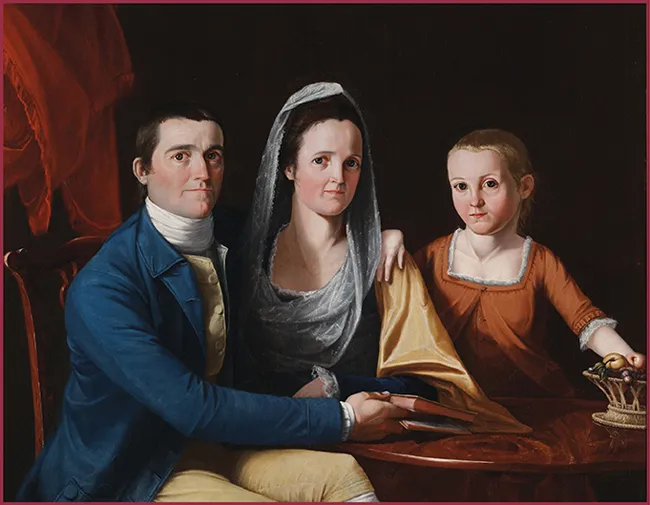
Jonathan Trumbull, Jr. with Mrs. Trumbull (Eunice Backus) and Faith Trumbull. John Trumbull, 1777
As a young artist, Trumbull often painted close members of his family, as in this 1777 canvas portraying his brother Jonathan with his wife and daughter. A basket of fruit, traditionally symbolizing fertility, was often included in New England paintings of women.
Yet drawing was what he loved best: “[A]fter school hours [I] frequently withdrew to my own room for a close study of my favorite pursuit.” He said, “[My] taste for drawing began to dawn early [and] for several years [the] floors were constantly scrawled with my rude attempts.” Although a fall down stairs caused him to lose the sight in his left eye, John became skilled at sketching pictures.
Choosing a Career
By the time he was fifteen, John’s education at Tisdale’s was complete. His father wanted him to enter Harvard College in Cambridge (near Boston) and become a minister or lawyer—the most highly respected careers in New England. Instead, his son asked to study art with Boston painter John Singleton Copley. John Trumbull admired Copley, whose work had thrilled him. Governor Trumbull agreed that his son had a “natural genius” for “limning,” as painting was called, but the governor thought art was useless as a career.
John protested, saying that even after “the expense of a college education… I should still have to study some profession.” He argued that if he studied art with Copley, he would possess a profession and the means of supporting himself. The governor firmly refused. John would attend Harvard.
Trumbull passed the entry exams with flying colors. He skipped the first two years and immediately joined the junior class. He was one of the youngest, and brightest, students in his ...