- 432 pages
- English
- ePUB (mobile friendly)
- Available on iOS & Android
eBook - ePub
About this book
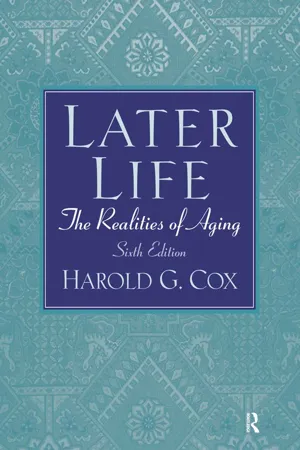
An interdisciplinary introduction to the aging process which uses symbolic interactionism as the main theoretical perspective. Accessible, interdisciplinary coverage with chapters covering a variety of subject matter areas from biology to psychology, from economics to sociology, from political science to religion. Utilizes symbolic interaction perspective to explain behavior problems and an individual's adaptations associated with the process of aging.
Trusted by 375,005 students
Access to over 1.5 million titles for a fair monthly price.
Study more efficiently using our study tools.
Information
Subtopic
Developmental PsychologyIndex
Social SciencesCHAPTER | 1 |
Emergence and Scope
of Gerontology
The year grows rich as it groweth old, and life’s latest sands are its sands of gold!
Julia C. R. Dorr
To the “Bouquet Club”
To the “Bouquet Club”
THE ADVENT OF GERONTOLOGY
Throughout the history of the human species, men and women have clung to life and used every means available to live as long as possible. A theme running through historical records in different time periods and different cultures has been the search for a way to reverse the aging process. The search for an elixir or fountain of youth was almost universal. Leonard Breen (1970) observed that “Special foods to be eaten, special relationships to be cultivated, surgery which might be undertaken, special waters or other liquids to be ingested all were thought to be solutions by some.”1 It was not until the twentieth century, however, that the understanding and study of the aging process left the area of witchcraft and folklore and became a legitimate subject of a number of different scientific disciplines.
Moreover, during the past 40 years, aging and the field of gerontology have become the focus of extensive concern, discussion, editorializing, and political action. Aging has arrived as an issue and object of study; people are examining what it means to be old in America.
What accounts for this burst of interest? A number of factors might explain it—factors stemming both from individual experience and from the experience of society as a whole. The increasing number of people and the percentage of our population living to age 65 and beyond have made the problems of aging more widespread, more visible, and ultimately more widely known. And because of this increased longevity, almost all of us at one time or another have had the experience of helping an aging relative adjust and survive under changing life circumstances.
When only a small proportion of older people experience poverty, illness, or social isolation, we may not be aware of their problems. But as the number of older people living under these conditions grows, a challenge is directly posed to our social service systems and the problem “takes off.” It becomes acute enough to be discussed and debated by politicians, the media, and other concerned individuals and groups. One definite effect emerges: a growing consciousness of—and sensitivity to—the problems of older people.
As the number of older persons has grown and public awareness of problems of the aged has increased, government delivery systems for older Americans have developed, providing services such as food, employment, information, homemaking, and counseling. New paraprofessional and professional occupations deal with the problems of older people, and political action and legislation have been initiated on their behalf. Significantly, the academic community has recognized aging as a legitimate area of study.
Before this surge of interest, physicians, health practitioners, and behavioral scientists often avoided the study of aging. Perhaps concern with the illnesses and problems of younger persons seemed more directly related to a humane cause: Young people have all their lives before them, and those who help them may justifiably feel that they are contributing to the future of society.
Older people, on the other hand, have most of their mortal lives behind them. Their medical, psychiatric, and social problems are often more difficult to deal with because they are frequently complex and interrelated. Whereas the communicable diseases of the young can often be entirely cured, many of the chronic medical problems of later life cannot. At best, the illnesses of the aged can be controlled, so that a bad situation will not get worse; at worst, illnesses may resist treatment, resulting in disability and death. It is easy to understand why doctors would find more satisfaction in curing a disease than in stopping it from accelerating. But whatever the reason, in the past, older people have not received as much attention as younger people from health care and other professions.
In much the same way, psychology, sociology, and social work have not devoted as much research and attention to the problems of older persons as they have to those of younger people. Since scientists are subject to the same latent fears about aging and death that trouble the general population, they frequently find the study of aging uncongenial, if not actually depressing. Paying attention to aging processes reminds researchers that someday they too will grow old and die. As a result, the subject of aging has not received the attention it demands from scientists.
This neglect of the problems of aging appears to be over. Aging has become a legitimate subject of study, and the relevant professions as well as the public are becoming increasingly sensitive to its issues and problems. Individually, there are both personal and objective reasons for looking carefully at the later part of the life cycle. First, because all of us hope to live long lives, the better we understand this phase of the life cycle the better we can anticipate our future lives and the experiences we will confront at that time. Whereas courses in child development may help us understand our children, courses in gerontology should help us understand our future selves. Second, even if we are not interested in our current and future selves, understanding the life course, including both the problems and the potentials of later life, should prove invaluable as we attempt to understand and share the lives of our older relatives and friends. Finally, anyone who is sensitive and alert to the surrounding world cannot help but be intrigued by the explosion of scientific research and information that is both prolonging life and improving the quality of the lives of older persons. From organ transplants to senior services, from hospice programs to the debate over euthanasia, from exercise programs to living wills, the field of gerontology appears to be at the forefront of a proliferation of new knowledge and understanding of the human condition.
The remainder of this chapter will provide you with an overview of the demographic trends that reveal the dramatic rise in the number of persons age 65 and older in the population.
DEMOGRAPHIC TRENDS
In 1900 there were 3.1 million Americans age 65 or older, constituting 4 percent of the population (1 in 25). In 1970, 20 million Americans were 65 or older—approximately 10 percent of the population (1 in 10). In 1980 there were 25.5 million Americans 65 or older, approximately 11 percent of the population (1 in 9). In 1990 there were 31.1 million persons 65 or older, comprising 12.5 percent of the population (1 in 8). In 2000 there were nearly 35 million Americans 65 or older, comprising 12.4 percent of the population (1 in 8). While the older population grew by 4 million between 1990 and 2000, the total population grew at approximately the same rate and, as a result, the percentage of the total population age 65 plus did not increase between 1990 and 2000. The baby boomers (those born between 1946 and 1964 when there was a very high crude birth rate) will begin retiring in 2010. This is projected to cause a dramatic increase in the older population. By 2020, the 65 plus population is projected to be 16.5 percent of the total population (1 in 6). By 2040 the 65 plus population is projected to be 20.5 percent of the total population (1 in 5) (see Table 1–1).2
These figures are based on the current birthrate. Should the birthrate suddenly rise, the percentage of the total population over age 65 would drop slightly. The long-range trend in the birthrate has been downward, however, and no one is predicting any dramatic reversals in the next 30 years. Any further drop in the birthrate would make the 65-and-older group an even larger percentage of the population.
The population of the 65 plus age group has grown by 3 to 4 million per decade since 1940. Growth during the 1970s exceeded earlier projections, climbing at an annual increment of 460,000. Every day approximately 5,000 persons reach their sixty-fifth birthday. Every day 3,600 persons in the same age group die. This means an increase of 1,400 persons in the 65 plus group each day. Figure 1–1 reveals how much more rapidly this age group has grown compared to the total population from 1900 to 1975. Moreover, census bureau projections indicate that the 65 plus group will be the fastest-growing segment of the population until 2040 when the last of the baby boomers reach retirement age (see Figure 1–1).
Not only are more people living to 65, but once they reach that age they live longer. Thirty-nine percent of the 65 plus age group were persons 75 and older in 1900 compared with 48 percent of this age group who were 75 and older in 2000. Similarly, 5 percent of the 65 plus age group were 85 and older in 1900 compared to 12 percent of this age group who were 85 and older in 2000. Moreover, the 85 plus group is projected to grow more rapidly than the 65 plus group until about 2010 when cohorts born in the baby-boom generation begin to retire (see F...
Table of contents
- Cover
- Title Page
- Copyright Page
- Table of Contents
- Preface
- Part I: Introduction
- PART II: The Individual and the Social System
- Part III: Adjustment Patterns and Changing Lifestyles in Old Age
- Part IV: Societal Issues Confronting Older Americans
- Index
Frequently asked questions
Yes, you can cancel anytime from the Subscription tab in your account settings on the Perlego website. Your subscription will stay active until the end of your current billing period. Learn how to cancel your subscription
No, books cannot be downloaded as external files, such as PDFs, for use outside of Perlego. However, you can download books within the Perlego app for offline reading on mobile or tablet. Learn how to download books offline
Perlego offers two plans: Essential and Complete
- Essential is ideal for learners and professionals who enjoy exploring a wide range of subjects. Access the Essential Library with 800,000+ trusted titles and best-sellers across business, personal growth, and the humanities. Includes unlimited reading time and Standard Read Aloud voice.
- Complete: Perfect for advanced learners and researchers needing full, unrestricted access. Unlock 1.5M+ books across hundreds of subjects, including academic and specialized titles. The Complete Plan also includes advanced features like Premium Read Aloud and Research Assistant.
We are an online textbook subscription service, where you can get access to an entire online library for less than the price of a single book per month. With over 1.5 million books across 990+ topics, we’ve got you covered! Learn about our mission
Look out for the read-aloud symbol on your next book to see if you can listen to it. The read-aloud tool reads text aloud for you, highlighting the text as it is being read. You can pause it, speed it up and slow it down. Learn more about Read Aloud
Yes! You can use the Perlego app on both iOS and Android devices to read anytime, anywhere — even offline. Perfect for commutes or when you’re on the go.
Please note we cannot support devices running on iOS 13 and Android 7 or earlier. Learn more about using the app
Please note we cannot support devices running on iOS 13 and Android 7 or earlier. Learn more about using the app
Yes, you can access Later Life by Harold Cox in PDF and/or ePUB format, as well as other popular books in Social Sciences & Developmental Psychology. We have over 1.5 million books available in our catalogue for you to explore.