
eBook - ePub
Paying for Performance: An International Comparison
An International Comparison
- 314 pages
- English
- ePUB (mobile friendly)
- Available on iOS & Android
eBook - ePub
Paying for Performance: An International Comparison
An International Comparison
About this book
Although performance pay is used in many industrialized nations, the structure and success of this pay system vary widely depending on the institutions, regulatory framework, and legal settings of each country. This book makes the details and effects of these local variations clear for the first time. World-renowned experts on the programs in their respective countries provide in-depth analyses of performance pay in the United States, Canada, France, the United Kingdom, Germany, Australia, Japan, and Brazil. They draw out common themes across the countries, as well as country-specific determinants of the use of performance pay and its level of success.
Chapter 1
Paying for Performance
Setting the Stage
Michelle Brown and John S. Heywood
Introduction
Performance pay has emerged from the curtains to take center stage in academic debates, in firm strategy, and in government policies. Previously the narrow province of specialists in compensation, it now comprises an intellectual building block for a new generation of labor economists under the heading “the economics of personnel.” It concerns macroeconomists studying unemployment and the flexibility of earnings across the business cycle. Strategic specialists identify it as a critical dimension of productivity enhancing best practices, and human resource management scholars debate its fairness and influences on employee cooperation and on morale. Industrial relations experts discuss its influence on the institutions of unionization and its role in collective bargaining. Those concerned with worker participation study the complex relationship between performance pay and worker decision making. Governments promote the practice of performance pay, particularly for their own employees; and consultants sell its virtues.
The current importance attached to pay systems in each of these disciplines derives from the role they are seen to play in affecting employee and, subsequently, organizational performance. This importance in turn derives from the increasing cost and competitive pressures facing both public and private sector organizations. The amount of monies paid to employees can represent a significant proportion of the overall costs of the organization. Further, the amount of employee work effort purchased by the organization is not fixed, so organizations have an incentive to establish mechanisms that encourage employees to work in the best interests of the organization (Braverman 1974; Pencavel 1977). Most employees derive an income through the sale of their labor. This income determines the overall standard of living of the employee. Therefore, pay is central to the employment relationship, making it a potentially powerful tool in the employment relationship, particularly in the context of organizations seeking to maximize their efficiency and productivity.
Most of this study and debate remains either theoretical, divorced from actual labor market institutions, or specific to the labor market institutions of a single country. This volume presents another voice. We take for granted that the comparative labor market institutions of nations provide important constraints and incentives influencing the adoption, variety, and success of performance pay. Methods of pay successful in an otherwise equal firm in one country may fail in another country. Indeed, studying performance pay in a comparative context means that not only are the respective institutions illuminated but the accepted general wisdom of one country is revealed to be unworkable in the next.
A fundamental notion in both economics and management holds that capital and technology are highly mobile and accessible. Success is thus driven by those factors unique to an enterprise: the best location, the greatest knowledge, and the most productive workers (Wright, McMahan, and McWilliams 1994). Performance pay has elements in common both with these unique factors and with the more accessible factors. While it is an easy theoretical prospect to take a method of pay across a national border, the practical challenge can be enormous. Profit sharing is mandated in France, viewed with skepticism or as irrelevant in Germany, usually deferred in the United States, and rarely deferred in Japan. The institutions of these countries set the stage and limit the prospects for what firms can achieve from managerial strategies involving performance pay. To ignore the institutions or take a single set of institutions for granted leaves undiscovered the critical link between the variation in institutions, the resulting range of performance pay schemes and the influence on success of otherwise equal enterprises in different countries. Ultimately, ignoring that link leaves the value of respective institutions less examined, more likely to be taken for granted and thus less mutable.
The Renewed Promise of Performance Pay
Long a major weapon in the arsenal of scientific management, performance pay received far less emphasis during the third quarter of the last century.
Articles in the United States trumpeted the “domination of time rates,” unions fought for solidarity wages, Japanese firms provided “seniority wages,” and the centralized wage systems of continental Europe and Australia created remarkable uniformity in earnings. Yet, the institutions that limited performance pay came under increasing pressure in the last two decades of the century. International competition, privatization, a protracted recession in Japan, and an emerging single market in Europe all helped provide the pressure. Private sector unionization in the United States dropped into single digits, the Australian awards system was “deregulated”; and European governments and scholars became highly concerned with labor market flexibility, a siren sound heard even by Japanese managers. In this environment, interest in performance pay grew, as both firms and governments became more concerned with labor productivity and the ability to respond to changing external pressures. The expectation was that an appropriate compensation system that linked worker and firm objectives could be part of managing a workforce to create a competitive advantage or productive edge.
This interest infused the employment relations of governments themselves. The United Kingdom and Australia both implemented merit pay schemes for large shares of their central government activities (O’Donnell 1998; Marsden and French 1998). In the United States, much of the innovation in performance pay was done by states and localities.
The experience in local public education in the United States is illustrative. It shows not only the range of potential performance pay schemes but also the instability of such schemes, a more general theme returned to in the country chapters. The state of Tennessee developed a sophisticated statistical model identifying the effect of specific teachers on the increase in test scores of primary and secondary school students (Wright, Horn, and Sanders 1997). This effort was seen as a prerequisite for explicitly tying teacher earnings to student scores. Actual implementation of performance pay in U.S. schools typically relies on other measures of productivity. Eberts, Hollenberg, and Stone (2000) compare two similar secondary schools in the same Michigan jurisdiction, one of which explicitly rewards teachers for high student evaluations and for retention, and the other of which retains a traditional pay structure without merit pay. They found the first school successfully increased its retention rate (share of a teacher’s students who stayed until the end of the course) relative to the second. They also found that the merit pay resulted in a larger rate of course failure, lower average attendance, and no increase in achievement. While the objective measure of performance increased, the ultimate success of the school did not. Indeed, Hatry, Greiner, and Ashford (1994) find that over 75 percent of all merit plans started in U.S. schools fail and are no longer in operation within a decade.
Yet schools, and government operations more generally, suffer from many of the difficulties long identified with traditional merit pay schemes. There exist multiple stakeholders, many and conflicting goals, interdependent team production, and uncertain inputs to name just a few. While these difficulties exist in the private sector as well, they may be less severe in some cases and the range of performance pay options appears higher.
Thus, the current concern about aligning the interests of workers with firms frequently focuses on a combination of financial and decision-making participation. Yet the details of how this happens depends on the labor market institutions, and it is these details that help determine success. Thus, France has mandated profit sharing largely independently of other forms of worker participation. Germany has mandated decision-making participation, but unions are skeptical of profit sharing. Japan has large degrees of both financial and decision-making participation, but both remain within the context of individual firms and company unions. U.S. firms without unions may have greater freedom to institute profit sharing than their union counterparts, but may face legal constraints on the creation of other forms of worker participation and the integration of these with profit sharing.1 Brazil provided for profit sharing in its 1946 Constitution but took till 1995 to establish the facilitating mechanisms, including mandating it as a subject of collective bargaining, to make it legally available to organizations. Clearly, the model for transforming workplaces and the role performance pay plays must necessarily differ by country.
A Taxonomy of Performance Pay
Performance pay can be seen as a generic term that covers any system that seeks to link pay to some measure of individual, group or organizational level performance (Milkovich and Widgor 1991). The following country studies examine a range of performance pay schemes, so it is useful to review a number of taxonomies that have been developed to demonstrate the variety of ways in which pay can be linked to performance. Marriott (1957) developed a classification system that used a time frame and the relationship to output. Performance pay schemes could be:
1. Short-term output based (e.g., piece rates and bonuses)
2. Non-output based (e.g., commissions, merit pay schemes)
3. Long-term collective payment schemes (e.g., gainsharing, profit sharing).
Figure 1.1 Matrix of Performance Pay
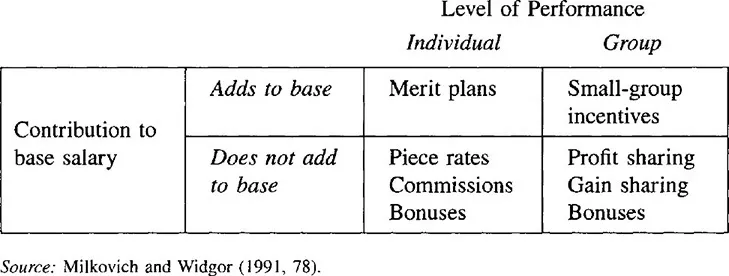
More recently, Milkovich and Widgor (1991) developed a matrix of performance pay schemes (Figure 1.1) that distinguishes between the level of performance assessment (individual and group) and the relationship of performance payments to base salary (accumulating or nonaccumulating).
The level of performance assessment is important, as it influences the strength of the connection between the performance of individual employees and the rewards they receive. According to Lawler (1990), individual schemes offer the clearest “line of sight.” Group schemes, on the other hand, suffer from “free-rider” problems in that all workers share in the gains, regardless of whether or not they contribute differentially to group performance. However, as will be argued in the next section, individual schemes have the potential to create “dysfunctional individualism” (Geary 1992).
Performance payments can be nonaccumulating in that the worker is required to reearn the payments each evaluation cycle (e.g., piece rates, commissions). Under an accumulating scheme, performance payments earned in one evaluation cycle roll into the base. This new (higher) base salary is used for the calculation of pay-related benefits and subsequent performance payments. Nonaccumulating schemes are seen to produce a higher average performance at a lower cost to the organization. However, they may also demonstrate a lack of commitment by the organization to its workers (Milkovich and Widgor 1992).
The choice of performance pay scheme can be made on the basis of a “best-practice” or “strategic-fit” approach (Milkovich and Newman 1998). A best-practice perspective asserts that there is a range of compensation practices that are intrinsically better than other compensation practices and that can be effectively applied in any organization, independently of the circumstances of that organization (e.g., Pfeffer 1994). In an environment of heightened domestic and international competition, performance pay is intuitively attractive to organizations and their managers and is sometimes adopted merely because a competitor uses performance pay for its workers.
A strategic-fit perspective requires the compensation system to fit with the overall business objectives of the organization. The underlying premise is that the greater the alignment between organizational conditions and the compensation system, the more effective the organization. This approach requires the organization to make an assessment of, among other things, its work force, its strategic objectives, the nature of the relations between jobs in the organization and technology in order to identify the most appropriate compensation system. There is a current body of research that examines the relationship between organizational characteristics and conditions and the form of performance pay. Some of this is reported, and added to, in the following country chapters.
Objectives of Performance Pay
At its most basic, adoption of performance pay is intended to align the interest of workers with the goals of the enterprises for which they work (Kessler and Purcell 1992). For private sector enterprises, the ultimate goal is increased profit but translation of that goal into performance pay may take many forms. For relatively simple tasks yielding easily countable output, the incentives from paying piece rates may be most successful.2 Indeed, case studies of individual firms have demonstrated substantial gains in productivity from their adoption (Lazear 2000). Yet, the unintended consequences of piece rates may include reduced quality, increased scrap rates, or inappropriate maintenance of equipment. At least theoretically, piece rates might be modified to account for these. Thus, the “premium pay” used in Germany represents a variation on piece rates, which explicitly rewards reduced wastage or increased quality. Yet, clearly, as jobs become more complex and outputs more multidimensional, the difficulty of being formulaic increases.
Using piece rates may also introduce counterproductive strategic behavior on the part of both firms and workers. Workers may fear ratchet effects in which the firm lowers the piece rates after worker output has increased in response (Gibbons 1987). As a result of this fear, workers may exert very low effort preceding the introduction of a piece rate and agree to “simply work to rate,” a specific number of units per day, after that introduction....
Table of contents
- Cover
- Half Title
- Title Page
- Copyright Page
- Table of Contents
- List of Tables and Figures
- Foreword
- Preface
- 1. Paying for Performance Setting the Stage
- 2. Performance Pay in the United States Its Determinants and Effects
- 3. Performance Pay in Canada
- 4. France Weitzman Under State Paternalism?
- 5. Performance Pay in the United Kingdom: The Case of the Inland Revenue Service
- 6. The German Experience with Performance Pay
- 7. Performance Related Pay in Australia
- 8. Financial Participation and Pay for Performance in Japan
- 9. The Brazilian Case Performance Pay as Workers’ Right
- 10. The Brazilian Case Performance Pay as Workers’ Right
- About the Editors and Contributors
- Index
Trusted by 375,005 students
Access to over 1.5 million titles for a fair monthly price.
Study more efficiently using our study tools.
Frequently asked questions
Yes, you can cancel anytime from the Subscription tab in your account settings on the Perlego website. Your subscription will stay active until the end of your current billing period. Learn how to cancel your subscription
No, books cannot be downloaded as external files, such as PDFs, for use outside of Perlego. However, you can download books within the Perlego app for offline reading on mobile or tablet. Learn how to download books offline
Perlego offers two plans: Essential and Complete
- Essential is ideal for learners and professionals who enjoy exploring a wide range of subjects. Access the Essential Library with 800,000+ trusted titles and best-sellers across business, personal growth, and the humanities. Includes unlimited reading time and Standard Read Aloud voice.
- Complete: Perfect for advanced learners and researchers needing full, unrestricted access. Unlock 1.5M+ books across hundreds of subjects, including academic and specialized titles. The Complete Plan also includes advanced features like Premium Read Aloud and Research Assistant.
We are an online textbook subscription service, where you can get access to an entire online library for less than the price of a single book per month. With over 1.5 million books across 990+ topics, we’ve got you covered! Learn about our mission
Look out for the read-aloud symbol on your next book to see if you can listen to it. The read-aloud tool reads text aloud for you, highlighting the text as it is being read. You can pause it, speed it up and slow it down. Learn more about Read Aloud
Yes! You can use the Perlego app on both iOS and Android devices to read anytime, anywhere — even offline. Perfect for commutes or when you’re on the go.
Please note we cannot support devices running on iOS 13 and Android 7 or earlier. Learn more about using the app
Please note we cannot support devices running on iOS 13 and Android 7 or earlier. Learn more about using the app
Yes, you can access Paying for Performance: An International Comparison by Michelle Brown,John S. Heywood in PDF and/or ePUB format, as well as other popular books in Business & Business General. We have over 1.5 million books available in our catalogue for you to explore.