eBook - ePub
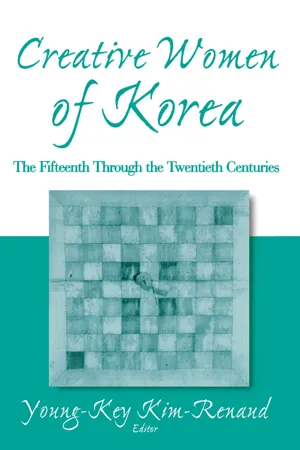
Creative Women of Korea: The Fifteenth Through the Twentieth Centuries
The Fifteenth Through the Twentieth Centuries
- 280 pages
- English
- ePUB (mobile friendly)
- Available on iOS & Android
eBook - ePub
Creative Women of Korea: The Fifteenth Through the Twentieth Centuries
The Fifteenth Through the Twentieth Centuries
About this book
This book introduces important contributions in the humanities by a select group of traditional and modern Korean women, from the 15th through the 20th centuries. The literary and artistic works of these women are considered Korean classics, and the featured artists and writers range from a queen, to a courtesan, to a Buddhist nun, to unknown women of Korea. Although women's works were generally meant only to circulate among women, these creative expressions have caught the attention of literary and artistic connoisseurs. By bringing them to light, the book seeks to demonstrate how Korean women have tried to give their lives meaning over the ages through their very diverse, yet common artistic responses to the details and drama of everyday life in Confucian Korea. The stories of these women and their work give us glimpses of their personal views on culture, aesthetics, history, society, politics, morality, and more.
Information
1
Introduction
This book, Creative Women of Korea: The Fifteenth Through the Twentieth Centuries, was conceived with the specific aim of filling a certain gap in available Western-language materials on Korean women’s contributions to the humanities. It introduces to the English-speaking world aspects of important contributions by women in traditional and modern Korea, from the fifteenth through the twentieth centuries. From the outset, three questions were posed:
(1) Have Korean women, especially those in the Confucian Korea of the Chosŏn dynasty (1392–1910), been passive recipients of the subservient status imposed by that society, or have they had their own agency?
(2) In what historical and social context did some of the most creative women achieve their artistic triumphs?
(3) What are the key characteristics of their creativity? Are there any shared traits in their creativity?
Creative Women of Korea consists of nine chapters that discuss literary and artistic works by women that may be considered Korean classics. Most of the women included in this book lived during the Chosŏn dynasty, with the exception of two moderns whose work presents contrasting reactions to past conventions in the wake of Korea’s modernization. I excluded living artists, many of whom are among the top literary and artistic figures of contemporary Korea.
The names of most women artists in traditional Korea are unknown to us because their creative activities were not meant to be publicized beyond the world of women. A small number of women—Queen Sohye, Sin Saimdang, Hŏ Nansŏrhŏn, Hwang Chini, and Lady Hyegyŏng of Chosŏn-dynasty Korea, and Kim Iryŏp and Hahn Moo-Sook of modern Korea—have achieved great fame. Their works occupy a public space, each by different circumstances.
All the women discussed in Creative Women of Korea are from the upper class (yangban), with the exception of Hwang Chini, a courtesan entertainer, or kisaeng, who, according to legend, was at least partially noble in origin. It is no coincidence that what literary and artistic works by women have survived are by noblewomen. They were the educated ones, with enough leisure and presence of mind to participate in creative endeavors, unlike lower-class women for whom education was thought useless as they would be too busy tending to daily chores. There may have been exceptions, but even if lowborn women did write and create, their productions were probably considered too unimportant for anyone to preserve whatever they left behind.
Propriety demanded that the literature and works of art by noblewomen not be publicized, even if these women, in their hearts, wished for their works to be discovered. In premodern times, therefore, among creative pieces by female authors and artists, anonymous works far exceed in number those whose creators are known. Women’s work was meant to circulate among their own gender, although circumstances made some of their works known among the general public. So, the creative women discussed in this book may share similar backgrounds, but their individual works are extremely varied in their originality and provenance. Thus, while those works represent the range of Korean women’s achievements, in no way is their presentation here meant as a characterization of Korean women in general.
Nevertheless, the force behind their creation is very much of one thread. Creative activity was the road to self-discovery. Each artist possessed a clear sense of self-confidence and an urge to express her creativity. Each wrote, painted, and made objects from a sincere and genuine desire to express deep emotions, trying to lead a life of harmony, good taste, and beauty emanating from within (mǒt), while guarding her personal creed, integrity, and dignity, in her own particular ways. These women occupied unmistakable spaces of their own in traditional Korea; they often challenge the view of Korean women of the past commonly held today.
How did a woman of traditional Korea feel about herself? Was she miserable about her wretched “life of bondage” in the service of men? Conventionally, a traditional Korean woman has been considered as powerless under the burdens and abuses inflicted upon her by the patriarchal norms of Confucian society. An “ideal” woman was one of noble birth, who remained cloistered within the inner quarters (anch’ae). In fact, the higher her status, the more she was sequestered.1 The assumed inferior position of women in human relationships and the presumed paucity of women’s works in pre-modern Korean literature and art would seem to attest to the verisimilitude of such preconceptions.2 Women had no room of their own in the sense of Virginia Woolf, the English writer, as they were ostensibly silenced into non-existence.3
The Neo-Confucian politico-moral system supposedly was adopted as the set of governing principles of the Chosŏn dynasty at its founding. And current scholarship informs us that, as the dynasty progressed, women—especially of the yangban class—gradually became less publicly visible.4 Under a dogmatic interpretation, the “proper” place for women was narrowly defined in terms of the physical and abstract sphere they occupied. A wellborn woman belonged to the inner quarters behind the thick walls of her family’s house—and those of her husband’s abode after marriage. In Confucian Korea, the world of a decent woman was private; the public sphere belonged to men only. An ideal woman was neither to be visible to, nor to communicate with, the opposite sex, with the exception of male servants, who were “less than normal” human beings. She was modest, diligent, frugal, faithful, docile, patient, and, above all, discreet. A system of female doctors, chosen from the lower classes, was created because aristocratic women refused to see male doctors.5
Among the key characteristics of Korean civilization are rites, lineage structure, literature, and education. In a Confucian society, rites are of the utmost importance, because “correct” acts are considered crucial for enhancing harmony among the members of society.6 In an ideal Confucian state, the moral conduct of the people was thought to contribute directly to the health of society and the vigor of the nation. Three cardinal human relationships (samgang) and five moral imperatives (oryun) were the inviolable creed, which regulated people’s behavior in minute detail. Samgang concerned the relationships between ruler and subject, father and son, and husband and wife. Oryun, reinforcing and clarifying samgang, prescribed righteousness between ruler and subject, affinity between father and son, separation of functions between husband and wife, proper order of birth between elder and younger brother, and fidelity between friends.7
To maintain proper human relationships, ritual and etiquette were mandated. Of the Four Rites (sarye)—adulthood, nuptials, funeral, and ancestor worship (or the remembrance ceremony)—the institution of ancestor worship brought about the most profound change in Korean society. Ancestral worship categorized members of the descent group into a hierarchy. In the early Chosŏn dynasty, well before the seventeenth century, when Korea was completely Confucianized, women were equal participants in ancestral rites, but gradually the main line of the eldest sons came to assume the heaviest responsibility in ritual obligations. The system of primogeniture was thus solidified, and unequal inheritance customs ensued. Patriarchy was considered the most natural requirement for an orderly life. Women’s participation in ritual gradually but surely came to be limited to the preparation of sacrificial foods and proper ceremonial garb for men.
On the surface, a woman’s status seemed to be determined uniquely by the men in her life. The “etiquette of Three Dependencies” (Samjong chi ŭi) meant that a woman obeyed her parents as a child, her husband as a wife, and her son as a widow. With the wholesale Confucianization of society, women seemed to lose their identity completely. However, in contrast to most patrilineal systems, in Confucian Korea the old custom of women playing a pivotal role in determining the social status of their offspring persisted. It is well known that the issue of illegitimate or secondary consorts met with discrimination. Protest literature, such as the Hong Kiltong chŏn (The Tale of Hong Kiltong) by Hŏ Kyun, attests to the unhappiness felt by victims of the system and their sympathizers.8
However, there has been substantial variation and complexity even in the matter of gender and class in traditional Korea, depending on the historical period, personal life cycles, and, finally, individual qualities and talents of the person in question. With the common belief of pubu ilch’e (“a couple is one body”), even in the worst period for women, a woman received due respect from all who respected her husband. For the same reason, filial piety did not apply only to one’s father, but to both parents. This is well reflected in linguistic protocol. Due to an elaborate honorific system in the Korean language, the choice of the appropriate forms of address and referent honorifics is the most overt representation of interpersonal relationships. A husband and a wife have not used equal speech levels to each other of late, but early twentieth-century novels indicate that, until quite recently, aristocratic couples used to address each other by equal-in-level polite forms. A mother may use a formal speech style to a grown son (or daughter), especially if he (or she, as is manifest in Lady Hyegyŏng’s memoirs) attained high social status, but in no way would a son “talk down” to his own mother or elder sister, however high a position he or she may have reached.
Recent studies have shown that the social institutions affecting women in the gravest ways were fully implemented only by the seventeenth century.9 Even in the most unfavorable times for women, a noblewoman often exercised considerable power by virtue of her birth, station, and upbringing. Her ancestry bestowed privilege upon her. Married, she became an opposing but complementary half in the yin and yang whole, playing a key role in establishing the legitimacy of a noble lineage. In other words, although one’s aristocratic lineage was through one’s father, one’s mother’s aristocratic origin was equally important in confirming one’s nobility in the Korean tradition. At a certain stage of her life cycle, a woman would even become a lead manager of not only the inner quarters but of the entire household. Thus, Korean “women opened up arenas of freedom for themselves without directly challenging the ideal norms promulgated by the official ideology.”10
There is a clear parallel here to Dorothy Ko’s portrayal of traditional Chinese women:
[I]f the assumptions of patriarchy were not being challenged outright in the seventeenth century, in practice they were being constantly mitigated. Although men still claimed legal rights over family property and fathers enjoyed authority over women and children, the housewife as de facto household manager, mother, and educator of children had ample opportunities to influence family affairs. In the context of everyday life, women were hardly outsiders to the family system.11
Indeed, stories abound about virtuous Asian women who lectured their corrupt (official) and undiscerning husbands. The quantity of known women’s writings and artwork in Korea is minimal compared to men’s, as women were not supposed to be visible in the first place. However, a few works by identifiable women authors, and by countless anonymous others who are clearly women, allow us a glimpse of the world of women and an idea of their sensibility, intelligence, and dignity. In almost every work, there is a surprising sense of self-confidence or self-awareness on the part of the author or creator as an important and often daring and innovative participant in artistic life, even when some women may have been lamenting their destiny.
Women wrote mainly in han’gŭl, the Korean alphabet invented in the mid-fifteenth century. Only men held public office, and official positions were filled through the civil-service examina...
Table of contents
- Cover
- Half Title
- Title Page
- Copyright Page
- Table of Contents
- List of Illustrations
- Preface
- Acknowledgments
- 1. Introduction
- 2. The Naehun and the Politics of Gender in Fifteenth-Century Korea
- 3. Sin Saimdang: The Foremost Woman Painter of the Chosŏn Dynasty
- 4. Hŏ Nansŏrhŏn and ‘Shakespeare’s Sister’
- 5. Demythologizing Hwang Chini
- 6. Private Memory and Public History: The Memoirs of Lady Hyegyŏng and Testimonial Literature
- 7. Kyubang Kasa: Women’s Writings from the Late Chosŏn
- 8. A Celebration of Life: Patchwork and Embroidered Pojagi by Unknown Korean Women
- 9. Kim Iryŏp’s Conflicting Worlds
- 10. Dialectics of Life: Hahn Moo-Sook and Her Literary World
- Glossary
- The Editor and Contributors
- Index
Trusted by 375,005 students
Access to over 1.5 million titles for a fair monthly price.
Study more efficiently using our study tools.
Frequently asked questions
Yes, you can cancel anytime from the Subscription tab in your account settings on the Perlego website. Your subscription will stay active until the end of your current billing period. Learn how to cancel your subscription
No, books cannot be downloaded as external files, such as PDFs, for use outside of Perlego. However, you can download books within the Perlego app for offline reading on mobile or tablet. Learn how to download books offline
Perlego offers two plans: Essential and Complete
- Essential is ideal for learners and professionals who enjoy exploring a wide range of subjects. Access the Essential Library with 800,000+ trusted titles and best-sellers across business, personal growth, and the humanities. Includes unlimited reading time and Standard Read Aloud voice.
- Complete: Perfect for advanced learners and researchers needing full, unrestricted access. Unlock 1.5M+ books across hundreds of subjects, including academic and specialized titles. The Complete Plan also includes advanced features like Premium Read Aloud and Research Assistant.
We are an online textbook subscription service, where you can get access to an entire online library for less than the price of a single book per month. With over 1.5 million books across 990+ topics, we’ve got you covered! Learn about our mission
Look out for the read-aloud symbol on your next book to see if you can listen to it. The read-aloud tool reads text aloud for you, highlighting the text as it is being read. You can pause it, speed it up and slow it down. Learn more about Read Aloud
Yes! You can use the Perlego app on both iOS and Android devices to read anytime, anywhere — even offline. Perfect for commutes or when you’re on the go.
Please note we cannot support devices running on iOS 13 and Android 7 or earlier. Learn more about using the app
Please note we cannot support devices running on iOS 13 and Android 7 or earlier. Learn more about using the app
Yes, you can access Creative Women of Korea: The Fifteenth Through the Twentieth Centuries by Young-Key Kim-Renaud in PDF and/or ePUB format, as well as other popular books in Art & Art General. We have over 1.5 million books available in our catalogue for you to explore.