- 320 pages
- English
- ePUB (mobile friendly)
- Available on iOS & Android
eBook - ePub
Voices of Feminist Liberation
About this book
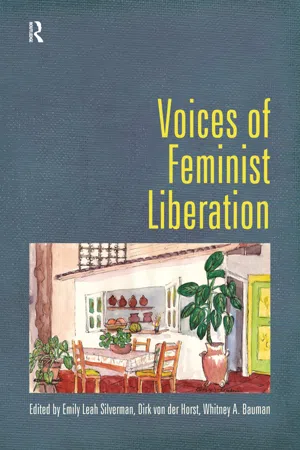
'Voices of Feminist Liberation' brings together a wide range of scholars to explore the work of Rosemary Radford Ruether, one of the most influential feminist and liberation theologians of our time. Ruether's extraordinary and ground-breaking thinking has shaped debates across liberation theology, feminism and eco-feminism, queer theology, social justice and inter-religious dialogue. At the same time, her commitment to practice and agency has influenced sites of local resistance around the world as well as on globalised strategies for ecological sustainability and justice. 'Voices of Feminist Liberation' examines the potential of Ruether's thinking to mobilize critical theology, social theory and cultural practice. The scholars gathered here present their personal engagements with Ruether's thinking and teaching. The book will be invaluable to scholars, policy-makers, and activists seeking to understand how colonial and patriarchal oppression in the name of religion can be confronted and defeated.
Information
PART I
THE CRUCIBLE OF EXPERIENCE AND THE LIFE OF DIALOGUE
CHAPTER ONE
THE PUBLIC ROLE OF THEOLOGY, OR HOW A FEMINIST THEOLOGIAN BECOMES A GLOBAL CITIZEN
Rosemary Radford Ruether’s name is known worldwide for her groundbreaking contribution to feminist theology. Her reputation as a feminist scholar motivated me to leave my home country, Brazil, to pursue doctoral studies under her mentorship in the mid 1980s in the joint Garrett-Evangelical Theological Seminary and Northwestern University graduate program. As time went by, I had not only an outstanding adviser for my theological education but also a mentor for life. Rosemary is, however, a role model nearly impossible to follow. Few women in our generation have published, traveled or lectured as much as Rosemary while also being a spouse, mother, grandmother, gardener, political activist, artist, and dog lover.
Rosemary and her husband, political scientist Herman (Herc) Ruether, have modeled a family lifestyle that overcomes the public–private dichotomy. Besides three children, their household often included students, overseas guests or friends in need of a temporary shelter. Rosemary and Herc’s long-lasting relationship always reflected the ideals of equality and companionship. They have shared a deep commitment to making the world a better place and, in their common journey, their love for one another became more than a private affair: it has been a sharing of ideals, a taste for beauty, a longing for justice, and a striving for peace. I have been a recipient of their hospitality and a beneficiary of their enduring friendship, gifts that I have cherished and tried to incorporate in my own life.
To assess Rosemary Radford Ruether’s social and theological contributions will take several generations and can only be done in an atmosphere of celebration. Her accomplishments are many. Rosemary’s gifted intellectual capacity to weave together the origins of Christianity, the history of women in American religion, and contemporary social issues such as the Israeli–Palestinian conflict and the ecological crisis make her one of the most influential theologians of our time. Few scholars are able to combine fields as diverse as ecofeminism and reproductive rights, patristics and the historical and theological roots of anti-Semitism, liberation theology and the mythology of the Ancient Near East. Her theology is always engaging and prophetic.
Because religion can both hinder or support social transformation, Rosemary has geared her teaching, lecturing, publications, and daily life to embody the principle that faith needs to be relevant to the here and now. By mapping the past and contemporary repercussion of Christian faith in the public arena, she has shown that faith can never be reduced to a private affair or narrowed down to individual salvation. In her work, she is capable of establishing interlocution with multiple audiences: church members, social activists, and scholars find her to speak with profound knowledge and deep commitment to the wellbeing of the world. Academic endeavor and practical grounding make Rosemary’s theology contextual, public, and extremely relevant for our time.1
GLOBAL CITIZENSHIP
As a Roman Catholic lay woman, Rosemary often introduced herself in class by saying that she studied the pathology of theology. It was an invitation to put students at ease. To study the pathology of theology meant to unveil levels of complexity and interconnection between religious articulation and historical machination, naming the ills of theology. To reveal the problems that theological discourse and practice created also made possible finding powerful examples (from past and present) that offer healthy alternatives. While pointing out the wrongs within patriarchal, androcentric, imperialist, classist, and racist systems of thought and might, Rosemary also recovered the life-affirming aspects of religious discourse and practice.
This concern for social and political wellbeing can be better described through the concept of citizenship. Although Rosemary does not employ this category, her teaching, activism, and overall scholarship lead to citizenship formation. Her theology fosters consciousness-raising, a deep acknowledgement of one’s location in time and space, and engenders awareness of the socio-economic and political disparities that undergird human relations. This theological work exists within the framework of public theology not only because it acknowledges the public role of theological discourse and practice, but also because it proposes alternatives to create a more egalitarian, democratic, and participatory society. Feminist theology, therefore, is instrumental in fostering citizenship.2
In our context, the notion of citizenship is most often associated with the political rights and privileges one enjoys as a naturalized or native-born of a particular country. Citizenship, however, goes beyond that. As Rosemary so skillfully presents in her publications, Christianity has never denied that women are entitled to citizenship in the Reign of God. To the contrary, the key tenets of Christianity are quite favorable to women and encourage female discipleship. Unfortunately, however, women have not become full citizens in the church.3 Not only that, but religious discourse has also been instrumental in preventing women’s flourishing in society. It is a well-known fact that Roman Catholicism still does not ordain women, thus robbing women from one of the denomination’s seven sacraments.
Rosemary’s writings help to unveil the complex systems of social and political exclusion that affect not only women but all those who do not fully encompass the patriarchal ideal of humanity.4 The term citizen, in its origin, referred to the role free, propertied males exercised in ancient Greek city-states. Although the distinction between private and public lives was not as demarcated as it is in modernity, ancient Greeks were expected to use their citizenship as an exercise in virtue. To be an active citizen to the community was, to a great extent, a measure of humanity, as summed by Aristotle:
… while a man who is incapable of entering into partnership, or who is so self-sufficing that he has no need to do so, is no part of a state, so that he must be either a lower animal or a god… For a man is the best of the animals when perfected, so he is the worst of all when sundered from law and justice.5
To be a citizen was not only the obligation to ensure the destiny of the citystate (seeking out the best interests of the community) but also an opportunity for honor and respect. It was a way to elevate oneself over nature and seek perfection. Ultimately, however, citizenship was the social and political articulation of power. It was an exclusive claim, since women, slaves, and barbarians could not be citizens. They could not be perfected.
Nowadays, the ideal of citizenship has been considerably expanded and somewhat redefined. Historical retrospective shows that women have been granted citizenship in many societies, to a great extent also because of the political pressures of the feminist movement (among other civil rights initiatives). Owing allegiance to a particular country entitles protection, marking the relationship between state and individual, as well as the political relationship between the citizens themselves. Because the relationships among individuals and of those with the state have undergone changes, also the notion of citizenship has expanded. Hence, not only propertied free males can claim citizenship, but any person who is a native or naturalized member of a state can benefit from citizen rights.
Our Western notion of citizenship is based on the principles of democracy, where all citizens are full and equal participants in the political process and the body politic is not dictated by privileges or authoritarian exercise of power. But that was not always the case. In the past, society was structured by following a dichotomy and hierarchy of male over female, free over slave, culture over nature, public over private, production over reproduction, and mind over body. Privileges and obligations were ascertained depending on which side of the spectrum one was located. This hierarchy was allegedly designed not only by culture, but also by divine command. The natural order determined subjects and followers, rulers and ruled. So, if citizens self-identified as superiors, the subaltern group could not enjoy such nomenclature. Citizenship existed so that others could be kept out or at bay. If, however, citizenship is not reduced to maintenance of privilege but includes participation in the social and cultural fabric, then citizenship needs to necessarily address those who have historically been outcast in order to promote justice and equality.
Historical events – such as the French Revolution, independence of former colonies, and abolition of slavery – and the demand of native populations, African-Americans, LGTBQ people, and women for their civil rights have redefined and expanded our understanding of citizenship. The suffragist movement, for instance, established that without the right to vote, women were deemed second-class citizens, and without such rights there could be no real equality. Rights associated with equality, however, is a formula with potential shortcomings, because it still operates under the premise of nor-mativity (the norm being the white propertied male). Differences – whether in terms of gender, race, class, religion, physical mobility or age – were cause for stigmatization and hierarchy. Others were nothing but the copy of the idea of man (the male ideal against which the imperfect copies had to mirror themselves). The many were subordinate to the privileged white male, and his rights became the measuring stick for all other rights. In this, there is no room for diversity.
The interactions and duties an individual has with larger society depend on political views, cultural norms, and socio-historical location, which in turn both determine and are determined by society. The negotiation between rights and obligations – and who benefits from particular social, political, and economic arrangements – has marked the history of civilization. It is no surprise, therefore, that the struggle of women, African-Americans, indigenous populations, and LGTBQ people to obtain their rights has been a constant and ongoing struggle. Rights are not granted freely, but are conquered at the expense of social and political negotiations.
Rights are a vital part of citizenship and social movements have mobilized around them. However, the language of rights does not always fully translate the meaning of citizenship. A limited understanding of citizenship as a system of rights and obligations does not encompass the possibilities of participation and political responsibility that citizenship entails. Rather, citizenship is participation in the transformative processes that bring about autonomy, accountability, and concern for the wellbeing of self, others, and the planet. Citizenship includes advocacy on behalf of social groups, communal causes or collective efforts for the promotion of the common good.
Rosemary’s work identifies the transformative capacity of faith – deconstructing its oppressive aspects and building on its life-affirming elements. In doing so, it has fostered a notion of citizenship that goes beyond boundaries of nation, class, race, or gender. Seeking the betterment of local and global communities and employing religious discourse to do so became hallmarks of her work. Rosemary’s theology is public theology, for it moves faith out of the realms of individual concern. Faith ceases to be a private affair, to embrace its communal, transformative dimension.
In this sense, Rosemary’s work has offered tremendous contributions to a broader notion of citizenship – one that includes the language of rights and obligations but goes beyond it, fostering a practice of citizenship that translates into concern for the wellbeing of all. Her address of the environmental crisis, genocide, economic disparities, sexism, warfare, racism, and xenophobia are among the many topics that characterize Rosemary as a promoter of global citizenship. Raising consciousness in relation to socio-economic and political disparities that assail our generation, Rosemary also presents alternatives to create a more egalitarian society and a just world.
GRASSROOTS SOLIDARITY AND POLITICAL ACTIVISM
One of the many things that attracted me to Rosemary’s way of doing theology was its overlap with the action-reflection model that I had known from liberation theology. In Latin America, theology is a critical reflection based on the everyday practice of faith, one that relates biblical narrative with daily life, theological dogmas with the quotidian, and incorporates the plight of the poor into the core of Christian teachings. Rosemary’s theology not only echoes many of these ideas, but creatively presents the discovery of the prophetic side of the Christian tradition in a re-contextualized manner.
In Rosemary’s life, a foundational experience was the civil rights movement. In the summer of 1965, she worked as a Delta Ministry volunteer with the Mississippi Child Development Group, a community-organizing approach to Head Start.6 After finishing her doctoral work, Rosemary taught in the School of Religion of Howard University from 1965 to 1976. Howard University in Washington, DC, was at the center of the civil rights movement and the peace movement. Rosemary took the signs of the time seriously as she explored the interconnection between theological ideas and social practices.
From her first writings, Rosemary established the connection between theological ideal and social practice. Fundamentally, there could be no rupture between faith and everyday life, or theology and concrete struggles for justice. The decades of her work in Washington also saw the peak of the peace movement, and much of the anti-war effort happened through church-related groups. And yet, this struggle went beyond the boundaries of denomination or religion. As recalled by Rosemary:
It would be hard to count how many marches I participated in; how many sing-ins, pray-ins, and die-ins won me brief stays in Washington jails during that period. Always it seemed like some reliable Jewish lawyer was on the spot to bail the Christians out of the clink.7
Attention to grassroots organizations and networking has been a constant in Rosemary’s life and theology. While traveling to Central America, Scandinavia or South Africa, for instance, she made it a point to connect with people and organizations that shared a similar passion for justice and peace. Although highly sought after as a public speaker and writer, Rosemary was as pleased to meet with renowned scholars as she was with local peasants or social leaders. Having hosted Rosemary in one of her trips to Brazil, I witnessed that her interest with grassroots networking was not only to help locals organize themselves – they already knew their problems and how to address them – but to encourage their work. Rosemary’s role in legitimizing the questions being posed by those deemed socially outcasts interconnected their plight with the suffering of others. It established correlation with systems of oppression as diverse as the caste system in India, deforestation of the Amazon, or racism in the US. In doing so, she identified transnational and cross-cultural systems of oppression.
I also accompanied Rosemary and Herc in a study abroad course during the winter of 1987, to Israel and Palestine. This was before the first Intifada, and we were able to travel throughout the entire area. We visited many peace groups and feminist networks, talked extensively with religious and political figures, and did our share of archaeological studies. As part of the experience we also visited a Palestinian refugee camp. One of the highlights was to meet a local artist whose paintings portrayed Middle Eastern culture and his expectation for a Palestinian homeland. His paintings often included a Palestinian flag or other aspects of Palestinian culture. Because of this, the paintings were considered illegal by Israeli authorities, and yet we all left the artist’s house with postcards and posters of his striking work.
Rosemary’s reputation opened many doors in Israel. Her book Faith and Fratricide, denouncing anti-Semitism within Christianity, earned her great esteem among Jewish scholars and a standing ovation when she was introduced as a speaker at the Hebrew University.8 Never one to rest on her laurels, however, Rosemary took the opportunity to bring up the plight of the Palestinians living under Israeli occupation. One day, while we were staying at the Tantur Institute for Ecumenical Studies (located on the road from Jerusalem to Bethlehem), Rosemary walked in at breakfast and announced: “I am with book!” Based on her grassroots ex...
Table of contents
- Cover
- Half Title
- Title Page
- Copyright Page
- Table of Contents
- Preface
- Introduction: Divining Prophetic Voices
- Part I: The Crucible of Experience and the Life of Dialogue
- Part II: Legacies of Colonialism and Resistance
- Part III: Angles on Ecofeminism
- Notes
- Bibliography
- Contributors
- Index
Trusted by 375,005 students
Access to over 1.5 million titles for a fair monthly price.
Study more efficiently using our study tools.
Frequently asked questions
Yes, you can cancel anytime from the Subscription tab in your account settings on the Perlego website. Your subscription will stay active until the end of your current billing period. Learn how to cancel your subscription
No, books cannot be downloaded as external files, such as PDFs, for use outside of Perlego. However, you can download books within the Perlego app for offline reading on mobile or tablet. Learn how to download books offline
Perlego offers two plans: Essential and Complete
- Essential is ideal for learners and professionals who enjoy exploring a wide range of subjects. Access the Essential Library with 800,000+ trusted titles and best-sellers across business, personal growth, and the humanities. Includes unlimited reading time and Standard Read Aloud voice.
- Complete: Perfect for advanced learners and researchers needing full, unrestricted access. Unlock 1.5M+ books across hundreds of subjects, including academic and specialized titles. The Complete Plan also includes advanced features like Premium Read Aloud and Research Assistant.
We are an online textbook subscription service, where you can get access to an entire online library for less than the price of a single book per month. With over 1.5 million books across 990+ topics, we’ve got you covered! Learn about our mission
Look out for the read-aloud symbol on your next book to see if you can listen to it. The read-aloud tool reads text aloud for you, highlighting the text as it is being read. You can pause it, speed it up and slow it down. Learn more about Read Aloud
Yes! You can use the Perlego app on both iOS and Android devices to read anytime, anywhere — even offline. Perfect for commutes or when you’re on the go.
Please note we cannot support devices running on iOS 13 and Android 7 or earlier. Learn more about using the app
Please note we cannot support devices running on iOS 13 and Android 7 or earlier. Learn more about using the app
Yes, you can access Voices of Feminist Liberation by Emily Leah Silverman,Dirk von der Horst,Whitney Bauman in PDF and/or ePUB format, as well as other popular books in Philosophy & Philosophy History & Theory. We have over 1.5 million books available in our catalogue for you to explore.