- 408 pages
- English
- ePUB (mobile friendly)
- Available on iOS & Android
eBook - ePub
About this book
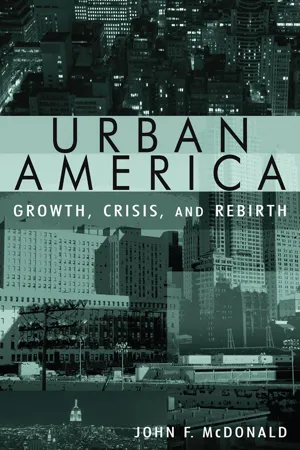
This book will change the way Americans think about their cities. It provides a comprehensive economic and social history of urban America since 1950, covering the 29 largest urban areas of that period. Specifically, the book covers 17 cities in the Northeast, 6 in the South, and 6 in the West, decade by decade, with extensive data and historical narrative. The author divides his analysis into three periods - urban growth (1950 to 1970), urban crisis (late 1960s to 1990), and urban rebirth (since 1990). He draws on the concepts of the vicious circle and the virtuous circle to offer the first in-depth explanation for the transition from urban crisis to urban rebirth that took place in the early 1990s. "Urban America" is both a message of hope and a call to action for students and professionals in urban studies. It will inspire readers to concentrate on finding ways and means to ensure that the urban rebirth will continue.
Information
Part I
Urban America in 1950
1
Urban Areas of the Northeast
The American Economy in 1950
In 1950 there was really only one major league sport—baseball. Major league baseball was played in only ten cities: Boston (2 teams), New York (3 teams), Philadelphia (2 teams), Chicago (2 teams), St. Louis (2 teams), Washington, D.C., Pittsburgh, Cleveland, Cincinnati, and Detroit. Half of the sixteen teams were located on the East Coast in the Boston–New York–Philadelphia–Washington axis. This configuration for major league baseball was set in 1903 with the founding of the American League and was doubtless based partly on how far one could travel overnight by train at the turn of the twentieth century. In 1947 the Brooklyn Dodgers had hired the first black player in the major leagues since the nineteenth century, Jackie Robinson, and in 1950 there were only five black players. The Negro League was still active, with teams in many of the major league cities. All of this was about to change. One major league team, the St. Louis Browns, moved to Baltimore in 1953 and took the name Baltimore Orioles, and the New York Giants and the Brooklyn Dodgers moved to the West Coast in 1957. Teams started to travel by airplane. The numbers of black players and players from Latin America would increase dramatically. The Negro League folded. But in 1950 all of that was in the future.
The United States had come through World War II and the immediate postwar years as by far the most powerful and economically advanced nation in the world. The nation’s major cities had been the “arsenals of democracy” during the war, and after the war had switched successfully to the production of consumer goods. The fear that the economy would enter a postwar depression proved unfounded. Both the Cold War and the hot war in Korea had begun, but Americans were poised to enter a period of unprecedented prosperity. James T. Patterson (1996), in his marvelous contribution to the Oxford History of the United States series, calls it the period of “Grand Expectations.”
The United States had a population of 151 million in 1950. The nation’s population is now over 300 million, so one basic fact about our urban areas is that they have had to grow to accommodate a doubling of the population. (No new urban areas have been founded. They all existed in 1950.) Life was different in 1950. The median annual household income in the nation in 1950 was $2,599 (including families and unrelated individuals). Median income for families in urban areas was $3,673. There were 40.2 million registered passenger cars (and taxis). There were very few four-lane highways. Only 10 percent of households owned television sets, and 38 percent of the population had never seen a television program (although all of the Los Angeles Rams football games were televised in 1950). Agricultural employment was still 7 million in 1950, and nonagricultural employment as reported in the 1950 census was 49.23 million—broken down as follows:
| Mining and construction | 4.36 million |
| Manufacturing | 14.58 million |
| Transportation, communication, and utilities | 4.37 million |
| Wholesale and retail trade | 10.55 million |
| Finance, insurance, and real estate (FIRE) | 1.92 million |
| Business and repair services | 1.41 million |
| Other services | 9.55 million |
| Public sector | 2.49 million |
| Total | 49.23 million |
Manufacturing was 29.6 percent of nonagricultural employment in 1950, and mining and construction and distribution (transportation, communication, utilities, and trade) made up 19.3 percent of the total. Services of all kinds (including FIRE) made up 26.2 percent of nonagricultural employment. The economy was dominated by the production and distribution of goods.
This author was seven years old in 1950. My parents and I lived in Decatur, Illinois (an industrial urban area of 99,000 in central Illinois farm country—the Soybean Capital of the World), in a new four-room house with about 900 square feet of living space and a basement. Much of the basement was taken up by the coal furnace and the coal bin. During the winter my father shoveled coal into the furnace at regular intervals. Air conditioning was unknown (at least to us). We had an electric refrigerator, but everyone called it an icebox. There was no television station in Illinois outside of Chicago. It is likely true that I had never heard of television, let alone seen it. My parents did own a car; my recollection is that it was a Nash. My father worked as a grain inspector for the federal government in downtown Decatur. My mother also worked, something that was quite unusual for a mother in those days. She was the receptionist and assistant for a physician whose specialization was eye, ear, nose, and throat. This is, of course, a specialty that no longer exists. My mother was trained as a Red Cross first-aid instructor but had no medical training beyond that. Much later she told me stories of the patients who appeared at the doctor’s office in dire straits—usually with eye injuries. I walked three blocks to my school and attended the second grade. We had lived in another house when I was in kindergarten, and I had taken the city bus to school. I would walk to a close neighbor’s house, and the mother saw to it that her son and I got on the bus. I presume that the bus driver made sure that we got off at the right place. We never locked our house in those days.
So life was different in 1950. We shall begin this history with a systematic look at the urban areas of the Northeast in that year. The purpose of this chapter is to give a snapshot in 1950 of the top seventeen urban areas in the Northeast, which is assumed to extend from Washington, D.C., west to Kansas City and north to Minneapolis–St. Paul. The next chapter is a quick look at the twelve largest urban areas of the Sunbelt. Chapter 3 is a short update on race in urban America—in the context of Gunnar Myrdal’s 1944 book, An American Dilemma.
Principles of Business Location in 1950
We have seen that the production and distribution of goods dominated the U.S. economy in 1950. The northeastern portion of the nation dominated the production of goods, and most of that production was located inside the cities of the Northeast. An understanding of the history of urban America first requires knowledge of the principles of business location that were at work in 1950. Businesses must assemble inputs and distribute output to customers. Choosing a location that will save on transportation costs can be a very complex problem that must take into account the costs of transporting the inputs and outputs and the relative weights attached to those costs.
The urban areas of the Northeast all began as what are called transshipment points—breaks in the national or regional transportation system where freight must be moved from one mode of transportation to another (or from one carrier to another if there is no change in mode). In particular, the urban areas of the East Coast began life as ports where agricultural products were brought in by boat or wagon and moved out on ships. Goods also arrived on ships and were transferred to wagons or boats for distribution to customers. The major urban areas of the Midwest began as ports on the Great Lakes (Chicago, Cleveland, Detroit, Milwaukee) or as river ports (St. Louis, Cincinnati, Kansas City, Minneapolis–St. Paul). Their first function was to transport agricultural products to the consumers in the East, but soon entrepreneurs realized that transshipment points for agricultural products could be centers of production as well.
During the first half of the nineteenth century, two factors combined to create America’s first group of real cities. Those two factors were the invention of large-scale production methods (for that time) and what economic historians call the transportation revolution. Factories with economies of scale were developed in several industries—textiles, apparel, iron, tools, ordnance, wagons, lumber, food products such as flour, and so on. The transportation revolution was based first on the steamboat and, a few years later, on the railroad. Production to build the railroads and companies to run them became major parts of the economy. These two factors made it economical to house large manufacturing enterprises at the transshipment points. For example, Cyrus McCormick invented the mechanical reaper in his home state of Virginia in 1831. He started production of the reaper in Cincinnati in 1845, but he realized that Chicago, the rapidly growing city that was to become the focus of the transportation system of the Midwest, was the place to produce his reapers. He moved his factory to Chicago in 1847, even before there was one railroad serving the city. He produced 700 reapers in 1848, and by 1850 production had doubled. McCormick had made a good decision because Chicago became the central point for a vast railroad system that serves the Midwest and the nation. The McCormick Reaper Works became International Harvester. Thanks to many other entrepreneurs like McCormick, Chicago became the nation’s number two center of production and distribution (second to New York).
Business location within the city was based on access to transportation, which in the nineteenth and early twentieth centuries meant access to water and rail. McCormick’s first Chicago reaper plant was located at the mouth of the Chicago River, which was also home to the enormous grain elevators from which the agricultural products of the Midwest were shipped east. Later, McCormick factories were placed on both the north and south branches of this river. The Union Stockyards, which consolidated Chicago’s various stockyards and meat packers into one location in 1865, was located at a rail junction and on a tributary of the Chicago River. Cattle and hogs arrived by rail from Midwestern farms, and packed meat was sent to customers by rail. (The tributary of the Chicago River, called Bubbly Creek because of the horrible pollution, was used as a sewer.) The iron and steel industry and other heavy industry were located on the south side of the city where the Calumet River empties into Lake Michigan. A new generation of steel plants was located across the state line in Indiana—again on Lake Michigan. Inland Steel, located in the southern suburb of Chicago Heights, took its name from the remarkable fact that it was not located on Lake Michigan. It was, however, located near a bevy of rail lines that extend in all four directions. Steel plants needed to locate where inputs could be assembled at the least cost. In the case of the steel industry of Chicago and northwest Indiana, ore came by ship from Duluth, and coal and limestone were brought by rail from southern Illinois, southern Indiana, and Kentucky. Other Chicago industries that produced goods for the farmers and artisans of the Midwest (and sold them by catalog through Sears, Roebuck and Montgomery Ward) were located within easy reach of the many rail lines that delivered the goods to the customers.
In general, the allocation of land to various uses is based on the amount those various users are willing to pay. Land-use zoning—municipal laws that allocate land to the various uses—did not exist until the 1920s. “Downtown” locations were dominated by retailers and people who needed office space—lawyers, accountants, bankers, and the like. Manufacturers might have liked being located downtown (and some were), but they could not normally outbid these users for downtown sites. Manufacturing firms that e...
Table of contents
- Cover
- Half Title
- Title Page
- Copyright Page
- Table of Contents
- List of Tables
- Preface
- Introduction
- Part I. Urban America in 1950
- Part II. Urban Growth and Prosperity: 1950–1970
- Part III. The Years of Urban Crisis
- Part IV. The Rebirth of Urban America After 1990
- Bibliography
- Index
- About the Author
Trusted by 375,005 students
Access to over 1.5 million titles for a fair monthly price.
Study more efficiently using our study tools.
Frequently asked questions
Yes, you can cancel anytime from the Subscription tab in your account settings on the Perlego website. Your subscription will stay active until the end of your current billing period. Learn how to cancel your subscription
No, books cannot be downloaded as external files, such as PDFs, for use outside of Perlego. However, you can download books within the Perlego app for offline reading on mobile or tablet. Learn how to download books offline
Perlego offers two plans: Essential and Complete
- Essential is ideal for learners and professionals who enjoy exploring a wide range of subjects. Access the Essential Library with 800,000+ trusted titles and best-sellers across business, personal growth, and the humanities. Includes unlimited reading time and Standard Read Aloud voice.
- Complete: Perfect for advanced learners and researchers needing full, unrestricted access. Unlock 1.5M+ books across hundreds of subjects, including academic and specialized titles. The Complete Plan also includes advanced features like Premium Read Aloud and Research Assistant.
We are an online textbook subscription service, where you can get access to an entire online library for less than the price of a single book per month. With over 1.5 million books across 990+ topics, we’ve got you covered! Learn about our mission
Look out for the read-aloud symbol on your next book to see if you can listen to it. The read-aloud tool reads text aloud for you, highlighting the text as it is being read. You can pause it, speed it up and slow it down. Learn more about Read Aloud
Yes! You can use the Perlego app on both iOS and Android devices to read anytime, anywhere — even offline. Perfect for commutes or when you’re on the go.
Please note we cannot support devices running on iOS 13 and Android 7 or earlier. Learn more about using the app
Please note we cannot support devices running on iOS 13 and Android 7 or earlier. Learn more about using the app
Yes, you can access Urban America: Growth, Crisis, and Rebirth by John Mcdonald in PDF and/or ePUB format, as well as other popular books in Social Sciences & Development Economics. We have over 1.5 million books available in our catalogue for you to explore.