Community Practice and Urban Youth is for graduate level students in fields that offer youth studies and community practice courses. Practitioners in these fields, too, will find the book particularly useful in furthering the integration of social justice as a conceptual and philosophical foundation. The use of food, environmental justice, and immigrant-rights and the book's focus on service-learning and civic engagement involving these three topics offers an innovative approach for courses.
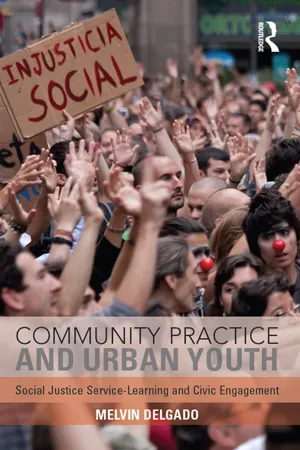
eBook - ePub
Community Practice and Urban Youth
Social Justice Service-Learning and Civic Engagement
- 248 pages
- English
- ePUB (mobile friendly)
- Available on iOS & Android
eBook - ePub
Community Practice and Urban Youth
Social Justice Service-Learning and Civic Engagement
About this book
Information
Setting the Context
1
Overview
Introduction
The twenty-first century ushered in a period of great excitement resulting from social justice campaigns—and even, in some cases, revolutions—to rectify acts of social injustice, with youth playing instrumental roles, although this was not new in the United States nor in other countries (Aronowitz, 2013; Shragge, 2013). Social activism is boundless in what it can accomplish and only limited by adults’ lack of imagination in seeing youth as contributing members of society. Youth activism potential can reach from localized to national transformation efforts (Flanagan, Syvertsen & Wray-Lake, 2007; Piotrowski, 2014).
The potential of social activism involving educators and helping professionals has raised questions about how youth community practice fosters the advance of social justice as an integral part of practice, including social activism involving and led by youth (Delgado & Staples, 2007; Hardina, 2013; Staples, 2012). A variety of well-recognized avenues are open to educators and community practitioners, such as service-learning and civic engagement, to facilitate youth activism.
One example with substantial potential is youth work/critical pedagogies/youth studies. The potential role of youth-focused practice is well laid out in the following quote (Lavie-Ajayi & Krumer-Nevo, 2013, p. 1698): “Critical youth work is based on a dual focus, on individual psychosocial development on the one hand, and collective critical consciousness and the promotion of social justice on the other. … The model is comprised of a three dimensions: the streets as a physical and political place, the use of counter narrative, and the role the youth workers take as social capital agents.”
Contextualizing place, space, and age together makes youth social activism a viable form of community practice in a wide variety of community settings (McLaughlin et al., 2009). United Farm Workers campaigns, for example, were an excellent training ground for young activists (Shaw, 2008), illustrating how this campaign served as a training ground for youth who eventually assumed adult activist roles.
Batsleer (2013) applies a feminist paradigm (Girls Work Movement), the ending of oppression based upon gender, to practice with girls and women in community settings, showing how participants-recipients benefit from engagement and preparing them for important roles in future change efforts. Initiatives providing youth with opportunities to engage with adults must assume a prominent role in community practice (Delgado & Staples, 2007).
Critical youth studies provide a conceptualization, language, and home to encourage youth use of critical thinking (praxis) and to create positive change in their lives. The introduction of participatory action research brings an added dimension to practice and critical youth studies (Quijada Cerecer, Cahill & Bradley, 2013). Youth activism, in essence, is a fertile subject for youth to study and undertake (Rogers, Morrell & Enyedy, 2007) and for community practitioners to embrace.
Youth as researchers, in turn, bring a missing dimension to this field, offering great promise for transformation and new knowledge and insights that can be applied to social activism (Reiter, 2014; Watson & Marciano, 2015). Mockler and Groundwater-Smith (2015) issue a call for using a “mosaic” approach towards research that taps multiple sources of “evidence” based on maximum participation, providing “a more complete” picture of a social phenomenon. Youth asking the questions they deem important is an essential core in development of this mosaic of evidence (Aldana, 2015; Richards-Schuster, 2015).
Community practice has evolved over the past several decades and expanded its reach into new and highly exciting and challenging arenas involving youth, particularly those in urban centers. This embrace of innovation has increased the reach of practice and reinforced an ethos of pushing the boundaries of what constitutes community social justice practice.
The quest for social justice is not relegated to democracies and can be found in totalitarian states where social justice movements of any kind are often labeled as revolutions (Abdelrahman, 2013; Pearce, Freelon & Kendzior, 2014). This quest is not restricted to any particular demographic group, with some groups facing multiple jeopardies or what is referred to as intersectionality, with low-income/low-wealth urban youth of color being an example. Global activism has also seen the intersectionality of youth and women highlighting a potentially powerful coalition of two disenfranchised groups, as in the case in Sudan (Hale & Kadoda, 2014).
This rather lengthy introductory chapter provides a roadmap for how social activism and three specific social movements will be addressed, and what community practitioners can do to foster youth activism and social justice through service-learning and civic engagement. Youth social activism is a critical ingredient in any healthy democracy, although adults may see these movements as misguided and tearing at a nation’s social fabric (Lund & Carr, 2008; Yoder Clark, 2009).
Nevertheless, these social change efforts would not be needed if injustices did not exist and mechanisms to redress them were not broken. Youths’ civic involvement early in their lives wields important influence in creating bonding (social capital) with the broader community (Duke et al., 2009). Social activism, in addition, can create new political realities (Blow, 2014, p. A25): “One of the people’s greatest strengths in a democracy is the flexing of potential muscle and the exercising of political power, through ballots and boot leather.” Democracy, however, is learned and socially constructed, and mechanisms must be in place to facilitate and enhance this learning (Saltmarsh, 2005).
Book Goals
The following five goals will be addressed in this book:
- Provide a theoretical foundation and critique upon which to better appreciate the use of social justice service-learning and civic engagement for immigrant rights, food, and environment, and the key rewards and challenges each movement faces.
- Provide readers with case vignettes on how youth are leading or significantly participating and contributing to using critical service-learning and social justice civic engagement in three movements, with a focus on urban centers and low-income/low-wealth youth of color.
- Provide a conceptual framework and foundation from which to examine service-learning and civic engagement initiatives focused on youth activism in social change and social movements.
- Raise a series of rewards, challenges, and possible strategies for increasing youth decision-making and leadership in service-learning and civic engagement using community practice involving immigrant-rights, environmental, and food justice campaigns.
- Examine the potential of civic engagement and service-learning as vehicles for community practitioners to provide youth with opportunities to engage in social activism and become active citizens. Although educators, too, are playing important roles in these areas, the focus will be on community practitioners because space is too limited to cover both educators and community practitioners.
Significance of Social Activism
Social activism must be viewed within a democratic context. What constitutes “democracy”? Democracy is much more than electoral participation, and this perspective is much too narrow (Boulianne & Brailey, 2014). Unfortunately, democracy, in similar fashion to political capital, is too often thought of as voting in national and local elections, a narrow and sterile manifestation. Voting, however, takes place in many different settings, such as schools, community-based organizations, and houses of worship, and this activity is rarely referred to as democracy or political capital.
Democracy is also about free speech and protest of unjust laws and social conditions that push the marginalized to the brink of society and undermine their future prospects and dreams in the process. Some readers will argue that democracy and social protest are integrally related, with social protest being a highly visible indicator of the health of a democracy (Porta, 2013; Preiss & Brunner, 2013; Zimpelman & Stoddard, 2013). Polletta (2012) describes democracy as “ambiguous and radical.” Theiss-Morse and Hibbing (2005), in turn, argue that to be good citizens democracy must be understood as “messy, inefficient, and conflict-ridden.”
Levinson (2010, p. 2) poses the question of what constitutes a “good” citizen, raising additional questions as to who is asking and answering the questions, with implications for how social activism is viewed:
What are the components of citizenship, and what does it mean to be a good citizen? These questions necessarily must be answered prior to any discussion about the aims or content of civic education. Can you be a good citizen if you don’t vote? What if you vote, but are uninformed about most of the issues and candidates, or vote solely on the basis of a single issue? How important is it to be law-abiding? Is being economically self-sufficient a hallmark (or even a precondition) of good citizenship? Is never being a burden on others enough to make one a good citizen? How should we judge the act of protesting injustice via civil disobedience against the act of sacrificing oneself on the battlefield for the good of country?
Social protest is democracy at its best even though it can create tension and reactionary feelings. Good citizens are those individuals who are not afraid to act on their conscience for the greater good.
Ardizzone (2007, p. 39) poses questions that, when answered, set the foundation for youth social activism: “What makes learning to action? Why does social responsibility serve as an impetus for activism? What ‘clicks’ for these young people and how does their conscientization come about?” The normalizing of social protest, similar to other oppositional resistance tactics, can be a marker of a ‘healthy’ democracy rather than a disintegrating society. Living in a democracy does not mean that youth do not experience a heightened sense of surveillance due to mistrust on the part of adults and authorities, resulting in development of a “strong sense of betrayal by adults” (Annamma, 2014; Fine et al., 2003; Gutierrez, 2014; Ruck et al., 2008).
Weiss (2011, p. 595) calls for greater understanding and research on how youth cope with increased surveillance in their lives:
The tragedies of Columbine and September 11th led public schools to step up surveillance practices in urban schools—producing an environment with less freedom and more control. While students are aware of the seeming powerlessness they face at the hands of security guards and surveillance technologies, they are also engaged in developing new ways to cope with, negotiate, and respond to these practices and injustices. Everyday surveillance is matched by everyday resistance. Not passively succumbing to the programs of surveillance in their schools and communities, students are navigating and responding in surprising, sometimes radical, ways. In an era of punitive public policies and school reforms, when urban teenagers are already perceived as threatening and misbehaving and labeled as deviant and criminals, research in search of resistance needs to seek out hidden transcripts and public protest.
Increased surveillance is in response to major events that have made the nation feel less safe, yet they are often based on profiles that signal out youth and other groups.
All segments of society must be free to engage in public dissent and not have it be relegated to the exclusive domain of one age group. Giroux (2014, p. 1) argues that democracy in the United States is in a state of crisis if viewed from a youth perspective:
This is especially true for young people. While a great deal has been written about the budget busting costs of the invasion of Iraq and the passing of new anti-terrorist laws in the name of “homeland security” that make it easier to undermine those basic civil liberties that protect individuals against invasive and potentially repressive government actions, there is a thunderous silence on the part of many critics and academics regarding the ongoing insecurity and injustice suffered by young people in this country. As a result, the state is increasingly resorting to repression and punitive social policies at home and abroad.
Giroux raises a distressing flag about the undermining of civil liberties in the name of national security. Unfortunately, certain groups in society pay a higher price than others.
Boggs and Kurashige (2012, p. xiii) make a poignant statement about democracy and social change that is applicable to central themes in this book: “In times of crisis you either deepen democracy, or you go to the other extreme and become totalitarian.”
Social activism can be a form of civic engagement and a way for free speech to be manifested; all demographic segments of society have this right. Civic engagement is a critical element of democracy and must be fostered among youth to ensure that democracy continues to flourish now and in the future as they assume adult status (Flanagan & Levine, 2010). Service-learning, too, can help youths to become more connected to their communities. Civic engagement and service-learning, however, must not be narrowly conceptualized to exclude social protest.
Costanza-Chock (2012, p. 5) offers a counter-narrative to prevailing adult sentiments about social activism and grounds youth social protest within a democratic frame, casting youth participation as healthy for a nation: “Youth are often dismissed for a lack of civic engagement, or attacked for being disruptive. Yet disruption of oppressive laws, norms, and practices is a crucial aspect of all liberatory movements: think of the struggle to end slavery, or to gain suffrage for women.” The lessons and competencies youth activists obtain bring immediate and future rewards and translate into creating future engaged and contributing adult members (Lund, 2010), who, in turn, will hopefully encourage their own children to assume prominent roles in enhancing democracy.
United States urban marginalized youth certainly have not suffered from a lack of scholarly or public attention (Stolberg, 2015). Unfortunately, this attention has invariably been negative, causing the failure of educational and human service programs to meet their most pressing needs (Spencer & Spencer, 2014). They suffer from counterproductive views that have been compounded by racism and classism (Miller & Garran, 2008). These youth have been written off by society and considered surplus populations. Giroux (2012), a leading theoretician on the relationship between democracy and youth, calls them “disposable youth” (Macrine, 2011; Robbins, 2012).
I consider this topic of great significance and have devoted a considerable amount of time and energy over the past fifteen years researching and writing on urban youth and community practice. The evolution of community practice can be compared to an expanding universe with endless potential contributions to youth-led and youth-involved practice, and no more so than when it is social justice driven.
Youth and Social Justice Campaigns and Movements
Some social justice movements have been relatively quiet and peaceful—the “consumer” and “green” movements, for example—although this conclusion is certainly open to debate. Others have been loud and disruptive, resulting in police arrests and extensive media coverage, as in the case of the “Occupy Movement” in 2011–2012, for example (Gaby & Caren, 2012; Hayduk, 2012). As a result, there are many different sources and strategies for community organizing and social protest (Pyles, 2013; Schutz & Sandy, 2011). This abundance of conceptualizations makes this topic complex to grasp from a theoretical or practice perspective, making understanding of youth and social activism that more challenging to comprehend against this backdrop.
Unfortunately, regardless of the intensity of the movement or degree to which it is disruptive, this country’s youth contributions have been invisible or minimized by adults who often are credited for leading these movements, covering them for the media, and authoring history (Gordon, 2010). This oversight limits our historical and current-day comprehension of how youth have shaped activism in the United States.
Some critics of youth social movements and activism believe that there are numerous opportunities presently in society to engage youth in “non-law breaking” and “constructive” pursuits without having them resorting to disruptive civil disobedience. They can pursue volunteering opportunities developed by adults as “constructive” alternatives, for example (Youniss & Levine, 2009). Others argue that youth have very limited access to engage in “meaningful” activities and decisions in their lives (Kirshner & Geil, 2010), and being included in social justice efforts by adults as equal partners in the cause is both desirable and viable.
The importance of social activism and how it gets manifested in democratic social movements and encouraged by community practitioners is well understood as a barometer of how well a society tolerates public dissent (Delgado & Staples, 2007; Meyer, 2009). It gives voice to social justice issues for those who have been wronged by those in power, and it is often in direct response to efforts to marginalize a group of people and forcefully quell their dissent. Practitioners, as a result, can find avenues for furthering youth social causes in ways that support their quest for justice (Nissen, 2011).
A society that addresses social dissent through use of police and military responses is a society that cannot address the concerns of injustices through reason and the law, as in the case of Michael Brown, Ferguson, Missouri; Eric Garner, New York City; and Freddie Gray, Baltimore. The dea...
Table of contents
- Cover
- Title
- Copyright
- Dedication
- CONTENTS
- Preface
- Acknowledgments
- SECTION 1 Setting the Context
- SECTION 2 Reflections From the Field
- Epilogue
- References
- Index
Trusted by 375,005 students
Access to over 1.5 million titles for a fair monthly price.
Study more efficiently using our study tools.
Frequently asked questions
Yes, you can cancel anytime from the Subscription tab in your account settings on the Perlego website. Your subscription will stay active until the end of your current billing period. Learn how to cancel your subscription
No, books cannot be downloaded as external files, such as PDFs, for use outside of Perlego. However, you can download books within the Perlego app for offline reading on mobile or tablet. Learn how to download books offline
Perlego offers two plans: Essential and Complete
- Essential is ideal for learners and professionals who enjoy exploring a wide range of subjects. Access the Essential Library with 800,000+ trusted titles and best-sellers across business, personal growth, and the humanities. Includes unlimited reading time and Standard Read Aloud voice.
- Complete: Perfect for advanced learners and researchers needing full, unrestricted access. Unlock 1.5M+ books across hundreds of subjects, including academic and specialized titles. The Complete Plan also includes advanced features like Premium Read Aloud and Research Assistant.
We are an online textbook subscription service, where you can get access to an entire online library for less than the price of a single book per month. With over 1.5 million books across 990+ topics, we’ve got you covered! Learn about our mission
Look out for the read-aloud symbol on your next book to see if you can listen to it. The read-aloud tool reads text aloud for you, highlighting the text as it is being read. You can pause it, speed it up and slow it down. Learn more about Read Aloud
Yes! You can use the Perlego app on both iOS and Android devices to read anytime, anywhere — even offline. Perfect for commutes or when you’re on the go.
Please note we cannot support devices running on iOS 13 and Android 7 or earlier. Learn more about using the app
Please note we cannot support devices running on iOS 13 and Android 7 or earlier. Learn more about using the app
Yes, you can access Community Practice and Urban Youth by Melvin Delgado in PDF and/or ePUB format, as well as other popular books in Social Sciences & Civics & Citizenship. We have over 1.5 million books available in our catalogue for you to explore.