![]()
INTRODUCTION
It is very important to develop a good understanding of the functions, powers and relationships between the main institutions of the European Union. This requires knowledge of four key institutions in particular, which have their origins in the first Community, the European Coal and Steel Community, established in 1952 with a fixed life of 50 years. Although there have been some important changes since then, most notably for the European Parliament (EP), the basic principles have remained the same. The Treaty of Lisbon came into force on 1 December 2009 and this is the latest example of changes made to the institutions and the numbering of the articles relating to the institutions. With regard to the Treaty of Lisbon you should remember that there are in fact two Treaties under that one umbrella: Treaty on European Union (TEU) and the Treaty on the Functioning of the European Union (TFEU). This came about due to the failure to ratify the Constitutional Treaty in 2003.
You should try to get a feel for the need for such institutions. It is sometimes forgotten that the European Union (previously called the European Community) was an innovative idea, in the sense that a supranational body was being created by the transfer of sovereignty from Member States to a Union which was to act on behalf of all its members. Therefore, it was important to ensure that the institutions established would provide a forum for an input by the Member States, a body to implement and police policies decided by the Union, a court to settle disputes and provide authoritative judgments and, finally, a body which would allow an input from a wider base of views from the Member States. Hence, the Treaty of Rome established the Council, the European Commission, the Court of Justice of the European Union (CJEU) and the European Assembly, later to be called the European Parliament in the Single European Act.
The starting point for an understanding of the EU institutions is their origin, that is, the Treaty Articles. Although these need not be learned by heart, there are key points which must be grasped as you build up an understanding of their functions and relationships. Do not be confused by the fact that the numbering of the Articles has been affected by the Treaty of Lisbon, where the opportunity was taken to reorder them. As some textbooks and old judgments still refer to the ‘traditional’ numbering, a Table of Equivalences is included on pp xxi–xxiv to help you. This details old and new Treaty numbers.
One of the best ways to get an overview of the variety of institutions is to read material that is intended for the non-specialist reader. Some of the publications produced by the European Commission are very good and have the added advantage of being free. There is also a very good website (www.europa.eu). Once you have an overview, you should begin to build up a more detailed picture, which shows the more complex functions and relationships between the institutions. However, you should always be alert to practical examples of the friction or otherwise generated by these institutions and reported in the media. Such examples are invaluable in impressing the examiner but, more importantly, they should convince you that you are not dealing with a theoretical group of institutions, but ‘a living community’. For a UK domestic view the Foreign & Commonwealth Office provides the government’s opinion and the various European Committees in the UK Parliament hold enquiries and issue reports (see www.parliament.uk/).
Checklist
You need to have a good understanding of the functions, procedures and membership of the main Union institutions, plus an awareness of the less significant ones. You should also look at Chapter 11, where some of the proposed changes to the institutions are discussed. In particular, you should concentrate on:
the European Parliament –
Art 14 TEU and
Arts 223–234 TFEU;
the Council of the European Union or Council –
Art 16 TEU and
Arts 237–243 TFEU;
the European Commission –
Art 17 TEU and
Arts 244–250 TFEU;
the Court of Justice (CJEU) –
Art 19 TEU and
Arts 251–281 TFEU; and
the European Council, the General Court, the European Economic and Social Committee (EESC), the Committee of Permanent Representatives (COREPER), the Committee of the Regions and the Court of Auditors.
QUESTION 1
What has been the impact, if any, of the Lisbon Treaty on the democratic deficit within the EU?
How to Read this Question
This question is seeking your views, based on authorities, of the effects that the Lisbon Treaty has had on the important principle of democratic accountability within the EU. The question is leaving the conclusion of impact open by using the phrase ‘if any’ so you need to be objective.
How to Answer this Question
This type of question has become very popular in recent years. This is largely due to developments that have affected the Parliament and the emphasis given to democracy in the European Union. The main points to cover in your answer are:
powers and composition of the European Parliament;
procedures of the Parliament;
role of the Parliament in the legislative process;
the changes brought about by the Lisbon Treaty.
Answer Structure
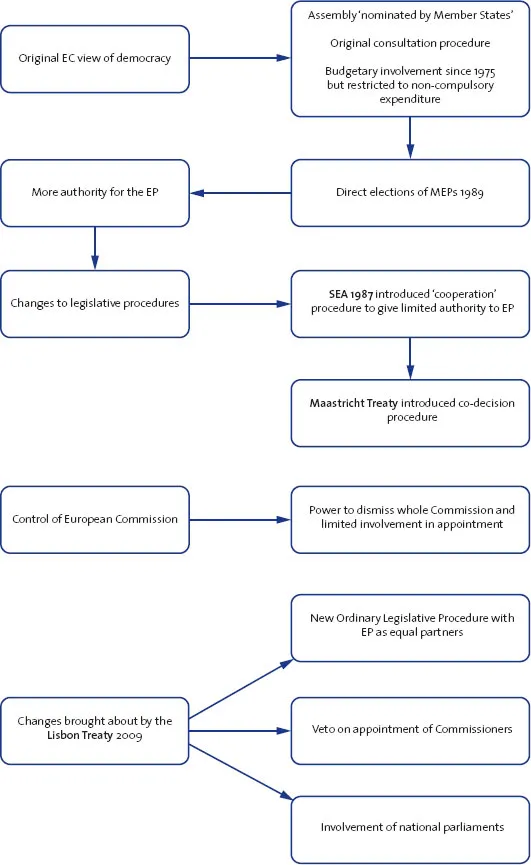
The diagram indicates matters to be discussed in answering this question.
ANSWER
Democratic deficit is a term that has been used to label the European Union since its predecessor the European Community was established in 1957. The term is used to identify the absence of what some observers see as the fundamental involvement of elected representatives in the governance of the EU; where there is a lack of democratic accountability and control over the decision-making process.1 This arises where individuals compare the EU with the governance of an individual Member State, when any analysis of the Union shows that such a comparison is limited due to its international organisation structure. Attempts have been made since the Single European Act 1987 to bolster the democratic element and the Treaty of Lisbon is the latest treaty amendment to do so. The Treaty of Lisbon did not have an easy birth as it followed the aborted Constitutional Treaty and was challenged in the German courts and concessions had to be given to Ireland before it was ratified in a second referendum of the Irish people. The Treaty of Lisbon finally came into force on 1 December 2009 and made changes in an attempt to lessen the democratic deficit within the EU due to the interrelationship between the main institutions of the European Parliament, European Council, the Council and the European Commission.
Democracy has always been identified as an important principle to the EU and is seen as a characteristic of all Member States. The Copenhagen criteria for membership of the Union listed three requirements including ‘candidate country to have achieved stability of institutions guaranteeing democracy, the rule of law, human rights and respect for and protection of minorities’. How democratic are the EU institutions? Since 1989 the only directly elected institution has been the European Parliament (EP), with MEPs being elected every five years. The original EEC Treaty in 1957 provided for the ‘European Assembly’ to be consulted but that body was made up of Member State nominees who had no mandate or constituency. Every amendment to the Treaties since 1987 has provided more authority to the EP in relation to European legislation; first with the cooperation procedure and then the co-decision procedure established in the Maastricht Treaty of 1992. The co-decision procedure gave equal authority to the EP on specific areas of policy which were gradually increased but the political power still remained with the Council who are the representatives of the Member States. The EP gained some involvement in the setting of the EU budget in 1975 but this was restricted to ‘non-compulsory’ expenditure, which included all expenditure that was committed under the Treaties, such as the common agricultural policy. The ‘non-compulsory’ expenditure is not insignificant at about 42 per cent of the total budget and included Union social policy, regional and industrial policies. However, at the start of the twenty-first century, the EP did not have the authority that was recognisable in a national parliament.
The institutions of the EU are not a mirror of those found in the Member States, as it is an international organisation. The legislative procedure of the EU has to be instigated by the European Commission making a proposal (Art 294 TFEU) which then goes to the EP and the Council. The EP has gradually obtained more authority in the appointment of the Commission to add to its long-standing power to dismiss the whole collegiate body (now Art 234 TFEU). The EP has to approve the appointment of the Commission President, who is nominated by the European Council after taking into account the results of the EP elections (Art 17(7) TEU). The EP then has to approve the appointment of the remaining members of the Commission before they can be formally appointed by the European Council. The European Commission is therefore not democratically elected in the sense of involving the citizens of the EU exercising their universal suffrage!2 It could be said that the ‘democratic element’ in the EU is of two types: representative democracy and participatory democracy. Representative democracy is where the EU citizens directly elect their MEP once every five years and this is in addition to the members of the European Council and Council who are members of their national governments and accountable to their national electorate via their...