eBook - ePub
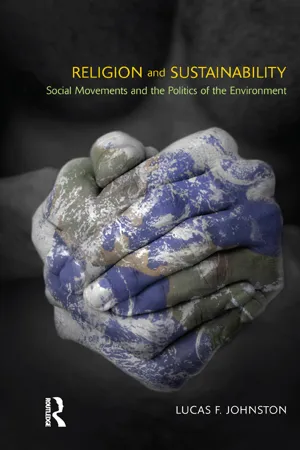
Religion and Sustainability
Social Movements and the Politics of the Environment
- 224 pages
- English
- ePUB (mobile friendly)
- Available on iOS & Android
eBook - ePub
About this book
Sustainability is now key to international and national policy, manufacture and consumption. It is also central to many individuals who try to lead environmentally ethical lives. Historically, religion has been a significant part of many visions of sustainability. Pragmatically, the inclusion of religious values in conservation and development efforts has facilitated relationships between people with different value structures. Despite this, little attention has been paid to the interdependence of sustainability and religion, and no significant comparisons of religious and secular sustainability advocacy. Religion and Sustainability presents the first broad analysis of the spiritual dimensions of sustainability-oriented social movements. Exploring the similarities and differences between the conceptions of sustainability held by religious, interfaith and secular organizations, the book analyses how religious practice and discourse have impacted on political ideology and process.
Information
Topic
Theology & ReligionSubtopic
Environment & Energy PolicyPART 1
DEFINING RELIGION AND SUSTAINABILITY, AND WHY IT MATTERS
Part I offers a brief description of trends that are widely considered unsustainable, and then relates them to analyses of the religious and spiritual dimensions of social movements related to correcting these trends. The academic background for the ethnographic portion of the study is explained, including some of the intellectual tributaries that influenced the method utilized. In addition, some of the common themes that emerged from the ethnography are discussed in greater detail to frame the following chapters on defining the key terms, and finding religion in social movements that are not obviously all about religion. Some of the key metaphors and tropes used to advertise sustainability in the public sphere are detailed with an eye to how these highly affective concepts are transmitted through and across cultures.
These first three chapters which comprise Part I are intended to lay the groundwork for the historical and ethnographic work that follows. They also, however, offer some novel contributions. Specifically, a new definition of sustainability, which highlights its religious dimensions and the ways in which it is inextricably tied to broader cultural trends, is offered. The definition of religion utilized in this study, while drawing on earlier scholars, extends their analyses to paint a picture of the ways in which rich and multifaceted terms such as sustainability and religion can be a sort of productive social therapy. Finally, the theoretical approach detailed in Chapter 3 also draws on existing scholarship, but offers a robust portrait of the individual nested within several communities of accountability. While the analysis contained here focuses primarily on scales beyond the individual, the model could provide a possible starting point for further empirical research on the ways in which values relevant to individuals and communities, which operate at various scales, can be fruitfully explored.
CHAPTER ONE
THE STAKES OF SUSTAINABILITY AND ITS RELIGIOUS DIMENSIONS
It is not uncommon in popular media to trace the first inklings of environmental activism to the first photos of earth from space and the accompanying realization that we live on a finite and fragile planet. Many have drawn inspiration from the accounts of astronauts such as Edgar Mitchell (“My view of our planet was a glimpse of divinity”), Alexi Leonov (“The Earth was small, light blue, and so touchingly alone, our home that must be defended like a holy relic”), and James Irwin (“Tat beautiful, warm, living object looked so fragile, so delicate, that if you touched it with a finger it would crumble and fall apart. Seeing this has to change a man, has to make a man appreciate the creation of God and the love of God”) (Kelley [1988] 1991: 24, 52, 38). It is perhaps no coincidence that the first Earth Day celebration in 1970 followed closely on the heels of these first forays into space.
Awareness of environmental scarcity, however, far predates the first space explorations or the counter-cultural environmental movements of the late twentieth century. By the first Earth Day it had long been clear that human cultures were on an unsustainable course. In the postwar period the growth of the interstate system and urban planning schemes built around this new individualized form of transportation had contributed significant amounts of carbon to the atmosphere. Industrial capacity continued to grow exponentially, while the international concern with development allowed increasingly global economic markets access to more resources and labor, and promoted the growth of multinational corporations who possessed the rights of citizens with none of the concomitant obligations. In the 1970s, the term sustainable development was forged as a euphemism for attempts to mitigate these dramatic shifts. By the 1980s such activities were correlated with shifting climatic trends and a dramatically widening gap between the rich and the poor.
At this writing the world population has passed 7,000 million humans, approximately one third of whom suffer from hunger and malnutrition and about one half of which live below the poverty level. Globally wealth inequality continues to increase both in the developing world and within industrialized economies. To illustrate, according to the Gini coefficient (a measure of income disparity) the US ranks 100th out of 140 nations in income inequality, just below Iran and just above Jamaica, Mozambique, and Rwanda. The United Kingdom ranks forty-sixth, while the European Union comes in at twenty-fourth.1 Meanwhile, an emerging middle class in developing economies such as India and China is driving increased consumption and production of many commodities. Take for example meat production, which has tripled worldwide in the past forty years, and grown 20 per cent in the past ten years alone, creating significant environmental problems related to habitat fragmentation and waste disposal.2 These emerging economies have literally millions of people making the transition from extreme energy poverty to new energy consumption, while the primary mode of energy production remains the use of fossil fuels, pointing toward worsening ecological ramifications.
The ecological impacts of the prevailing economic and social development policies are well documented, and include the disruption of planetary cycles (i.e. the nitrogen and carbon cycles [Vitousek 1994; Vitousek et al. 1997]) and the radical simplification of biocultural diversity. Most scientists would agree that species are disappearing at a rate at least 1,000 (and some have speculated as high as 10,000) times faster than the background extinction rate. Globally there is a strong correlation between biological and cultural diversity, and as biodiversity is being eroded, so are the traditional cultures that have depended on this natural variety. Cultural groups, their languages and knowledge of their habitats, including various medicinal plants and practices, are also vanishing. The twenty-first century will continue to be characterized by increasingly frequent conflicts over increasingly scarce resources, particularly if societies continue to depend on solving energy poverty with finite reserves of fossil fuels that have only grown more difficult to access, secure, and protect.
These trends are the very definition of unsustainability. Beginning with the first scientific resource management regimes over two hundred years ago, however, several loosely related social movements related to generating more sustainable societies emerged and continue to grow and diversify. As illustrated below, social movements and programs designed for sustainability or sustainable development have from their earliest manifestations been used to channel economic relations, maintain social control, and exert political will. “Like ‘motherhood’ and ‘God,’” the environmental policy expert Michael Redclift notes, “sustainable development is invoked by different groups of people in support of various projects and goals, both abstract and concrete” (in Ghai & Vivian 1992: 25).
Much like the astronauts quoted above, who gained new perspectives on humanity’s place in the cosmos, Redclift illustrates that sustainability is increasingly tied to spiritual and highly affective modes of communication in the public sphere. Indeed, as the public intellectual Stephen Prothero argued, “religion is now emerging alongside race, gender, and ethnicity as one of the key identity markers of the twenty-first century” (Prothero 2007: 7). The concept of sustainability is also emerging as a popular term that in some cases acts as an identity marker, often used as a shorthand reference to a complex set of socio-politico-economic problems and possible solutions. As sustainability expert and educator Andrés Edwards put it, sustainability is linguistic shorthand that links “the central issues confronting our civilization” (Edwards 2005: 133). In what follows I explore these two contested twenty-first century identity markers: religion and sustainability.3
WHAT IS USUALLY MISSING FROM THE DISCOURSE: THE RELIGIOUS DIMENSIONS OF SUSTAINABILITY
Most treatments of sustainability begin by defining what the term means. Some of these definitions of sustainability describe particular approaches to development (WCED 1987), represent alternatives to existing development practices and socio-political arrangements (Sumner 2005; Hawken 2007a), or suggest that sustainability is best measured in terms of empirical data such as biodiversity (Patten 2000; Lovejoy 2002). Development-related definitions, however, too often pay inadequate attention to existing global power imbalances. Counter-hegemonic definitions can make the mistake of dismissing or downplaying the power of nation states to promote social change, a presupposition that, as policy experts Michael Kenny and James Meadowcroft put it, is “rather short-sighted politically, and suspect intellectually” (Kenny & Meadowcroft 1999: 2). Finally, scientific definitions, which often offer preservation of biodiversity or other scientific measurements as central to sustainability, may simply shift the locus of power from nation states and corporate elites to the scientific “experts” who can design and implement policy in a values vacuum.
Such definitions provide narrow lenses through which it may be difficult to see and account for sustainable living arrangements that depend on locally adapted (and historically situated) knowledges, or non-economic variables. In part, this is because these definitions of sustainability, it turns out, have very little to do with what is actually sustainable in particular situations. Disputing such simplistic understandings of sustainability, indigenous activists and scholars and even development entities such as the World Bank and the United Nations have encouraged the investigation of alternative sources of knowledge and locally adaptive social norms, and their application in international agreements. Disciplines such as ethnobotany, ethnobiology, and activist forms of anthropology emerged, at least in theory, from the recognition that the native eye did not see a positive vision in the Western versions of sustainable development.
Counter to these approaches, I will suggest that in some cases sustainability has become a term that mediates a brokering process between different constituencies, their epistemologies, and their visions of the good life. As the anthropologist Scott Atran put it, “Environmental management increasingly involves diverse groups with distinctive views of nature. Understanding the ways in which local cultural boundaries are permeable to the diffusion of relevant knowledge may offer clues to success with more global, multicultural commons” (Atran et al. 2002: 422). Sustainability should be imagined as a positive term forged to broker relationships between and across these cultural boundaries and their accompanying views and uses of nature.
Thus, energies expended defining sustainability (WCED 1987; Baker 2006), discerning some so-called central principles (Dresner 2005), or elucidating its foundational ethical tenets should instead be directed at understanding the core values of those who use the term, and the reasons for which it is deployed. Although it has received little attention, this religious dimension, strongly related to core values of particular constituencies, has long been a pervasive feature of sustainability discourse. Moreover, these underlying values, which are often a prominent feature of the religious dimensions of sustainability, are in some cases important to producing successful policy outcomes. But in all cases, to the extent that it acts as a tool for connecting affective states with political issues related to resource utilization, sustainability acts as a political religion.4
This is important because rather than creating intractable disputes, religious people and groups, as well as those who generate the more diffuse religious ambiance of much sustainability discourse, have in some cases inspired what I refer to as an ethic of personal risk, which may be an adaptive “meme” to promote.5 Such an approach entails viewing political, social, or cultural “others” from a standpoint of humility, vulnerable to (or at least willing to empathetically consider) others’ worldviews, values, and behaviors. Toward the end of the book the narrative shifts from a descriptive to a normative mode, arguing that when used appropriately such tactics can facilitate sustainable relationships between people with different values, increasing chances of long-term success for some sustainability ventures. Sustainability advocates, in other words, should pay attention to the strategies pioneered by religious groups and secular sustainability advocates who use highly affective and loosely spiritual language. Encouraging an ethic of interpersonal and intercultural risk can be bioculturally adaptive by promoting the peaceful co-existence of cultures and societies even when they differ in their core value commitments.
BACKGROUND AND COMMON THEMES THAT EMERGED FROM THE ETHNOGRAPHY
To gather data I utilized a combination of ethnographic and historical research methods, focusing specifically on a network of actors who occupied high level positions in various sustainability movements, with the aim of comparing the use of religious discourse among religious and secular groups.
The focus here, the sustainability milieu, is characterized by a human-centered ethos, the recognition of biological, ecological, or cosmological interdependence, and an ethic of personal empathy, or risk. So the unit of analysis—the sustainability milieu—was no doubt significantly influenced by environmentalism, although it has become a broader and more inclusive sub-population than the environmentalist milieu. The methodology exercised here, however, investigating a particular expert network and analysis of the manner in which they transmit the central themes related to the religious dimensions of sustainability, is rather narrow, and is not intended as an exhaustive study of the remarkable breadth of the sustainability milieu.
The inspiration for this research emerged from my perception of parallel questions (although not yet research convergences) among the methods or theoretical approaches of three distinct academic disciplines. (a) In sustainability studies literature, I noted the contested usefulness of the term. Some believed that sustainability was always counter-hegemonic (Sumner 2005; Hawken 2007a); others noted that the term could be used to generate the illusion of consensus while preserving the status quo (Davison 2001); some thought it was specifically about a set of principles and requisite duties (Dresner 2005); still others thought the term ought to be jettisoned altogether. (b) The attention of cultural anthropologists to sustainable development programs has made traditional ecological knowledge an important topic in global sustainability discourse. Yet, questions are continuously raised about whether these programs actually benefit the people they meant to help (Escobar 1995). Little attention, however, has been paid to the differences between what specific sets of citizens mean when they use the terms sustainability and sustainable deve...
Table of contents
- Cover Page
- Half Title page
- Title Page
- Copyright Page
- Dedication
- Contents
- Acknowledgments
- Introduction and Reader's Guide
- Part I Defining Religion and Sustainability, and Why it Matters
- 1. The Stakes of Sustainability and its Religious Dimensions
- 2. Defining the Terms: Religion and Sustainability
- 3. Sustainability as a Contagious Meme
- Part II The Emergence and Development of Sustainability
- 4. The Genesis and Globalization of Sustainability
- 5. The Religious Dimensions of Sustainability at the Nexus of Civil Society and International Politics
- 6. The Contributions of Natural and Social Sciences to the Religious Dimensions of Sustainability
- Part III The Ethnographic Data and Sustainability Cases
- 7. Walking Together Separately: Evangelical Creation Care
- 8. Stories of Partnership: Interfaith Efforts Toward Sustainability
- 9. The Religious Dimensions of Secular Sustainability
- 10. Manufacturing or Cultivating Common Ground?
- Notes
- Bibliography
- Index
Trusted by 375,005 students
Access to over 1.5 million titles for a fair monthly price.
Study more efficiently using our study tools.
Frequently asked questions
Yes, you can cancel anytime from the Subscription tab in your account settings on the Perlego website. Your subscription will stay active until the end of your current billing period. Learn how to cancel your subscription
No, books cannot be downloaded as external files, such as PDFs, for use outside of Perlego. However, you can download books within the Perlego app for offline reading on mobile or tablet. Learn how to download books offline
Perlego offers two plans: Essential and Complete
- Essential is ideal for learners and professionals who enjoy exploring a wide range of subjects. Access the Essential Library with 800,000+ trusted titles and best-sellers across business, personal growth, and the humanities. Includes unlimited reading time and Standard Read Aloud voice.
- Complete: Perfect for advanced learners and researchers needing full, unrestricted access. Unlock 1.5M+ books across hundreds of subjects, including academic and specialized titles. The Complete Plan also includes advanced features like Premium Read Aloud and Research Assistant.
We are an online textbook subscription service, where you can get access to an entire online library for less than the price of a single book per month. With over 1.5 million books across 990+ topics, we’ve got you covered! Learn about our mission
Look out for the read-aloud symbol on your next book to see if you can listen to it. The read-aloud tool reads text aloud for you, highlighting the text as it is being read. You can pause it, speed it up and slow it down. Learn more about Read Aloud
Yes! You can use the Perlego app on both iOS and Android devices to read anytime, anywhere — even offline. Perfect for commutes or when you’re on the go.
Please note we cannot support devices running on iOS 13 and Android 7 or earlier. Learn more about using the app
Please note we cannot support devices running on iOS 13 and Android 7 or earlier. Learn more about using the app
Yes, you can access Religion and Sustainability by Lucas F. Johnston in PDF and/or ePUB format, as well as other popular books in Theology & Religion & Environment & Energy Policy. We have over 1.5 million books available in our catalogue for you to explore.