eBook - ePub
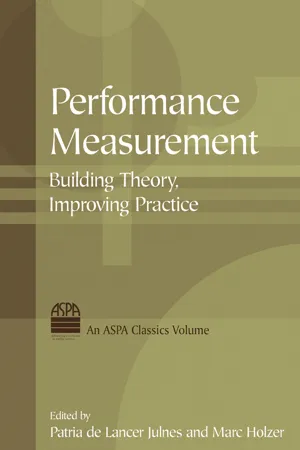
Performance Measurement
Building Theory, Improving Practice
- 208 pages
- English
- ePUB (mobile friendly)
- Available on iOS & Android
eBook - ePub
About this book
This volume in the "ASPA Classics" series compiles the most influential contributions to the theory and practice of performance measurement that have been published in various journals affiliated with the American Society for Public Administration. The book includes major sections of original text along with the readings, and provides students and practitioners with a handy reference source for theory development and practice improvement in performance measurement. The coverage is broad, including methods and techniques for developing effective performance measurement systems, building performance-based management systems, and sustaining performance-based budgeting. The articles are all classics in the field that have endured the test of time and are considered 'must reads' on performance measurement.
Information
CHAPTER 1
MAKING THE CASE FOR PERFORMANCE MEASUREMENT
INTRODUCTION
In 1992 Joe Wholey and Harry Hatry made the case for performance measurement by arguing that monitoring the performance of public programs is feasible and worthwhile. In their article, which is the classic article featured in this chapter, they affirmed the value of performance monitoring because of the information that it provides to government agencies.
According to Wholey and Hatry (1992), government needs timely and high quality information on what programs are accomplishing in order to avoid being “wasteful, ineffective, and unresponsive” (p. 605). The authors conclude that the need for timely, valid information can be fulfilled by measuring government’s activities and their accomplishments on an on-going basis. Furthermore, in making their case Wholey and Hatry presented examples of already successful practice at all levels of governments. They also provided an insightful analysis of the barriers to performance monitoring and reporting, as well as suggestions for overcoming those barriers.
The case for measuring the performance of government, so compellingly communicated by Wholey and Hatry, has its roots in a century of earnest efforts. The earliest identifiable systematic attempts at measuring performance have been traced back to 1906 in New York City. That quest for more effective government led to the creation of the Bureau of City Betterment, which later became the Bureau of Municipal Research (de Lancer Julnes, 2000, Williams, 2003). The Bureau engaged in systematic data gathering. It would collect accounting data, work records, outputs, outcomes, and social indicators, which were then used for reporting, budget allocations and efficiency improvements (Williams, 2003). Although the reasons for seeking better government in New York City are still debated, with critics on one side claiming that efficiency was sought to protect the interests of the upper class, and supporters claiming that efficiency was sought in order to develop a capacity to provide better services, this initiative became the model for many other cities across the country, Canada, and abroad (Gulick, 1928).
Furthermore, the Brookings Institution, whose predecessor was the privately sponsored Institute for Government Research (IGA), also had an important impact on supporting, as well as defining, the meaning of “better government” in the early part of the twentieth century. For example, with respect to the controversy as to whether the focus of government should be efficiency, the IGA, in making its assessment of the Bureau of Indian Affairs, believed that outcomes and results in an agency would improve as a consequence of improved efficiency (Bouckaert, 1992). Improved efficiency was equated with good governance.
In addition to local level initiatives, similar events were occurring at the national level. The difference was that the main focus at the national level was administrative reform, the study of government and principles of administration. But the end result sought was the same: better, more effective government. Examples include the Taft Commission of 1913 and the President’s Committee on Administrative Management (Brownlow Committee), which was created under President Roosevelt in the late 1930s. In 1949, the first Hoover Commission made recommendations on performance budgets and standards, and in 1955 the second Hoover Commission made recommendations on budgets, costs, and management reports (Bouckaert, 1992). Those commissions worked to streamline the federal government; it had grown to be too large and too disorganized as a result of programs created during the Great Depression and World War II.
In 1970, President Richard Nixon created the National Commission on Productivity and Quality of Working Life, which later became the National Center for Productivity and Quality of Working Life under President Jimmy Carter. The purpose of the commission was to improve productivity growth and increase economic effectiveness in the public and private sectors of the United States. When this center was eliminated in 1978, its public sector focus was assumed by the National Center for Public Productivity, now the National Center for Public Performance at Rutgers University’s School of Public Affairs and Administration in Newark. The National Center now houses the Public Performance Measurement and Reporting Network, the Public Performance and Management Review, book-length projects such as the Public Productivity Handbook, national and regional conferences, and an online certificate in Public Performance Measurement, the E-Governance Institute, and projects to identify and build best practices.
Another national government-sponsored initiative was the National Academy of Public Administration (NAPA). The Academy, founded in 1967, is an independent, nonpartisan organization chartered by Congress to assist federal, state, and local government in improving their effectiveness, efficiency, and accountability (NAPA, 2006). NAPA’s congressional charter was signed into law in 1984, and NAPA has implemented a series of performance measurement studies at the federal level.
In 1993 President Bill Clinton charged Vice President Al Gore to oversee a National Performance Review, which in 1998 evolved into the National Partnership for Reinventing Government. This effort developed steps to deal with areas in need of reform. One of the outcomes was “Managing for Results,” the cornerstone of the Results Act of 1993 (Government Performance and Results Act, GPRA). The goal of these efforts, which continues, is to help the federal government become high-performing, outcome-driven, and fully accountable.
GPRA requires federal agencies to conduct strategic planning, develop a performance plan that contains performance measures that are aligned with agency’s goals, and prepare a performance report that reviews the success of the agency in meeting performance goals. These requirements represent a value shift in organizations with the premise that agencies need to “reinvent” themselves.
Embedded in these efforts at reinventing government and managing for results is performance measurement. To develop and implement a quality performance measurement system Gloria Grizzle (1982) suggested that governments first consider and resolve the issues that could become obstacles to the process. Those issues deal with the scope of the performance measurement system and the interpretation of performance data. Governments should consider the cost of collecting data, who the users of the performance information will be, and who will be the winners or losers if information on only some dimensions of performance is collected and not others.
Box 1.1
Measuring State and Local Government Performance
Issues to Resolve Before Implementing a Performance Measurement System
Measuring State and Local Government Performance
Issues to Resolve Before Implementing a Performance Measurement System
Gloria A. Grizzle
As public-sector productivity gets increasing national attention, state and local governments seek more ways of improving their performance. Performance measurement systems may be helpful tools for improving both productivity and accountability. This paper identifies issues that governments should consider before implementing a performance measurement system.
Performance is a multidimensional concept. The term can include such concepts as efficiency (cost related to direct output), cost-effectiveness (cost related to benefit or impact), service delivery quality, service delivery equity, governmental fiscal stability, and conformance with governmental policies. A comprehensive performance measurement system might give information about how well a government, or single governmental agency, is operating in terms of all these performance dimensions.
Factors to Consider When Setting the Performance Measurement System’s Scope
If collecting the data required to measure performance were inexpensive, a manager might want to include all the performance dimensions previously mentioned. Unfortunately, data collection is expensive. Cost may encourage restricting the system’s scope to a subset of these performance dimensions. Before doing so, the manager should carefully consider who will use the performance information and who stands to gain or lose if the performance measurement system collects information on only selected performance dimensions.
Excluding Outcome as a Performance Dimension
Accountability can mean that those in charge of a program are responsible to someone outside the program for the way they use program resources and the goals they seek [1. p. 417]. Information from performance measurement can help move accountability from theory to practice. Before deciding how to measure a program’s performance, one should consider: (1) What is the program impact? (2) Who is responsible? These questions arise because the public and their elected representatives want to know if the programs really work and if the public is benefiting. For example, is the public safer because of crime control programs: are air and water cleaner as a result of environmental programs: did program participants get and keep good jobs because of manpower training and employment programs? This pragmatic orientation suggests that accountability should focus on the program’s impact upon clients or other groups indirectly affected by the program.
The Role of Goals in Setting the Measurement System’s Scope
What effect will goals have on performance measurement system design? Goals may be defined as broad, general statements of desired conditions external to programs. Goals provide the basic purposes for which programs were authorized and funded. If performance measurement were to be based upon a rational model of decision-making, the first step in developing a performance measurement system would be identifying the goals against which performance is to be compared. Though this step seems easy, there are several questions to be considered before the performance measurement system is built around a set of goals.
Excluding Measures Affecting Performance
Should measures that affect performance be included in the performance measurement system? Performance measurement is not a neutral managerial tool. Management control systems, for example, include performance measures for the explicit purpose of detecting deviations from plans or standards so that, when program processes malfunction, managers can take action to bring operations back on course. Neither should it come as any surprise that measures designed to compare performance with goals focus an organization’s effort upon those activities that foster attaining those goals.
Conclusion
Several conclusions emerge from this discussion. First, performance measurement should not be confined to those events over which a program manager has near-total control. Doing so would ignore the questions about program outcomes that the public and their elected officials most want answered. Instead, outcomes, though often not controllable by a single actor, should be measured and the question of accountability approached by developing the concept of joint responsibility.
Second, the distortion of effort resulting from performance measurement is likely to be most severe when measurements focus upon program activities rather than program outcomes. Measuring outcomes has the additional advantage, then, of providing the organization with an incentive rather than a disincentive to achieve stated goals.
Third, one cannot isolate performance measurement system design and development from systems politics. Neither can one keep the information that the performance measurement system generates from being used in the political process.
Finally, the manager must resolve the dilemma of developing a performance measurement system flexible enough to respond to changing ideas about what is important to measure, yet stable enough to provide the comparisons over time needed when judging whether the performance experienced in a given year is adequate.
Excerpted from State and Local Government Review 14: 123–136. Copyright © 1982 by Carl Vinson Institute of Government, University of Georgia. Reprinted with permission.
Grizzle’s article, excerpts of which are shown in Box 1.1, was written more than ten years before GPRA was passed. Grizzle was already arguing for the need to measure program results. While acknowledging the difficulties inherent in measuring those program results, she emphasized that leaving this dimension out can have adverse consequences. Her article also explored the role that goals should play in deciding the scope of the performance measurement system, particularly in the cases of inconsistent and conflicting goals. Finally, she also addressed a little discussed issue: whether measures that affect performance should be excluded from the performance measurement system.
As argued by Van Wart in Box 1.2 (1995, p. 436), “performance assessment is where ‘the rubber meets the road.’” Therefore, it is critical that organizations seeking to “reinvent” their values take into account the complex area of performance assessment. In particular, argues Van Wart, agencies need to have a good quality performance assessment system. Traditionally, public agencies have had weak performance assessment systems that make it difficult for them to tie the required “value adjustments to concrete goals” (p. 435).
Nonprofit organizations have also had an important role in government reform in general, and the measurement of performance in particular. One of the leading institutions in this respect is the Urban Institute, beginning shortly after its founding in 1968 with the development of methods for government to measure the performance of their programs. The early work of this think tank, under the leadership of Joseph Wholey, focused on the application of cost-effectiveness analysis and system analysis to assess the performance of state and local government’s programs and services. The Urban Institute continues to conduct research and disseminate this knowledge to help solve social problems and to improve government decisions and their implementation.
The United Way of America is considered one of the first non-profit organizations to lead the way in the measurement of program outcomes for health and human services agencies. Some United Way agencies had begun experimenting with outcome measures prior to 1995. By 1996, the agency had partnered with the Urban Institute to develop a manual to help agencies measure and use program outcomes. This is a step-by-step manual for health, human service, and youth-and family-serving agencies on specifying program outcomes, developing measurable indicators, identifying ...
Table of contents
- Cover
- Aspa Classics
- Title Page
- Copyright Page
- Table of Contents
- Introduction
- Chapter 1. Making the Case for Performance Measurement
- Chapter 2. Performance Measurement Purposes and Techniques
- Chapter 3. Performance-Based Budgeting
- Chapter 4. Performance-Based Management
- Chapter 5. The Role of Citizens in Measuring and Promoting Performance
- Chapter 6. Performance Measurement Across Government Levels
- Chapter 7. Implementation
- Index
- About the Editors
Trusted by 375,005 students
Access to over 1.5 million titles for a fair monthly price.
Study more efficiently using our study tools.
Frequently asked questions
Yes, you can cancel anytime from the Subscription tab in your account settings on the Perlego website. Your subscription will stay active until the end of your current billing period. Learn how to cancel your subscription
No, books cannot be downloaded as external files, such as PDFs, for use outside of Perlego. However, you can download books within the Perlego app for offline reading on mobile or tablet. Learn how to download books offline
Perlego offers two plans: Essential and Complete
- Essential is ideal for learners and professionals who enjoy exploring a wide range of subjects. Access the Essential Library with 800,000+ trusted titles and best-sellers across business, personal growth, and the humanities. Includes unlimited reading time and Standard Read Aloud voice.
- Complete: Perfect for advanced learners and researchers needing full, unrestricted access. Unlock 1.5M+ books across hundreds of subjects, including academic and specialized titles. The Complete Plan also includes advanced features like Premium Read Aloud and Research Assistant.
We are an online textbook subscription service, where you can get access to an entire online library for less than the price of a single book per month. With over 1.5 million books across 990+ topics, we’ve got you covered! Learn about our mission
Look out for the read-aloud symbol on your next book to see if you can listen to it. The read-aloud tool reads text aloud for you, highlighting the text as it is being read. You can pause it, speed it up and slow it down. Learn more about Read Aloud
Yes! You can use the Perlego app on both iOS and Android devices to read anytime, anywhere — even offline. Perfect for commutes or when you’re on the go.
Please note we cannot support devices running on iOS 13 and Android 7 or earlier. Learn more about using the app
Please note we cannot support devices running on iOS 13 and Android 7 or earlier. Learn more about using the app
Yes, you can access Performance Measurement by Patria de Lancer Julnes,Marc Holzer in PDF and/or ePUB format, as well as other popular books in Politics & International Relations & Business General. We have over 1.5 million books available in our catalogue for you to explore.